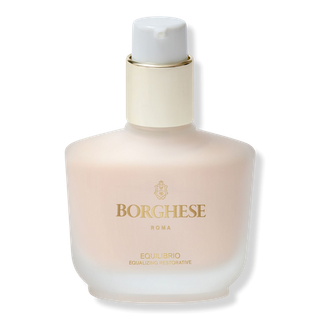
Borghese Equilibrio Equalizing Restorative Moisturizer
Works for
1 of 2 advertised claims delivered
MoisturizingSodium pca, Polymethylsilsesquioxane + 12 moreGood evidence
“Equilibrio Equalizing Restorative Moisturizer”
This product can help improve hydration of the skin with the two types of ingredients.
The first type is called “humectants”:
these ingredients help attract water.
When humectants are on the surface of the skin, they “pull in” the moisture from the outside environment, or from
within deeper layers of the skin. The following ingredients in this product do the job:
glycerin, hyaluronic acid.
This product also contains ingredients called “occlusives”. They help reduce the speed with which our skin loses moisture to the outside environment. These ingredients also help soften the upper layer of the skin, so it feels less tight and nicer to the touch. The following ingredients in this product do the job: dimethicone, hydrolyzed collagen.
Evens skin toneNo ingredient credited for this claimNo evidence
“Helps uneven skin tone and texture”
Effective ingredients missing or their concentration is too low
Anti-agingNot advertised by the brand · Adenosine triphosphate, Hyaluronic acidModerate evidence
This product contains adenosine triphosphate. This ingredient might be able to help reduce and prevent fine lines and wrinkles, improve skin elasticity and firmness, but there is not enough evidence that it actually works.
Can it cause trouble?
Irritancy4 strong irritants: Parfum, Hamamelis virginiana leaf extract + 2 more — patch-test recommendedHigh risk
Comedogenic2 ingredients rated 2 or more on the 0–5 pore-clogging scale2 flagged
User reviews
Be the first — your take helps the next person decide.
Ingredients
Filter by role to see what each ingredient is doing.
Water~45–55%
Butylene glycol~5.7–7%
- Irritation risk
- Low
Used to create a nice product texture and help delivery of other ingredients. Might be somewhat helpful in attracting water to the upper layer of the skin
More about Butylene glycolCyclopentasiloxane~4–4.9%
- Irritation risk
- Low
A silicone that helps improve the product texture and spreadability. Can absorb oil creating a short-term mattifying effect on the skin
More about CyclopentasiloxaneIsostearyl neopentanoate~3.1–3.8%
- Irritation risk
- Medium
- Comedogenicity
- 2/5
Used to create a nice product texture and helps soften the upper layer of the skin. Could be comedogenic
More about Isostearyl neopentanoateCeteareth-30~2.3–2.8%
Ethylhexyl methoxycinnamate~2.4–2.9%
- Irritation risk
- High
Octinoxate. When used in higher concentrations, works as a sunscreen protecting the skin from UVB rays. When used in lower concentration, helps to preserve the product formulation. Is shown to be harmful to coral reefs - consider avoiding bathing in coral reef areas when wearing a product with this ingredient. It can be irritating
More about Ethylhexyl methoxycinnamateDimethicone~1.6–2%
- Irritation risk
- Low
A silicone that helps to reduce water loss from the surface of the skin. Can temporarily "fill in" lines and wrinkles, absorb oil, and create a nice product finish
More about DimethiconePeg-8~1.3–1.6%
- Irritation risk
- Medium
Used to create a nice product consistency
More about Peg-8Polymethylsilsesquioxane~1.1–1.3%
- Irritation risk
- Low
A silicone that improves product texture and helps dissolve other ingredients. Can form a non-greasy film on the skin to prevent moisture loss
More about PolymethylsilsesquioxaneGlyceryl stearate~0.75–1.15%
- Irritation risk
- Low
An emollient that softens the skin and forms a protective layer on its surface. Helps water and oil mix together
More about Glyceryl stearatePeg-100 stearate~0.65–0.95%
- Irritation risk
- Low
Helps oil and water mix togehter and creates a nice product texture
More about Peg-100 stearateCetearyl alcohol~0.6–0.9%
- Irritation risk
- Low
- Comedogenicity
- 2/5
A non-drying alcohol. Works as an emollient. Helps water and oil mix together and creates a nice product texture
More about Cetearyl alcoholPhenoxyethanol~0.45–0.65%
- Irritation risk
- Low
A preservative. It helps prevent bacterial growth in cosmetic products
More about PhenoxyethanolLysine carboxymethyl cysteinate~0.35–0.6%
- Irritation risk
- Low
Glycerin~0.35–0.65%
- Irritation risk
- Low
One of the best moisturizing ingredients. Naturally present in skin. It attracts water to the upper layer of the skin working as a humectant
More about GlycerinKaolin~0.55–0.85%
- Irritation risk
- Low
A type of clay that consists mainly of aluminum silicate. Helps absorb oil and creates a thicker product consistency. Can be used to add a white color
More about KaolinSodium c8-16 isoalkylsuccinyl soy sulfonate~0.3–0.6%
- Irritation risk
- Low
Tromethamine~0.3–0.55%
Ci 19140~0.3–0.55%
Ci 14700~0.25–0.5%
Carbomer~0.25–0.45%
- Irritation risk
- Low
Helps create a thicker or gel-like product texture. It is not a surfactant but can be used in gentle cleansing formulations
More about CarbomerPolysorbate 60~0.25–0.5%
Steareth-20~0.3–0.55%
Bisabolol~0.15–0.3%
- Irritation risk
- Low
An active component of chamomile plant that historically has been used to calm down irritated skin. A recent study shows that bisabolol indeed can have some anti-inflammatory effect on skin, even though conclusive data is lacking. Bisabolol has a sweet floral scent and can be added to products for its aromatic properties
More about BisabololEthylhexylglycerin~0.2–0.4%
Tocopheryl acetate~0.2–0.4%
- Irritation risk
- Medium
A more stable but less bio-available form of vitamin E compared to Tocopherol. Might help moisturize and protect the skin from free radicals, but mostly used in low concentrations to stabilize other ingredients.
More about Tocopheryl acetateEthylhexyl salicylate~0.4–0.6%
- Irritation risk
- Low
Octisalate. A UV filter. It offers some protection against the sun rays that cause sunburn (UVB), but does not protect against the most aging sun rays (UVA). It loses its effectiveness quickly when exposed to sunlight. It is an organic, or so called "chemical" sunscreen
More about Ethylhexyl salicylateButyl methoxydibenzoylmethane~0.4–0.6%
- Irritation risk
- Medium
Avobenzone. An organic, or so-called "chemical" UV filter. Protects against both UVA and UVB rays. Needs to be combined with other filters in a formulation to be stable.
More about Butyl methoxydibenzoylmethaneBetula alba leaf extract~0.25–0.45%
- Irritation risk
- Low
Parfum~0.2–0.35%
- Irritation risk
- High
An aromatic blend of unspecified and possibly irritating ingredients
More about ParfumLysine thiazolidine carboxylate~0.2–0.35%
- Irritation risk
- Medium
Helps oil and water mix together
More about Lysine thiazolidine carboxylateSodium pca~0.2–0.4%
- Irritation risk
- Low
Naturally present in skin and helps to attract water to its upper layer
More about Sodium pcaPropylene glycol~0.2–0.35%
- Irritation risk
- High
Helps oil and water mix together and can enhance the penetration of other ingredients into the skin. It can be irritating
More about Propylene glycolTetrasodium edta~0.2–0.4%
Peg-150 distearate~0.25–0.45%
- Irritation risk
- Medium
Helps oil and water mix together
More about Peg-150 distearateDisodium edta~0.2–0.35%
Leuconostoc/radish root ferment filtrate~0.2–0.35%
- Irritation risk
- Medium
A preservative that comes from radishes fermented by a bacteria. New research suggests that the preservation properties in the ingredient come from an ammonium salt that is not present naturally in radish root but used in its cultivation. Is problematic because the exact amount of the preservative agents is difficult to determine
More about Leuconostoc/radish root ferment filtrateHamamelis virginiana leaf extract~0.2–0.35%
- Irritation risk
- High
A plant extract that can help calm down inflammation in skin. Can, however, itself be irritating
More about Hamamelis virginiana leaf extractRosmarinus officinalis leaf extract~0.15–0.3%
- Irritation risk
- High
Can be helpful in reducing inflammation in skin, including inflamed acne. It can be irritating
More about Rosmarinus officinalis leaf extractTilia cordata flower extract~0.15–0.3%
- Irritation risk
- High
Urtica dioica extract~0.15–0.25%
- Irritation risk
- Low
Hydrolyzed collagen~0.2–0.4%
- Irritation risk
- Low
A typically plant-derived compound that is supposed mimic human collagen. Cannot penetrate the skin barrier so is not particularly useful in skincare products beyond attracting water to the upper layer of the skin
More about Hydrolyzed collagenCollagen amino acids~0.15–0.25%
- Irritation risk
- Low
Help attract water to the upper layer of the skin, soften it and support the skin barrier function
More about Collagen amino acidsAdenosine triphosphate~0.1–0.2%
Hyaluronic acid~0.1–0.15%
- Irritation risk
- Low
One of the best moisturizing ingredients. Attracts water into the upper layer of the skin. Naturally present in skin. Typically has large molecule size unless advertised otherwise on the product label. Helps support skin's barrier function and may help to reduce inflammation
More about Hyaluronic acidIngredient list view
Water, Butylene glycol, Cyclopentasiloxane, Isostearyl neopentanoate, Ceteareth-30, Ethylhexyl methoxycinnamate, Dimethicone, Peg-8, Polymethylsilsesquioxane, Glyceryl stearate, Peg-100 stearate, Cetearyl alcohol, Phenoxyethanol, Lysine carboxymethyl cysteinate, Glycerin, Kaolin, Sodium c8-16 isoalkylsuccinyl soy sulfonate, Tromethamine, Ci 19140, Ci 14700, Carbomer, Polysorbate 60, Steareth-20, Bisabolol, Ethylhexylglycerin, Tocopheryl acetate, Ethylhexyl salicylate, Butyl methoxydibenzoylmethane, Betula alba leaf extract, Parfum, Lysine thiazolidine carboxylate, Sodium pca, Propylene glycol, Tetrasodium edta, Peg-150 distearate, Disodium edta, Leuconostoc/radish root ferment filtrate, Hamamelis virginiana leaf extract, Rosmarinus officinalis leaf extract, Tilia cordata flower extract, Urtica dioica extract, Hydrolyzed collagen, Collagen amino acids, Adenosine triphosphate, Hyaluronic acid
Compare prices
Retailers ranked by price — lowest first.

Affiliate links · prices updated regularly
Sources cited in this review
Every concentration estimate and effectiveness label is anchored to one of these 15 studies and safety reviews.
- 1
- 2
- 3Final Report on the Safety Assessment of Dimethicone Copolyoljournals.sagepub.com
- 4
- 5Safety Assessment of Tromethamine as Used in Cosmeticscir-safety.org
- 6

Affiliate links · As an Amazon Associate, WIMJ earns from qualifying purchases.