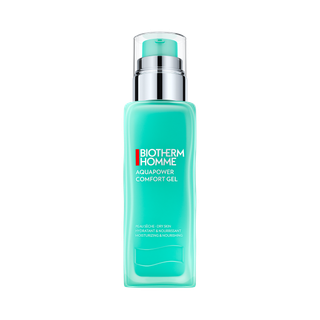
BIOTHERM AQUAPOWER COMFORT GEL MOISTURIZER
Works for
1 of 1 advertised claim delivered
Moisturizing28 ingredients credited for this claimStrong support
“ultra-moisturizing and nourishing gel”
This product can help improve hydration of the skin with the two types of ingredients.
The first type is called “humectants”:
these ingredients help attract water.
When humectants are on the surface of the skin, they “pull in” the moisture from the outside environment, or from
within deeper layers of the skin. The following ingredients in this product do the job:
alanine, aspartic acid.
This product also contains ingredients called “occlusives”. They help reduce the speed with which our skin loses moisture to the outside environment. These ingredients also help soften the upper layer of the skin, so it feels less tight and nicer to the touch. The following ingredients in this product do the job: butyrospermum parkii butter, dimethicone.
The following ingredients in this product are especially good for supporting the skin barrier and helping with the hydration level: ceramide np, hydroxypalmitoyl sphinganine, urea
Anti-agingNot advertised by the brand · 8 ingredients credited for this claimModerate support
This product contains aspartic acid. This ingredient might be able to help reduce and prevent fine lines and wrinkles, improve skin elasticity and firmness, but there is not enough evidence that it actually works.
Can it cause trouble?
Irritancy11 strong irritants: Alcohol denat., Menthoxypropanediol + 9 more — patch-test recommendedHigh risk
Comedogenic2 ingredients rated 2 or more on the 0–5 pore-clogging scale2 flagged
User reviews
Be the first — your take helps the next person decide.
Ingredients
Filter by role to see what each ingredient is doing.
Water~45–55%
Dimethicone~5.3–6.5%
- Irritation risk
- Low
A silicone that helps to reduce water loss from the surface of the skin. Can temporarily "fill in" lines and wrinkles, absorb oil, and create a nice product finish
More about DimethiconeButyrospermum parkii butter~4.6–5.6%
- Irritation risk
- Low
- Comedogenicity
- 3/5
A great moisturising ingredient that softens the skin and reduces water loss from its upper layer. It also can be helpful in protecting skin from free radicals
More about Butyrospermum parkii butterPrunus armeniaca kernel oil~3.3–4%
- Irritation risk
- Medium
An emollient that helps soften the skin
More about Prunus armeniaca kernel oilGlycerin~2.5–3.1%
- Irritation risk
- Low
One of the best moisturizing ingredients. Naturally present in skin. It attracts water to the upper layer of the skin working as a humectant
More about GlycerinAlcohol denat.~2–2.5%
- Irritation risk
- High
Produces temporary toning effect. Can help dissolve other ingredients or preserve products
More about Alcohol denat.Butylene glycol~1.7–2.1%
- Irritation risk
- Low
Used to create a nice product texture and help delivery of other ingredients. Might be somewhat helpful in attracting water to the upper layer of the skin
More about Butylene glycolAmmonium polyacryloyldimethyl taurate~1.4–1.7%
- Irritation risk
- Low
Used to create a thicker product consistency
More about Ammonium polyacryloyldimethyl taurateGlycine soja oil~1.2–1.4%
- Irritation risk
- Medium
- Comedogenicity
- 2/5
A good emollient that helps soften the skin and helps repair its barrier function. It can clog pores if used in high concentrations.
More about Glycine soja oilUrea~0.9–1.1%
- Irritation risk
- Low
Naturally present in skin (urea makes up about 7% of natural moisturizing factors in skin). Attracts water to the upper layer of the skin. Also has a positive effect on the skin barrier beyond the humectant action. Can enhance penetration of other ingredients. Is an exfoliating ingredient when used in high concentrations
More about UreaAspartic acid~0.65–1%
- Irritation risk
- Low
An amino-acid that helps increase skin hydration and might help to slightly improve skin firmness, potentially reducing lines and wrinkles
More about Aspartic acidCeramide np~0.6–0.9%
- Irritation risk
- Low
A type of lipid similar to ceramides naturally present in skin. Helps to soften the upper layer of the skin and supports the skin barrier function to keep it hydrated. Can help to prevent inflammation in skin
More about Ceramide npZinc gluconate~0.5–0.75%
- Irritation risk
- Medium
Typically used to stabilize the product formulations. It is a salt of a polyhydroxy acid (PHA) and in larger concentrations, can help shed the dead cells from the skin surface revealing smoother skin. It can help attract water to the upper layer of the skin. Might to be helpful against acne and clogged pores. Could be helpful in neutralizing free radicals, but solid research is missing. Due to the zinc content, might help calm down inflammation in skin
More about Zinc gluconateGlucose~0.45–0.7%
- Irritation risk
- Low
Helps attract water to the upper layer of the skin. Could be helpful in restoring the skin barrier function
More about GlucoseFructose~0.45–0.65%
- Irritation risk
- Low
Helps attract water to the upper layer of the skin
More about FructoseTriethanolamine~0.45–0.7%
- Irritation risk
- Medium
Used to adjust pH of the product and can help improve the product's smell
More about TriethanolamineDimethiconol~0.45–0.7%
- Irritation risk
- Low
A silicone that makes products more spreadable and keeps skin smooth. Helps to add gloss to skin and may visually fill in fine lines/wrinkles for short time
More about DimethiconolManganese gluconate~0.35–0.6%
- Irritation risk
- Low
Might be able to help restore skin barrier function supporting its hydration
More about Manganese gluconateSodium palmitoyl sarcosinate~0.45–0.65%
- Irritation risk
- Medium
Helps water and oil mix together
More about Sodium palmitoyl sarcosinate2-oleamido-1,3-octadecanediol~0.3–0.55%
- Irritation risk
- Low
Helps soften the upper layer of the skin and slow down the water loss over time
More about 2-oleamido-1,3-octadecanediolCholesterol~0.35–0.65%
- Irritation risk
- Low
An emollient that is naturally found in skin
More about CholesterolPalmitic acid~0.35–0.65%
- Irritation risk
- Low
An emollient that is naturally present in skin and helps soften it
More about Palmitic acidPalmitoyl proline~0.25–0.5%
- Irritation risk
- Low
An amino-acid that helps attract watet to the upper layer of the skin and might have some anti-aging properties
More about Palmitoyl prolineAlanine~0.25–0.5%
- Irritation risk
- Low
An amino-acid that helps to attract water to the upper layer of the skin and might help to lighten the skin, but solid evidence is lacking
More about AlanineMagnesium gluconate~0.25–0.5%
- Irritation risk
- Low
A mineral that might be able to support skin hydration, but convincing research on its effectiveness in topical skincare is lacking
More about Magnesium gluconateMagnesium palmitoyl glutamate~0.25–0.5%
- Irritation risk
- Low
An amino acid that helps attract water to the upper layer of the skin. Might be helpful against lines and wrinkles, but evidence of effectiveness is lacking
More about Magnesium palmitoyl glutamateAscorbyl glucoside~0.25–0.5%
- Irritation risk
- Medium
A vitamin C derivative that is more stable but less potent than pure form of vitamin C. Has a potential to boost collagen production, nutralise free radicals and reduce hyperpigmentation, but the required concentration is likely to be much higher than for the pure form of vitamin C, limiting the ingredient's effectiveness in products
More about Ascorbyl glucosideDisodium edta~0.25–0.5%
Copper gluconate~0.25–0.5%
- Irritation risk
- Medium
Typically used to stabilize the product formulations. It is a salt of polyhydroxy acid (PHA) and in larger concentrations, can help shed the dead cells from the skin surface revealing smoother skin. It can help attract water to the upper layer of the skin. Might to be helpful against acne and clogged pores. Could be helpful in neutralizing free radicals, but solid research is missing
More about Copper gluconateSucrose~0.25–0.45%
- Irritation risk
- Low
Can help attract water to the upper layer of the skin. In crystal form, it can work as a gentle exfoliant, gentler than the salt scrub. Helps stabilize the emulsion
More about SucroseHydroxypalmitoyl sphinganine~0.25–0.5%
- Irritation risk
- Low
A type of lipid similar to ceramides naturally present in skin. Helps to soften the upper layer of the skin and supports the skin barrier function to keep it hydrated. Can help to prevent inflammation in skin
More about Hydroxypalmitoyl sphinganineVitreoscilla ferment~0.25–0.5%
- Irritation risk
- Low
Citric acid~0.25–0.5%
- Irritation risk
- Medium
Can work as an exfoliant but is typically used to adjust the product pH
More about Citric acidPanthenol~0.25–0.5%
- Irritation risk
- Low
Helps attract water to the upper layer of the skin and can help improve skin barrier function
More about PanthenolMenthoxypropanediol~0.25–0.5%
Glutamic acid~0.25–0.5%
- Irritation risk
- Low
An amino-acid that helps attract water to the upper layer of the skin
More about Glutamic acidDextrin~0.3–0.55%
- Irritation risk
- Low
A sugar that is used to stabilize the product formulation. Can help attract water to the upper layer of the skin
More about DextrinPolyperfluoromethylisopropyl ether~0.25–0.5%
- Irritation risk
- Low
Hexyl nicotinate~0.3–0.55%
- Irritation risk
- High
Might be able to enhance blood flow in the skin. Can be irritating and result in skin redness
More about Hexyl nicotinateHexylene glycol~0.25–0.5%
- Irritation risk
- Medium
Helps create a more spreadable product texture
More about Hexylene glycolTocopherol~0.3–0.5%
- Irritation risk
- Low
Pure form of vitamin E. Can help moisturise and protect the skin from free radicals. Often used to help stabilise other ingredients or the formula itself
More about TocopherolTocopheryl acetate~0.25–0.5%
- Irritation risk
- Medium
A more stable but less bio-available form of vitamin E compared to Tocopherol. Might help moisturize and protect the skin from free radicals, but mostly used in low concentrations to stabilize other ingredients.
More about Tocopheryl acetatePhenoxyethanol~0.25–0.5%
- Irritation risk
- Low
A preservative. It helps prevent bacterial growth in cosmetic products
More about PhenoxyethanolCi 19140~0.25–0.45%
Ci 42090~0.25–0.45%
Linalool~0.2–0.4%
Coumarin~0.2–0.35%
Limonene~0.2–0.35%
- Irritation risk
- High
A common frangrance that can easily irritate skin, especially if exposed to air, light or heat
More about LimoneneHydroxycitronellal~0.15–0.3%
- Irritation risk
- High
A fragrance. A likely allergen and can be irritating
More about HydroxycitronellalCitral~0.15–0.25%
Citronellol~0.15–0.3%
Benzyl alcohol~0.15–0.25%
- Irritation risk
- High
A preservative. Can be used to mask unpleasant smell. Can be irritating
More about Benzyl alcoholBenzyl salicylate~0.1–0.15%
Parfum~0.1–0.15%
- Irritation risk
- High
An aromatic blend of unspecified and possibly irritating ingredients
More about ParfumIngredient list view
Water, Dimethicone, Butyrospermum parkii butter, Prunus armeniaca kernel oil, Glycerin, Alcohol denat., Butylene glycol, Ammonium polyacryloyldimethyl taurate, Glycine soja oil, Urea, Aspartic acid, Ceramide np, Zinc gluconate, Glucose, Fructose, Triethanolamine, Dimethiconol, Manganese gluconate, Sodium palmitoyl sarcosinate, 2-oleamido-1,3-octadecanediol, Cholesterol, Palmitic acid, Palmitoyl proline, Alanine, Magnesium gluconate, Magnesium palmitoyl glutamate, Ascorbyl glucoside, Disodium edta, Copper gluconate, Sucrose, Hydroxypalmitoyl sphinganine, Vitreoscilla ferment, Citric acid, Panthenol, Menthoxypropanediol, Glutamic acid, Dextrin, Polyperfluoromethylisopropyl ether, Hexyl nicotinate, Hexylene glycol, Tocopherol, Tocopheryl acetate, Phenoxyethanol, Ci 19140, Ci 42090, Linalool, Coumarin, Limonene, Hydroxycitronellal, Citral, Citronellol, Benzyl alcohol, Benzyl salicylate, Parfum
Compare prices
Retailers ranked by price — lowest first.
Worth comparing, line by line.
Match % combines shared ingredients, the first five ingredients, shared actives and hero ingredients, irritancy (lower counts in the alternative's favour), texture and body area. Only products in the same routine step are compared.
| BIOTHERMAQUAPOWER COMFORT GEL MOISTURIZERYOUR PRODUCT | BIOAQUAPOWER GEL MOISTURIZER | |
|---|---|---|
| Match | — | 50% |
| Price | $70.07 | $38.00−$32.07 |
| Shared key ingredients | — | 16 of 25 |
| Key difference | — | Biosaccharide Gum-1 |
| Irritancy | High | High |
| Drying alcohol | Contains drying alcohol | Contains drying alcohol |
| View product | Shop |

Product summary
Based on the ingredients included, "BIOTHERM HOMME - AQUAPOWER COMFORT GEL MOISTURIZER" works well for moisturizing the skin. This moisturizer uses a good combo of humectants and emollients. These both types of ingredients are essentials for improving the skin hydration and keeping the skin barrier healthy. Urea, alanine, aspartic acid, fructose and glutamic acid in this product (humectants) attract water molecules to the upper layer of the skin (the water comes from the outside air or from the deeper layers of the skin if the air is dry). Emollients in this formulation (ceramide np, cholesterol, glycine soja oil, prunus armeniaca kernel oil and butyrospermum parkii butter) help to reduce the moisture loss from the skin. They also soften the skin surface and relieve the feeling of dryness and tightness.
Ingredient callouts
- Another benefit is that this moisturizer contain ceramides (ceramide np 0.60% - 0.90%). Ceramides are an important part of our natural skin barrier. The Ceramides used in skincare are synthetic or come from plants. They help soften the skin and can help "fill the gaps" in the skin barrier, keeping the skin hydrated and resilient for longer.
Irritation risk
There are quite a few common irritants in this product, including ingredients without particular skin benefits. We would not recommend it for sensitive skin. We assess the overall irritancy of this moisturizer to be high. For a detailed overview of all potential irritants: click here
You can see the detailed formula review with the breakdown of all actives in the product and the full ingredient list with estimated concentrations in the tables below.
Price
The product retails from 43.00CA$ up to 45.00CA$ in Canada.
For a detailed price comparison: click here.
Sources cited in this review
Every concentration estimate and effectiveness label is anchored to one of these 31 studies and safety reviews.
- 1
- 2Final Report on the Safety Assessment of Dimethicone Copolyoljournals.sagepub.com
- 3
- 4
- 5Topical urea in skincare: A reviewpubmed.ncbi.nlm.nih.gov
- 6

Affiliate links · As an Amazon Associate, WIMJ earns from qualifying purchases.