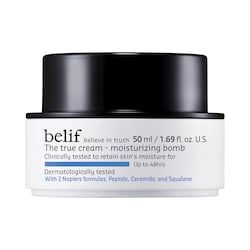
belif The True Cream Moisturizing Bomb with Peptide and Ceramide
Works for
1 of 1 advertised claim delivered
MoisturizingCeramide np, Urea + 28 moreStrong evidence
“The True Cream Moisturizing Bomb with Peptide and Ceramide”
This product can help improve hydration of the skin with the two types of ingredients.
The first type is called “humectants”:
these ingredients help attract water.
When humectants are on the surface of the skin, they “pull in” the moisture from the outside environment, or from
within deeper layers of the skin. The following ingredients in this product do the job:
glycerin, imperata cylindrica root extract.
This product also contains ingredients called “occlusives”. They help reduce the speed with which our skin loses moisture to the outside environment. These ingredients also help soften the upper layer of the skin, so it feels less tight and nicer to the touch. The following ingredients in this product do the job: dimethicone, squalane.
The following ingredients in this product are especially good for supporting the skin barrier and helping with the hydration level: acetyl hexapeptide-8, ceramide np, panthenol, urea
Anti-agingNot advertised by the brand · Acetyl hexapeptide-8, Butyrospermum parkii butter + 1 moreModerate evidence
This product contains acetyl hexapeptide-8. This ingredient might be able to help reduce and prevent fine lines and wrinkles, improve skin elasticity and firmness, but there is not enough evidence that it actually works.
Anti-oxidationNot advertised by the brand · Imperata cylindrica root extract, Althaea officinalis root extract + 11 moreModerate evidence
This product contains antioxidants (imperata cylindrica root extract) that might be able to help neutralize free radicals in skin to lessen the damage it gets from the UV light (sun). There is not enough evidence to confirm their effectiveness in skin though.
Can it cause trouble?
Irritancy13 strong irritants: Calendula officinalis flower extract, Rosa damascena flower extract + 11 more — patch-test recommendedHigh risk
Comedogenic2 ingredients rated 2 or more on the 0–5 pore-clogging scale2 flagged
User reviews
Be the first — your take helps the next person decide.
Ingredients
Filter by role to see what each ingredient is doing.
Water~45–55%
Glycerin~4.5–5.5%
- Irritation risk
- Low
One of the best moisturizing ingredients. Naturally present in skin. It attracts water to the upper layer of the skin working as a humectant
More about GlycerinCyclohexasiloxane~4.2–5.1%
- Irritation risk
- Low
A silicone that serves as an emollient. Helps create a nice non-greasy feels
More about CyclohexasiloxaneHydrogenated polydecene~3–3.7%
- Irritation risk
- Low
Helps to soften the upper layer of the skin and create a nice product texture
More about Hydrogenated polydeceneDipropylene glycol~2.2–2.7%
- Irritation risk
- Low
Helps to dissolve other ingredients in a formulation. Slows down the rate of product drying
More about Dipropylene glycolMacadamia ternifolia seed oil~2–2.4%
- Irritation risk
- Medium
Plant oil from nuts that helps soften the upper layer of the skin. Contains a high concentration of oleic acid that can weaken skin's barrier function and increase water-loss while enhancing penetration of other ingredients
More about Macadamia ternifolia seed oil1,2-hexanediol~0.75–1.1%
Triethylhexanoin~1.3–1.6%
- Irritation risk
- Medium
Helps soften the upper layer of the skin
More about TriethylhexanoinBis-peg-18 methyl ether dimethyl silane~1.2–1.5%
- Irritation risk
- Low
A type of silicone that helps soften the upper layer of the skin and create a nice product texture
More about Bis-peg-18 methyl ether dimethyl silaneStearyl alcohol~1.1–1.3%
- Irritation risk
- Low
An emollient that helps soften the skin
More about Stearyl alcoholGlyceryl stearate~0.75–1.1%
- Irritation risk
- Low
An emollient that softens the skin and forms a protective layer on its surface. Helps water and oil mix together
More about Glyceryl stearatePeg-40 stearate~0.6–0.9%
Pentaerythrityl tetraethylhexanoate~0.55–0.85%
- Irritation risk
- Low
Used to create a nice product consistency while softening the upper layer of the skin
More about Pentaerythrityl tetraethylhexanoateSymphytum officinale leaf extract~0.45–0.7%
- Irritation risk
- High
A plant extract that has an anti-bacterial effect
More about Symphytum officinale leaf extractAvena sativa kernel extract~0.45–0.7%
- Irritation risk
- Low
An effective moisturizing and skin barrier repair ingredient. Helps calm down inflammation and has some anti-oxidant properties
More about Avena sativa kernel extractCalendula officinalis flower extract~0.4–0.6%
- Irritation risk
- High
A plant extract that has some anti-oxidant and anti-bacterial properties. Can be irritating
More about Calendula officinalis flower extractNepeta cataria extract~0.4–0.6%
- Irritation risk
- Low
Rubus idaeus leaf extract~0.35–0.6%
- Irritation risk
- Medium
A plant extract that might have some anti-oxidant properties but evidence of effectiveness in skin is lacking
More about Rubus idaeus leaf extractBaptisia tinctoria root extract~0.3–0.55%
- Irritation risk
- Low
Stellaria media extract~0.3–0.55%
- Irritation risk
- Low
Alchemilla vulgaris leaf extract~0.25–0.5%
- Irritation risk
- Low
Viola tricolor extract~0.3–0.5%
- Irritation risk
- Medium
A plant extract that might have an anti-inflammatory effect in skin
More about Viola tricolor extractRosa damascena flower extract~0.25–0.45%
Spiraea ulmaria flower extract~0.25–0.45%
- Irritation risk
- High
Might have some anti-oxidant and anti-inflammatory properties. Can be irritating
More about Spiraea ulmaria flower extractAlthaea officinalis root extract~0.25–0.45%
- Irritation risk
- High
A plant extract that can help attract water to the upper layer of the skin and might help to reduce inflammation
More about Althaea officinalis root extractEuphrasia officinalis extract~0.25–0.45%
- Irritation risk
- Low
Thuja occidentalis leaf extract~0.25–0.4%
- Irritation risk
- Low
Achillea millefolium flower extract~0.25–0.45%
- Irritation risk
- High
A plant extract that is used as a fragrance. Its main fragrant compound is linalool
More about Achillea millefolium flower extractTrifolium pratense flower extract~0.25–0.5%
- Irritation risk
- High
Red clover flower extract. Can contain anti-oxidants but also potential irritant compounds
More about Trifolium pratense flower extractMenyanthes trifoliata leaf extract~0.25–0.45%
- Irritation risk
- Low
Salix alba bark extract~0.25–0.4%
- Irritation risk
- High
A plant extract that can help neutralize free radicals in skin. It contains a compound salicin that can theoretically be converted into salicylic acid that, in turn, helps reduce inflammation in skin, but the evidence of effectiveness in skin is lacking and the extract is usually not used in a concentration that would enable an exfoliating effect
More about Salix alba bark extractPoncirus trifoliata fruit extract~0.25–0.5%
- Irritation risk
- Low
Imperata cylindrica root extract~0.25–0.45%
- Irritation risk
- Medium
A plat extract that might help neutralize free radicals in skin and attract water to its upper layer
More about Imperata cylindrica root extractC14-22 alcohols~0.25–0.5%
- Irritation risk
- Low
A non-drying alcohol that helps stabilize product formulations
More about C14-22 alcoholsSqualane~0.3–0.55%
- Irritation risk
- Low
An oil naturally present in skin. Works as an emollient to soften the skin and form a protective layer on its surface without a greasy feeling.
More about SqualaneButyrospermum parkii butter~0.3–0.55%
- Irritation risk
- Low
- Comedogenicity
- 3/5
A great moisturising ingredient that softens the skin and reduces water loss from its upper layer. It also can be helpful in protecting skin from free radicals
More about Butyrospermum parkii butterArachidyl glucoside~0.25–0.5%
Ceramide np~0.3–0.55%
- Irritation risk
- Low
A type of lipid similar to ceramides naturally present in skin. Helps to soften the upper layer of the skin and supports the skin barrier function to keep it hydrated. Can help to prevent inflammation in skin
More about Ceramide npCholesterol~0.3–0.55%
- Irritation risk
- Low
An emollient that is naturally found in skin
More about CholesterolCaprylyl glycol~0.3–0.55%
- Irritation risk
- Medium
Helps preserve products and creates a nice product texture
More about Caprylyl glycolAcetyl hexapeptide-8~0.25–0.45%
- Irritation risk
- Low
A type of peptide. Peptides are excellent moisturizers and might be able support collagen production reducing fine lines and wrinkles
More about Acetyl hexapeptide-8Tocopherol~0.25–0.5%
- Irritation risk
- Low
Pure form of vitamin E. Can help moisturise and protect the skin from free radicals. Often used to help stabilise other ingredients or the formula itself
More about TocopherolPanthenol~0.25–0.5%
- Irritation risk
- Low
Helps attract water to the upper layer of the skin and can help improve skin barrier function
More about PanthenolHydroxyethylpiperazine ethane sulfonic acid~0.25–0.5%
- Irritation risk
- Medium
Used to regulate product's pH, but can be also used as an exfoliator when included in higher concentrations. There is a controversy about whether it can generate free radicals and induce skin cell damage when used in topical products
More about Hydroxyethylpiperazine ethane sulfonic acidUrea~0.25–0.45%
- Irritation risk
- Low
Naturally present in skin (urea makes up about 7% of natural moisturizing factors in skin). Attracts water to the upper layer of the skin. Also has a positive effect on the skin barrier beyond the humectant action. Can enhance penetration of other ingredients. Is an exfoliating ingredient when used in high concentrations
More about UreaSaccharomyces ferment filtrate~0.25–0.45%
- Irritation risk
- Low
A product of yeast fermentation. Helps attract water to the upper layer of the skin
More about Saccharomyces ferment filtrateViscum album extract~0.2–0.4%
- Irritation risk
- Low
Glycosyl trehalose~0.3–0.5%
Lactobacillus/soybean ferment extract~0.25–0.45%
- Irritation risk
- Low
A fermentation product created by bacteria Lactobacillus out of soybean. The fermented product helps to attract water to the upper layer of the skin and has anti-bacterial properties. It might be helpful in calming down inflammation and could be helpful in evening out skin tone, but studies are lacking
More about Lactobacillus/soybean ferment extractStearic acid~0.4–0.6%
- Irritation risk
- Low
Helps oil and water mix together and works as an emollient
More about Stearic acidTromethamine~0.25–0.5%
Peg-100 stearate~0.35–0.65%
- Irritation risk
- Low
Helps oil and water mix togehter and creates a nice product texture
More about Peg-100 stearateCetearyl olivate~0.25–0.5%
Palmitic acid~0.3–0.55%
- Irritation risk
- Low
An emollient that is naturally present in skin and helps soften it
More about Palmitic acidSorbitan olivate~0.25–0.5%
Hydrogenated lecithin~0.25–0.5%
- Irritation risk
- Low
Helps to retain moisture by creating a protective barrier on the skin. Rich in fatty acids. Improves product texture and helps with the penetration of other ingredients.
More about Hydrogenated lecithinAcrylates/c10-30 alkyl acrylate crosspolymer~0.3–0.5%
- Irritation risk
- Medium
Maintains the texture of skincare products. Allows the product to spread evenly. Helps oil and water mix together
More about Acrylates/c10-30 alkyl acrylate crosspolymerDimethicone/vinyl dimethicone crosspolymer~0.25–0.5%
- Irritation risk
- Low
Used to stabilize product formulations and create a nice product texture
More about Dimethicone/vinyl dimethicone crosspolymerCarbomer~0.25–0.5%
- Irritation risk
- Low
Helps create a thicker or gel-like product texture. It is not a surfactant but can be used in gentle cleansing formulations
More about CarbomerHydrogenated starch hydrolysate~0.25–0.45%
- Irritation risk
- Low
Helps to attract water to the upper layer of the skin. Can add sweet taste to lip products
More about Hydrogenated starch hydrolysateXanthan gum~0.25–0.5%
- Irritation risk
- Low
Used to create a thicker product consistency
More about Xanthan gumTrisodium edta~0.25–0.45%
Cetearyl alcohol~0.3–0.55%
- Irritation risk
- Low
- Comedogenicity
- 2/5
A non-drying alcohol. Works as an emollient. Helps water and oil mix together and creates a nice product texture
More about Cetearyl alcoholButylene glycol~0.25–0.45%
- Irritation risk
- Low
Used to create a nice product texture and help delivery of other ingredients. Might be somewhat helpful in attracting water to the upper layer of the skin
More about Butylene glycolDimethicone~0.3–0.55%
- Irritation risk
- Low
A silicone that helps to reduce water loss from the surface of the skin. Can temporarily "fill in" lines and wrinkles, absorb oil, and create a nice product finish
More about DimethiconeSorbitan stearate~0.25–0.45%
Citrus aurantium dulcis peel oil~0.2–0.4%
- Irritation risk
- High
An essentil oil from orange peel. Potential allergen and can be irritating
More about Citrus aurantium dulcis peel oilCitrus aurantifolia oil~0.25–0.45%
- Irritation risk
- High
Rosmarinus officinalis leaf oil~0.2–0.4%
- Irritation risk
- High
A plant oil with high content of volatile compounds that can irritate the skin. Can be used as a fragrance. Has anti-bacterial properties and might help neutralize free radicals on the surface of the skin
More about Rosmarinus officinalis leaf oilPelargonium graveolens flower oil~0.2–0.35%
- Irritation risk
- High
An essential oil. Can be irritating. Can become an allergen with oxidation
More about Pelargonium graveolens flower oilLimonene~0.15–0.25%
- Irritation risk
- High
A common frangrance that can easily irritate skin, especially if exposed to air, light or heat
More about LimoneneCitronellol~0.15–0.3%
Geraniol~0.15–0.25%
Citral~0.1–0.15%
Linalool~0.1–0.15%
Ingredient list view
Water, Glycerin, Cyclohexasiloxane, Hydrogenated polydecene, Dipropylene glycol, Macadamia ternifolia seed oil, 1,2-hexanediol, Triethylhexanoin, Bis-peg-18 methyl ether dimethyl silane, Stearyl alcohol, Glyceryl stearate, Peg-40 stearate, Pentaerythrityl tetraethylhexanoate, Symphytum officinale leaf extract, Avena sativa kernel extract, Calendula officinalis flower extract, Nepeta cataria extract, Rubus idaeus leaf extract, Baptisia tinctoria root extract, Stellaria media extract, Alchemilla vulgaris leaf extract, Viola tricolor extract, Rosa damascena flower extract, Spiraea ulmaria flower extract, Althaea officinalis root extract, Euphrasia officinalis extract, Thuja occidentalis leaf extract, Achillea millefolium flower extract, Trifolium pratense flower extract, Menyanthes trifoliata leaf extract, Salix alba bark extract, Poncirus trifoliata fruit extract, Imperata cylindrica root extract, C14-22 alcohols, Squalane, Butyrospermum parkii butter, Arachidyl glucoside, Ceramide np, Cholesterol, Caprylyl glycol, Acetyl hexapeptide-8, Tocopherol, Panthenol, Hydroxyethylpiperazine ethane sulfonic acid, Urea, Saccharomyces ferment filtrate, Viscum album extract, Glycosyl trehalose, Lactobacillus/soybean ferment extract, Stearic acid, Tromethamine, Peg-100 stearate, Cetearyl olivate, Palmitic acid, Sorbitan olivate, Hydrogenated lecithin, Acrylates/c10-30 alkyl acrylate crosspolymer, Dimethicone/vinyl dimethicone crosspolymer, Carbomer, Hydrogenated starch hydrolysate, Xanthan gum, Trisodium edta, Cetearyl alcohol, Butylene glycol, Dimethicone, Sorbitan stearate, Citrus aurantium dulcis peel oil, Citrus aurantifolia oil, Rosmarinus officinalis leaf oil, Pelargonium graveolens flower oil, Limonene, Citronellol, Geraniol, Citral, Linalool
Compare prices
Retailers ranked by price — lowest first.
Affiliate links · prices updated regularly · As an Amazon Associate, WIMJ earns from qualifying purchases.
Worth comparing, line by line.
Match % combines shared ingredients, the first five ingredients, shared actives and hero ingredients, irritancy (lower counts in the alternative's favour), texture and body area. Only products in the same routine step are compared.
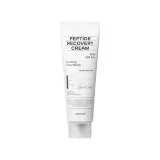
| belifThe True Cream Moisturizing Bomb with Peptide and CeramideYOUR PRODUCT | oganacellPeptide Recovery Cream | NEOGEN X SUR.MEDICSurmedic 24K Gold Caviar Repair Vital Cream | |
|---|---|---|---|
| Match | — | 50% | 50% |
| Price | $32.30 | $20.10−$12.20 | $60.00+$27.70 |
| Shared key ingredients | — | 6 of 17 | 6 of 17 |
| Key difference | — | Nonapeptide-1 | Copper Tripeptide-1 |
| Irritancy | High | Medium | Medium |
| Drying alcohol | — | — | — |
| View product | Shop | Shop |

Sources cited in this review
Every concentration estimate and effectiveness label is anchored to one of these 38 studies and safety reviews.
- 1
- 2Safety Assessment of Polyene Group as Used in Cosmeticscir-safety.org
- 3
- 4
- 5
- 6Safety Assessment of Pentaerythrityl Tetraesters as Used in Cosmeticsjournals.sagepub.com

Affiliate links · As an Amazon Associate, WIMJ earns from qualifying purchases.