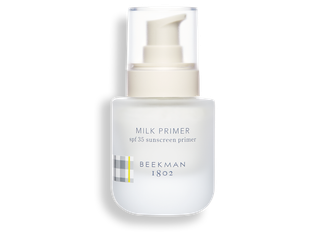
Beekman 1802 Milk Primer SPF 35 2-in-1 Daily Defense Sunscreen & Makeup Perfecter
Works for
1 of 1 advertised claim delivered
Sun protectionSPF 35 · 2 UV filtersBroad spectrum
This product offers a good level of protection against both UVB and UVA rays.
This sunscreen uses organic (so-called "chemical") sunscreen filters. Organic, or "chemical" filters usually provide reliable sun protection and rarely leave a white cast. Sunscreens with organic filters can sting eyes.
This product can be considered "reef safe" because it does not contain the UV filters (oxybenzone and octinoxate) that can be harmful to coral reefs when present in the water in high concentrations.
Anti-agingNot advertised by the brand · 2 ingredients credited for this claimStrong support
This product can help prevent early signs of skin aging because it offers a good level of broad spectrum sun protection. Sun damage is the main cause of premature skin aging, and protecting your skin from the sun is the best anti-aging strategy.
Evens skin toneNot advertised by the brand · 1 ingredient credited for this claimStrong support
This product offers broad spectrum sun protection. It means that it can prevent hyperpigmentation and help keep the skin tone even (sun damage is the main factor causing age spots, darkening of post-acne marks and other discolorations).
Anti-oxidationNot advertised by the brand · 3 ingredients credited for this claimModerate support
This product contains antioxidants (bifida ferment lysate) that might be able to help neutralize free radicals in skin to lessen the damage it gets from the UV light (sun). There is not enough evidence to confirm their effectiveness in skin though.
MoisturizingNot advertised by the brand · 18 ingredients credited for this claimGood support
This product can help improve hydration of the skin with the two types of ingredients.
The first type is called “humectants”:
these ingredients help attract water.
When humectants are on the surface of the skin, they “pull in” the moisture from the outside environment, or from
within deeper layers of the skin. The following ingredients in this product do the job:
glycerin, honey.
This product also contains ingredients called “occlusives”. They help reduce the speed with which our skin loses moisture to the outside environment. These ingredients also help soften the upper layer of the skin, so it feels less tight and nicer to the touch. The following ingredients in this product do the job: cocos nucifera fruit extract, carthamus tinctorius oleosomes.
Can it cause trouble?
Irritancy9 flagged ingredientsLow risk
Comedogenic2 ingredients rated 2 or more on the 0–5 pore-clogging scale2 flagged
User reviews
Ingredients
Filter by role to see what each ingredient is doing.
Zinc oxide13%
- Irritation risk
- Low
A broad spectrum sunblock (protects from both UVA and UVB rays). Is suitable for most sensitive skins. In small concentrations, can be used as a colorant
More about Zinc oxideWater~45–55%
Caprae lac~8.4–10.3%
- Irritation risk
- Low
Goat milk~5.1–6.3%
- Irritation risk
- Low
Colostrum~3.2–3.9%
- Irritation risk
- Low
Bifida ferment lysate~2.3–2.8%
- Irritation risk
- Low
Consists of remains of dead yeast bacteria cells. Helps to hydrate the skin and reduce irritation. Might has some anti-oxidant effect
More about Bifida ferment lysateLactose~1.9–2.3%
- Irritation risk
- Low
Helps attract water to the upper layer of the skin
More about LactoseMilk protein~1.6–2%
- Irritation risk
- Low
Helps attract water to the upper layer of the skin
More about Milk proteinAloe barbadensis leaf juice~1.5–1.8%
- Irritation risk
- Medium
Traditionally used to treat sunburns, dermatitis and inflammation, but evidence for its effectiveness is lacking. The extract can contain humectants that help attract water into the skin
More about Aloe barbadensis leaf juiceCaprylyl glycol~1.3–1.6%
- Irritation risk
- Medium
Helps preserve products and creates a nice product texture
More about Caprylyl glycolCarthamus tinctorius oleosomes~1.1–1.3%
- Irritation risk
- Low
Helps soften the upper layer of the skin
More about Carthamus tinctorius oleosomesChamomilla recutita flower extract~0.75–1.15%
- Irritation risk
- High
Plant extract that can have healing and anti-inflammatory properties. It is a potential allergen and can be irritating
More about Chamomilla recutita flower extractCocos nucifera fruit extract~0.7–1%
- Irritation risk
- Low
- Comedogenicity
- 3/5
An emollient. Found to be as effective as a moisturizer for dry skin as mineral oil. Could be comedogenic
More about Cocos nucifera fruit extractCucumis sativus fruit extract~0.6–0.9%
- Irritation risk
- Medium
Might be somewhat helpful in reducing hyperpigmentation and neutralizing free radicals but its typical concentration in a product is too low for having an effect
More about Cucumis sativus fruit extractSymphytum officinale leaf extract~0.55–0.8%
- Irritation risk
- High
A plant extract that has an anti-bacterial effect
More about Symphytum officinale leaf extractHoney~0.5–0.8%
- Irritation risk
- Low
Helps attract water to the skin and might have some anti-bacterial properties. Can be an allergen
More about HoneyEryngium maritimum extract~0.5–0.8%
- Irritation risk
- Low
Shea butter ethyl esters~0.55–0.8%
- Irritation risk
- Low
Helps soften the upper layer of the skin
More about Shea butter ethyl estersHydrolyzed milk protein~0.45–0.65%
Bentonite~0.45–0.65%
Butyloctyl salicylate~0.35–0.65%
- Irritation risk
- Medium
A synthetic ester of salicylic acid that is used to help disperse pigments and boost effectiveness of sunscreen ingredients. It is able to absorb UV light (working as an organic, or chemical filter), but is not approved as a sunscreen ingredient on its own
More about Butyloctyl salicylateCaprylhydroxamic acid~0.3–0.6%
Capryloyl glycerin/sebacic acid copolymer~0.3–0.6%
- Irritation risk
- Low
Helps soften the upper layer of the skin
More about Capryloyl glycerin/sebacic acid copolymerCetearyl alcohol~0.35–0.6%
- Irritation risk
- Low
- Comedogenicity
- 2/5
A non-drying alcohol. Works as an emollient. Helps water and oil mix together and creates a nice product texture
More about Cetearyl alcoholCitric acid~0.3–0.5%
- Irritation risk
- Medium
Can work as an exfoliant but is typically used to adjust the product pH
More about Citric acidCyclodextrin~0.25–0.5%
- Irritation risk
- Low
A type of sugar that is used to support delivery of active ingredients and can enhance their penetration into the skin without disrupting the skin's barrier
More about CyclodextrinDiheptyl succinate~0.3–0.55%
- Irritation risk
- Low
Helps to soften the upper layer of the skin and creates a nice product finish on the skin
More about Diheptyl succinateGlycerin~0.3–0.55%
- Irritation risk
- Low
One of the best moisturizing ingredients. Naturally present in skin. It attracts water to the upper layer of the skin working as a humectant
More about GlycerinGlyceryl stearate citrate~0.3–0.55%
- Irritation risk
- Low
Helps oil and water mix together while softening the upper layer of the skin
More about Glyceryl stearate citrateGlyceryl caprylate~0.3–0.5%
- Irritation risk
- Low
An emollient that can also help water and oil mix together, as well as prevent bacteria growth in products
More about Glyceryl caprylateHydrolyzed wheat protein/pvp crosspolymer~0.2–0.35%
- Irritation risk
- Low
Propanediol~0.2–0.35%
- Irritation risk
- Low
Acts as a solvent for other ingredients. Speeds up the absorption of other ingredients into the skin
More about PropanediolSodium gluconate~0.15–0.25%
Sodium stearoyl glutamate~0.2–0.35%
- Irritation risk
- Medium
Helps oil and water mix together
More about Sodium stearoyl glutamateTocopherol~0.1–0.15%
- Irritation risk
- Low
Pure form of vitamin E. Can help moisturise and protect the skin from free radicals. Often used to help stabilise other ingredients or the formula itself
More about TocopherolIngredient list view
Zinc oxide, Water, Caprae lac, Goat milk, Colostrum, Bifida ferment lysate, Lactose, Milk protein, Aloe barbadensis leaf juice, Caprylyl glycol, Carthamus tinctorius oleosomes, Chamomilla recutita flower extract, Cocos nucifera fruit extract, Cucumis sativus fruit extract, Symphytum officinale leaf extract, Honey, Eryngium maritimum extract, Shea butter ethyl esters, Hydrolyzed milk protein, Bentonite, Butyloctyl salicylate, Caprylhydroxamic acid, Capryloyl glycerin/sebacic acid copolymer, Cetearyl alcohol, Citric acid, Cyclodextrin, Diheptyl succinate, Glycerin, Glyceryl stearate citrate, Glyceryl caprylate, Hydrolyzed wheat protein/pvp crosspolymer, Propanediol, Sodium gluconate, Sodium stearoyl glutamate, Tocopherol
Compare prices
Retailers ranked by price — lowest first.
Product summary
We believe that "Beekman 1802 - Milk Primer SPF 35 2-in-1 Daily Defense Sunscreen & Makeup Perfecter" can provide reliable sun protection based on the ingredients listed. We love that it can protect from both UVA and UVB rays (not all sunscreens with SPF ratings give UVA protection. UVA rays do not cause sunburn, but still damage our skin and lead to early aging).
Because it includes good moisturizing ingredients, it can also work as a hydrating day cream. Like all broad-spectrum sunscreens, this product has an anti-aging benefit.
Sunscreen filters
This sunscreen uses a mixture of both mineral and organic (so-called "chemical") UV filters. The organic filters in the product are: butyloctyl salicylate. As for the mineral filters, this sunscreen uses zinc oxide.
Irritation risk
There are actives in this product that can be irritating. We assess the overall irritancy of this sunscreen to be low. For a detailed overview of all potential irritants: click here
You can see the detailed formula review with the breakdown of all actives in the product and the full ingredient list with estimated concentrations in the tables below.
What our users say
Based on 1 review 0% recommend this product- When it comes to comedogenicity, the reviewer believes that it clogs pores.
- As for the white cast, it did not leave a noticeable white residue for the reviewer.
- As for using this sunscreen in the eye area, the reviewer reported that it does not sting eyes.
About the brand
According to Cruelty-Free Kitty "Beekman 1802" is cruelty free and so is its parent company.
Sources cited in this review
Every concentration estimate and effectiveness label is anchored to one of these 13 studies and safety reviews.
- 1A review of inorganic UV filters zinc oxide and titanium dioxideonlinelibrary.wiley.com
- 2
- 3
- 4
- 5
- 6Bifidobacterium longumlysate, a new ingredient forreactive skinonlinelibrary.wiley.com

Affiliate links · As an Amazon Associate, WIMJ earns from qualifying purchases.