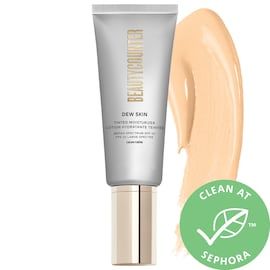
Beautycounter Dew Skin Tinted Moisturizer SPF 20
Works for
1 of 4 advertised claims delivered
Sun protectionSPF 20 · 2 UV filters · Broad spectrumWeak protectionSPF under 30
This product offers broad spectrum sun protection, but it is weak. We recommend to use a broad spectrum sunscreen with at least SPF 30.
This product can be considered "reef safe" because it does not contain the UV filters (oxybenzone and octinoxate) that can be harmful to coral reefs when present in the water in high concentrations.
Moisturizing18 ingredients credited for this claimGood evidence
“Dew Skin Tinted Moisturizer SPF 20”
This product can help improve hydration of the skin with the two types of ingredients.
The first type is called “humectants”:
these ingredients help attract water.
When humectants are on the surface of the skin, they “pull in” the moisture from the outside environment, or from
within deeper layers of the skin. The following ingredients in this product do the job:
glycerin, sodium hyaluronate.
This product also contains ingredients called “occlusives”. They help reduce the speed with which our skin loses moisture to the outside environment. These ingredients also help soften the upper layer of the skin, so it feels less tight and nicer to the touch. The following ingredients in this product do the job: beeswax, caprylic/capric triglyceride.
Evens skin tone2 ingredients credited for this claimLimited evidence
“Visibly even skin tone and enhance the look of radiance. . Vitamin C. Visibly brightens and evens skin tone.”
This product contains ingredients () that could help reduce hyperpigmentation (for example, post-acne marks or age spots) in theory, but there is not enough evidence that they actually work.
The biggest effect for evening out skin tone in this product comes from sun protection. Sun damage is the main factor causing age spots, darkening of post-acne marks and other discolorations. This is why sun protection is the best strategy for maintaining an even skin tone. We, however, do not recommend using this product as a sunscreen because the protection it offers is not strong enough).
Anti-aging3 ingredients credited for this claimLimited evidence
“Dryness, Dullness, and Loss of Firmness and Elasticity Formulation.”
This product does not contain ingredients that are able to reduce fine lines and wrinkles or help with skin elasticity, but it can improve the look of the skin temporarily through moisturization. Well-moisturized skin might also be able to repair the sun damage better.
The biggest anti-aging effect in this product comes from sun protection. Sun damage is the main factor causing early signs of skin aging. We, however, do not recommend using this product as a sunscreen because the protection it offers is not strong enough).
Can it cause trouble?
Irritancy7 strong irritants: Rosmarinus officinalis leaf extract, Alcohol + 5 more — patch-test recommendedHigh risk
Comedogenic3 ingredients rated 2 or more on the 0–5 pore-clogging scale3 flagged


User reviews
Be the first — your take helps the next person decide.
Ingredients
Filter by role to see what each ingredient is doing.
Zinc oxide14%
- Irritation risk
- Low
A broad spectrum sunblock (protects from both UVA and UVB rays). Is suitable for most sensitive skins. In small concentrations, can be used as a colorant
More about Zinc oxideWater~45–55%
Caprylic/capric triglyceride~6.5–8%
- Irritation risk
- Medium
A good mix of fatty acids that forms a protective layer on the skin. Improves the shelf life of products. Derived from coconut and glycerin
More about Caprylic/capric triglycerideCoco-caprylate~5.3–6.5%
- Irritation risk
- Medium
An emollient that softens skin and creates a nice product texture
More about Coco-caprylateTrimethylsiloxysilicate~3.2–3.9%
- Irritation risk
- Low
A type of silicone that helps create a nice product consistency and support the delivery of other ingredients
More about TrimethylsiloxysilicateIsopropyl palmitate~2.3–2.9%
- Irritation risk
- Medium
- Comedogenicity
- 3/5
Helps soften the upper layer of the skin and create a thicker product consistency
More about Isopropyl palmitateDimethicone/vinyl dimethicone crosspolymer~2–2.4%
- Irritation risk
- Low
Used to stabilize product formulations and create a nice product texture
More about Dimethicone/vinyl dimethicone crosspolymerPolyglyceryl-4 diisostearate/polyhydroxystearate/sebacate~1.8–2.2%
- Irritation risk
- Medium
Helps water and oil mix together
More about Polyglyceryl-4 diisostearate/polyhydroxystearate/sebacateOctyldodecyl oleate~1.6–2%
- Irritation risk
- Low
Ethylhexyl palmitate~1.4–1.7%
- Irritation risk
- Low
- Comedogenicity
- 3/5
An emollient that helps soften the skin and create a nice product texture
More about Ethylhexyl palmitateIsopropyl myristate~1.2–1.4%
- Irritation risk
- Low
- Comedogenicity
- 3/5
An emollient that helps soften the skin. Could be comedogenic
More about Isopropyl myristateDimethicone~1–1.2%
- Irritation risk
- Low
A silicone that helps to reduce water loss from the surface of the skin. Can temporarily "fill in" lines and wrinkles, absorb oil, and create a nice product finish
More about DimethiconeMagnesium sulfate~0.75–1.1%
Beeswax~0.7–1.05%
- Irritation risk
- Low
Forms a protective barrier that holds water and keeps dry skin hydrated. Keeps an emulsion from separating into its oil and liquid components, and increases the thickness of a product. Can be an allergen
More about BeeswaxCera alba~0.7–1.05%
- Irritation risk
- Medium
Forms a protective barrier that holds water and keeps dry skin hydrated. Keeps an emulsion from separating into its oil and liquid components, and increases the thickness of a product. Can be an allergen
More about Cera albaBeeswax~0.6–0.95%
- Irritation risk
- Low
Forms a protective barrier that holds water and keeps dry skin hydrated. Keeps an emulsion from separating into its oil and liquid components, and increases the thickness of a product. Can be an allergen
More about BeeswaxGluconolactone~0.55–0.8%
- Irritation risk
- Medium
A polyhydroxy acid (PHA) that helps shed the dead cells from the skin surface revealing smoother skin. Is believed to be genter than AHAs. It helps attract water to the upper layer of the skin and can stimulate production of skin's own hyaluronic acid resulting in improved hydration levels. It has been shown to be helpful against acne and clogged pores if used consistently (e.g over a period of 12 weeks) in high enough concentration. It can help reduce fine lines and wrinkles and improve skin tone with long-term application. Can help neutralize free radicals
More about GluconolactoneSodium hyaluronate~0.55–0.8%
- Irritation risk
- Low
One of the best moisturizing ingredients. Attracts water into the upper layer of the skin
More about Sodium hyaluronateLecithin~0.55–0.8%
- Irritation risk
- Low
Used mostly for creating emulsions - helping oil and water mix together. Helps soften the upper layer of the skin
More about LecithinRibes nigrum seed oil~0.5–0.8%
- Irritation risk
- Medium
An emollient. Can be helpful for restoring skin barrier function.
More about Ribes nigrum seed oilRosmarinus officinalis leaf extract~0.45–0.65%
- Irritation risk
- High
Can be helpful in reducing inflammation in skin, including inflamed acne. It can be irritating
More about Rosmarinus officinalis leaf extractSolidago virgaurea extract~0.4–0.65%
- Irritation risk
- Low
Polyhydroxystearic acid~0.45–0.7%
- Irritation risk
- Medium
Used to create a thicker product consistency and stabilize the formulation
More about Polyhydroxystearic acidPolyglyceryl-3 polyricinoleate~0.45–0.65%
- Irritation risk
- Medium
Helps oil and water mix together
More about Polyglyceryl-3 polyricinoleateIsostearic acid~0.5–0.75%
- Irritation risk
- Low
Used to create a nice product texture
More about Isostearic acidGlycerin~0.45–0.65%
- Irritation risk
- Low
One of the best moisturizing ingredients. Naturally present in skin. It attracts water to the upper layer of the skin working as a humectant
More about GlycerinPropanediol~0.45–0.65%
- Irritation risk
- Low
Acts as a solvent for other ingredients. Speeds up the absorption of other ingredients into the skin
More about PropanediolSodium benzoate~0.25–0.5%
Isoeicosane~0.45–0.65%
- Irritation risk
- Low
Hydrogenated castor oil~0.45–0.7%
- Irritation risk
- Medium
A plant oil that can help soften the skin. It might be helpful in calming down inflammation, but solid research is lacking. Is often used in lip products to create the needed product consistency
More about Hydrogenated castor oilTetrahexyldecyl ascorbate~0.4–0.65%
- Irritation risk
- Medium
Being a lipid soluble form of vitamin C, it is more stable than ascorbic acid, but still degrades quickly and needs to be stabilized in a formulation with another ingredient. It is claimed to penetrate skin better than pure vitamin C and have the the similar benefits, but solid studies of its effectiveness are lacking. Is likely to require a higher concentration in a product than pure vitamin C to be effective. It might be able to help reduce pore clogging.
More about Tetrahexyldecyl ascorbateOctyldodecanol~0.35–0.65%
- Irritation risk
- Low
An emollient that helps to soften the skin and create a pleasant product texture and stabilize the formulation
More about OctyldodecanolOctyldodecyl stearoyl stearate~0.4–0.6%
- Irritation risk
- Low
Alcohol~0.3–0.6%
- Irritation risk
- High
Can be drying and contribute to skin irritation. Used in formulars to dissolve other ingredients, create a thinner product consistency or for its antibacterial properties
More about AlcoholPaeonia suffruticosa root extract~0.3–0.55%
Prunus amygdalus dulcis oil~0.4–0.6%
- Irritation risk
- Low
An emollient that softens the skin
More about Prunus amygdalus dulcis oilCitrus aurantium bergamia fruit oil~0.3–0.55%
- Irritation risk
- High
A plant oil with a high content of volatile compounds that can irritate the skin and lead to allergic reactions. Can lead to photosensitivity
More about Citrus aurantium bergamia fruit oilCitrus aurantium dulcis peel oil~0.3–0.55%
- Irritation risk
- High
An essentil oil from orange peel. Potential allergen and can be irritating
More about Citrus aurantium dulcis peel oilRosa damascena flower oil~0.3–0.55%
- Irritation risk
- High
Used as a fragrance. Can be irritating
More about Rosa damascena flower oilSalvia sclarea extract~0.25–0.45%
- Irritation risk
- High
Used as a fragrance. Can be irritating
More about Salvia sclarea extractClay~0.3–0.55%
- Irritation risk
- Low
Can absorb oil. There is no research confirming other benefits for the skin
More about ClayCitrus aurantium dulcis flower oil~0.25–0.45%
- Irritation risk
- High
Vanilla planifolia fruit~0.2–0.4%
- Irritation risk
- Low
Calcium gluconate~0.2–0.35%
- Irritation risk
- Low
Helps attract water to the upper layer of the skin and helps to improve appearance of the product
More about Calcium gluconateSodium chloride~0.15–0.3%
- Irritation risk
- Low
Used to stabilize mixtures of oil and water, and create thicker, gel-like product textures
More about Sodium chlorideMica~0.15–0.3%
- Irritation risk
- Low
Creates an illusion of smoother and more radiant skin tone. Adds shimmer to the skin by reflecting light
More about MicaIron oxides~0.15–0.25%
- Irritation risk
- Low
An umbrella term for the following three colorants: CI 77491, CI 77492, CI 77499. They might be able to offer some protection against visible light, but the degree of the protection is not clear
More about Iron oxidesTitanium dioxide~0.1–0.15%
- Irritation risk
- Low
Works as a UV filter when used in high concentrations. It is photostable and is effective mostly against the UVB light, with some protection in the UVA range. In small concentrations, used for its ability to improve the color of cosmetic products. Is usually well tolerated by the skin
More about Titanium dioxideCi 77891~0.05–0.15%
- Irritation risk
- Low
Ingredient list view
Zinc oxide, Water, Caprylic/capric triglyceride, Coco-caprylate, Trimethylsiloxysilicate, Isopropyl palmitate, Dimethicone/vinyl dimethicone crosspolymer, Polyglyceryl-4 diisostearate/polyhydroxystearate/sebacate, Octyldodecyl oleate, Ethylhexyl palmitate, Isopropyl myristate, Dimethicone, Magnesium sulfate, Beeswax, Cera alba, Beeswax, Gluconolactone, Sodium hyaluronate, Lecithin, Ribes nigrum seed oil, Rosmarinus officinalis leaf extract, Solidago virgaurea extract, Polyhydroxystearic acid, Polyglyceryl-3 polyricinoleate, Isostearic acid, Glycerin, Propanediol, Sodium benzoate, Isoeicosane, Hydrogenated castor oil, Tetrahexyldecyl ascorbate, Octyldodecanol, Octyldodecyl stearoyl stearate, Alcohol, Paeonia suffruticosa root extract, Prunus amygdalus dulcis oil, Citrus aurantium bergamia fruit oil, Citrus aurantium dulcis peel oil, Rosa damascena flower oil, Salvia sclarea extract, Clay, Unknown, Citrus aurantium dulcis flower oil, Vanilla planifolia fruit, Calcium gluconate, Sodium chloride, Mica, Iron oxides, Titanium dioxide, Ci 77891
Compare prices
Retailers ranked by price — lowest first.
Worth comparing, line by line.
Match % combines shared ingredients, the first five ingredients, shared actives and hero ingredients, irritancy (lower counts in the alternative's favour), texture and body area. Only products in the same routine step are compared.
| BeautycounterDew Skin Tinted Moisturizer SPF 20YOUR PRODUCT | EvolveClimate Veil Tinted SPF20 | Farmacy BeautyGreen Defense Daily Mineral Sunscreen | Salt & StoneSalt Stone SPF 30 Sunscreen Lotion | |
|---|---|---|---|---|
| Match | — | 58% | 57% | 56% |
| Price | $45.00 | $15.34−$29.66 | $36.00−$9.00 | $24.02−$20.98 |
| Shared key ingredients | — | 5 of 11 | 3 of 11 | 7 of 11 |
| Key difference | — | Caryodendron Orinocense Seed Oil | Bisabolol | Hyaluronic Acid |
| Irritancy | High | Medium | Low | Medium |
| SPF | SPF 20 | SPF 20 | SPF 30 | SPF 30 |
| Drying alcohol | Contains drying alcohol | — | — | — |
| View product | Shop | Shop | Shop |


Product summary
"Beautycounter - Dew Skin Tinted Moisturizer SPF 20" offers broad spectrum protection. It means that it protects from both UVA and UVB rays (you can remember UVB as "burning" sunlight - they cause sunburn. You can remember UVA rays as "aging" - they do not lead to sunburn, but they cause photodamage and contribute to early signs of skin aging and hyperpigmentation). On the negative side, the SPF of this moisturizer is not high enough. We recommend to use a sunscreen with at least SPF 30 daily.
Because it includes good moisturizing ingredients, it can also work as a hydrating day cream.
Sunscreen filters
This moisturizer is a mineral sunscreen. It uses titanium dioxide and zinc oxide for sun protection. Both titanium dioxide and zinc oxide almost never irritate even the most sensitive skin and eyes, but can leave a white cast.
Irritation risk
There are quite a few common irritants in this product, including ingredients without particular skin benefits. We would not recommend it for sensitive skin. We assess the overall irritancy of this moisturizer to be high. For a detailed overview of all potential irritants: click here
You can see the detailed formula review with the breakdown of all actives in the product and the full ingredient list with estimated concentrations in the tables below.
Sources cited in this review
Every concentration estimate and effectiveness label is anchored to one of these 37 studies and safety reviews.
- 1A review of inorganic UV filters zinc oxide and titanium dioxideonlinelibrary.wiley.com
- 2
- 3
- 4
- 5
- 6Final Report on the Safety Assessment of Isopropyl Isostearatejournals.sagepub.com

Affiliate links · As an Amazon Associate, WIMJ earns from qualifying purchases.