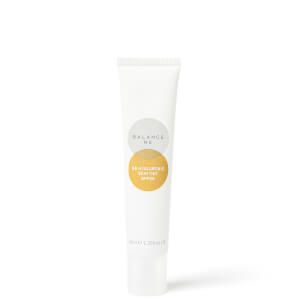
Balance Me BB Hyaluronic Skin Tint SPF25
Works for
1 of 3 advertised claims delivered
Sun protectionSPF 25 · 1 UV filter · Partial spectrumWeak protectionSPF under 30
This product does not offer good protection against UVA rays.
This product can be considered "reef safe" because it does not contain the UV filters (oxybenzone and octinoxate) that can be harmful to coral reefs when present in the water in high concentrations.
MoisturizingLactoperoxidase, Caprylic/capric triglyceride + 19 moreGood evidence
“BB Hyaluronic Skin Tint SPF25”
This product can help improve hydration of the skin with the two types of ingredients.
The first type is called “humectants”:
these ingredients help attract water.
When humectants are on the surface of the skin, they “pull in” the moisture from the outside environment, or from
within deeper layers of the skin. The following ingredients in this product do the job:
glycerin, hydrolyzed hyaluronic acid.
This product also contains ingredients called “occlusives”. They help reduce the speed with which our skin loses moisture to the outside environment. These ingredients also help soften the upper layer of the skin, so it feels less tight and nicer to the touch. The following ingredients in this product do the job: caprylic/capric triglyceride, helianthus annuus seed oil.
Evens skin toneNo ingredient credited for this claimLimited evidence
“Bursting with beauty essentials like anti-inflammatory fatty acids, Vitamin A and C this natural oil helps brighten, firm, address scarring and even out skin tone. . Titanium Dioxide.”
This product contains ingredients () that could help reduce hyperpigmentation (for example, post-acne marks or age spots) in theory, but there is not enough evidence that they actually work.
The biggest effect for evening out skin tone in this product comes from sun protection. Sun damage is the main factor causing age spots, darkening of post-acne marks and other discolorations. This is why sun protection is the best strategy for maintaining an even skin tone. We, however, do not recommend using this product as a sunscreen because the protection it offers is not strong enough).
Can it cause trouble?
Irritancy11 strong irritants: Michelia alba flower oil, Citrus aurantium bergamia fruit oil + 9 more — patch-test recommendedHigh risk
Comedogenic1 ingredient rated 2 or more on the 0–5 pore-clogging scale1 flagged
User reviews
Be the first — your take helps the next person decide.
Ingredients
Filter by role to see what each ingredient is doing.
Water~45–55%
Caprylic/capric triglyceride~5.7–6.9%
- Irritation risk
- Medium
A good mix of fatty acids that forms a protective layer on the skin. Improves the shelf life of products. Derived from coconut and glycerin
More about Caprylic/capric triglycerideTitanium dioxide~4.9–6%
- Irritation risk
- Low
Works as a UV filter when used in high concentrations. It is photostable and is effective mostly against the UVB light, with some protection in the UVA range. In small concentrations, used for its ability to improve the color of cosmetic products. Is usually well tolerated by the skin
More about Titanium dioxideSorbitan isostearate~3.2–3.9%
- Irritation risk
- Low
Helps oil and water mix together
More about Sorbitan isostearatePolyglyceryl-2 dipolyhydroxystearate~2.7–3.3%
- Irritation risk
- Low
Helps to soften the upper layer of the skin
More about Polyglyceryl-2 dipolyhydroxystearateCetyl ricinoleate~2.2–2.7%
- Irritation risk
- Low
An emollient that helps soften the upper layer of the skin
More about Cetyl ricinoleateCoco-caprylate~1.8–2.3%
- Irritation risk
- Medium
An emollient that softens skin and creates a nice product texture
More about Coco-caprylateAlumina~1.7–2.1%
- Irritation risk
- Low
The same compound that is used safely in dental implants and bone cements. In cosmetics, it is used to improve the consistency of products
More about AluminaStearic acid~1.4–1.7%
- Irritation risk
- Low
Helps oil and water mix together and works as an emollient
More about Stearic acidMica~1.2–1.5%
- Irritation risk
- Low
Creates an illusion of smoother and more radiant skin tone. Adds shimmer to the skin by reflecting light
More about MicaGlycerin~1–1.2%
- Irritation risk
- Low
One of the best moisturizing ingredients. Naturally present in skin. It attracts water to the upper layer of the skin working as a humectant
More about GlycerinPolyglyceryl-3 diisostearate~0.75–1.15%
- Irritation risk
- Medium
- Comedogenicity
- 3/5
Helps oil and water mix together
More about Polyglyceryl-3 diisostearateHydrolyzed hyaluronic acid~0.7–1.05%
- Irritation risk
- Low
One of the best moisturizing ingredients. Attracts water into the upper layer of the skin. A version of it is naturally present in skin
More about Hydrolyzed hyaluronic acidSodium hyaluronate~0.7–1%
- Irritation risk
- Low
One of the best moisturizing ingredients. Attracts water into the upper layer of the skin
More about Sodium hyaluronateRubus fruticosus leaf extract~0.65–0.95%
- Irritation risk
- Low
Michelia alba flower oil~0.65–0.95%
- Irritation risk
- High
A plant essential oil. Used as a fragrance. Can be irritating
More about Michelia alba flower oilCrambe abyssinica seed oil~0.6–0.9%
- Irritation risk
- Medium
Helps soften the upper layer of the skin
More about Crambe abyssinica seed oilCamellia oleifera seed oil~0.6–0.9%
- Irritation risk
- Medium
An emollient that does not leave a greasy finish
More about Camellia oleifera seed oilRosa canina fruit oil~0.55–0.85%
- Irritation risk
- Medium
A great emollient. Contains vitamin E (tocopherol) which may give it some anti-oxidant properties. Can contain volatile compounds and can be irritating
More about Rosa canina fruit oilAleurites moluccanus seed oil~0.5–0.75%
- Irritation risk
- Low
Helps soften the upper layer of the skin
More about Aleurites moluccanus seed oilAloe barbadensis leaf extract~0.55–0.85%
- Irritation risk
- Medium
Traditionally used to treat sunburns, dermatitis and inflammation, but evidence for its effectiveness is lacking. The extract can contain humectants that help attract water into the skin
More about Aloe barbadensis leaf extractRicinus communis seed oil~0.5–0.8%
- Irritation risk
- Medium
A plant oil that can help soften the skin. It might be helpful in calming down inflammation, but solid research is lacking. Is often used in lip products to create the needed product consistency
More about Ricinus communis seed oilCitrus aurantium bergamia fruit oil~0.45–0.7%
- Irritation risk
- High
A plant oil with a high content of volatile compounds that can irritate the skin and lead to allergic reactions. Can lead to photosensitivity
More about Citrus aurantium bergamia fruit oilStyrax benzoin resin extract~0.5–0.8%
- Irritation risk
- Low
Anthemis nobilis flower oil~0.45–0.65%
- Irritation risk
- High
An essential oil that is used as a fragrance and can be irritating. It might have some anti-oxidant effect in skin
More about Anthemis nobilis flower oilLavandula angustifolia flower oil~0.5–0.7%
- Irritation risk
- High
A fragrant plant oil, can be irritating
More about Lavandula angustifolia flower oilSalvia sclarea flower oil~0.45–0.65%
- Irritation risk
- High
Citrus aurantium amara leaf/twig oil~0.5–0.7%
- Irritation risk
- High
Tocopherol~0.5–0.75%
- Irritation risk
- Low
Pure form of vitamin E. Can help moisturise and protect the skin from free radicals. Often used to help stabilise other ingredients or the formula itself
More about TocopherolHelianthus annuus seed oil~0.5–0.75%
- Irritation risk
- Low
A great emollient due to its high linoleic acid content. One of the most effective plant oils in helping skin hydration and repairing skin barrier function
More about Helianthus annuus seed oilRosmarinus officinalis extract~0.5–0.7%
- Irritation risk
- High
Glucose~0.5–0.7%
- Irritation risk
- Low
Helps attract water to the upper layer of the skin. Could be helpful in restoring the skin barrier function
More about GlucoseSodium chloride~0.5–0.75%
- Irritation risk
- Low
Used to stabilize mixtures of oil and water, and create thicker, gel-like product textures
More about Sodium chlorideGlucose oxidase~0.5–0.7%
- Irritation risk
- Low
Helps attract water to the upper layer of the skin
More about Glucose oxidasePotassium iodide~0.5–0.75%
- Irritation risk
- Low
Potassium thiocyanate~0.5–0.75%
- Irritation risk
- Low
Lactoperoxidase~0.45–0.7%
- Irritation risk
- Low
Helps attract water to the upper layer of the skin. In theory, could support healthy skin's microbiome, but evidence of effectiveness in skin is lacking
More about LactoperoxidaseBisabolol~0.4–0.6%
- Irritation risk
- Low
An active component of chamomile plant that historically has been used to calm down irritated skin. A recent study shows that bisabolol indeed can have some anti-inflammatory effect on skin, even though conclusive data is lacking. Bisabolol has a sweet floral scent and can be added to products for its aromatic properties
More about BisabololMaltodextrin~0.45–0.7%
- Irritation risk
- Low
Used to stabilize the product formulation and can help absorb oil
More about MaltodextrinDistarch phosphate~0.45–0.65%
- Irritation risk
- Low
Cellulose~0.45–0.65%
- Irritation risk
- Low
Can be used to help absorb oil as well as add volume and imporve texture of products.
More about CelluloseDiheptyl succinate~0.35–0.6%
- Irritation risk
- Low
Helps to soften the upper layer of the skin and creates a nice product finish on the skin
More about Diheptyl succinateCapryloyl glycerin/sebacic acid copolymer~0.3–0.55%
- Irritation risk
- Low
Helps soften the upper layer of the skin
More about Capryloyl glycerin/sebacic acid copolymerLinalool~0.3–0.5%
Limonene~0.25–0.5%
- Irritation risk
- High
A common frangrance that can easily irritate skin, especially if exposed to air, light or heat
More about LimoneneBenzyl benzoate~0.25–0.45%
- Irritation risk
- High
Fragrance with sweet balsamic smell. Help to preserve products and dissolve other ingredients. Could trigger allergic reactions and be irritating
More about Benzyl benzoateBenzyl alcohol~0.25–0.45%
- Irritation risk
- High
A preservative. Can be used to mask unpleasant smell. Can be irritating
More about Benzyl alcoholGeraniol~0.2–0.4%
Citral~0.2–0.35%
Ci 77163~0.2–0.4%
Ci 77492~0.2–0.35%
Iron oxides~0.15–0.25%
- Irritation risk
- Low
An umbrella term for the following three colorants: CI 77491, CI 77492, CI 77499. They might be able to offer some protection against visible light, but the degree of the protection is not clear
More about Iron oxidesCi 77491~0.1–0.2%
- Irritation risk
- Low
A red colorant made of iron oxide. Typically is not irritating
More about Ci 77491Iron oxides~0.1–0.2%
- Irritation risk
- Low
An umbrella term for the following three colorants: CI 77491, CI 77492, CI 77499. They might be able to offer some protection against visible light, but the degree of the protection is not clear
More about Iron oxidesCi 77499~0.1–0.2%
Iron oxides~0.05–0.1%
- Irritation risk
- Low
An umbrella term for the following three colorants: CI 77491, CI 77492, CI 77499. They might be able to offer some protection against visible light, but the degree of the protection is not clear
More about Iron oxidesIngredient list view
Water, Caprylic/capric triglyceride, Titanium dioxide, Sorbitan isostearate, Polyglyceryl-2 dipolyhydroxystearate, Cetyl ricinoleate, Coco-caprylate, Alumina, Stearic acid, Mica, Glycerin, Polyglyceryl-3 diisostearate, Hydrolyzed hyaluronic acid, Sodium hyaluronate, Rubus fruticosus leaf extract, Michelia alba flower oil, Crambe abyssinica seed oil, Camellia oleifera seed oil, Rosa canina fruit oil, Aleurites moluccanus seed oil, Aloe barbadensis leaf extract, Ricinus communis seed oil, Citrus aurantium bergamia fruit oil, Styrax benzoin resin extract, Anthemis nobilis flower oil, Lavandula angustifolia flower oil, Salvia sclarea flower oil, Citrus aurantium amara leaf/twig oil, Tocopherol, Helianthus annuus seed oil, Rosmarinus officinalis extract, Glucose, Sodium chloride, Glucose oxidase, Potassium iodide, Potassium thiocyanate, Lactoperoxidase, Bisabolol, Maltodextrin, Distarch phosphate, Cellulose, Diheptyl succinate, Capryloyl glycerin/sebacic acid copolymer, Linalool, Limonene, Benzyl benzoate, Benzyl alcohol, Geraniol, Citral, Ci 77163, Ci 77492, Iron oxides, Ci 77491, Iron oxides, Ci 77499, Iron oxides, Unknown
Compare prices
Retailers ranked by price — lowest first.

.png)
Product summary
"Balance Me - BB Hyaluronic Skin Tint SPF25" does not provide enough UVA protection. UVA rays do not cause sunburn, but still damage the skin, leading to early signs of aging and pigmentation issues.
This product should also be hydrating enough to use without an additional moisturizer during the day.
Sunscreen filters
This product is a mineral sunscreen. It uses titanium dioxide for sun protection. Titanium dioxide almost never irritates the skin or stings eyes, but it can leave a white cast.
Irritation risk
This sunscreen contains a bunch of common irritants, including ingredients that do not provide any known benefit for the skin. It might not be the best choice if your skin is sensitive. We assess the overall irritancy of this product to be high. For a detailed overview of all potential irritants: click here
You can see the detailed formula review with the breakdown of all actives in the product and the full ingredient list with estimated concentrations in the tables below.
Price
The product retails from 20.80£ up to 37.00£ in the United Kingdom, from 24.50$ up to 26.00$ in the United States and for 32.60CA$ in Canada.
For a detailed price comparison: click here.
Sources cited in this review
Every concentration estimate and effectiveness label is anchored to one of these 22 studies and safety reviews.
- 1
- 2
- 3Efficacy of a New Topical Nano-hyaluronic Acid in Humansncbi.nlm.nih.gov
- 4Physiochemical properties and application of hyaluronic acid: a systematic reviewonlinelibrary.wiley.com
- 5Hyaluronic acid: A key molecule in skin agingncbi.nlm.nih.gov
- 6

Affiliate links · As an Amazon Associate, WIMJ earns from qualifying purchases.