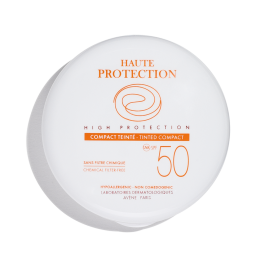
Avène Mineral Tinted Compact SPF 50
Works for
4 of 4 advertised claims delivered
Sun protectionSPF 50 · 4 UV filtersBroad spectrum
This product offers a good level of protection against both UVB and UVA rays.
This sunscreen uses organic (so-called "chemical") sunscreen filters. Organic, or "chemical" filters usually provide reliable sun protection and rarely leave a white cast. Sunscreens with organic filters can sting eyes.
Moisturizing14 ingredients credited for this claimStrong support
“This broad-spectrum sunscreen contains skin-nourishing vitamin E for potent antioxidant protection and Avene thermal spring water to soothe and soften the skin.”
This product can help soften the skin and reduce its moisture loss with emollients and occlusives: beeswax, cera microcristallina.
Keep in mind that this product does not contain effective ingredients to attract water to the upper layer of the skin. This is why an additional product with humectants like glycerin or hyaluronic acid can be helpful (apply it before this product for the best results).
The following ingredients in this product are especially good for supporting the skin barrier and helping with the hydration level: paraffinum liquidum
Anti-aging1 ingredient credited for this claimStrong support
“Enriched with a powerful anti-oxidant, this matte-finish sunscreen provides broad spectrum SPF 50 UVA/UVB protection.”
This product can help prevent early signs of skin aging because it offers a good level of broad spectrum sun protection. Sun damage is the main cause of premature skin aging, and protecting your skin from the sun is the best anti-aging strategy.
Evens skin toneNo ingredient credited for this claimStrong support
“Significantly helps to prevent pigmentation induced by visible light. . 100% mineral sunscreen filters.”
This product offers broad spectrum sun protection. It means that it can prevent hyperpigmentation and help keep the skin tone even (sun damage is the main factor causing age spots, darkening of post-acne marks and other discolorations).
Can it cause trouble?
Irritancy3 strong irritants: Parfum, Alcohol + 1 more — patch-test recommendedHigh risk
Comedogenic2 ingredients rated 2 or more on the 0–5 pore-clogging scale2 flagged


User reviews
Be the first — your take helps the next person decide.
Ingredients
Filter by role to see what each ingredient is doing.
Parfum~22–33%
- Irritation risk
- High
An aromatic blend of unspecified and possibly irritating ingredients
More about ParfumAlcohol~5.7–8.6%
- Irritation risk
- High
Can be drying and contribute to skin irritation. Used in formulars to dissolve other ingredients, create a thinner product consistency or for its antibacterial properties
More about AlcoholTriticum vulgare germ oil~4.7–7.1%
- Irritation risk
- Low
- Comedogenicity
- 3/5
A good emoillient. Contains vitamin E which can help neutralise free radicals, however the oil is unstable. Avoid if you have gluten or wheat sensitivity (including food allergies).
More about Triticum vulgare germ oilParaffinum liquidum~4–6%
- Irritation risk
- Low
Mineral oil. One of the most effective and well studied occlusive and emollient moisturizing ingredients. Helps reduce moisture loss in skin and repair skin barrier function
More about Paraffinum liquidumEthylhexyl methoxycinnamate~3.5–5.2%
- Irritation risk
- High
Octinoxate. When used in higher concentrations, works as a sunscreen protecting the skin from UVB rays. When used in lower concentration, helps to preserve the product formulation. Is shown to be harmful to coral reefs - consider avoiding bathing in coral reef areas when wearing a product with this ingredient. It can be irritating
More about Ethylhexyl methoxycinnamateBenzophenone-3~2.6–3.9%
- Irritation risk
- High
Same as oxybenzone. Protects in the UVB and short UVA range. In small concentrations, used to stabilize product formulation. Can be irritating. Is shown to be harmful to coral reefs - consider avoiding bathing in coral reef areas when wearing a product with this ingredient. It can penetrate the skin and get absorbed into bloodstream faster than other popular filters available in the US. The study that produced this finding did not address any potential health effects of the absorption
More about Benzophenone-3Zinc oxide4.9%
- Irritation risk
- Low
A broad spectrum sunblock (protects from both UVA and UVB rays). Is suitable for most sensitive skins. In small concentrations, can be used as a colorant
More about Zinc oxideDimethicone~1.8–2.8%
- Irritation risk
- Low
A silicone that helps to reduce water loss from the surface of the skin. Can temporarily "fill in" lines and wrinkles, absorb oil, and create a nice product finish
More about DimethiconeHydrogenated polyisobutene~1.5–2.3%
- Irritation risk
- Low
Used to improve the product consistency and soften the upper layer of the skin
More about Hydrogenated polyisobutenePhenyl trimethicone~1.3–1.9%
- Irritation risk
- Low
A type of silicone that can decrease loss of moisture from the skin surface. It helps create a nice product texture
More about Phenyl trimethiconeIsodecyl neopentanoate~1–1.5%
- Irritation risk
- Low
An emollient that helps soften the skin. It also forms a protective on its surface to reduce water loss.
More about Isodecyl neopentanoateSqualane~0.9–1.35%
- Irritation risk
- Low
An oil naturally present in skin. Works as an emollient to soften the skin and form a protective layer on its surface without a greasy feeling.
More about SqualaneTalc~1–1.45%
Ethylhexyl hydroxystearate~0.6–1.35%
- Irritation risk
- Low
Helps soften the upper layer of the skin and reduce water loss from it
More about Ethylhexyl hydroxystearatePolyethylene~0.95–1.45%
Iron oxides~0.5–1.2%
- Irritation risk
- Low
An umbrella term for the following three colorants: CI 77491, CI 77492, CI 77499. They might be able to offer some protection against visible light, but the degree of the protection is not clear
More about Iron oxidesPolymethyl methacrylate~0.6–1.35%
- Irritation risk
- Low
Is used to enhance product texture and can help to optically mask skin imperfections
More about Polymethyl methacrylateSilica~0.55–1.25%
Polyglyceryl-3 diisostearate~0.4–0.95%
- Irritation risk
- Medium
- Comedogenicity
- 3/5
Helps oil and water mix together
More about Polyglyceryl-3 diisostearateAlumina~0.45–1.05%
- Irritation risk
- Low
The same compound that is used safely in dental implants and bone cements. In cosmetics, it is used to improve the consistency of products
More about AluminaStearic acid~0.45–1.05%
- Irritation risk
- Low
Helps oil and water mix together and works as an emollient
More about Stearic acidWater~0.3–0.75%
Beeswax~0.3–0.75%
- Irritation risk
- Low
Forms a protective barrier that holds water and keeps dry skin hydrated. Keeps an emulsion from separating into its oil and liquid components, and increases the thickness of a product. Can be an allergen
More about BeeswaxBht~0.15–0.6%
Caprylic/capric triglyceride~0.3–0.75%
- Irritation risk
- Medium
A good mix of fatty acids that forms a protective layer on the skin. Improves the shelf life of products. Derived from coconut and glycerin
More about Caprylic/capric triglycerideMicrocrystalline wax~0.15–0.65%
Cera microcristallina~0.3–0.75%
- Irritation risk
- Low
Helps to soften the upper layer of the skin, reduce water loss from its surface and create a thicker product consistency
More about Cera microcristallinaPhenoxyethanol~0.15–0.65%
- Irritation risk
- Low
A preservative. It helps prevent bacterial growth in cosmetic products
More about PhenoxyethanolTocopherol~0.15–0.55%
- Irritation risk
- Low
Pure form of vitamin E. Can help moisturise and protect the skin from free radicals. Often used to help stabilise other ingredients or the formula itself
More about TocopherolTocopheryl glucoside~0.2–0.75%
- Irritation risk
- Low
Antioxidant that helps stabilize product formulations and, if used in higher concentration, might help neutralize free radicals in skin
More about Tocopheryl glucosideTribehenin~0.2–0.75%
- Irritation risk
- Low
Used to create a thicker product consistency and soften the upper layer of the skin
More about TribeheninTriethoxycaprylylsilane~0.1–0.5%
- Irritation risk
- Low
A type of silicone that helps oil and water mix well together. Helps to disperse other ingredients, e.g. pigments, evenly in a formulation
More about TriethoxycaprylylsilaneTitanium dioxide13.7%
- Irritation risk
- Low
Works as a UV filter when used in high concentrations. It is photostable and is effective mostly against the UVB light, with some protection in the UVA range. In small concentrations, used for its ability to improve the color of cosmetic products. Is usually well tolerated by the skin
More about Titanium dioxideCi 77891~0.1–0.3%
- Irritation risk
- Low
Iron oxides~0.05–0.3%
- Irritation risk
- Low
An umbrella term for the following three colorants: CI 77491, CI 77492, CI 77499. They might be able to offer some protection against visible light, but the degree of the protection is not clear
More about Iron oxidesCi 77492~0.05–0.25%
Ci 77491~0.05–0.2%
- Irritation risk
- Low
A red colorant made of iron oxide. Typically is not irritating
More about Ci 77491Ci 77499~0.05–0.2%
Ingredient list view
Parfum, Unknown, Alcohol, Unknown, Triticum vulgare germ oil, Paraffinum liquidum, Ethylhexyl methoxycinnamate, Benzophenone-3, Zinc oxide, Dimethicone, Hydrogenated polyisobutene, Phenyl trimethicone, Isodecyl neopentanoate, Squalane, Talc, Ethylhexyl hydroxystearate, Polyethylene, Iron oxides, Polymethyl methacrylate, Silica, Polyglyceryl-3 diisostearate, Alumina, Stearic acid, Water, Beeswax, Bht, Caprylic/capric triglyceride, Microcrystalline wax, Cera microcristallina, Phenoxyethanol, Tocopherol, Tocopheryl glucoside, Tribehenin, Triethoxycaprylylsilane, Titanium dioxide, Ci 77891, Iron oxides, Ci 77492, Ci 77491, Ci 77499
Compare prices
Retailers ranked by price — lowest first.

.png)

Worth comparing, line by line.
Match % combines shared ingredients, the first five ingredients, shared actives and hero ingredients, irritancy (lower counts in the alternative's favour), texture and body area. Only products in the same routine step are compared.
| AvèneMineral Tinted Compact SPF 50YOUR PRODUCT | MISSHAM Perfect Cover Bb Cream #31 Spf 42 Pa+++ -Lightweight, Multi-Function, High Coverage Makeup To Help Infuse Moisture For Firmer-Looking Skin With Reduction In Appearance Of Fine Lines | KoseSuncut Prodefense Tone Up UV Sunscreen Stick SPF 50+ PA++++ | |
|---|---|---|---|
| Match | — | 52% | 52% |
| Price | $38.00 | $12.50−$25.50 | $11.10−$26.90 |
| Shared key ingredients | — | 9 of 13 | 7 of 13 |
| Key difference | — | Adenosine | Ascorbyl Tetraisopalmitate |
| Irritancy | High | High | High |
| SPF | SPF 50 | SPF 42 | SPF 50 |
| Drying alcohol | Contains drying alcohol | — | — |
| View product | Shop | Shop |

Product summary
Based on the ingredient list, we assess that "Avène - Mineral Tinted Compact SPF 50" can provide reliable sun protection. We love that it can protect from both UVA and UVB rays (not all sunscreens with SPF ratings give UVA protection. UVA rays do not cause sunburn, but still damage our skin and lead to early aging).
It contains good moisturizing ingredients and can double as a hydrating day cream. Like all broad-spectrum sunscreens, this product has an anti-aging benefit.
Sunscreen filters
This sunscreen uses a mixture of both mineral and organic (so-called "chemical") UV filters. The organic filters in the product are: oxybenzone and octinoxate. As for the mineral filters, this sunscreen uses both titanium dioxide and zinc oxide.
Irritation risk
There are some common irritants in this product, including ingredients that do not have benefits for the skin. We assess the overall irritancy of this product to be high. For a detailed overview of all potential irritants: click here
You can see the detailed formula review with the breakdown of all actives in the product and the full ingredient list with estimated concentrations in the tables below.
Price
The product retails for 38.00$ in the United States.
For a detailed price comparison: click here.
Sources cited in this review
Every concentration estimate and effectiveness label is anchored to one of these 17 studies and safety reviews.
- 1A review on the extensive skin benefits of mineral oilncbi.nlm.nih.gov
- 2
- 3
- 4On Photostability of Oxybenzonecore.ac.uk
- 5A review of inorganic UV filters zinc oxide and titanium dioxideonlinelibrary.wiley.com
- 6

Affiliate links · As an Amazon Associate, WIMJ earns from qualifying purchases.