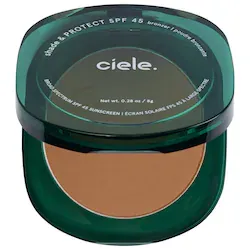
Ciele shade & PROTECT SPF 45+ powder bronzer
Works for
Sun protectionSPF 45 · 2 UV filtersBroad spectrum
This product offers a good level of protection against both UVB and UVA rays.
It is a mineral sunscreen. In other words, it contains non-organic UV filters. It will probably not sting your eyes but might leave a white cast.
This product can be considered "reef safe" because it does not contain the UV filters (oxybenzone and octinoxate) that can be harmful to coral reefs when present in the water in high concentrations.
Evens skin toneSide benefit · No ingredient credited for this claimWorks well
This product offers broad spectrum sun protection. It means that it can prevent hyperpigmentation and help keep the skin tone even (sun damage is the main factor causing age spots, darkening of post-acne marks and other discolorations).
Anti-agingSide benefit · TocopherolWorks well
This product can help prevent early signs of skin aging because it offers a good level of broad spectrum sun protection. Sun damage is the main cause of premature skin aging, and protecting your skin from the sun is the best anti-aging strategy.
MoisturizingSide benefit · Dimethicone, Diisostearyl malate + 3 moreWorks
This product can help soften the skin and reduce its moisture loss with emollients and occlusives: dimethicone, diisostearyl malate.
Keep in mind that this product does not contain effective ingredients to attract water to the upper layer of the skin. This is why an additional product with humectants like glycerin or hyaluronic acid can be helpful (apply it before this product for the best results).
Can it cause trouble?
Irritancy3 flagged ingredientsLow risk
ComedogenicClean of flagged comedogenic ingredientsNone flagged
User reviews
Be the first — your take helps the next person decide.
Ingredients
Filter by role to see what each ingredient is doing.
Zinc oxide5.85%
- Irritation risk
- Low
A broad spectrum sunblock (protects from both UVA and UVB rays). Is suitable for most sensitive skins. In small concentrations, can be used as a colorant
More about Zinc oxideMica~23–35%
- Irritation risk
- Low
Creates an illusion of smoother and more radiant skin tone. Adds shimmer to the skin by reflecting light
More about MicaDimethicone~6.8–10.1%
- Irritation risk
- Low
A silicone that helps to reduce water loss from the surface of the skin. Can temporarily "fill in" lines and wrinkles, absorb oil, and create a nice product finish
More about DimethiconeBoron nitride~4–6%
- Irritation risk
- Low
Helps to absord oil and evenly disperse other ingredients (for example, pigment) in product formulation
More about Boron nitrideSynthetic fluorphlogopite~2.7–4.1%
- Irritation risk
- Low
A mineral that is used as an optical filter (makes the skin looks nicer through light reflection) and to improve the texture of cosmetic products
More about Synthetic fluorphlogopiteTitanium dioxide6.8%
- Irritation risk
- Low
Works as a UV filter when used in high concentrations. It is photostable and is effective mostly against the UVB light, with some protection in the UVA range. In small concentrations, used for its ability to improve the color of cosmetic products. Is usually well tolerated by the skin
More about Titanium dioxideIron oxides~2.4–3.6%
- Irritation risk
- Low
An umbrella term for the following three colorants: CI 77491, CI 77492, CI 77499. They might be able to offer some protection against visible light, but the degree of the protection is not clear
More about Iron oxidesHydrogenated polyisobutene~1.9–2.8%
- Irritation risk
- Low
Used to improve the product consistency and soften the upper layer of the skin
More about Hydrogenated polyisobuteneDimethicone/vinyl dimethicone crosspolymer~1.3–1.9%
- Irritation risk
- Low
Used to stabilize product formulations and create a nice product texture
More about Dimethicone/vinyl dimethicone crosspolymerSilica~1.4–2%
Zinc stearate~0.9–1.35%
- Irritation risk
- Low
Diisostearyl malate~0.55–1.3%
- Irritation risk
- Medium
Helps to soften the upper layer of the skin
More about Diisostearyl malateEthylhexylglycerin~0.4–0.95%
Triethoxycaprylylsilane~0.2–0.75%
- Irritation risk
- Low
A type of silicone that helps oil and water mix well together. Helps to disperse other ingredients, e.g. pigments, evenly in a formulation
More about TriethoxycaprylylsilaneCaprylyl glycol~0.15–0.65%
- Irritation risk
- Medium
Helps preserve products and creates a nice product texture
More about Caprylyl glycolAluminum hydroxide~0.15–0.55%
- Irritation risk
- Low
Is used to add opaque (non-transparent) appearance to formulations. Can be used to coat other ingredients for even dispersion. This is a different ingredient compared to the ones used in antipersperants (aluminium chloride and aluminium chlorohydrate)
More about Aluminum hydroxideTin oxide~0.15–0.5%
- Irritation risk
- Low
A colorant that can add a pearl-like appearance to the formulation
More about Tin oxideTocopherol~0.05–0.2%
- Irritation risk
- Low
Pure form of vitamin E. Can help moisturise and protect the skin from free radicals. Often used to help stabilise other ingredients or the formula itself
More about TocopherolIngredient list view
Zinc oxide, Mica, Dimethicone, Boron nitride, Synthetic fluorphlogopite, Titanium dioxide, Iron oxides, Hydrogenated polyisobutene, Dimethicone/vinyl dimethicone crosspolymer, Silica, Zinc stearate, Diisostearyl malate, Ethylhexylglycerin, Triethoxycaprylylsilane, Caprylyl glycol, Aluminum hydroxide, Tin oxide, Tocopherol
Compare prices
Retailers ranked by price — lowest first.

Worth comparing, line by line.
Match % combines shared ingredients, the first five ingredients, shared actives and hero ingredients, irritancy (lower counts in the alternative's favour), texture and body area. Only products in the same routine step are compared.
| Cieleshade & PROTECT SPF 45+ powder bronzerYOUR PRODUCT | MDSolarSciencesMineral KidCreme SPF 40 - Not Boxed | BiodermaPhotoderm NUDE Touch MINERAL SPF50+ | Susan PosnickTinted Mineral SPF30 | |
|---|---|---|---|---|
| Match | — | 35% | 35% | 35% |
| Price | $36.00 | — | $12.72−$23.28 | $51.37+$15.37 |
| Shared key ingredients | — | 3 of 3 | 3 of 3 | 2 of 3 |
| Key difference | — | Tetrahexyldecyl Ascorbate | Salicylic Acid | Camellia Sinensis Leaf Extract |
| Irritancy | Low | Low | Low | Low |
| SPF | SPF 45 | SPF 40 | SPF 50 | SPF 30 |
| Drying alcohol | — | — | — | — |
| View product | Shop | Shop | Shop |


More alternatives: Derma E Sun Protection Mineral Face Powder SPF 30PRIORI Skincare TETRA fx251 Broad Spectrum SPF55 Sunscreen Color Guide
Sources cited in this review
Every concentration estimate and effectiveness label is anchored to one of these 13 studies and safety reviews.
- 1A review of inorganic UV filters zinc oxide and titanium dioxideonlinelibrary.wiley.com
- 2
- 3
- 4
- 5
- 6

Affiliate links · As an Amazon Associate, WIMJ earns from qualifying purchases.