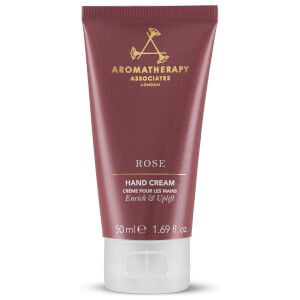
Aromatherapy Associates Rose Hand Cream
Works for
1 of 2 advertised claims delivered
Moisturizing22 ingredients credited for this claimGood support
“Sumptuous and nourishing, the hand creams locks in moisture for long-lasting, touchable softness, while an infusion of Sea Daffodil works to minimise the appearance of blemishes, dark spots and imperfections.”
This product can help improve hydration of the skin with the two types of ingredients.
The first type is called “humectants”:
these ingredients help attract water.
When humectants are on the surface of the skin, they “pull in” the moisture from the outside environment, or from
within deeper layers of the skin. The following ingredients in this product do the job:
fructose, glycerin.
This product also contains ingredients called “occlusives”. They help reduce the speed with which our skin loses moisture to the outside environment. These ingredients also help soften the upper layer of the skin, so it feels less tight and nicer to the touch. The following ingredients in this product do the job: butyrospermum parkii butter, helianthus annuus seed oil.
Evens skin tone1 ingredient credited for this claimWeak support
“Sumptuous and nourishing, the hand creams locks in moisture for long-lasting, touchable softness, while an infusion of Sea Daffodil works to minimise the appearance of blemishes, dark spots and imperfections.”
Effective ingredients missing or their concentration is too low
Can it cause trouble?
Irritancy26 strong irritants: Lonicera caprifolium extract, Pelargonium graveolens oil + 24 more — patch-test recommendedHigh risk
Comedogenic2 ingredients rated 2 or more on the 0–5 pore-clogging scale2 flagged
User reviews
Be the first — your take helps the next person decide.
Ingredients
Filter by role to see what each ingredient is doing.
Water~45–55%
Vitis vinifera seed oil~8.3–10.2%
- Irritation risk
- Medium
A great emollient that can also have anti-oxidant properties
More about Vitis vinifera seed oilButyrospermum parkii butter~4.5–5.5%
- Irritation risk
- Low
- Comedogenicity
- 3/5
A great moisturising ingredient that softens the skin and reduces water loss from its upper layer. It also can be helpful in protecting skin from free radicals
More about Butyrospermum parkii butterSimmondsia chinensis seed oil~3–3.7%
- Irritation risk
- Medium
Softens the upper layer of skin and helps restore the healthy skin barrier. Has shown to help calm down inflammation in skin. It is a stable oil, meaning that it retains its properties even when exposed to air.
More about Simmondsia chinensis seed oilGlyceryl stearate citrate~2.2–2.6%
- Irritation risk
- Low
Helps oil and water mix together while softening the upper layer of the skin
More about Glyceryl stearate citrateGlycerin~1.8–2.3%
- Irritation risk
- Low
One of the best moisturizing ingredients. Naturally present in skin. It attracts water to the upper layer of the skin working as a humectant
More about GlycerinPentylene glycol~1.6–2%
- Irritation risk
- Medium
Used to preserve products, dissolve other ingredients and create a nice product texture
More about Pentylene glycolGlyceryl stearate~1.5–1.8%
- Irritation risk
- Low
An emollient that softens the skin and forms a protective layer on its surface. Helps water and oil mix together
More about Glyceryl stearateCetearyl alcohol~1.4–1.7%
- Irritation risk
- Low
- Comedogenicity
- 2/5
A non-drying alcohol. Works as an emollient. Helps water and oil mix together and creates a nice product texture
More about Cetearyl alcoholHelianthus annuus seed cera~1.1–1.3%
- Irritation risk
- Low
Helps soften the upper layer of the skin
More about Helianthus annuus seed ceraInulin~0.75–1.1%
- Irritation risk
- Low
Helps attract water to the upper layer of the skin. Is claimed to support the growth of "good" bacteria in skin (as a "prebiotic"), but the research is lacking
More about InulinOlea europaea oil unsaponifiables~0.65–0.95%
- Irritation risk
- Low
Help soften the upper layer of the skin
More about Olea europaea oil unsaponifiablesTocopherol~0.6–0.9%
- Irritation risk
- Low
Pure form of vitamin E. Can help moisturise and protect the skin from free radicals. Often used to help stabilise other ingredients or the formula itself
More about TocopherolSodium stearoyl glutamate~0.6–0.9%
- Irritation risk
- Medium
Helps oil and water mix together
More about Sodium stearoyl glutamateSclerocarya birrea seed oil~0.55–0.85%
- Irritation risk
- Medium
An emollient that helps to soften the skin. It has a high contetn of oleic acid that might weaken the skin barrier. Might have some anti-oxidant properties. It might be somewhat helpful against hyperpigmentation.
More about Sclerocarya birrea seed oilOenothera biennis oil~0.55–0.85%
- Irritation risk
- Medium
Helps soften the upper layer of the skin and can support skin barrier function
More about Oenothera biennis oilXanthan gum~0.5–0.8%
- Irritation risk
- Low
Used to create a thicker product consistency
More about Xanthan gumRosa canina fruit oil~0.5–0.8%
- Irritation risk
- Medium
A great emollient. Contains vitamin E (tocopherol) which may give it some anti-oxidant properties. Can contain volatile compounds and can be irritating
More about Rosa canina fruit oilHelianthus annuus seed oil~0.5–0.7%
- Irritation risk
- Low
A great emollient due to its high linoleic acid content. One of the most effective plant oils in helping skin hydration and repairing skin barrier function
More about Helianthus annuus seed oilLonicera caprifolium extract~0.45–0.65%
- Irritation risk
- High
Lactic acid~0.4–0.6%
- Irritation risk
- Medium
An exfoliating and moisturizing alpha-hydroxy acid (AHA). Typically causes less irritation than other AHAs, for example, glycolic acid. At high concentrations (about 15%), lactic acid can help reduce lines and wrinkles. Recent studies show that lactic acid can support the "good" bacteria living on skin's surface (healthy skin microbiome)
More about Lactic acidShorea robusta resin~0.4–0.65%
- Irritation risk
- Low
Rhus verniciflua peel cera~0.45–0.65%
- Irritation risk
- Low
Lonicera japonica flower extract~0.35–0.65%
- Irritation risk
- High
A plant extract that might help neutralize free radicals in skin. Can contain volalite oils and be irritating
More about Lonicera japonica flower extractPelargonium graveolens oil~0.35–0.6%
Limonene~0.35–0.6%
- Irritation risk
- High
A common frangrance that can easily irritate skin, especially if exposed to air, light or heat
More about LimoneneCitronellol~0.35–0.6%
Bisabolol~0.3–0.6%
- Irritation risk
- Low
An active component of chamomile plant that historically has been used to calm down irritated skin. A recent study shows that bisabolol indeed can have some anti-inflammatory effect on skin, even though conclusive data is lacking. Bisabolol has a sweet floral scent and can be added to products for its aromatic properties
More about BisabololSodium gluconate~0.35–0.6%
Fructose~0.35–0.65%
- Irritation risk
- Low
Helps attract water to the upper layer of the skin
More about FructoseSodium hyaluronate~0.35–0.65%
- Irritation risk
- Low
One of the best moisturizing ingredients. Attracts water into the upper layer of the skin
More about Sodium hyaluronateEquisetum arvense extract~0.45–0.65%
- Irritation risk
- High
A plant extract that might have anti-oxidant properties. Can be irritating
More about Equisetum arvense extractAloe barbadensis leaf juice powder~0.35–0.65%
- Irritation risk
- Medium
Traditionally used to treat sunburns, dermatitis and inflammation, but evidence for its effectiveness is lacking. The extract can contain humectants that help attract water into the skin
More about Aloe barbadensis leaf juice powderTerminalia ferdinandiana fruit extract~0.4–0.6%
- Irritation risk
- Medium
A plant extract that might have some anti-oxidant effect in skin, but evidence is lacking
More about Terminalia ferdinandiana fruit extractCananga odorata flower oil~0.35–0.6%
Geraniol~0.35–0.6%
Citrus grandis peel oil~0.3–0.6%
- Irritation risk
- High
A plant oil with high content of volatile compounds that, especially when exposed to air, can cause allergic reactions and irritate the skin
More about Citrus grandis peel oilCymbopogon martini oil~0.35–0.6%
- Irritation risk
- High
Aromatic plant oil used in cosmetics as a fragrance. A likely irritant
More about Cymbopogon martini oilLinalool~0.35–0.6%
Citrus aurantium dulcis peel oil~0.35–0.65%
- Irritation risk
- High
An essentil oil from orange peel. Potential allergen and can be irritating
More about Citrus aurantium dulcis peel oilParfum~0.35–0.6%
- Irritation risk
- High
An aromatic blend of unspecified and possibly irritating ingredients
More about ParfumCaprylic/capric triglyceride~0.45–0.65%
- Irritation risk
- Medium
A good mix of fatty acids that forms a protective layer on the skin. Improves the shelf life of products. Derived from coconut and glycerin
More about Caprylic/capric triglycerideCitrus aurantium amara leaf/twig oil~0.35–0.6%
- Irritation risk
- High
Citrus aurantium bergamia peel oil~0.35–0.6%
- Irritation risk
- High
Rosa damascena flower oil~0.3–0.6%
- Irritation risk
- High
Used as a fragrance. Can be irritating
More about Rosa damascena flower oilVetiveria zizanoides root oil~0.3–0.55%
- Irritation risk
- Low
Benzyl benzoate~0.3–0.5%
- Irritation risk
- High
Fragrance with sweet balsamic smell. Help to preserve products and dissolve other ingredients. Could trigger allergic reactions and be irritating
More about Benzyl benzoateCitral~0.3–0.5%
Cinnamomum camphora linalooliferum wood oil~0.25–0.5%
- Irritation risk
- High
Lavandula angustifolia oil~0.3–0.5%
- Irritation risk
- High
An essential oil. Potential allergen and can be irritating. It has some anti-bacterial properties
More about Lavandula angustifolia oilCitrus limon peel oil~0.25–0.45%
Cymbopogon citratus leaf oil~0.2–0.4%
- Irritation risk
- High
Pogostemon cablin leaf oil~0.25–0.5%
Mentha piperita oil~0.15–0.3%
Farnesol~0.1–0.25%
Benzyl salicylate~0.15–0.25%
Schinus molle oil~0.15–0.25%
- Irritation risk
- Low
Artemisia pallens flower oil~0.1–0.15%
- Irritation risk
- Low
Boswellia carterii oil~0.1–0.15%
Ingredient list view
Water, Vitis vinifera seed oil, Butyrospermum parkii butter, Simmondsia chinensis seed oil, Glyceryl stearate citrate, Glycerin, Pentylene glycol, Glyceryl stearate, Cetearyl alcohol, Helianthus annuus seed cera, Inulin, Olea europaea oil unsaponifiables, Tocopherol, Sodium stearoyl glutamate, Sclerocarya birrea seed oil, Oenothera biennis oil, Xanthan gum, Rosa canina fruit oil, Helianthus annuus seed oil, Lonicera caprifolium extract, Lactic acid, Shorea robusta resin, Rhus verniciflua peel cera, Lonicera japonica flower extract, Pelargonium graveolens oil, Limonene, Citronellol, Bisabolol, Sodium gluconate, Fructose, Sodium hyaluronate, Equisetum arvense extract, Aloe barbadensis leaf juice powder, Terminalia ferdinandiana fruit extract, Cananga odorata flower oil, Geraniol, Citrus grandis peel oil, Cymbopogon martini oil, Linalool, Citrus aurantium dulcis peel oil, Parfum, Caprylic/capric triglyceride, Citrus aurantium amara leaf/twig oil, Citrus aurantium bergamia peel oil, Rosa damascena flower oil, Vetiveria zizanoides root oil, Benzyl benzoate, Citral, Cinnamomum camphora linalooliferum wood oil, Lavandula angustifolia oil, Citrus limon peel oil, Cymbopogon citratus leaf oil, Pogostemon cablin leaf oil, Mentha piperita oil, Farnesol, Benzyl salicylate, Schinus molle oil, Artemisia pallens flower oil, Boswellia carterii oil
Compare prices
Retailers ranked by price — lowest first.

.png)
Worth comparing, line by line.
Match % combines shared ingredients, the first five ingredients, shared actives and hero ingredients, irritancy (lower counts in the alternative's favour), texture and body area. Only products in the same routine step are compared.
| Aromatherapy AssociatesRose Hand CreamYOUR PRODUCT | LAFCOBluemercury Spa Hand Cream | |
|---|---|---|
| Match | — | 50% |
| Price | $20.00 | $28.00+$8.00 |
| Shared key ingredients | — | 4 of 15 |
| Key difference | — | Panthenol |
| Irritancy | High | High |
| Drying alcohol | — | — |
| View product | Shop |


Sources cited in this review
Every concentration estimate and effectiveness label is anchored to one of these 20 studies and safety reviews.
- 1
- 2
- 3Vitamin E in dermatologyncbi.nlm.nih.gov
- 4Vitamin E and Skin Healthlpi.oregonstate.edu
- 5
- 6

Affiliate links · As an Amazon Associate, WIMJ earns from qualifying purchases.