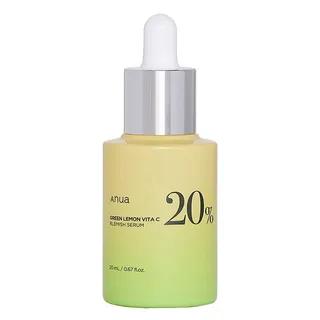
Anua Green Lemon Vitamin C Blemish Serum

Anua Green Lemon Vitamin C Blemish Serum

Efficacy83/100IrritancyHigh

Works for

Evens skin tone
Ascorbic acid, Glutathione + 2 more
Works well
What the product description says
“Improves observable freckles and blemishes and those inside skin With Vitamin E and Ferulic Acid.”
Source: Lila Beauty

This product can help reduce hypepigmentation and even out the skin tone because it contains the following effective ingredients: ascorbic acid.

In addition, this product contains glutathione. This ingredient (ingredients) might help reduce hyperpigmentation, but the effect, if any, is likely to be small.

The following ingredient (ingredients) in this product might be helpful, but there is no evidence to confirm that it actually can help even out the skin tone: ferulic acid.

Keep in mind that you would need to apply any topical skincare targetted at hypigmentation consistently for a couple of months to get a result. No topical skincare product can help get rid of hyperpigmentation (including post-acne marks and age spots) instantly.

Ascorbic acidHeroEffect: HighThe most well-researched antioxidant that works in skin. Helps neutralize free radicals supporting collagen production, helping to even out the skin tone and preventing early signs of aging~4.5–6.7%
GlutathioneKey activeEffect: HighA peptide that can help neutralize free radicals in skin and reduce melanin production resulting in skin lightening effect and reduction in hyperpigmentation. It can also help attract moisture to the upper layer of the skin~0.15–0.65%
Ferulic acidKey activeEffect: MediumA potent anti-oxidant that has been shown to be effective in neutralizing free radicals in skin. There seem to have a synergetic effect of ferulic acid, vitamin E and C, meaning that when the ingredients are used together, they enhance each other's ability protect the skin against free radicals. Ferulic acid also helps to stabilize other ingredients - including vitamins C and E. It can help to even out the skin tone. Ferulic acid is approved for use as a sunscreen ingredient in Japan in concentrations up to 10%~0.15–0.55%
NiacinamideUnder-dosedIs proven to be effective in reducing blemishes, evening out skin tone and helping to improve lines and wrinkles. It helps the skin to repair sun damage, calm down inflammation and keep maintain good levels of moisture. The concentration of about 2% is effective for supporting the skin barrier and evening out the skin tone. Concentration of 4-6% is better for helping with acne and balancing the sebum production~0.15–0.7%
Anti-aging
Ascorbic acid, Adenosine + 9 more
Works well
What the product description says
“Delivers anti-aging by brightening and improving wrinkles with the help of Alpha-Bisabolol and Adenosine.”
Source: Lila Beauty

This product can help reduce and prevent fine lines and wrinkles, improve skin elasticity and firmness because it contains ascorbic acid, adenosine.

These ingredients in the product can also be helpful, even though there is less evidence for their effectiveness: ferulic acid, folic acid.

Keep in mind that it typically takes at least 6 weeks to notice any results because the changes that are needed to improve fine lines and elasticity happen in the deeper layers of the skin. No topical anti-aging product can “erase” wrinkles or fully reverse signs of aging.

Ascorbic acidHeroEffect: HighThe most well-researched antioxidant that works in skin. Helps neutralize free radicals supporting collagen production, helping to even out the skin tone and preventing early signs of aging~4.5–6.7%
AdenosineKey activeEffect: HighMight help improve cell turnover and reduce inflammation in skin. One study shows that the ingredients might be able to help reduce dynamic wrinkles (for example, in the corners of the eyes or on the forehead)~0.15–0.55%
Ferulic acidKey activeEffect: MediumA potent anti-oxidant that has been shown to be effective in neutralizing free radicals in skin. There seem to have a synergetic effect of ferulic acid, vitamin E and C, meaning that when the ingredients are used together, they enhance each other's ability protect the skin against free radicals. Ferulic acid also helps to stabilize other ingredients - including vitamins C and E. It can help to even out the skin tone. Ferulic acid is approved for use as a sunscreen ingredient in Japan in concentrations up to 10%~0.15–0.55%
Folic acidKey activeEffect: MediumCan help stimulate collagen production in skin. While available studies are promising, more research is needed to confirm the efficacy in skin~0.15–0.65%
Hyaluronic acidEffect: LowOne of the best moisturizing ingredients. Attracts water into the upper layer of the skin. Naturally present in skin. Typically has large molecule size unless advertised otherwise on the product label. Helps support skin's barrier function and may help to reduce inflammation~0.15–0.65%
Thioctic acidEffect: Low~0.15–0.7%
UbiquinoneEffect: LowCoenzyme Q10. It helps neutralize free radicals in skin, improves skin hydration and might be helpful agains fine lines and wrinkles. It can be an allergen~0.15–0.65%
Beta-glucanEffect: LowHelps attract water to the upper layer of the skin, calm down inflammation and irritation, restore the barrier function and support wound healing. It can be helpful in reducing fine lines and wrinkles~0.15–0.6%
TocopherolEffect: Low, below effective dosePure form of vitamin E. Can help moisturise and protect the skin from free radicals. Often used to help stabilise other ingredients or the formula itself~0.15–0.55%
Sodium ascorbyl phosphateEffect: Low, below effective doseA stable derivative of vitamin C. It is oil-soluble which means it is more likely to penetrate the skin compared to the pure form of vitamin C (which is water-soluble), but it is less bio-available and is way less effective in stimulating collagen and reducing wrinkles compared to the pure form of vitamin C (L-ascorbic acid) and its other derivatives (for example, magnesium ascorbyl phosphate). At the same time, this vitamin C derivative has been shown in studies to be effective in reducing acne, blemishes and clogged pores. It is less irritating then the pure form of vitamin C~0.15–0.6%
NiacinamideUnder-dosedIs proven to be effective in reducing blemishes, evening out skin tone and helping to improve lines and wrinkles. It helps the skin to repair sun damage, calm down inflammation and keep maintain good levels of moisture. The concentration of about 2% is effective for supporting the skin barrier and evening out the skin tone. Concentration of 4-6% is better for helping with acne and balancing the sebum production~0.15–0.7%
Anti-blemish
Linoleic acid, Beta-glucan + 3 more
Not delivered
What the product description says
“Green Lemon Vitamin C Blemish Serum”
Source: Lila Beauty

This product contains ingredients (linoleic acid) that could help reduce blemishes and clogged pores in theory, but there is not enough evidence that they actually work.

Linoleic acidEffect: MediumAn excellent emollient. Helps soften the skin, restore its barrier function, and can help to calm down inflammation. It can be helpful to prevent blemishes and clogged pores~0.35–0.75%
Beta-glucanEffect: LowHelps attract water to the upper layer of the skin, calm down inflammation and irritation, restore the barrier function and support wound healing. It can be helpful in reducing fine lines and wrinkles~0.15–0.6%
AllantoinEffect: Low, below effective doseHelps calm down inflammation in skin and can help reduce itching. Helps to repair the skin barrier and keep skin hydrated~0.15–0.55%
NiacinamideUnder-dosedIs proven to be effective in reducing blemishes, evening out skin tone and helping to improve lines and wrinkles. It helps the skin to repair sun damage, calm down inflammation and keep maintain good levels of moisture. The concentration of about 2% is effective for supporting the skin barrier and evening out the skin tone. Concentration of 4-6% is better for helping with acne and balancing the sebum production~0.15–0.7%
Sodium ascorbyl phosphateUnder-dosedA stable derivative of vitamin C. It is oil-soluble which means it is more likely to penetrate the skin compared to the pure form of vitamin C (which is water-soluble), but it is less bio-available and is way less effective in stimulating collagen and reducing wrinkles compared to the pure form of vitamin C (L-ascorbic acid) and its other derivatives (for example, magnesium ascorbyl phosphate). At the same time, this vitamin C derivative has been shown in studies to be effective in reducing acne, blemishes and clogged pores. It is less irritating then the pure form of vitamin C~0.15–0.6%
Anti-oxidation
Side benefit · Ascorbic acid, Ubiquinone + 10 more
Works well

This product contains antioxidants (ascorbic acid, ferulic acid, glutathione, thioctic acid, ubiquinone) that can help neutralize free radicals in skin. By doing so, they can lessen the damage the skin gets from the UV light (sun).

The following ingredients - pyridoxine also can have an antioxidant effect, but there is less evidence to confirm their effectiveness in skin.

Ascorbic acidHeroEffect: HighThe most well-researched antioxidant that works in skin. Helps neutralize free radicals supporting collagen production, helping to even out the skin tone and preventing early signs of aging~4.5–6.7%
UbiquinoneKey activeEffect: HighCoenzyme Q10. It helps neutralize free radicals in skin, improves skin hydration and might be helpful agains fine lines and wrinkles. It can be an allergen~0.15–0.65%
Ferulic acidKey activeEffect: HighA potent anti-oxidant that has been shown to be effective in neutralizing free radicals in skin. There seem to have a synergetic effect of ferulic acid, vitamin E and C, meaning that when the ingredients are used together, they enhance each other's ability protect the skin against free radicals. Ferulic acid also helps to stabilize other ingredients - including vitamins C and E. It can help to even out the skin tone. Ferulic acid is approved for use as a sunscreen ingredient in Japan in concentrations up to 10%~0.15–0.55%
GlutathioneKey activeEffect: HighA peptide that can help neutralize free radicals in skin and reduce melanin production resulting in skin lightening effect and reduction in hyperpigmentation. It can also help attract moisture to the upper layer of the skin~0.15–0.65%
Thioctic acidKey activeEffect: High~0.15–0.7%
PyridoxineKey activeEffect: MediumMight help neutralize free radicals in skin, but evidence of effectiveness in skin is lacking. It might be irritating~0.15–0.65%
AdenosineEffect: LowMight help improve cell turnover and reduce inflammation in skin. One study shows that the ingredients might be able to help reduce dynamic wrinkles (for example, in the corners of the eyes or on the forehead)~0.15–0.55%
Beta-glucanEffect: LowHelps attract water to the upper layer of the skin, calm down inflammation and irritation, restore the barrier function and support wound healing. It can be helpful in reducing fine lines and wrinkles~0.15–0.6%
BisabololEffect: Low, below effective doseAn active component of chamomile plant that historically has been used to calm down irritated skin. A recent study shows that bisabolol indeed can have some anti-inflammatory effect on skin, even though conclusive data is lacking. Bisabolol has a sweet floral scent and can be added to products for its aromatic properties~0.4–0.9%
TocopherolUnder-dosedPure form of vitamin E. Can help moisturise and protect the skin from free radicals. Often used to help stabilise other ingredients or the formula itself~0.15–0.55%
Sodium ascorbyl phosphateUnder-dosedA stable derivative of vitamin C. It is oil-soluble which means it is more likely to penetrate the skin compared to the pure form of vitamin C (which is water-soluble), but it is less bio-available and is way less effective in stimulating collagen and reducing wrinkles compared to the pure form of vitamin C (L-ascorbic acid) and its other derivatives (for example, magnesium ascorbyl phosphate). At the same time, this vitamin C derivative has been shown in studies to be effective in reducing acne, blemishes and clogged pores. It is less irritating then the pure form of vitamin C~0.15–0.6%
ErgothioneineUnder-dosedCan help neutralize free radicals in skin. Preliminary studies show that it can be more effective than coenzyme Q10 but studies on effective concentration for topical applications are lacking~0.1–0.5%
Moisturizing
Side benefit · Linoleic acid, Ceramide np + 25 more
Works well

This product can help improve hydration of the skin with the two types of ingredients.

The first type is called “humectants”:
these ingredients help attract water. When humectants are on the surface of the skin, they “pull in” the moisture from the outside environment, or from within deeper layers of the skin. The following ingredients in this product do the job: glycerin, hyaluronic acid.

This product also contains ingredients called “occlusives”. They help reduce the speed with which our skin loses moisture to the outside environment. These ingredients also help soften the upper layer of the skin, so it feels less tight and nicer to the touch. The following ingredients in this product do the job: helianthus annuus seed oil, cyclopentasiloxane.

The following ingredients in this product are especially good for supporting the skin barrier and helping with the hydration level: ceramide np, linoleic acid, panthenol

Linoleic acidHero· EmollientEffect: HighAn excellent emollient. Helps soften the skin, restore its barrier function, and can help to calm down inflammation. It can be helpful to prevent blemishes and clogged pores~0.35–0.75%
Ceramide npHero· EmollientEffect: HighA type of lipid similar to ceramides naturally present in skin. Helps to soften the upper layer of the skin and supports the skin barrier function to keep it hydrated. Can help to prevent inflammation in skin~0.3–0.7%
PanthenolHero· HumectantEffect: HighHelps attract water to the upper layer of the skin and can help improve skin barrier function~0.15–0.55%
CyclopentasiloxaneKey active· EmollientEffect: MediumA silicone that helps improve the product texture and spreadability. Can absorb oil creating a short-term mattifying effect on the skin~2–3%
Glyceryl stearatesKey active· EmollientEffect: MediumHelp soften the upper layer of the skin~0.3–0.75%
GlycerinKey active· HumectantEffect: HighOne of the best moisturizing ingredients. Naturally present in skin. It attracts water to the upper layer of the skin working as a humectant~0.2–0.75%
Helianthus annuus seed oilKey active· Emollient, OcclusiveEffect: HighA great emollient due to its high linoleic acid content. One of the most effective plant oils in helping skin hydration and repairing skin barrier function~0.2–0.75%
UbiquinoneKey activeEffect: HighCoenzyme Q10. It helps neutralize free radicals in skin, improves skin hydration and might be helpful agains fine lines and wrinkles. It can be an allergen~0.15–0.65%
Sodium acetylated hyaluronateKey active· HumectantEffect: HighA type of hyaluronic acid that works as an excellent moisturizer by attracting water into the upper layer of the skin. Is typically feels less sticky on the skin compared to the usual hyaluronic acid~0.15–0.65%
Sodium hyaluronateKey active· HumectantEffect: HighOne of the best moisturizing ingredients. Attracts water into the upper layer of the skin~0.15–0.6%
Sodium hyaluronate crosspolymerKey active· HumectantEffect: HighAttracts water into the upper layer of the skin~0.15–0.65%
Beta-glucanKey activeEffect: HighHelps attract water to the upper layer of the skin, calm down inflammation and irritation, restore the barrier function and support wound healing. It can be helpful in reducing fine lines and wrinkles~0.15–0.6%
CyanocobalaminKey activeEffect: HighCan support skin barrier function and reduce inflammation in skin~0.15–0.65%
GlutathioneKey activeEffect: HighA peptide that can help neutralize free radicals in skin and reduce melanin production resulting in skin lightening effect and reduction in hyperpigmentation. It can also help attract moisture to the upper layer of the skin~0.15–0.65%
Hyaluronic acidKey active· HumectantEffect: HighOne of the best moisturizing ingredients. Attracts water into the upper layer of the skin. Naturally present in skin. Typically has large molecule size unless advertised otherwise on the product label. Helps support skin's barrier function and may help to reduce inflammation~0.15–0.65%
Hydrolyzed hyaluronic acidKey active· HumectantEffect: HighOne of the best moisturizing ingredients. Attracts water into the upper layer of the skin. A version of it is naturally present in skin~0.15–0.65%
Hydrolyzed sodium hyaluronateKey activeEffect: HighAttracts water into the upper layer of the skin~0.15–0.65%
AdenosineKey activeEffect: MediumMight help improve cell turnover and reduce inflammation in skin. One study shows that the ingredients might be able to help reduce dynamic wrinkles (for example, in the corners of the eyes or on the forehead)~0.15–0.55%
Butylene glycol· HumectantEffect: LowUsed to create a nice product texture and help delivery of other ingredients. Might be somewhat helpful in attracting water to the upper layer of the skin~3.3–4.9%
Cyclohexasiloxane· EmollientEffect: LowA silicone that serves as an emollient. Helps create a nice non-greasy feels~1.2–1.8%
Sorbitol· HumectantEffect: LowHelps attract water to the upper layer of the skin and improves the product texture~0.15–0.55%
BiotinEffect: LowMight have some moisturising properties. Is not effective when applied topically beyond some moisturizing effect~0.15–0.7%
Polyglyceryl-10 stearateEffect: LowHelps water and oil mix together and softens the upper layer of the skin~0.15–0.6%
TocopherolEffect: Low, below effective dosePure form of vitamin E. Can help moisturise and protect the skin from free radicals. Often used to help stabilise other ingredients or the formula itself~0.15–0.55%
Caprylic/capric triglycerideUnder-dosedA good mix of fatty acids that forms a protective layer on the skin. Improves the shelf life of products. Derived from coconut and glycerin~0.3–0.7%
AllantoinUnder-dosedHelps calm down inflammation in skin and can help reduce itching. Helps to repair the skin barrier and keep skin hydrated~0.15–0.55%
NiacinamideUnder-dosedIs proven to be effective in reducing blemishes, evening out skin tone and helping to improve lines and wrinkles. It helps the skin to repair sun damage, calm down inflammation and keep maintain good levels of moisture. The concentration of about 2% is effective for supporting the skin barrier and evening out the skin tone. Concentration of 4-6% is better for helping with acne and balancing the sebum production~0.15–0.7%

Can it cause trouble?

Irritancy
10 strong irritants: Citrus limon fruit extract, Citrus aurantium dulcis flower oil + 8 more — patch-test recommended
High risk
We flagged 22 ingredients with irritancy potential. Severity depends on your sensitivity threshold; the table lists the worst offenders first.
IngredientFunctionIrritationEst. amount
Citrus limon fruit extractUsed as a fragrance. Can be irritating and cause photosensitivityHigh~22–33%est.
Ascorbic acidThe most well-researched antioxidant that works in skin. Helps neutralize free radicals supporting collagen production, helping to even out the skin tone and preventing early signs of agingHigh~4.5–6.7%est.
Citrus aurantium dulcis flower oil—High~0.15–0.55%est.
Litsea cubeba fruit oilAn essential oil with a lemon-like smell that is extracted from a fruit grown in Asia. Used as a fragranceHigh~0.1–0.5%est.
Citrus paradisi peel oilUsed as a fragrance. Can be irritatingHigh~0.1–0.5%est.
Citrus aurantium bergamia fruit oilA plant oil with a high content of volatile compounds that can irritate the skin and lead to allergic reactions. Can lead to photosensitivityHigh~0.15–0.5%est.
Mentha viridis leaf oilUsed as a fragrance and can be irritatingHigh~0.15–0.55%est.
Equisetum arvense extractA plant extract that might have anti-oxidant properties. Can be irritatingHigh~0.2–0.75%est.
PyridoxineMight help neutralize free radicals in skin, but evidence of effectiveness in skin is lacking. It might be irritatingHigh~0.15–0.65%est.
LimoneneA common frangrance that can easily irritate skin, especially if exposed to air, light or heatHigh~0.1–0.45%est.
LinaloolA fragrance. Can be irritatingHigh~0.1–0.35%est.
CitralA fragrance with a lemon scent. A likely irritantHigh~0.1–0.35%est.
1,2-hexanediolA preservativeMedium~0.5–1.2%est.
Sodium polyacryloyldimethyl taurateHelps oil and water mix togetherMedium~0.4–0.9%est.
EthylhexylglycerinA preservativeMedium~0.2–0.7%est.
GlutathioneA peptide that can help neutralize free radicals in skin and reduce melanin production resulting in skin lightening effect and reduction in hyperpigmentation. It can also help attract moisture to the upper layer of the skinMedium~0.15–0.65%est.
Disodium edtaStabilizes the product formulationMedium~0.15–0.55%est.
Polyglyceryl-10 stearateHelps water and oil mix together and softens the upper layer of the skinMedium~0.15–0.6%est.
Sodium ascorbyl phosphateA stable derivative of vitamin C. It is oil-soluble which means it is more likely to penetrate the skin compared to the pure form of vitamin C (which is water-soluble), but it is less bio-available and is way less effective in stimulating collagen and reducing wrinkles compared to the pure form of vitamin C (L-ascorbic acid) and its other derivatives (for example, magnesium ascorbyl phosphate). At the same time, this vitamin C derivative has been shown in studies to be effective in reducing acne, blemishes and clogged pores. It is less irritating then the pure form of vitamin CMedium~0.15–0.6%est.
Caprylic/capric triglycerideA good mix of fatty acids that forms a protective layer on the skin. Improves the shelf life of products. Derived from coconut and glycerinMedium~0.3–0.7%est.
Sodium hyaluronate crosspolymerAttracts water into the upper layer of the skinMedium~0.15–0.65%est.
Thiamine hclCan help attract water to the upper layer of the skin. Is studied as a mosquito repellentMedium~0.15–0.65%est.
Comedogenic
Clean of flagged comedogenic ingredients
None flagged

User reviews

Would you recommend?
No community reviews yet.

Be the first — your take helps the next person decide.

Ingredients

Filter by role to see what each ingredient is doing.

Citrus limon fruit extract~22–33%
Irritant · high
Irritation risk
High

Used as a fragrance. Can be irritating and cause photosensitivity

More about Citrus limon fruit extract
Ascorbic acid~4.5–6.7%
Hero · Anti-aging, Anti-oxidation, Evens skin toneIrritant · high
Irritation risk
High
Works for
Anti-oxidationAnti-agingEvens skin tone

The most well-researched antioxidant that works in skin. Helps neutralize free radicals supporting collagen production, helping to even out the skin tone and preventing early signs of aging

More about Ascorbic acid
Propanediol~4.2–6.3%
Formula
Irritation risk
Low

Acts as a solvent for other ingredients. Speeds up the absorption of other ingredients into the skin

More about Propanediol
Butylene glycol~3.3–4.9%
Formula
Irritation risk
Low
Works for
Moisturizing

Used to create a nice product texture and help delivery of other ingredients. Might be somewhat helpful in attracting water to the upper layer of the skin

More about Butylene glycol
Dipropylene glycol~2.4–3.6%
Formula
Irritation risk
Low

Helps to dissolve other ingredients in a formulation. Slows down the rate of product drying

More about Dipropylene glycol
Cyclopentasiloxane~2–3%
Key active
Irritation risk
Low
Works for
MoisturizingMattifying

A silicone that helps improve the product texture and spreadability. Can absorb oil creating a short-term mattifying effect on the skin

More about Cyclopentasiloxane
1,2-hexanediol~0.5–1.2%
Irritant · medium
Irritation risk
Medium

A preservative

More about 1,2-hexanediol
Cyclohexasiloxane~1.2–1.8%
Formula
Irritation risk
Low
Works for
Moisturizing

A silicone that serves as an emollient. Helps create a nice non-greasy feels

More about Cyclohexasiloxane
Sodium hydroxide~0.95–1.4%
Formula
Irritation risk
Low

Used to adjust the product's pH

More about Sodium hydroxide
C12-14 alketh-12~0.6–1.4%
Formula
Bisabolol~0.4–0.9%
Formula
Irritation risk
Low
Works for
Anti-inflammatoryReduces irritationAnti-oxidation

An active component of chamomile plant that historically has been used to calm down irritated skin. A recent study shows that bisabolol indeed can have some anti-inflammatory effect on skin, even though conclusive data is lacking. Bisabolol has a sweet floral scent and can be added to products for its aromatic properties

More about Bisabolol
Sodium polyacryloyldimethyl taurate~0.4–0.9%
Irritant · medium
Irritation risk
Medium

Helps oil and water mix together

More about Sodium polyacryloyldimethyl taurate
Water~0.35–0.8%
Formula
Irritation risk
Low

Plain old water

More about Water
Polyacrylate crosspolymer-6~0.3–0.75%
Formula
Dimethicone/vinyl dimethicone crosspolymer~0.2–0.75%
Formula
Irritation risk
Low

Used to stabilize product formulations and create a nice product texture

More about Dimethicone/vinyl dimethicone crosspolymer
Xanthan gum~0.2–0.75%
Formula
Irritation risk
Low
Works for
Cleansing

Used to create a thicker product consistency

More about Xanthan gum
Ethylhexylglycerin~0.2–0.7%
Irritant · medium
Irritation risk
Medium

A preservative

More about Ethylhexylglycerin
Allantoin~0.15–0.55%
Under-dosed
Irritation risk
Low
Works for
Anti-inflammatoryMoisturizingReduces irritationReduces rednessAnti-blemishExfoliation

Helps calm down inflammation in skin and can help reduce itching. Helps to repair the skin barrier and keep skin hydrated

More about Allantoin
Glycerin~0.2–0.75%
Key active
Irritation risk
Low
Works for
Moisturizing

One of the best moisturizing ingredients. Naturally present in skin. It attracts water to the upper layer of the skin working as a humectant

More about Glycerin
Glutathione~0.15–0.65%
Key activeIrritant · medium
Irritation risk
Medium
Works for
MoisturizingAnti-oxidationEvens skin tone

A peptide that can help neutralize free radicals in skin and reduce melanin production resulting in skin lightening effect and reduction in hyperpigmentation. It can also help attract moisture to the upper layer of the skin

More about Glutathione
Citrus aurantium dulcis flower oil~0.15–0.55%
Irritant · high
Litsea cubeba fruit oil~0.1–0.5%
Irritant · high
Irritation risk
High
Works for
Antibacterial

An essential oil with a lemon-like smell that is extracted from a fruit grown in Asia. Used as a fragrance

More about Litsea cubeba fruit oil
Adenosine~0.15–0.55%
Key active
Irritation risk
Low
Works for
Anti-agingMoisturizingAnti-oxidation

Might help improve cell turnover and reduce inflammation in skin. One study shows that the ingredients might be able to help reduce dynamic wrinkles (for example, in the corners of the eyes or on the forehead)

More about Adenosine
Citrus paradisi peel oil~0.1–0.5%
Irritant · high
Irritation risk
High

Used as a fragrance. Can be irritating

More about Citrus paradisi peel oil
Disodium edta~0.15–0.55%
Irritant · medium
Irritation risk
Medium

Stabilizes the product formulation

More about Disodium edta
Citrus aurantium bergamia fruit oil~0.15–0.5%
Irritant · high
Irritation risk
High

A plant oil with a high content of volatile compounds that can irritate the skin and lead to allergic reactions. Can lead to photosensitivity

More about Citrus aurantium bergamia fruit oil
Mentha viridis leaf oil~0.15–0.55%
Irritant · high
Irritation risk
High

Used as a fragrance and can be irritating

More about Mentha viridis leaf oil
Tocopherol~0.15–0.55%
Under-dosed
Irritation risk
Low
Works for
Anti-oxidationAnti-agingAnti-inflammatoryMoisturizing

Pure form of vitamin E. Can help moisturise and protect the skin from free radicals. Often used to help stabilise other ingredients or the formula itself

More about Tocopherol
Ferulic acid~0.15–0.55%
Key active
Irritation risk
Low
Works for
Anti-oxidationEvens skin toneAnti-inflammatoryAnti-aging

A potent anti-oxidant that has been shown to be effective in neutralizing free radicals in skin. There seem to have a synergetic effect of ferulic acid, vitamin E and C, meaning that when the ingredients are used together, they enhance each other's ability protect the skin against free radicals. Ferulic acid also helps to stabilize other ingredients - including vitamins C and E. It can help to even out the skin tone. Ferulic acid is approved for use as a sunscreen ingredient in Japan in concentrations up to 10%

More about Ferulic acid
Barosma betulina leaf extract~0.15–0.5%
Formula
N-butyl alcohol~0.15–0.5%
Formula
Hydrogenated lecithin~0.15–0.6%
Formula
Irritation risk
Low
Works for
Cleansing

Helps to retain moisture by creating a protective barrier on the skin. Rich in fatty acids. Improves product texture and helps with the penetration of other ingredients.

More about Hydrogenated lecithin
Polyglyceryl-10 stearate~0.15–0.6%
Irritant · medium
Irritation risk
Medium
Works for
Moisturizing

Helps water and oil mix together and softens the upper layer of the skin

More about Polyglyceryl-10 stearate
Sorbitol~0.15–0.55%
Formula
Irritation risk
Low
Works for
Moisturizing

Helps attract water to the upper layer of the skin and improves the product texture

More about Sorbitol
Panthenol~0.15–0.55%
Hero · Moisturizing
Irritation risk
Low
Works for
Reduces rednessMoisturizingReduces irritation

Helps attract water to the upper layer of the skin and can help improve skin barrier function

More about Panthenol
Beta-glucan~0.15–0.6%
Key active
Irritation risk
Low
Works for
MoisturizingReduces irritationAnti-inflammatoryAnti-agingAnti-oxidationAnti-blemish

Helps attract water to the upper layer of the skin, calm down inflammation and irritation, restore the barrier function and support wound healing. It can be helpful in reducing fine lines and wrinkles

More about Beta-glucan
Sodium hyaluronate~0.15–0.6%
Key active
Irritation risk
Low
Works for
Moisturizing

One of the best moisturizing ingredients. Attracts water into the upper layer of the skin

More about Sodium hyaluronate
Sodium ascorbyl phosphate~0.15–0.6%
Under-dosedIrritant · medium
Irritation risk
Medium
Works for
Anti-blemishAnti-oxidationAnti-aging

A stable derivative of vitamin C. It is oil-soluble which means it is more likely to penetrate the skin compared to the pure form of vitamin C (which is water-soluble), but it is less bio-available and is way less effective in stimulating collagen and reducing wrinkles compared to the pure form of vitamin C (L-ascorbic acid) and its other derivatives (for example, magnesium ascorbyl phosphate). At the same time, this vitamin C derivative has been shown in studies to be effective in reducing acne, blemishes and clogged pores. It is less irritating then the pure form of vitamin C

More about Sodium ascorbyl phosphate
Caprylic/capric triglyceride~0.3–0.7%
Under-dosedIrritant · medium
Irritation risk
Medium
Works for
Moisturizing

A good mix of fatty acids that forms a protective layer on the skin. Improves the shelf life of products. Derived from coconut and glycerin

More about Caprylic/capric triglyceride
Helianthus annuus seed oil~0.2–0.75%
Key active
Irritation risk
Low
Works for
Moisturizing

A great emollient due to its high linoleic acid content. One of the most effective plant oils in helping skin hydration and repairing skin barrier function

More about Helianthus annuus seed oil
Hyaluronic acid~0.15–0.65%
Key active
Irritation risk
Low
Works for
MoisturizingAnti-inflammatoryAnti-aging

One of the best moisturizing ingredients. Attracts water into the upper layer of the skin. Naturally present in skin. Typically has large molecule size unless advertised otherwise on the product label. Helps support skin's barrier function and may help to reduce inflammation

More about Hyaluronic acid
Sucrose stearate~0.3–0.75%
Formula
Irritation risk
Low
Works for
Cleansing

Helps water and oil mix together

More about Sucrose stearate
Glyceryl stearates~0.3–0.75%
Key active
Irritation risk
Low
Works for
Moisturizing

Help soften the upper layer of the skin

More about Glyceryl stearates
Beta-carotene~0.15–0.65%
Formula
Irritation risk
Low

A colorant adding orange or bright yellow color

More about Beta-carotene
Sodium hyaluronate crosspolymer~0.15–0.65%
Key activeIrritant · medium
Irritation risk
Medium
Works for
Moisturizing

Attracts water into the upper layer of the skin

More about Sodium hyaluronate crosspolymer
Niacinamide~0.15–0.7%
Under-dosed
Irritation risk
Low
Works for
Anti-agingEvens skin toneMoisturizingAnti-blemishReduces irritationAnti-inflammatoryReduces rednessAntibacterial

Is proven to be effective in reducing blemishes, evening out skin tone and helping to improve lines and wrinkles. It helps the skin to repair sun damage, calm down inflammation and keep maintain good levels of moisture. The concentration of about 2% is effective for supporting the skin barrier and evening out the skin tone. Concentration of 4-6% is better for helping with acne and balancing the sebum production

More about Niacinamide
Hydrolyzed sodium hyaluronate~0.15–0.65%
Key active
Irritation risk
Low
Works for
Moisturizing

Attracts water into the upper layer of the skin

More about Hydrolyzed sodium hyaluronate
Hydrolyzed hyaluronic acid~0.15–0.65%
Key active
Irritation risk
Low
Works for
Moisturizing

One of the best moisturizing ingredients. Attracts water into the upper layer of the skin. A version of it is naturally present in skin

More about Hydrolyzed hyaluronic acid
Thioctic acid~0.15–0.7%
Key active
Irritation risk
Low
Works for
Anti-oxidationAnti-aging
More about Thioctic acid
Lycopodium clavatum extract~0.15–0.65%
Formula
Thioctic acid~0.15–0.7%
Key active
Irritation risk
Low
Works for
Anti-oxidationAnti-aging
More about Thioctic acid
Lycopodium clavatum extract~0.15–0.65%
Formula
Equisetum arvense extract~0.2–0.75%
Irritant · high
Irritation risk
High

A plant extract that might have anti-oxidant properties. Can be irritating

More about Equisetum arvense extract
Sodium acetylated hyaluronate~0.15–0.65%
Key active
Irritation risk
Low
Works for
Moisturizing

A type of hyaluronic acid that works as an excellent moisturizer by attracting water into the upper layer of the skin. Is typically feels less sticky on the skin compared to the usual hyaluronic acid

More about Sodium acetylated hyaluronate
Pyridoxine~0.15–0.65%
Key activeIrritant · high
Irritation risk
High
Works for
Anti-oxidation

Might help neutralize free radicals in skin, but evidence of effectiveness in skin is lacking. It might be irritating

More about Pyridoxine
Hydroxypropyltrimonium hyaluronate~0.35–0.75%
Formula
Folic acid~0.15–0.65%
Key active
Irritation risk
Low
Works for
Anti-aging

Can help stimulate collagen production in skin. While available studies are promising, more research is needed to confirm the efficacy in skin

More about Folic acid
Biotin~0.15–0.7%
Formula
Irritation risk
Low
Works for
Moisturizing

Might have some moisturising properties. Is not effective when applied topically beyond some moisturizing effect

More about Biotin
Ceramide np~0.3–0.7%
Hero · Moisturizing
Irritation risk
Low
Works for
MoisturizingReduces irritationAnti-inflammatory

A type of lipid similar to ceramides naturally present in skin. Helps to soften the upper layer of the skin and supports the skin barrier function to keep it hydrated. Can help to prevent inflammation in skin

More about Ceramide np
Ubiquinone~0.15–0.65%
Key active
Irritation risk
Low
Works for
Anti-oxidationMoisturizingAnti-aging

Coenzyme Q10. It helps neutralize free radicals in skin, improves skin hydration and might be helpful agains fine lines and wrinkles. It can be an allergen

More about Ubiquinone
Cyanocobalamin~0.15–0.65%
Key active
Irritation risk
Low
Works for
Anti-inflammatoryMoisturizing

Can support skin barrier function and reduce inflammation in skin

More about Cyanocobalamin
Thiamine hcl~0.15–0.65%
Irritant · medium
Irritation risk
Medium

Can help attract water to the upper layer of the skin. Is studied as a mosquito repellent

More about Thiamine hcl
Riboflavin~0.15–0.65%
Formula
Irritation risk
Low
More about Riboflavin
Linoleic acid~0.35–0.75%
Hero · Moisturizing
Irritation risk
Low
Works for
MoisturizingCleansingAnti-blemish

An excellent emollient. Helps soften the skin, restore its barrier function, and can help to calm down inflammation. It can be helpful to prevent blemishes and clogged pores

More about Linoleic acid
Hesperidin~0.15–0.7%
Formula
Irritation risk
Low
More about Hesperidin
Ergothioneine~0.1–0.5%
Under-dosed
Irritation risk
Low
Works for
Anti-oxidation

Can help neutralize free radicals in skin. Preliminary studies show that it can be more effective than coenzyme Q10 but studies on effective concentration for topical applications are lacking

More about Ergothioneine
Limonene~0.1–0.45%
Irritant · high
Irritation risk
High

A common frangrance that can easily irritate skin, especially if exposed to air, light or heat

More about Limonene
Linalool~0.1–0.35%
Irritant · high
Irritation risk
High

A fragrance. Can be irritating

More about Linalool
Citral~0.1–0.35%
Irritant · high
Irritation risk
High

A fragrance with a lemon scent. A likely irritant

More about Citral
Ingredient list view

Citrus limon fruit extract, Ascorbic acid, Propanediol, Butylene glycol, Dipropylene glycol, Cyclopentasiloxane, 1,2-hexanediol, Cyclohexasiloxane, Sodium hydroxide, C12-14 alketh-12, Bisabolol, Sodium polyacryloyldimethyl taurate, Water, Polyacrylate crosspolymer-6, Dimethicone/vinyl dimethicone crosspolymer, Xanthan gum, Ethylhexylglycerin, Allantoin, Glycerin, Glutathione, Citrus aurantium dulcis flower oil, Litsea cubeba fruit oil, Adenosine, Citrus paradisi peel oil, Disodium edta, Citrus aurantium bergamia fruit oil, Mentha viridis leaf oil, Tocopherol, Ferulic acid, Barosma betulina leaf extract, N-butyl alcohol, Hydrogenated lecithin, Polyglyceryl-10 stearate, Sorbitol, Panthenol, Beta-glucan, Sodium hyaluronate, Sodium ascorbyl phosphate, Caprylic/capric triglyceride, Helianthus annuus seed oil, Hyaluronic acid, Sucrose stearate, Glyceryl stearates, Beta-carotene, Sodium hyaluronate crosspolymer, Niacinamide, Hydrolyzed sodium hyaluronate, Hydrolyzed hyaluronic acid, Thioctic acid, Lycopodium clavatum extract, Thioctic acid, Lycopodium clavatum extract, Equisetum arvense extract, Sodium acetylated hyaluronate, Pyridoxine, Hydroxypropyltrimonium hyaluronate, Folic acid, Biotin, Ceramide np, Ubiquinone, Cyanocobalamin, Thiamine hcl, Riboflavin, Linoleic acid, Hesperidin, Ergothioneine, Limonene, Linalool, Citral

Compare prices

Retailers ranked by price — lowest first.

🇦🇺 Lila Beauty (AU)20 ml
≈ $26.23 Out of stock
Check

Affiliate links · As an Amazon Associate, WIMJ earns from qualifying purchases.

Worth comparing, line by line.

Match % combines shared ingredients, the first five ingredients, shared actives and hero ingredients, irritancy (lower counts in the alternative's favour), texture and body area. Only products in the same routine step are compared.

Side-by-side comparison of this product against its closest alternatives
AnuaGreen Lemon Vitamin C Blemish SerumYOUR PRODUCTSome By MiGalactomyces Pure Vitamin C Glow SerumPre-LaunchV.Biome Infusion SerumDr. Jart+Brightamin Brightening Serum with Niacinamide and Vitamin C
Match—81%79%76%
Price—$14.22—$37.00
Shared key ingredients—12 of 2614 of 269 of 26
Key difference—PiteraHydroxydecyl UbiquinoneAcetyl Hexapeptide-1
Irritancy High High High Medium
Drying alcohol————
View product Shop Shop Shop

More alternatives: Biobare Vitamin C, B, E & Ferulic SerumBliv:U The Real Vita C 20 Ampoule

Cheaper alternatives? See how this stacks up against similar formulas.
We compare ingredient profiles across our catalog — pick the closest match for your budget.
Open dupe finder

Product summary

"Anua - Buy Anua Green Lemon Vitamin C Blemish Serum Australia - Korean Skin Care and Cosmetics" is effective for: Anti-aging, Evens skin tone and Moisturizing

Ingredient callouts

  • This product also contains Vitamin C (Ascorbic Acid) 4.50% - 6.70% It can be helpful in stimulating collagen production, neutralizing free radicals in skin and improving pigmentation marks. We recommend to use up this product quickly after opening: Ascorbic Acid degrades fast when it gets in contact with air and light. The moment the product turns orange, it is a sign that a significant share of the vitamin C in it is no longer effective.
  • Ceramides (ceramide np 0.30% - 0.70%). Ceramides are an important part of our natural skin barrier. The Ceramides used in skincare are synthetic or come from plants. They help soften the skin and can help "fill the gaps" in the skin barrier, keeping the skin hydrated and resilient for longer.
  • Adenosine 0.15% - 0.55%. It is a chemical present inside our skin cells. A clinical trial confirmed that topical application of Adenosine in a low concentration can reduce dynamic wrinkles (these are the wrinkles that appear with age in a places where our mimic is the most active, for example, in the corners of the eyes or on the forehead).
  • Humectants (sodium acetylated hyaluronate 0.15% - 0.65%, hydrolyzed hyaluronic acid 0.15% - 0.65%, sodium hyaluronate crosspolymer 0.15% - 0.65%, hyaluronic acid 0.15% - 0.65%, sodium hyaluronate 0.15% - 0.60% and glycerin 0.30% - 0.70%). These ingredients help attract water to the upper layer of the skin and improve the skin hydration.

Price

The product retails for 38.00A$ in Australia.

For a detailed price comparison: click here.

Sources cited in this review

Every concentration estimate and effectiveness label is anchored to one of these 56 studies and safety reviews.

  1. 1
  2. 2
  3. 3
  4. 4
  5. 5
  6. 6
Anua Green Lemon Vitamin C Blemish Serum
AnuaGreen Lemon Vitamin C Blemish Serum

Affiliate links · As an Amazon Associate, WIMJ earns from qualifying purchases.

As an Amazon Associate, WIMJ earns from qualifying purchases.