Works for
1 of 2 advertised claims delivered
MoisturizingPetrolatum, Urea + 21 moreStrong evidence
“Shea butter, coconut oil and cocoa butter form a deeply nourishing cocktail of hydration to provide the skin with moisture for up to 8 hours, soothing any irritation and supporting the natural renewal process.”
This product can help improve hydration of the skin with the two types of ingredients.
The first type is called “humectants”:
these ingredients help attract water.
When humectants are on the surface of the skin, they “pull in” the moisture from the outside environment, or from
within deeper layers of the skin. The following ingredients in this product do the job:
glycerin, sodium lactate.
This product also contains ingredients called “occlusives”. They help reduce the speed with which our skin loses moisture to the outside environment. These ingredients also help soften the upper layer of the skin, so it feels less tight and nicer to the touch. The following ingredients in this product do the job: butyrospermum parkii butter, dimethicone.
The following ingredients in this product are especially good for supporting the skin barrier and helping with the hydration level: petrolatum, urea
ExfoliationUrea, Allantoin + 1 moreLimited evidence
“Biodegradeable bamboo granules and lactic acid combine to provide chemical exfoliation above and below the skin surface, effortlessly removing dead cells, flakiness and ingrown hairs for a softer and smoother texture.”
This product might help exfoliate the skin with urea, but This ingredient is not the most effective.
Anti-agingNot advertised by the brand · Serine, Butyrospermum parkii butter + 3 moreModerate evidence
This product contains serine. This ingredient might be able to help reduce and prevent fine lines and wrinkles, improve skin elasticity and firmness, but there is not enough evidence that it actually works.
Can it cause trouble?
Irritancy9 strong irritants: Parfum, Linalool + 7 more — patch-test recommendedHigh risk
Comedogenic6 ingredients rated 2 or more on the 0–5 pore-clogging scale6 flagged
User reviews
Be the first — your take helps the next person decide.
Ingredients
Filter by role to see what each ingredient is doing.
Water~45–55%
Synthetic wax~5.7–6.9%
- Irritation risk
- Low
Used to stabilize product formulations and thicken product consistency
More about Synthetic waxGlycerin~4.1–5%
- Irritation risk
- Low
One of the best moisturizing ingredients. Naturally present in skin. It attracts water to the upper layer of the skin working as a humectant
More about GlycerinBambusa arundinacea stem extract~3.3–4%
- Irritation risk
- Low
Ammonium lactate~2.6–3.1%
- Irritation risk
- Low
C12-15 alkyl benzoate~2.2–2.7%
- Irritation risk
- Low
Enhances the product texture and makes it more spreadable. Helps reduce water loss from the outer layer of skin. Extands the shelf life by preventing bacteria growth
More about C12-15 alkyl benzoateCetearyl alcohol~1.9–2.3%
- Irritation risk
- Low
- Comedogenicity
- 2/5
A non-drying alcohol. Works as an emollient. Helps water and oil mix together and creates a nice product texture
More about Cetearyl alcoholPetrolatum~1.7–2.1%
- Irritation risk
- Low
One of the most effective and the most studied occlusive ingredients that creates a protective layer on top of the skin preventing moisture loss
More about PetrolatumButyrospermum parkii butter~1.4–1.7%
- Irritation risk
- Low
- Comedogenicity
- 3/5
A great moisturising ingredient that softens the skin and reduces water loss from its upper layer. It also can be helpful in protecting skin from free radicals
More about Butyrospermum parkii butterIsopropyl palmitate~1.1–1.3%
- Irritation risk
- Medium
- Comedogenicity
- 3/5
Helps soften the upper layer of the skin and create a thicker product consistency
More about Isopropyl palmitatePolysorbate 60~0.8–1.2%
Glyceryl stearate~0.7–1.05%
- Irritation risk
- Low
An emollient that softens the skin and forms a protective layer on its surface. Helps water and oil mix together
More about Glyceryl stearateWater~0.6–0.9%
Peg-7 glyceryl cocoate~0.55–0.85%
- Irritation risk
- Medium
Helps oils and water mix together and works as a cleansing agent
More about Peg-7 glyceryl cocoateDisodium cocoamphodiacetate~0.6–0.9%
- Irritation risk
- Medium
Helps oil and water mix together and works as a cleansing agent
More about Disodium cocoamphodiacetateSodium lauroyl sarcosinate~1.2–1.5%
- Irritation risk
- Medium
Helps oil and water mix together and works as a cleansing agent
More about Sodium lauroyl sarcosinateCocamidopropyl betaine~1.2–1.4%
- Irritation risk
- High
Helps water and oil mix together. Used as a cleansing ingredient. Could be an allergen
More about Cocamidopropyl betaineAcrylates copolymer~0.5–0.7%
- Irritation risk
- Medium
Used to stabilize product formulation, help create an even product layer over skin (for example, in sunscreen) and create a thicker product consistency
More about Acrylates copolymerSodium chloride~0.45–0.7%
- Irritation risk
- Low
Used to stabilize mixtures of oil and water, and create thicker, gel-like product textures
More about Sodium chlorideGlycerin~0.45–0.65%
- Irritation risk
- Low
One of the best moisturizing ingredients. Naturally present in skin. It attracts water to the upper layer of the skin working as a humectant
More about GlycerinParfum~0.3–0.55%
- Irritation risk
- High
An aromatic blend of unspecified and possibly irritating ingredients
More about ParfumPhenoxyethanol~0.35–0.6%
- Irritation risk
- Low
A preservative. It helps prevent bacterial growth in cosmetic products
More about PhenoxyethanolGlycol distearate~0.3–0.6%
- Irritation risk
- Medium
Helps water and oil mix together
More about Glycol distearateBorago officinalis seed oil~0.3–0.6%
- Irritation risk
- Low
A plant oil that is effective in reducing irritation in skin, restore the barrier function and support its hydration
More about Borago officinalis seed oilCamelina sativa seed oil~0.3–0.55%
- Irritation risk
- Low
Helps soften the upper layer of the skin
More about Camelina sativa seed oilPeg-40 hydrogenated castor oil~0.3–0.6%
- Irritation risk
- Medium
Helps oil and water mix together
More about Peg-40 hydrogenated castor oilTrideceth-9~0.3–0.55%
Laureth-4~0.3–0.55%
- Irritation risk
- Medium
- Comedogenicity
- 2/5
Helps water and oil mix together
More about Laureth-4Styrene/acrylamide copolymer~0.3–0.55%
- Irritation risk
- Low
1,2-hexanediol~0.3–0.55%
Caprylyl glycol~0.3–0.6%
- Irritation risk
- Medium
Helps preserve products and creates a nice product texture
More about Caprylyl glycolEthylhexylglycerin~0.3–0.55%
Polyquaternium-10~0.3–0.6%
- Irritation risk
- Low
Helps soften the upper layer of the skin and create a nice product finish
More about Polyquaternium-10Disodium edta~0.3–0.55%
Sodium hydroxide~0.3–0.55%
Linalool~0.25–0.5%
Citronellol~0.25–0.5%
Hydrolyzed milk protein~0.3–0.5%
Propylene glycol~0.3–0.5%
- Irritation risk
- High
Helps oil and water mix together and can enhance the penetration of other ingredients into the skin. It can be irritating
More about Propylene glycolCitrus aurantium dulcis oil~0.3–0.55%
- Irritation risk
- High
Used as a fragrance. It can be irritating and cause photosensitivity
More about Citrus aurantium dulcis oilLimonene~0.25–0.5%
- Irritation risk
- High
A common frangrance that can easily irritate skin, especially if exposed to air, light or heat
More about LimoneneCoumarin~0.25–0.5%
Juniperus mexicana oil~0.3–0.55%
- Irritation risk
- Low
Lactic acid~0.3–0.5%
- Irritation risk
- Medium
An exfoliating and moisturizing alpha-hydroxy acid (AHA). Typically causes less irritation than other AHAs, for example, glycolic acid. At high concentrations (about 15%), lactic acid can help reduce lines and wrinkles. Recent studies show that lactic acid can support the "good" bacteria living on skin's surface (healthy skin microbiome)
More about Lactic acidAlpha-isomethyl ionone~0.3–0.5%
- Irritation risk
- High
A fragrance. Potential allergen and can be irritating
More about Alpha-isomethyl iononeCitric acid~0.3–0.6%
- Irritation risk
- Medium
Can work as an exfoliant but is typically used to adjust the product pH
More about Citric acidPelargonium graveolens oil~0.3–0.55%
Pentylene glycol~0.4–0.65%
- Irritation risk
- Medium
Used to preserve products, dissolve other ingredients and create a nice product texture
More about Pentylene glycolSerine~0.3–0.6%
- Irritation risk
- Low
An amino-acid that helps to attract water to the upper layer of the skin. In combination with other amino-acids, might help to reduce fine lines and wrinkles
More about SerineSodium lactate~0.3–0.6%
- Irritation risk
- Medium
Helps attract water to the upper layer of the skin. Is often used to adjust the pH level of the product
More about Sodium lactateSorbitol~0.3–0.6%
- Irritation risk
- Low
Helps attract water to the upper layer of the skin and improves the product texture
More about SorbitolUrea~0.3–0.6%
- Irritation risk
- Low
Naturally present in skin (urea makes up about 7% of natural moisturizing factors in skin). Attracts water to the upper layer of the skin. Also has a positive effect on the skin barrier beyond the humectant action. Can enhance penetration of other ingredients. Is an exfoliating ingredient when used in high concentrations
More about UreaBenzoic acid~0.25–0.5%
Tocopherol~0.35–0.6%
- Irritation risk
- Low
Pure form of vitamin E. Can help moisturise and protect the skin from free radicals. Often used to help stabilise other ingredients or the formula itself
More about TocopherolAllantoin~0.3–0.55%
- Irritation risk
- Low
Helps calm down inflammation in skin and can help reduce itching. Helps to repair the skin barrier and keep skin hydrated
More about AllantoinWater~0.35–0.6%
Ammonium lactate~0.3–0.6%
- Irritation risk
- Low
C12-15 alkyl benzoate~0.35–0.65%
- Irritation risk
- Low
Enhances the product texture and makes it more spreadable. Helps reduce water loss from the outer layer of skin. Extands the shelf life by preventing bacteria growth
More about C12-15 alkyl benzoateGlycerin~0.4–0.6%
- Irritation risk
- Low
One of the best moisturizing ingredients. Naturally present in skin. It attracts water to the upper layer of the skin working as a humectant
More about GlycerinPrunus amygdalus dulcis oil~0.4–0.6%
- Irritation risk
- Low
An emollient that softens the skin
More about Prunus amygdalus dulcis oilEthylhexyl palmitate~0.4–0.65%
- Irritation risk
- Low
- Comedogenicity
- 3/5
An emollient that helps soften the skin and create a nice product texture
More about Ethylhexyl palmitateCetearyl alcohol~0.45–0.65%
- Irritation risk
- Low
- Comedogenicity
- 2/5
A non-drying alcohol. Works as an emollient. Helps water and oil mix together and creates a nice product texture
More about Cetearyl alcoholGlyceryl stearate~0.45–0.7%
- Irritation risk
- Low
An emollient that softens the skin and forms a protective layer on its surface. Helps water and oil mix together
More about Glyceryl stearatePeg-100 stearate~0.5–0.7%
- Irritation risk
- Low
Helps oil and water mix togehter and creates a nice product texture
More about Peg-100 stearateDimethicone~0.45–0.7%
- Irritation risk
- Low
A silicone that helps to reduce water loss from the surface of the skin. Can temporarily "fill in" lines and wrinkles, absorb oil, and create a nice product finish
More about DimethiconeHydroxyethylcellulose~0.4–0.6%
- Irritation risk
- Low
Used to thicken product formulations and create gel-like textures
More about HydroxyethylcellulosePhenoxyethanol~0.4–0.6%
- Irritation risk
- Low
A preservative. It helps prevent bacterial growth in cosmetic products
More about PhenoxyethanolCetearyl glucoside~0.4–0.6%
- Irritation risk
- Medium
Helps water and oil in the product mix well together and improves product texture
More about Cetearyl glucosideXanthan gum~0.4–0.6%
- Irritation risk
- Low
Used to create a thicker product consistency
More about Xanthan gumSodium benzoate~0.25–0.5%
Sodium stearoyl glutamate~0.45–0.65%
- Irritation risk
- Medium
Helps oil and water mix together
More about Sodium stearoyl glutamateTocopheryl acetate~0.4–0.6%
- Irritation risk
- Medium
A more stable but less bio-available form of vitamin E compared to Tocopherol. Might help moisturize and protect the skin from free radicals, but mostly used in low concentrations to stabilize other ingredients.
More about Tocopheryl acetateParfum~0.3–0.6%
- Irritation risk
- High
An aromatic blend of unspecified and possibly irritating ingredients
More about ParfumPotassium sorbate~0.4–0.6%
Pentylene glycol~0.45–0.65%
- Irritation risk
- Medium
Used to preserve products, dissolve other ingredients and create a nice product texture
More about Pentylene glycolHydrolyzed milk protein~0.35–0.6%
Disodium edta~0.35–0.65%
Lactic acid~0.35–0.6%
- Irritation risk
- Medium
An exfoliating and moisturizing alpha-hydroxy acid (AHA). Typically causes less irritation than other AHAs, for example, glycolic acid. At high concentrations (about 15%), lactic acid can help reduce lines and wrinkles. Recent studies show that lactic acid can support the "good" bacteria living on skin's surface (healthy skin microbiome)
More about Lactic acidSerine~0.35–0.6%
- Irritation risk
- Low
An amino-acid that helps to attract water to the upper layer of the skin. In combination with other amino-acids, might help to reduce fine lines and wrinkles
More about SerineSodium lactate~0.35–0.65%
- Irritation risk
- Medium
Helps attract water to the upper layer of the skin. Is often used to adjust the pH level of the product
More about Sodium lactateSorbitol~0.3–0.6%
- Irritation risk
- Low
Helps attract water to the upper layer of the skin and improves the product texture
More about SorbitolUrea~0.3–0.6%
- Irritation risk
- Low
Naturally present in skin (urea makes up about 7% of natural moisturizing factors in skin). Attracts water to the upper layer of the skin. Also has a positive effect on the skin barrier beyond the humectant action. Can enhance penetration of other ingredients. Is an exfoliating ingredient when used in high concentrations
More about UreaLinalool~0.25–0.5%
Citronellol~0.25–0.5%
Sodium chloride~0.35–0.6%
- Irritation risk
- Low
Used to stabilize mixtures of oil and water, and create thicker, gel-like product textures
More about Sodium chlorideCitrus aurantium dulcis oil~0.3–0.55%
- Irritation risk
- High
Used as a fragrance. It can be irritating and cause photosensitivity
More about Citrus aurantium dulcis oilLimonene~0.25–0.45%
- Irritation risk
- High
A common frangrance that can easily irritate skin, especially if exposed to air, light or heat
More about LimoneneCoumarin~0.25–0.4%
Juniperus mexicana oil~0.2–0.4%
- Irritation risk
- Low
Alpha-isomethyl ionone~0.2–0.35%
- Irritation risk
- High
A fragrance. Potential allergen and can be irritating
More about Alpha-isomethyl iononeAllantoin~0.15–0.3%
- Irritation risk
- Low
Helps calm down inflammation in skin and can help reduce itching. Helps to repair the skin barrier and keep skin hydrated
More about AllantoinPelargonium graveolens oil~0.15–0.3%
Geraniol~0.1–0.2%
Ingredient list view
Water, Synthetic wax, Glycerin, Bambusa arundinacea stem extract, Ammonium lactate, C12-15 alkyl benzoate, Cetearyl alcohol, Petrolatum, Butyrospermum parkii butter, Isopropyl palmitate, Polysorbate 60, Glyceryl stearate, Water, Peg-7 glyceryl cocoate, Disodium cocoamphodiacetate, Sodium lauroyl sarcosinate, Cocamidopropyl betaine, Acrylates copolymer, Sodium chloride, Glycerin, Parfum, Phenoxyethanol, Glycol distearate, Borago officinalis seed oil, Camelina sativa seed oil, Peg-40 hydrogenated castor oil, Trideceth-9, Laureth-4, Styrene/acrylamide copolymer, 1,2-hexanediol, Caprylyl glycol, Ethylhexylglycerin, Polyquaternium-10, Disodium edta, Sodium hydroxide, Linalool, Citronellol, Hydrolyzed milk protein, Propylene glycol, Citrus aurantium dulcis oil, Limonene, Coumarin, Juniperus mexicana oil, Lactic acid, Alpha-isomethyl ionone, Citric acid, Pelargonium graveolens oil, Pentylene glycol, Serine, Sodium lactate, Sorbitol, Urea, Benzoic acid, Tocopherol, Allantoin, Water, Ammonium lactate, C12-15 alkyl benzoate, Glycerin, Prunus amygdalus dulcis oil, Ethylhexyl palmitate, Cetearyl alcohol, Glyceryl stearate, Peg-100 stearate, Dimethicone, Hydroxyethylcellulose, Phenoxyethanol, Cetearyl glucoside, Xanthan gum, Sodium benzoate, Sodium stearoyl glutamate, Tocopheryl acetate, Parfum, Potassium sorbate, Pentylene glycol, Hydrolyzed milk protein, Disodium edta, Lactic acid, Serine, Sodium lactate, Sorbitol, Urea, Linalool, Citronellol, Sodium chloride, Citrus aurantium dulcis oil, Limonene, Coumarin, Juniperus mexicana oil, Alpha-isomethyl ionone, Allantoin, Pelargonium graveolens oil, Geraniol
Compare prices
Retailers ranked by price — lowest first.

.png)
Worth comparing, line by line.
Match % combines shared ingredients, the first five ingredients, shared actives and hero ingredients, irritancy (lower counts in the alternative's favour), texture and body area. Only products in the same routine step are compared.
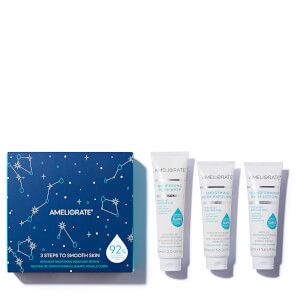
| AMELIORATE3 Steps to Smooth SkinYOUR PRODUCT | Vitamin ESensitive Oat and Coconut Body Lotion | |
|---|---|---|
| Match | — | 56% |
| Price | $17.37 | $6.67−$10.70 |
| Shared key ingredients | — | 7 of 12 |
| Key difference | — | Cocos Nucifera Oil |
| Irritancy | High | Medium |
| Drying alcohol | — | — |
| View product | Shop |
Product summary
"AMELIORATE - 3 Steps to Smooth Skin" is effective for: Moisturizing
This product could be helpful for: Anti-aging, but its actives are not the most effective or are not well-studied.
Ingredient callouts
- This product contains acids (lactic acid 0.15% - 0.25%, lactic acid 0.35% - 0.60% and lactic acid 0.30% - 0.50%). Their concentration is low, and they will not have a strong exfoliating effect. Instead, they work to support the skin natural acid mantle and to attract water (as humectants). Lactic acid is particularly good in attracting water to the upper layer of the skin and improving the skin barrier.
- Humectants (urea 0.30% - 0.60%, sodium lactate 0.35% - 0.65%, glycerin 0.40% - 0.60%, urea 0.30% - 0.60%, sodium lactate 0.30% - 0.60%, glycerin 0.45% - 0.65%, glycerin 0.70% - 1.00% and glycerin 4.10% - 5.00%). These ingredients help attract water to the upper layer of the skin and improve the skin hydration.
Price
The product retails for 76.49CA$ in Canada, from 14.80A$ up to 46.49A$ in Australia, from 21.00$ up to 29.00$ in the United States and for 13.65£ in the United Kingdom.
For a detailed price comparison: click here.
Sources cited in this review
Every concentration estimate and effectiveness label is anchored to one of these 28 studies and safety reviews.
- 1
- 2Final Report on the Safety Assessment of Isopropyl Isostearatejournals.sagepub.com
- 3
- 4
- 5
- 6

Affiliate links · As an Amazon Associate, WIMJ earns from qualifying purchases.