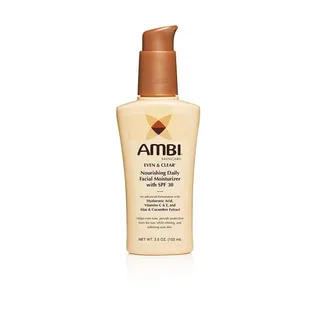
AMBI Even & Clear Daily Facial Moisturizer With 30 Spf
Works for
Sun protectionSPF 30 · 1 UV filter · Partial spectrumWeak protectionLow filter dose
This product does not offer good protection against UVA rays.
This product can be considered "reef safe" because it does not contain the UV filters (oxybenzone and octinoxate) that can be harmful to coral reefs when present in the water in high concentrations.
Anti-oxidationSide benefit · Camellia sinensis extract, Glycyrrhiza glabra root extract + 2 moreMay help
This product contains antioxidants (camellia sinensis extract) that might be able to help neutralize free radicals in skin to lessen the damage it gets from the UV light (sun). There is not enough evidence to confirm their effectiveness in skin though.
MoisturizingSide benefit the brand mentions · Caprylic/capric triglyceride, C12-15 alkyl benzoate + 10 moreWorks
“Even & Clear Daily Facial Moisturizer With 30 Spf”
This product can help improve hydration of the skin with the two types of ingredients.
The first type is called “humectants”:
these ingredients help attract water.
When humectants are on the surface of the skin, they “pull in” the moisture from the outside environment, or from
within deeper layers of the skin. The following ingredients in this product do the job:
glycerin, hyaluronic acid.
This product also contains ingredients called “occlusives”. They help reduce the speed with which our skin loses moisture to the outside environment. These ingredients also help soften the upper layer of the skin, so it feels less tight and nicer to the touch. The following ingredients in this product do the job: caprylic/capric triglyceride, dimethicone.
Can it cause trouble?
Irritancy10 flagged ingredientsLow risk
Comedogenic1 ingredient rated 2 or more on the 0–5 pore-clogging scale1 flagged
User reviews
Be the first — your take helps the next person decide.
Ingredients
Filter by role to see what each ingredient is doing.
Acrylates copolymer~23–34%
- Irritation risk
- Medium
Used to stabilize product formulation, help create an even product layer over skin (for example, in sunscreen) and create a thicker product consistency
More about Acrylates copolymerAloe barbadensis leaf juice~4.6–6.9%
- Irritation risk
- Medium
Traditionally used to treat sunburns, dermatitis and inflammation, but evidence for its effectiveness is lacking. The extract can contain humectants that help attract water into the skin
More about Aloe barbadensis leaf juiceWater~3.6–5.4%
Arctostaphylos uva ursi leaf extract~2.5–3.8%
- Irritation risk
- Low
Ascorbyl palmitate~1.8–2.6%
- Irritation risk
- Medium
Being a lipid soluble form of vitamin C, it is more stable and can penetrate the skin better than L-Ascorbic acid. It is effective in protecting the skin from free radicals, as well as evening the skin tone, but is less effective in stimulating collagen production compared to L-Ascorbic acid.
More about Ascorbyl palmitateButyloctyl salicylate~1.2–1.7%
- Irritation risk
- Medium
A synthetic ester of salicylic acid that is used to help disperse pigments and boost effectiveness of sunscreen ingredients. It is able to absorb UV light (working as an organic, or chemical filter), but is not approved as a sunscreen ingredient on its own
More about Butyloctyl salicylateC12-15 alkyl benzoate~1.1–1.6%
- Irritation risk
- Low
Enhances the product texture and makes it more spreadable. Helps reduce water loss from the outer layer of skin. Extands the shelf life by preventing bacteria growth
More about C12-15 alkyl benzoateCamellia sinensis extract~1.1–1.6%
- Irritation risk
- Low
Tea extract. Might be helpful in neutralizing free radicals in skin
More about Camellia sinensis extractCaprylic/capric triglyceride~1.1–1.7%
- Irritation risk
- Medium
A good mix of fatty acids that forms a protective layer on the skin. Improves the shelf life of products. Derived from coconut and glycerin
More about Caprylic/capric triglycerideCetearyl alcohol~1–1.45%
- Irritation risk
- Low
- Comedogenicity
- 2/5
A non-drying alcohol. Works as an emollient. Helps water and oil mix together and creates a nice product texture
More about Cetearyl alcoholCetearyl glucoside~0.5–1.2%
- Irritation risk
- Medium
Helps water and oil in the product mix well together and improves product texture
More about Cetearyl glucosideCetyl alcohol~0.6–1.35%
- Irritation risk
- Low
A non-drying alcohol that works to soften the skin and stabilize product formulations helping oil and water mix together
More about Cetyl alcoholCucumis sativus extract~0.45–1%
- Irritation risk
- Medium
Cyclopentasiloxane~0.45–1%
- Irritation risk
- Low
A silicone that helps improve the product texture and spreadability. Can absorb oil creating a short-term mattifying effect on the skin
More about CyclopentasiloxaneCyclotetrasiloxane~0.35–0.85%
- Irritation risk
- Low
Dimethicone~0.35–0.85%
- Irritation risk
- Low
A silicone that helps to reduce water loss from the surface of the skin. Can temporarily "fill in" lines and wrinkles, absorb oil, and create a nice product finish
More about DimethiconeEthylhexylglycerin~0.2–0.75%
Glycerin~0.2–0.75%
- Irritation risk
- Low
One of the best moisturizing ingredients. Naturally present in skin. It attracts water to the upper layer of the skin working as a humectant
More about GlycerinGlyceryl stearate~0.2–0.8%
- Irritation risk
- Low
An emollient that softens the skin and forms a protective layer on its surface. Helps water and oil mix together
More about Glyceryl stearateGlycyrrhiza glabra root extract~0.15–0.6%
- Irritation risk
- Medium
A plant extract that can help lighten the skin and calm down inflammation. Might be helpful in neutralizing free radicals
More about Glycyrrhiza glabra root extractHelianthus annuus seed oil~0.15–0.6%
- Irritation risk
- Low
A great emollient due to its high linoleic acid content. One of the most effective plant oils in helping skin hydration and repairing skin barrier function
More about Helianthus annuus seed oilHyaluronic acid~0.1–0.4%
- Irritation risk
- Low
One of the best moisturizing ingredients. Attracts water into the upper layer of the skin. Naturally present in skin. Typically has large molecule size unless advertised otherwise on the product label. Helps support skin's barrier function and may help to reduce inflammation
More about Hyaluronic acidMagnesium aluminum silicate~0.1–0.45%
- Irritation risk
- Low
Might be helpful in restoring skin barrier function and, when combined with zinc carbonate and malonic acid, reducing fine lines and wrinkles by stimulating elastin production. Also helps stabilize the product formulation
More about Magnesium aluminum silicatePhenoxyethanol~0.1–0.3%
- Irritation risk
- Low
A preservative. It helps prevent bacterial growth in cosmetic products
More about PhenoxyethanolPolysorbate 20~0.1–0.35%
Saccharide isomerate~0.05–0.2%
- Irritation risk
- Low
Helps attract water to the upper layer of the skin
More about Saccharide isomerateSilica~0.15–0.5%
Sodium hydroxide~0.05–0.15%
Stearyl alcohol~0.1–0.4%
- Irritation risk
- Low
An emollient that helps soften the skin
More about Stearyl alcoholTocopheryl acetate~0.05–0.1%
- Irritation risk
- Medium
A more stable but less bio-available form of vitamin E compared to Tocopherol. Might help moisturize and protect the skin from free radicals, but mostly used in low concentrations to stabilize other ingredients.
More about Tocopheryl acetateIngredient list view
Acrylates copolymer, Aloe barbadensis leaf juice, Water, Arctostaphylos uva ursi leaf extract, Ascorbyl palmitate, Butyloctyl salicylate, C12-15 alkyl benzoate, Camellia sinensis extract, Caprylic/capric triglyceride, Cetearyl alcohol, Cetearyl glucoside, Cetyl alcohol, Cucumis sativus extract, Cyclopentasiloxane, Cyclotetrasiloxane, Dimethicone, Ethylhexylglycerin, Glycerin, Glyceryl stearate, Glycyrrhiza glabra root extract, Helianthus annuus seed oil, Hyaluronic acid, Magnesium aluminum silicate, Phenoxyethanol, Polysorbate 20, Saccharide isomerate, Silica, Sodium hydroxide, Stearyl alcohol, Tocopheryl acetate
Compare prices
Retailers ranked by price — lowest first.
Worth comparing, line by line.
Match % combines shared ingredients, the first five ingredients, shared actives and hero ingredients, irritancy (lower counts in the alternative's favour), texture and body area. Only products in the same routine step are compared.
| AMBIEven & Clear Daily Facial Moisturizer With 30 SpfYOUR PRODUCT | Fenty SkinMini Hydra Vizor Mineral SPF 30 Refillable Moisturizer | Derma EAll Sport Performance Face Sunscreen SPF 30 | Bondi SandsSunny Daze SPF 50 Moisturiser | |
|---|---|---|---|---|
| Match | — | 35% | 33% | 33% |
| Price | — | $26.00 | — | $11.59 |
| Shared key ingredients | — | 5 of 9 | 5 of 9 | 5 of 9 |
| Key difference | — | Niacinamide | Avobenzone | Erythritol |
| Irritancy | Low | Low | Low | Low |
| SPF | SPF 30 | SPF 30 | SPF 30 | SPF 50 |
| Drying alcohol | — | — | — | Contains drying alcohol |
| View product | Shop | Shop | Shop |


More alternatives: The INKEY List CA SPF30 Sunscreen 100% Mineral UV FiltersSEPHORA COLLECTION Daily Sunscreen Cream SPF 30
Sources cited in this review
Every concentration estimate and effectiveness label is anchored to one of these 14 studies and safety reviews.
- 1
- 2
- 3
- 4
- 5Final Report on the Safety Assessment of Dimethicone Copolyoljournals.sagepub.com
- 6

Affiliate links · As an Amazon Associate, WIMJ earns from qualifying purchases.