Works for
1 of 3 advertised claims delivered
Moisturizing20 ingredients credited for this claimGood support
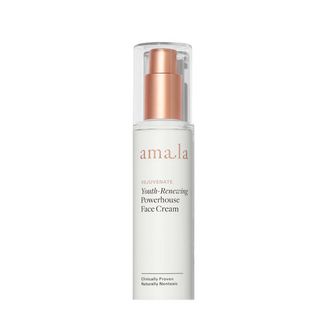
“Youth-Renewing Powerhouse Face Cream”
This product can help improve hydration of the skin with the two types of ingredients.
The first type is called “humectants”:
these ingredients help attract water.
When humectants are on the surface of the skin, they “pull in” the moisture from the outside environment, or from
within deeper layers of the skin. The following ingredients in this product do the job:
aminobutyric acid, lactobacillus ferment.
This product also contains ingredients called “occlusives”. They help reduce the speed with which our skin loses moisture to the outside environment. These ingredients also help soften the upper layer of the skin, so it feels less tight and nicer to the touch. The following ingredients in this product do the job: helianthus annuus seed oil, squalane.
Anti-aging2 ingredients credited for this claimLimited support
“Content Approved The Amala Youth-Renewing Powerhouse Face Cream helps to firm skin, smooth fine lines and wrinkles, and restore natural moisture with the whole plant ingredients.”
This product does not contain ingredients that are able to reduce fine lines and wrinkles or help with skin elasticity, but it can improve the look of the skin temporarily through moisturization. Well-moisturized skin might also be able to repair the sun damage better.This ingredient - aminobutyric acid - could be helpful for preventing or repairing signs of aging in theory, but there is no evidence that it actually works.
This ingredient pinus pinaster bark extract might be able to help neutralize free radicals in skin and help it fight off some of the sun damage.
Evens skin tone1 ingredient credited for this claimLimited support
“Contains b reakthrough natural biotechnology to deliver intense hydration and improve uneven skin tones.”
This product contains ingredients (pinus pinaster bark extract) that could help reduce hyperpigmentation (for example, post-acne marks or age spots) in theory, but there is not enough evidence that they actually work.
Anti-oxidationNot advertised by the brand · 5 ingredients credited for this claimModerate support
This product contains antioxidants (pinus pinaster bark extract) that might be able to help neutralize free radicals in skin to lessen the damage it gets from the UV light (sun). There is not enough evidence to confirm their effectiveness in skin though.
Can it cause trouble?
Irritancy10 strong irritants: Parfum, Citrus limon peel oil + 8 more — patch-test recommendedHigh risk
Comedogenic3 ingredients rated 2 or more on the 0–5 pore-clogging scale3 flagged
User reviews
Be the first — your take helps the next person decide.
Ingredients
Filter by role to see what each ingredient is doing.
Water~45–55%
Macadamia integrifolia seed oil~4.9–5.9%
- Irritation risk
- Low
A plant oil that helps soften the upper layer of the skin
More about Macadamia integrifolia seed oilSqualane~4.6–5.6%
- Irritation risk
- Low
An oil naturally present in skin. Works as an emollient to soften the skin and form a protective layer on its surface without a greasy feeling.
More about SqualaneCetearyl alcohol~3.1–3.8%
- Irritation risk
- Low
- Comedogenicity
- 2/5
A non-drying alcohol. Works as an emollient. Helps water and oil mix together and creates a nice product texture
More about Cetearyl alcoholTheobroma cacao seed butter~2.5–3%
- Irritation risk
- Low
- Comedogenicity
- 3/5
Helps soften the upper layer of the skin and can be helpful in restoring the skin barrier function. Might have some anti-oxidant effect
More about Theobroma cacao seed butterPentylene glycol~2.1–2.5%
- Irritation risk
- Medium
Used to preserve products, dissolve other ingredients and create a nice product texture
More about Pentylene glycolTheobroma grandiflorum seed butter~1.7–2%
- Irritation risk
- Medium
Helps soften the upper layer of the skin and might as well help to attract moisture to its upper layer
More about Theobroma grandiflorum seed butterIsoamyl cocoate~1.5–1.8%
- Irritation risk
- Medium
Helps oil and water mix together and works as a cleansing agent
More about Isoamyl cocoateLactobacillus/cocoa fruit ferment filtrate~1.2–1.5%
- Irritation risk
- Low
Cetearyl olivate~1–1.2%
Sorbitan olivate~0.75–1.1%
Silica~0.95–1.15%
Aminobutyric acid~0.55–0.85%
- Irritation risk
- Low
Has been shown to support wound healing and skin barrier function when used topically in rats. Is likely to be effective in supporting skin's hydration and barrier function, but research for human skin is missing. Might have some anti-aging properties but the research is missing
More about Aminobutyric acidSalvia hispanica seed oil~0.55–0.85%
- Irritation risk
- Low
Chia seed oil. Helps to soften the upper layer of the skin and might be helpful in repairing skin barrier
More about Salvia hispanica seed oilSalvia hispanica seed extract~0.5–0.8%
- Irritation risk
- Medium
A plant extract that typically contains linolenic and linoleic acids that help soften the upper layer of the skin and can support skin barrier function
More about Salvia hispanica seed extractInulin~0.5–0.75%
- Irritation risk
- Low
Helps attract water to the upper layer of the skin. Is claimed to support the growth of "good" bacteria in skin (as a "prebiotic"), but the research is lacking
More about InulinPhyllanthus emblica extract~0.5–0.75%
- Irritation risk
- Low
Paeonia lactiflora extract~0.45–0.7%
- Irritation risk
- Low
Spirulina platensis extract~0.45–0.65%
- Irritation risk
- Low
- Comedogenicity
- 3/5
An algae extract. Might help to attract water to the upper layer of the skin and have an anti-oxidant effect
More about Spirulina platensis extractPinus pinaster bark extract~0.4–0.65%
- Irritation risk
- Medium
A plant extract that might help neutralize free radicals and reduce hyperpigmentation, but evidence of effectiveness of topical application is lacking. It can be an INCI name for the trademarked ingredient Pycnogenol (but could also be a different type of this plant's bark extract)
More about Pinus pinaster bark extractAlpha-glucan oligosaccharide~0.45–0.65%
- Irritation risk
- Low
Helps attract water to the upper layer of the skin
More about Alpha-glucan oligosaccharideVigna aconitifolia seed extract~0.3–0.6%
- Irritation risk
- Low
Lysolecithin~0.35–0.6%
- Irritation risk
- Low
Lecithin derivative. It helps oil and water mix together and can enhance penetration of other ingredients. It helps soften the upper layer of the skin
More about LysolecithinSodium hyaluronate~0.3–0.55%
- Irritation risk
- Low
One of the best moisturizing ingredients. Attracts water into the upper layer of the skin
More about Sodium hyaluronateColloidal gold~0.3–0.55%
- Irritation risk
- Low
Helianthus annuus seed oil~0.35–0.65%
- Irritation risk
- Low
A great emollient due to its high linoleic acid content. One of the most effective plant oils in helping skin hydration and repairing skin barrier function
More about Helianthus annuus seed oilLactobacillus ferment~0.3–0.55%
- Irritation risk
- Low
A fermentation product created by bacteria Lactobacillus. The fermented product has anti-bacterial properties and might be helpful in calming down inflammation, but studies are lacking. Helps attract water to the upper layer of the skin. Can be used as a preservative
More about Lactobacillus fermentLactobacillus~0.3–0.55%
- Irritation risk
- Low
A non-living ingredient made by fermentation with the bacteria Lactobacillus. It can help attract water to the upper layer of the skin and might help reduce inflammation
More about LactobacillusSodium stearoyl glutamate~0.4–0.6%
- Irritation risk
- Medium
Helps oil and water mix together
More about Sodium stearoyl glutamateParfum~0.3–0.55%
- Irritation risk
- High
An aromatic blend of unspecified and possibly irritating ingredients
More about ParfumCitrus limon peel oil~0.3–0.55%
Styrax benzoin resin extract~0.35–0.65%
- Irritation risk
- Low
Vanilla planifolia fruit extract~0.3–0.55%
- Irritation risk
- High
A plant extract used as a fragrance. Can be irritating
More about Vanilla planifolia fruit extractCananga odorata flower oil~0.3–0.55%
Dipteryx odorata seed extract~0.3–0.6%
- Irritation risk
- Low
Rosa damascena flower oil~0.3–0.6%
- Irritation risk
- High
Used as a fragrance. Can be irritating
More about Rosa damascena flower oilJasminum sambac flower extract~0.3–0.55%
- Irritation risk
- Low
Citrus aurantium bergamia peel oil~0.3–0.55%
- Irritation risk
- High
Tocopherol~0.3–0.55%
- Irritation risk
- Low
Pure form of vitamin E. Can help moisturise and protect the skin from free radicals. Often used to help stabilise other ingredients or the formula itself
More about TocopherolLecithin~0.35–0.65%
- Irritation risk
- Low
Used mostly for creating emulsions - helping oil and water mix together. Helps soften the upper layer of the skin
More about LecithinMaltodextrin~0.25–0.5%
- Irritation risk
- Low
Used to stabilize the product formulation and can help absorb oil
More about MaltodextrinSclerotium gum~0.25–0.45%
- Irritation risk
- Low
Used to create gel-like formulas and stabilize emulsions
More about Sclerotium gumPullulan~0.25–0.45%
- Irritation risk
- High
Creates a thin drying film on the skin resulting in a short-term tightening effect
More about PullulanXanthan gum~0.2–0.4%
- Irritation risk
- Low
Used to create a thicker product consistency
More about Xanthan gumLeuconostoc/radish root ferment filtrate~0.2–0.35%
- Irritation risk
- Medium
A preservative that comes from radishes fermented by a bacteria. New research suggests that the preservation properties in the ingredient come from an ammonium salt that is not present naturally in radish root but used in its cultivation. Is problematic because the exact amount of the preservative agents is difficult to determine
More about Leuconostoc/radish root ferment filtrateLimonene~0.2–0.35%
- Irritation risk
- High
A common frangrance that can easily irritate skin, especially if exposed to air, light or heat
More about LimoneneLinalool~0.15–0.3%
Citral~0.1–0.2%
Benzyl benzoate~0.1–0.2%
- Irritation risk
- High
Fragrance with sweet balsamic smell. Help to preserve products and dissolve other ingredients. Could trigger allergic reactions and be irritating
More about Benzyl benzoateIngredient list view
Water, Macadamia integrifolia seed oil, Squalane, Cetearyl alcohol, Theobroma cacao seed butter, Pentylene glycol, Theobroma grandiflorum seed butter, Isoamyl cocoate, Lactobacillus/cocoa fruit ferment filtrate, Cetearyl olivate, Sorbitan olivate, Silica, Aminobutyric acid, Salvia hispanica seed oil, Salvia hispanica seed extract, Inulin, Phyllanthus emblica extract, Paeonia lactiflora extract, Spirulina platensis extract, Pinus pinaster bark extract, Alpha-glucan oligosaccharide, Vigna aconitifolia seed extract, Lysolecithin, Sodium hyaluronate, Colloidal gold, Helianthus annuus seed oil, Lactobacillus ferment, Lactobacillus, Sodium stearoyl glutamate, Parfum, Citrus limon peel oil, Styrax benzoin resin extract, Vanilla planifolia fruit extract, Cananga odorata flower oil, Dipteryx odorata seed extract, Rosa damascena flower oil, Unknown, Jasminum sambac flower extract, Citrus aurantium bergamia peel oil, Tocopherol, Lecithin, Maltodextrin, Sclerotium gum, Pullulan, Xanthan gum, Leuconostoc/radish root ferment filtrate, Limonene, Linalool, Citral, Benzyl benzoate
Compare prices
Retailers ranked by price — lowest first.
Affiliate links · prices updated regularly · As an Amazon Associate, WIMJ earns from qualifying purchases.
Sources cited in this review
Every concentration estimate and effectiveness label is anchored to one of these 23 studies and safety reviews.
- 1
- 2
- 3Advanced Skin Care – A Novel Ingredientncbi.nlm.nih.gov
- 4
- 5Wound healing activity of gamma-aminobutyric Acid (GABA) in ratspubmed.ncbi.nlm.nih.gov
- 6Moisturizing effect of Gamma-aminobutyric acid for cosmetic applicationam-2017.weebly.com

Affiliate links · As an Amazon Associate, WIMJ earns from qualifying purchases.