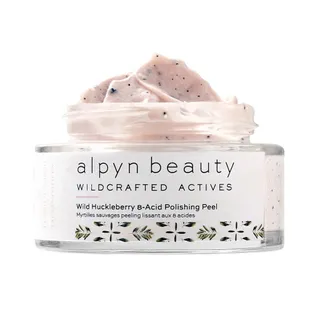
Alpyn Beauty Wild Huckleberry 8-Acid Polishing Peel

Alpyn Beauty Wild Huckleberry 8-Acid Polishing Peel

Efficacy100/100IrritancyHigh

Works for

Exfoliation
Azelaic acid, Glycolic acid + 4 more
Works well
What the product description says
“Wild Huckleberry 8-Acid Polishing Peel”
From product name

This product can help exfoliate the skin. In other words, it helps break down the bonds between dead cells on the surface of the skin and speed up the skin turnover. Skin often appears softer and brighter after exfoliation, but overdoing it can result in disrupted skin barrier. The following ingredient is doing the exfoliating job in this product: glycolic acid.

Azelaic acidKey activeEffect: MediumIs produced by a yeast that lives on normal human skin. It is used in medicine as a topical treatment for mild to moderate acne. It has a mild exfoliating effect. It can also help reduce hyperpigmentation, helps calm down inflammation and can help neutralize free radicals~0.55–0.8%
Glycolic acidKey activeEffect: HighAn alpha-hydroxy acid (AHA) that helps to remove the dead skin cells on the surface of the skin reveling a more even, smoother complexation. It is also able to stimulate collagen production with long-term use. Could help to reduce pore congestion. It can be irritating to the skin. Apply sunscreen daily if using products with glycolic acid~0.25–0.5%
Tartaric acidKey activeEffect: MediumAn AHA (alpha-hydroxy acid). It oxidizes quickly which makes it less effective in skincare formulations. It can support skin's barrier and moisture levels~0.25–0.5%
Lactobacillus/pumpkin ferment extractEffect: LowAn enzyme-based exfoliant~0.25–0.45%
Salix alba bark extractEffect: Low, below effective doseA plant extract that can help neutralize free radicals in skin. It contains a compound salicin that can theoretically be converted into salicylic acid that, in turn, helps reduce inflammation in skin, but the evidence of effectiveness in skin is lacking and the extract is usually not used in a concentration that would enable an exfoliating effect~0.25–0.45%
Lactic acidUnder-dosedAn exfoliating and moisturizing alpha-hydroxy acid (AHA). Typically causes less irritation than other AHAs, for example, glycolic acid. At high concentrations (about 15%), lactic acid can help reduce lines and wrinkles. Recent studies show that lactic acid can support the "good" bacteria living on skin's surface (healthy skin microbiome)~0.25–0.45%
Anti-blemish
Azelaic acid, Glycolic acid + 4 more
Works well
What the product description says
“A pillowy bamboo powder and berry seed paste acts as a natural polish.”
Source: Bluemercury

This product can help reduce breakouts and clogged pores because it contains the following ingredient: azelaic acid. This ingredient is used for treating acne and can have a noticeable effect.

The following ingredient (ingredients) in this product might be helpful, but there is no evidence to confirm that it actually works: glycolic acid

Azelaic acidHeroEffect: HighIs produced by a yeast that lives on normal human skin. It is used in medicine as a topical treatment for mild to moderate acne. It has a mild exfoliating effect. It can also help reduce hyperpigmentation, helps calm down inflammation and can help neutralize free radicals~0.55–0.8%
Glycolic acidKey activeEffect: MediumAn alpha-hydroxy acid (AHA) that helps to remove the dead skin cells on the surface of the skin reveling a more even, smoother complexation. It is also able to stimulate collagen production with long-term use. Could help to reduce pore congestion. It can be irritating to the skin. Apply sunscreen daily if using products with glycolic acid~0.25–0.5%
BentoniteEffect: LowHelps stabilize the product formulation~1.5–1.8%
Melia azadirachta leaf extractEffect: LowA plant extract that has anti-bacterial properties. Can be used to preserve the product. Can be irritating~0.25–0.45%
Aloe barbadensis leaf juiceEffect: Low, below effective doseTraditionally used to treat sunburns, dermatitis and inflammation, but evidence for its effectiveness is lacking. The extract can contain humectants that help attract water into the skin~0.4–0.6%
Salix alba bark extractEffect: Low, below effective doseA plant extract that can help neutralize free radicals in skin. It contains a compound salicin that can theoretically be converted into salicylic acid that, in turn, helps reduce inflammation in skin, but the evidence of effectiveness in skin is lacking and the extract is usually not used in a concentration that would enable an exfoliating effect~0.25–0.45%
Anti-aging
Not advertised by the brand · Ferulic acid, Glycolic acid + 2 more
Works well

This product can help reduce and prevent fine lines and wrinkles, improve skin elasticity and firmness because it contains glycolic acid.

These ingredients in the product can also be helpful, even though there is less evidence for their effectiveness: ferulic acid.

Keep in mind that it typically takes at least 6 weeks to notice any results because the changes that are needed to improve fine lines and elasticity happen in the deeper layers of the skin. No topical anti-aging product can “erase” wrinkles or fully reverse signs of aging.

Ferulic acidKey activeEffect: MediumA potent anti-oxidant that has been shown to be effective in neutralizing free radicals in skin. There seem to have a synergetic effect of ferulic acid, vitamin E and C, meaning that when the ingredients are used together, they enhance each other's ability protect the skin against free radicals. Ferulic acid also helps to stabilize other ingredients - including vitamins C and E. It can help to even out the skin tone. Ferulic acid is approved for use as a sunscreen ingredient in Japan in concentrations up to 10%~0.5–0.7%
Glycolic acidKey activeEffect: HighAn alpha-hydroxy acid (AHA) that helps to remove the dead skin cells on the surface of the skin reveling a more even, smoother complexation. It is also able to stimulate collagen production with long-term use. Could help to reduce pore congestion. It can be irritating to the skin. Apply sunscreen daily if using products with glycolic acid~0.25–0.5%
Aloe barbadensis leaf juiceEffect: Low, below effective doseTraditionally used to treat sunburns, dermatitis and inflammation, but evidence for its effectiveness is lacking. The extract can contain humectants that help attract water into the skin~0.4–0.6%
Lactic acidUnder-dosedAn exfoliating and moisturizing alpha-hydroxy acid (AHA). Typically causes less irritation than other AHAs, for example, glycolic acid. At high concentrations (about 15%), lactic acid can help reduce lines and wrinkles. Recent studies show that lactic acid can support the "good" bacteria living on skin's surface (healthy skin microbiome)~0.25–0.45%
Anti-oxidation
Not advertised by the brand · Azelaic acid, Ferulic acid + 8 more
Works well

This product contains antioxidants (azelaic acid, ferulic acid) that can help neutralize free radicals in skin. By doing so, they can lessen the damage the skin gets from the UV light (sun).

The following ingredients - tartaric acid also can have an antioxidant effect, but there is less evidence to confirm their effectiveness in skin.

Azelaic acidKey activeEffect: HighIs produced by a yeast that lives on normal human skin. It is used in medicine as a topical treatment for mild to moderate acne. It has a mild exfoliating effect. It can also help reduce hyperpigmentation, helps calm down inflammation and can help neutralize free radicals~0.55–0.8%
Ferulic acidKey activeEffect: HighA potent anti-oxidant that has been shown to be effective in neutralizing free radicals in skin. There seem to have a synergetic effect of ferulic acid, vitamin E and C, meaning that when the ingredients are used together, they enhance each other's ability protect the skin against free radicals. Ferulic acid also helps to stabilize other ingredients - including vitamins C and E. It can help to even out the skin tone. Ferulic acid is approved for use as a sunscreen ingredient in Japan in concentrations up to 10%~0.5–0.7%
Tartaric acidKey activeEffect: MediumAn AHA (alpha-hydroxy acid). It oxidizes quickly which makes it less effective in skincare formulations. It can support skin's barrier and moisture levels~0.25–0.5%
Vaccinium angustifolium fruit extractEffect: LowA plant extract tha can have anti-oxidant properties, but evidence of effectiveness in skin is lacking~0.25–0.45%
Eclipta prostrata extractEffect: LowA plant extract that might help neutralize free radicals in skin. It can be irritating~0.25–0.45%
Calendula officinalis flower extractEffect: LowA plant extract that has some anti-oxidant and anti-bacterial properties. Can be irritating~0.25–0.4%
Rubus idaeus fruit extractEffect: LowA fruit extract that might have some anti-oxidant properties but evidence of effectiveness in skin is lacking~0.2–0.4%
Lactobacillus fermentEffect: LowA fermentation product created by bacteria Lactobacillus. The fermented product has anti-bacterial properties and might be helpful in calming down inflammation, but studies are lacking. Helps attract water to the upper layer of the skin. Can be used as a preservative~0.1–0.2%
Pyrus malus fruit extractEffect: Low, below effective doseCan have some moisturizing properties due to its sugar content~0.25–0.45%
Salix alba bark extractEffect: Low, below effective doseA plant extract that can help neutralize free radicals in skin. It contains a compound salicin that can theoretically be converted into salicylic acid that, in turn, helps reduce inflammation in skin, but the evidence of effectiveness in skin is lacking and the extract is usually not used in a concentration that would enable an exfoliating effect~0.25–0.45%
Evens skin tone
Not advertised by the brand · Azelaic acid, Ferulic acid + 3 more
Works well

This product can help reduce hypepigmentation and even out the skin tone because it contains the following effective ingredients: azelaic acid, glycolic acid

The following ingredient (ingredients) in this product might be helpful, but there is no evidence to confirm that it actually can help even out the skin tone: ferulic acid, lactobacillus/pumpkin ferment extract.

Keep in mind that you would need to apply any topical skincare targetted at hypigmentation consistently for a couple of months to get a result. No topical skincare product can help get rid of hyperpigmentation (including post-acne marks and age spots) instantly.

Azelaic acidKey activeEffect: HighIs produced by a yeast that lives on normal human skin. It is used in medicine as a topical treatment for mild to moderate acne. It has a mild exfoliating effect. It can also help reduce hyperpigmentation, helps calm down inflammation and can help neutralize free radicals~0.55–0.8%
Ferulic acidKey activeEffect: MediumA potent anti-oxidant that has been shown to be effective in neutralizing free radicals in skin. There seem to have a synergetic effect of ferulic acid, vitamin E and C, meaning that when the ingredients are used together, they enhance each other's ability protect the skin against free radicals. Ferulic acid also helps to stabilize other ingredients - including vitamins C and E. It can help to even out the skin tone. Ferulic acid is approved for use as a sunscreen ingredient in Japan in concentrations up to 10%~0.5–0.7%
Glycolic acidKey activeEffect: HighAn alpha-hydroxy acid (AHA) that helps to remove the dead skin cells on the surface of the skin reveling a more even, smoother complexation. It is also able to stimulate collagen production with long-term use. Could help to reduce pore congestion. It can be irritating to the skin. Apply sunscreen daily if using products with glycolic acid~0.25–0.5%
Lactobacillus/pumpkin ferment extractEffect: LowAn enzyme-based exfoliant~0.25–0.45%
Lactic acidUnder-dosedAn exfoliating and moisturizing alpha-hydroxy acid (AHA). Typically causes less irritation than other AHAs, for example, glycolic acid. At high concentrations (about 15%), lactic acid can help reduce lines and wrinkles. Recent studies show that lactic acid can support the "good" bacteria living on skin's surface (healthy skin microbiome)~0.25–0.45%
Moisturizing
Not advertised by the brand · Glycerin, Cetearyl alcohol + 15 more
Works

This product can help improve hydration of the skin with the two types of ingredients.

The first type is called “humectants”:
these ingredients help attract water. When humectants are on the surface of the skin, they “pull in” the moisture from the outside environment, or from within deeper layers of the skin. The following ingredients in this product do the job: glycerin, isomalt.

This product also contains ingredients called “occlusives”. They help reduce the speed with which our skin loses moisture to the outside environment. These ingredients also help soften the upper layer of the skin, so it feels less tight and nicer to the touch. The following ingredients in this product do the job: helianthus annuus seed oil, cetearyl alcohol.

GlycerinKey active· HumectantEffect: HighOne of the best moisturizing ingredients. Naturally present in skin. It attracts water to the upper layer of the skin working as a humectant~4.6–5.6%
Cetearyl alcoholKey active· EmollientEffect: MediumA non-drying alcohol. Works as an emollient. Helps water and oil mix together and creates a nice product texture~2.5–3%
Glyceryl stearate seKey activeEffect: MediumUsed to stabilize the product formulations and works as an emollient~1.9–2.3%
Helianthus annuus seed oilKey active· Emollient, OcclusiveEffect: HighA great emollient due to its high linoleic acid content. One of the most effective plant oils in helping skin hydration and repairing skin barrier function~1.7–2%
Sodium hyaluronateKey active· HumectantEffect: HighOne of the best moisturizing ingredients. Attracts water into the upper layer of the skin~0.45–0.65%
GlucoseKey active· HumectantEffect: MediumHelps attract water to the upper layer of the skin. Could be helpful in restoring the skin barrier function~0.3–0.6%
Saccharum officinarum extractKey activeEffect: HighSugar extract that helps attract water to the upper layer of the skin~0.25–0.45%
Tartaric acidKey activeEffect: MediumAn AHA (alpha-hydroxy acid). It oxidizes quickly which makes it less effective in skincare formulations. It can support skin's barrier and moisture levels~0.25–0.5%
IsomaltKey active· HumectantEffect: HighHelps attract water to the upper layer of the skin~0.2–0.35%
Lactobacillus fermentKey active· HumectantEffect: HighA fermentation product created by bacteria Lactobacillus. The fermented product has anti-bacterial properties and might be helpful in calming down inflammation, but studies are lacking. Helps attract water to the upper layer of the skin. Can be used as a preservative~0.1–0.2%
Moringa oleifera seed oil· EmollientEffect: LowA plant oil that helps soften the upper layer of the skin. Is unlikely to be helpful in restoring skin barrier function due to the low content of linoleic acid~0.3–0.5%
Aloe barbadensis leaf juiceEffect: Low, below effective doseTraditionally used to treat sunburns, dermatitis and inflammation, but evidence for its effectiveness is lacking. The extract can contain humectants that help attract water into the skin~0.4–0.6%
LecithinEffect: Low, below effective doseUsed mostly for creating emulsions - helping oil and water mix together. Helps soften the upper layer of the skin~0.25–0.4%
Simmondsia chinensis seed oilUnder-dosedSoftens the upper layer of skin and helps restore the healthy skin barrier. Has shown to help calm down inflammation in skin. It is a stable oil, meaning that it retains its properties even when exposed to air.~0.35–0.6%
Caprylic/capric triglycerideUnder-dosedA good mix of fatty acids that forms a protective layer on the skin. Improves the shelf life of products. Derived from coconut and glycerin~0.3–0.6%
Lactic acidUnder-dosedAn exfoliating and moisturizing alpha-hydroxy acid (AHA). Typically causes less irritation than other AHAs, for example, glycolic acid. At high concentrations (about 15%), lactic acid can help reduce lines and wrinkles. Recent studies show that lactic acid can support the "good" bacteria living on skin's surface (healthy skin microbiome)~0.25–0.45%
Pyrus malus fruit extractUnder-dosedCan have some moisturizing properties due to its sugar content~0.25–0.45%

Can it cause trouble?

Irritancy
13 strong irritants: Arnica montana extract, Arnica montana flower extract + 11 more — patch-test recommended
High risk
We flagged 39 ingredients with irritancy potential. Severity depends on your sensitivity threshold; the table lists the worst offenders first.
IngredientFunctionIrritationEst. amount
Salix alba bark extractA plant extract that can help neutralize free radicals in skin. It contains a compound salicin that can theoretically be converted into salicylic acid that, in turn, helps reduce inflammation in skin, but the evidence of effectiveness in skin is lacking and the extract is usually not used in a concentration that would enable an exfoliating effectHigh~0.25–0.45%est.
Arnica montana extract—High~0.25–0.5%est.
Arnica montana flower extractA plant extract that can be irritating. It can have some anti-bacterial properties, but there are no evidence of a beneficial effect for skinHigh~0.25–0.4%est.
Calendula officinalis flower extractA plant extract that has some anti-oxidant and anti-bacterial properties. Can be irritatingHigh~0.25–0.4%est.
Chamomilla recutita flower extractPlant extract that can have healing and anti-inflammatory properties. It is a potential allergen and can be irritatingHigh~0.25–0.45%est.
Salvia officinalis leaf extractSage leaf extract. It can be irritatingHigh~0.3–0.55%est.
Eclipta prostrata extractA plant extract that might help neutralize free radicals in skin. It can be irritatingHigh~0.25–0.45%est.
Melia azadirachta leaf extractA plant extract that has anti-bacterial properties. Can be used to preserve the product. Can be irritatingHigh~0.25–0.45%est.
Benzyl alcoholA preservative. Can be used to mask unpleasant smell. Can be irritatingHigh~0.25–0.45%est.
Menthyl lactateUsed as a fragrance. Can be irritatingHigh~0.25–0.5%est.
Glycolic acidAn alpha-hydroxy acid (AHA) that helps to remove the dead skin cells on the surface of the skin reveling a more even, smoother complexation. It is also able to stimulate collagen production with long-term use. Could help to reduce pore congestion. It can be irritating to the skin. Apply sunscreen daily if using products with glycolic acidHigh~0.25–0.5%est.
Citrus aurantium dulcis fruit extractA plant extract that is used as a fragrance. Can be irritating and lead to photosensitivityHigh~0.25–0.45%est.
Citrus limon fruit extractUsed as a fragrance. Can be irritating and cause photosensitivityHigh~0.25–0.45%est.
Decyl glucosideHelps oil and water mix together. Can be irritatingHigh~0.35–0.6%est.
Citrus aurantium dulcis peel extractUsed as a fragranceHigh~0.25–0.4%est.
Vanilla planifolia fruit extractA plant extract used as a fragrance. Can be irritatingHigh~0.25–0.45%est.
Rosa damascena extractOil of a very fragrant pink rose used as fragrance in cosmetics. Extensive research has shown it has mixed benefits. In the pro column, inhaling this flower’s scent seems to have relaxing properties and the plant’s petals contain skin-soothing and antioxidant compounds that can benefit skin. On the flipside, the numerous chemicals that create this rose’s distinctive fragrance pose a risk of causing skin aggravation.High~0.25–0.45%est.
AlcoholCan be drying and contribute to skin irritation. Used in formulars to dissolve other ingredients, create a thinner product consistency or for its antibacterial propertiesHigh~0.2–0.4%est.
Hydroxypropyl starch phosphateHelps oil and water mix together and used to stabilize product formulationsMedium~2.3–2.8%est.
Aloe barbadensis leaf juiceTraditionally used to treat sunburns, dermatitis and inflammation, but evidence for its effectiveness is lacking. The extract can contain humectants that help attract water into the skinMedium~0.4–0.6%est.
CarrageenanHelps thicken the product formula and create a nice product formulationMedium~0.4–0.65%est.
Sodium stearoyl lactylateHelps oil and water mix togetherMedium~0.3–0.55%est.
Simmondsia chinensis seed oilSoftens the upper layer of skin and helps restore the healthy skin barrier. Has shown to help calm down inflammation in skin. It is a stable oil, meaning that it retains its properties even when exposed to air.Medium~0.35–0.6%est.
Moringa oleifera seed oilA plant oil that helps soften the upper layer of the skin. Is unlikely to be helpful in restoring skin barrier function due to the low content of linoleic acidMedium~0.3–0.5%est.
Pyrus malus fruit extractCan have some moisturizing properties due to its sugar contentMedium~0.25–0.45%est.
Lactobacillus/pumpkin ferment extractAn enzyme-based exfoliantMedium~0.25–0.45%est.
Dehydroacetic acidA preservativeMedium~0.25–0.45%est.
Potassium sorbateA preservativeMedium~0.25–0.5%est.
Lactic acidAn exfoliating and moisturizing alpha-hydroxy acid (AHA). Typically causes less irritation than other AHAs, for example, glycolic acid. At high concentrations (about 15%), lactic acid can help reduce lines and wrinkles. Recent studies show that lactic acid can support the "good" bacteria living on skin's surface (healthy skin microbiome)Medium~0.25–0.45%est.
Citric acidCan work as an exfoliant but is typically used to adjust the product pHMedium~0.25–0.5%est.
Acer saccharum extractA plant extract that contains small percentage of AHAs. Is unlikely to have any skin benefit due the small concentration of the active compoundsMedium~0.25–0.45%est.
Tartaric acidAn AHA (alpha-hydroxy acid). It oxidizes quickly which makes it less effective in skincare formulations. It can support skin's barrier and moisture levelsMedium~0.25–0.5%est.
Lauryl glucosideHelps oil and water mix togetherMedium~0.35–0.6%est.
Vaccinium angustifolium fruit extractA plant extract tha can have anti-oxidant properties, but evidence of effectiveness in skin is lackingMedium~0.25–0.45%est.
Caprylic/capric triglycerideA good mix of fatty acids that forms a protective layer on the skin. Improves the shelf life of products. Derived from coconut and glycerinMedium~0.3–0.6%est.
Rubus idaeus fruit extractA fruit extract that might have some anti-oxidant properties but evidence of effectiveness in skin is lackingMedium~0.2–0.4%est.
Leuconostoc/radish root ferment filtrateA preservative that comes from radishes fermented by a bacteria. New research suggests that the preservation properties in the ingredient come from an ammonium salt that is not present naturally in radish root but used in its cultivation. Is problematic because the exact amount of the preservative agents is difficult to determineMedium~0.1–0.2%est.
Comedogenic
3 ingredients rated 2 or more on the 0–5 pore-clogging scale
3 flagged
These ingredients have a comedogenic rating of 2 or more on a 0–5 scale; the table shows each one's rating. In leave-on products they can clog pores in acne-prone skin.
IngredientFunctionRatingEst. amount
CarrageenanHelps thicken the product formula and create a nice product formulation3/5~0.4–0.65%est.
Cetearyl alcoholA non-drying alcohol. Works as an emollient. Helps water and oil mix together and creates a nice product texture2/5~2.5–3%est.
Glyceryl stearate seUsed to stabilize the product formulations and works as an emollient2/5~1.9–2.3%est.

User reviews

Would you recommend?
No community reviews yet.

Be the first — your take helps the next person decide.

Ingredients

Filter by role to see what each ingredient is doing.

Water~45–55%
Formula
Irritation risk
Low

Plain old water

More about Water
Glycerin~4.6–5.6%
Key active
Irritation risk
Low
Works for
Moisturizing

One of the best moisturizing ingredients. Naturally present in skin. It attracts water to the upper layer of the skin working as a humectant

More about Glycerin
Hydrated silica~4.2–5.1%
Formula
Irritation risk
Low
Works for
Mattifying
More about Hydrated silica
Cetearyl alcohol~2.5–3%
Key activeComedogenic 2/5
Irritation risk
Low
Comedogenicity
2/5
Works for
CleansingMoisturizing

A non-drying alcohol. Works as an emollient. Helps water and oil mix together and creates a nice product texture

More about Cetearyl alcohol
Hydroxypropyl starch phosphate~2.3–2.8%
Irritant · medium
Irritation risk
Medium

Helps oil and water mix together and used to stabilize product formulations

More about Hydroxypropyl starch phosphate
Glyceryl stearate se~1.9–2.3%
Key activeComedogenic 2/5
Irritation risk
Low
Comedogenicity
2/5
Works for
CleansingMoisturizing

Used to stabilize the product formulations and works as an emollient

More about Glyceryl stearate se
Helianthus annuus seed oil~1.7–2%
Key active
Irritation risk
Low
Works for
Moisturizing

A great emollient due to its high linoleic acid content. One of the most effective plant oils in helping skin hydration and repairing skin barrier function

More about Helianthus annuus seed oil
Bentonite~1.5–1.8%
Formula
Irritation risk
Low
Works for
Anti-blemish

Helps stabilize the product formulation

More about Bentonite
Titanium dioxide~1.5–1.9%
Formula
Irritation risk
Low
Works for
Sun protection

Works as a UV filter when used in high concentrations. It is photostable and is effective mostly against the UVB light, with some protection in the UVA range. In small concentrations, used for its ability to improve the color of cosmetic products. Is usually well tolerated by the skin

More about Titanium dioxide
Ci 77891~1–1.2%
Formula
Irritation risk
Low
More about Ci 77891
Sodium phytate~0.65–1%
Formula
Irritation risk
Low

Used to stabilize product formulations

More about Sodium phytate
Azelaic acid~0.55–0.8%
Hero · Anti-blemish
Irritation risk
Low
Works for
Anti-blemishEvens skin toneAnti-oxidationExfoliation

Is produced by a yeast that lives on normal human skin. It is used in medicine as a topical treatment for mild to moderate acne. It has a mild exfoliating effect. It can also help reduce hyperpigmentation, helps calm down inflammation and can help neutralize free radicals

More about Azelaic acid
Ferulic acid~0.5–0.7%
Key active
Irritation risk
Low
Works for
Anti-oxidationAnti-agingAnti-inflammatoryEvens skin tone

A potent anti-oxidant that has been shown to be effective in neutralizing free radicals in skin. There seem to have a synergetic effect of ferulic acid, vitamin E and C, meaning that when the ingredients are used together, they enhance each other's ability protect the skin against free radicals. Ferulic acid also helps to stabilize other ingredients - including vitamins C and E. It can help to even out the skin tone. Ferulic acid is approved for use as a sunscreen ingredient in Japan in concentrations up to 10%

More about Ferulic acid
Sodium hyaluronate~0.45–0.65%
Key active
Irritation risk
Low
Works for
Moisturizing

One of the best moisturizing ingredients. Attracts water into the upper layer of the skin

More about Sodium hyaluronate
Aloe barbadensis leaf juice~0.4–0.6%
Irritant · medium
Irritation risk
Medium
Works for
MoisturizingAntibacterialAnti-inflammatoryReduces rednessReduces irritationAnti-blemishAnti-aging

Traditionally used to treat sunburns, dermatitis and inflammation, but evidence for its effectiveness is lacking. The extract can contain humectants that help attract water into the skin

More about Aloe barbadensis leaf juice
Xanthan gum~0.4–0.6%
Formula
Irritation risk
Low
Works for
Cleansing

Used to create a thicker product consistency

More about Xanthan gum
Carrageenan~0.4–0.65%
Comedogenic 3/5Irritant · medium
Irritation risk
Medium
Comedogenicity
3/5

Helps thicken the product formula and create a nice product formulation

More about Carrageenan
Glucose~0.3–0.6%
Key active
Irritation risk
Low
Works for
Moisturizing

Helps attract water to the upper layer of the skin. Could be helpful in restoring the skin barrier function

More about Glucose
Sodium stearoyl lactylate~0.3–0.55%
Irritant · medium
Irritation risk
Medium
Works for
Cleansing

Helps oil and water mix together

More about Sodium stearoyl lactylate
Salix alba bark extract~0.25–0.45%
Irritant · high
Irritation risk
High
Works for
Anti-inflammatoryAnti-oxidationAnti-blemishExfoliation

A plant extract that can help neutralize free radicals in skin. It contains a compound salicin that can theoretically be converted into salicylic acid that, in turn, helps reduce inflammation in skin, but the evidence of effectiveness in skin is lacking and the extract is usually not used in a concentration that would enable an exfoliating effect

More about Salix alba bark extract
Simmondsia chinensis seed oil~0.35–0.6%
Under-dosedIrritant · medium
Irritation risk
Medium
Works for
Moisturizing

Softens the upper layer of skin and helps restore the healthy skin barrier. Has shown to help calm down inflammation in skin. It is a stable oil, meaning that it retains its properties even when exposed to air.

More about Simmondsia chinensis seed oil
Arnica montana extract~0.25–0.5%
Irritant · high
Arnica montana flower extract~0.25–0.4%
Irritant · high
Irritation risk
High

A plant extract that can be irritating. It can have some anti-bacterial properties, but there are no evidence of a beneficial effect for skin

More about Arnica montana flower extract
Borago officinalis extract~0.3–0.55%
Formula
Calendula officinalis flower extract~0.25–0.4%
Irritant · high
Irritation risk
High
Works for
Anti-oxidation

A plant extract that has some anti-oxidant and anti-bacterial properties. Can be irritating

More about Calendula officinalis flower extract
Matricaria discoidea
Not recognized
Chamomilla recutita flower extract~0.25–0.45%
Irritant · high
Irritation risk
High
Works for
Anti-inflammatory

Plant extract that can have healing and anti-inflammatory properties. It is a potential allergen and can be irritating

More about Chamomilla recutita flower extract
Salvia officinalis leaf extract~0.3–0.55%
Irritant · high
Irritation risk
High

Sage leaf extract. It can be irritating

More about Salvia officinalis leaf extract
Eclipta prostrata extract~0.25–0.45%
Irritant · high
Irritation risk
High
Works for
Anti-inflammatoryAnti-oxidation

A plant extract that might help neutralize free radicals in skin. It can be irritating

More about Eclipta prostrata extract
Melia azadirachta leaf extract~0.25–0.45%
Irritant · high
Irritation risk
High
Works for
AntibacterialAnti-blemish

A plant extract that has anti-bacterial properties. Can be used to preserve the product. Can be irritating

More about Melia azadirachta leaf extract
Moringa oleifera seed oil~0.3–0.5%
Irritant · medium
Irritation risk
Medium
Works for
Moisturizing

A plant oil that helps soften the upper layer of the skin. Is unlikely to be helpful in restoring skin barrier function due to the low content of linoleic acid

More about Moringa oleifera seed oil
Pyrus malus fruit extract~0.25–0.45%
Under-dosedIrritant · medium
Irritation risk
Medium
Works for
MoisturizingAnti-oxidation

Can have some moisturizing properties due to its sugar content

More about Pyrus malus fruit extract
Lactobacillus/pumpkin ferment extract~0.25–0.45%
Irritant · medium
Irritation risk
Medium
Works for
ExfoliationEvens skin tone

An enzyme-based exfoliant

More about Lactobacillus/pumpkin ferment extract
Dehydroacetic acid~0.25–0.45%
Irritant · medium
Irritation risk
Medium

A preservative

More about Dehydroacetic acid
Benzyl alcohol~0.25–0.45%
Irritant · high
Irritation risk
High

A preservative. Can be used to mask unpleasant smell. Can be irritating

More about Benzyl alcohol
Menthyl lactate~0.25–0.5%
Irritant · high
Irritation risk
High

Used as a fragrance. Can be irritating

More about Menthyl lactate
Lactobacillus/capsicum frutescens fruit ferment extract~0.25–0.45%
Formula
Potassium sorbate~0.25–0.5%
Irritant · medium
Irritation risk
Medium

A preservative

More about Potassium sorbate
Lactic acid~0.25–0.45%
Under-dosedIrritant · medium
Irritation risk
Medium
Works for
ExfoliationEvens skin toneMoisturizingAnti-aging

An exfoliating and moisturizing alpha-hydroxy acid (AHA). Typically causes less irritation than other AHAs, for example, glycolic acid. At high concentrations (about 15%), lactic acid can help reduce lines and wrinkles. Recent studies show that lactic acid can support the "good" bacteria living on skin's surface (healthy skin microbiome)

More about Lactic acid
Glycolic acid~0.25–0.5%
Key activeIrritant · high
Irritation risk
High
Works for
ExfoliationEvens skin toneAnti-agingAnti-blemish

An alpha-hydroxy acid (AHA) that helps to remove the dead skin cells on the surface of the skin reveling a more even, smoother complexation. It is also able to stimulate collagen production with long-term use. Could help to reduce pore congestion. It can be irritating to the skin. Apply sunscreen daily if using products with glycolic acid

More about Glycolic acid
Vaccinium myrtillus fruit/leaf extract~0.25–0.45%
Formula
Saccharum officinarum extract~0.25–0.45%
Key active
Irritation risk
Low
Works for
Moisturizing

Sugar extract that helps attract water to the upper layer of the skin

More about Saccharum officinarum extract
Citric acid~0.25–0.5%
Irritant · medium
Irritation risk
Medium

Can work as an exfoliant but is typically used to adjust the product pH

More about Citric acid
Citrus aurantium dulcis fruit extract~0.25–0.45%
Irritant · high
Irritation risk
High

A plant extract that is used as a fragrance. Can be irritating and lead to photosensitivity

More about Citrus aurantium dulcis fruit extract
Citrus limon fruit extract~0.25–0.45%
Irritant · high
Irritation risk
High

Used as a fragrance. Can be irritating and cause photosensitivity

More about Citrus limon fruit extract
Acer saccharum extract~0.25–0.45%
Irritant · medium
Irritation risk
Medium

A plant extract that contains small percentage of AHAs. Is unlikely to have any skin benefit due the small concentration of the active compounds

More about Acer saccharum extract
Tartaric acid~0.25–0.5%
Key activeIrritant · medium
Irritation risk
Medium
Works for
ExfoliationAnti-oxidationMoisturizing

An AHA (alpha-hydroxy acid). It oxidizes quickly which makes it less effective in skincare formulations. It can support skin's barrier and moisture levels

More about Tartaric acid
Malic acid~0.25–0.5%
Formula
Irritation risk
Low

Helps adjust the product pH

More about Malic acid
Decyl glucoside~0.35–0.6%
Irritant · high
Irritation risk
High
Works for
Cleansing

Helps oil and water mix together. Can be irritating

More about Decyl glucoside
Lauryl glucoside~0.35–0.6%
Irritant · medium
Irritation risk
Medium
Works for
Cleansing

Helps oil and water mix together

More about Lauryl glucoside
Vaccinium angustifolium fruit extract~0.25–0.45%
Irritant · medium
Irritation risk
Medium
Works for
Anti-oxidation

A plant extract tha can have anti-oxidant properties, but evidence of effectiveness in skin is lacking

More about Vaccinium angustifolium fruit extract
Caprylic/capric triglyceride~0.3–0.6%
Under-dosedIrritant · medium
Irritation risk
Medium
Works for
Moisturizing

A good mix of fatty acids that forms a protective layer on the skin. Improves the shelf life of products. Derived from coconut and glycerin

More about Caprylic/capric triglyceride
Citrus aurantium dulcis peel extract~0.25–0.4%
Irritant · high
Irritation risk
High

Used as a fragrance

More about Citrus aurantium dulcis peel extract
Vanilla planifolia fruit extract~0.25–0.45%
Irritant · high
Irritation risk
High

A plant extract used as a fragrance. Can be irritating

More about Vanilla planifolia fruit extract
Rosa damascena extract~0.25–0.45%
Irritant · high
Irritation risk
High

Oil of a very fragrant pink rose used as fragrance in cosmetics. Extensive research has shown it has mixed benefits. In the pro column, inhaling this flower’s scent seems to have relaxing properties and the plant’s petals contain skin-soothing and antioxidant compounds that can benefit skin. On the flipside, the numerous chemicals that create this rose’s distinctive fragrance pose a risk of causing skin aggravation.

More about Rosa damascena extract
Rubus idaeus fruit extract~0.2–0.4%
Irritant · medium
Irritation risk
Medium
Works for
Anti-oxidation

A fruit extract that might have some anti-oxidant properties but evidence of effectiveness in skin is lacking

More about Rubus idaeus fruit extract
Musa sapientum fruit extract~0.25–0.45%
Formula
Citrus aurantium amara leaf/twig extract~0.25–0.45%
Irritant · high
Cinnamomum camphora linalooliferum wood extract~0.2–0.35%
Irritant · high
Alcohol~0.2–0.4%
Irritant · high
Irritation risk
High
Works for
Antibacterial

Can be drying and contribute to skin irritation. Used in formulars to dissolve other ingredients, create a thinner product consistency or for its antibacterial properties

More about Alcohol
Vitis vinifera fruit cell extract~0.2–0.4%
Formula
Isomalt~0.2–0.35%
Key active
Irritation risk
Low
Works for
Moisturizing

Helps attract water to the upper layer of the skin

More about Isomalt
Lecithin~0.25–0.4%
Formula
Irritation risk
Low
Works for
CleansingMoisturizing

Used mostly for creating emulsions - helping oil and water mix together. Helps soften the upper layer of the skin

More about Lecithin
Vaccinium corymbosum seed~0.25–0.45%
Formula
Powder
Not recognized
Bambusa arundinacea stem extract~0.15–0.3%
Formula
Lactobacillus ferment~0.1–0.2%
Key active
Irritation risk
Low
Works for
MoisturizingAnti-oxidationAnti-inflammatoryReduces irritation

A fermentation product created by bacteria Lactobacillus. The fermented product has anti-bacterial properties and might be helpful in calming down inflammation, but studies are lacking. Helps attract water to the upper layer of the skin. Can be used as a preservative

More about Lactobacillus ferment
Leuconostoc/radish root ferment filtrate~0.1–0.2%
Irritant · medium
Irritation risk
Medium

A preservative that comes from radishes fermented by a bacteria. New research suggests that the preservation properties in the ingredient come from an ammonium salt that is not present naturally in radish root but used in its cultivation. Is problematic because the exact amount of the preservative agents is difficult to determine

More about Leuconostoc/radish root ferment filtrate
Ingredient list view

Water, Glycerin, Hydrated silica, Cetearyl alcohol, Hydroxypropyl starch phosphate, Glyceryl stearate se, Helianthus annuus seed oil, Bentonite, Titanium dioxide, Ci 77891, Sodium phytate, Azelaic acid, Ferulic acid, Sodium hyaluronate, Aloe barbadensis leaf juice, Xanthan gum, Carrageenan, Glucose, Sodium stearoyl lactylate, Salix alba bark extract, Simmondsia chinensis seed oil, Arnica montana extract, Arnica montana flower extract, Borago officinalis extract, Calendula officinalis flower extract, Unknown, Chamomilla recutita flower extract, Salvia officinalis leaf extract, Eclipta prostrata extract, Melia azadirachta leaf extract, Moringa oleifera seed oil, Pyrus malus fruit extract, Lactobacillus/pumpkin ferment extract, Dehydroacetic acid, Benzyl alcohol, Menthyl lactate, Lactobacillus/capsicum frutescens fruit ferment extract, Potassium sorbate, Lactic acid, Glycolic acid, Vaccinium myrtillus fruit/leaf extract, Saccharum officinarum extract, Citric acid, Citrus aurantium dulcis fruit extract, Citrus limon fruit extract, Acer saccharum extract, Tartaric acid, Malic acid, Decyl glucoside, Lauryl glucoside, Vaccinium angustifolium fruit extract, Caprylic/capric triglyceride, Citrus aurantium dulcis peel extract, Vanilla planifolia fruit extract, Rosa damascena extract, Rubus idaeus fruit extract, Musa sapientum fruit extract, Citrus aurantium amara leaf/twig extract, Cinnamomum camphora linalooliferum wood extract, Alcohol, Vitis vinifera fruit cell extract, Isomalt, Lecithin, Vaccinium corymbosum seed, Unknown, Bambusa arundinacea stem extract, Lactobacillus ferment, Leuconostoc/radish root ferment filtrate

Compare prices

Retailers ranked by price — lowest first.

SpaceNK US
$56.00
Buy
Amazon US
Price unavailable Out of stock
Check

Affiliate links · As an Amazon Associate, WIMJ earns from qualifying purchases.

Worth comparing, line by line.

Match % combines shared ingredients, the first five ingredients, shared actives and hero ingredients, irritancy (lower counts in the alternative's favour), texture and body area. Only products in the same routine step are compared.

Side-by-side comparison of this product against its closest alternatives
Alpyn BeautyWild Huckleberry 8-Acid Polishing PeelYOUR PRODUCThellobubbleMoon Walk GENTLE EXFOLIATING SERUMBubble SkincareMoon Walk Gentle Exfoliating SerumDermalogicabreakout clearing liquid peel
Match—77%77%73%
Price$56.00$17.00−$39.00$11.98−$44.02$37.50−$18.50
Shared key ingredients—6 of 166 of 164 of 16
Key difference—GluconolactoneGluconolactoneSalicylic Acid
Irritancy High Low Low Low
Drying alcohol Contains drying alcohol ———
View product Shop Shop Shop

More alternatives: Urban Skin Rx Clear Even Tone Clarifying Glycolic PadsDermadoctor Picture Porefect Pore Minimizer

Cheaper alternatives? See how this stacks up against similar formulas.
We compare ingredient profiles across our catalog — pick the closest match for your budget.
Open dupe finder

Product summary

"Alpyn Beauty - Wild Huckleberry 8-Acid Polishing Peel" is effective for: Anti-inflammatory, Exfoliation, Anti-aging, Anti-blemish and Evens skin tone

This product could be helpful for: Moisturizing, but its actives are not the most effective or are not well-studied.

Ingredient callouts

  • Humectants (lactobacillus ferment 0.10% - 0.20%, isomalt 0.20% - 0.35%, sodium hyaluronate 0.45% - 0.65% and glycerin 4.60% - 5.60%). These ingredients help attract water to the upper layer of the skin and improve the skin hydration.

About the brand

According to Cruelty-Free Kitty "Alpyn Beauty" is cruelty free and so is its parent company.

Price

The product retails from 52.50£ up to 58.00£ in the United Kingdom and for 56.00$ in the United States.

For a detailed price comparison: click here.

Sources cited in this review

Every concentration estimate and effectiveness label is anchored to one of these 44 studies and safety reviews.

  1. 1
  2. 2
  3. 3
  4. 4
  5. 5
  6. 6
Alpyn Beauty Wild Huckleberry 8-Acid Polishing Peel
Alpyn BeautyWild Huckleberry 8-Acid Polishing Peel

Affiliate links · As an Amazon Associate, WIMJ earns from qualifying purchases.

As an Amazon Associate, WIMJ earns from qualifying purchases.