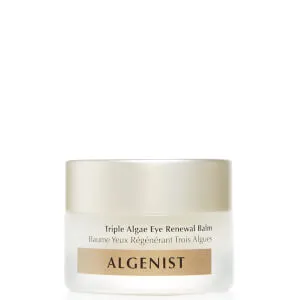
Algenist Triple Algae Eye Renewal Balm

Algenist Triple Algae Eye Renewal Balm

Efficacy91/100IrritancyMedium·100% recommend (1 review)

Works for

Anti-aging
Palmitoyl tetrapeptide-7, Palmitoyl hexapeptide-12 + 9 more
Works well
What the product description says
“A targeted eye cream that combines powerful triple algae with our proprietary, patented Alguronic Acid® clinically shown to help reduce dark under eye circles, bags, puffiness, lines, wrinkles and crow's feet.”
Source: Algenist

This product can help reduce and prevent fine lines and wrinkles, improve skin elasticity and firmness because it contains palmitoyl hexapeptide-12.

These ingredients in the product can also be helpful, even though there is less evidence for their effectiveness: dipeptide-2, palmitoyl tetrapeptide-7, palmitoyl tripeptide-5.

Keep in mind that it typically takes at least 6 weeks to notice any results because the changes that are needed to improve fine lines and elasticity happen in the deeper layers of the skin. No topical anti-aging product can “erase” wrinkles or fully reverse signs of aging.

Palmitoyl tetrapeptide-7Key activeEffect: MediumA type of peptide. Peptides are excellent moisturizers and might be able support collagen production reducing fine lines and wrinkles~0.55–0.85%
Palmitoyl hexapeptide-12Key activeEffect: HighA type of peptide. Peptides are excellent moisturizers and might be able support collagen production reducing fine lines and wrinkles~0.5–0.75%
Dipeptide-2Key activeEffect: MediumA type of peptide. Peptides are excellent moisturizers and might be able support collagen production reducing fine lines and wrinkles~0.5–0.75%
Palmitoyl tripeptide-5Key activeEffect: MediumA type of peptide. Peptides are excellent moisturizers and might be able support collagen production reducing fine lines and wrinkles~0.45–0.65%
Butyrospermum parkii butterEffect: LowA great moisturising ingredient that softens the skin and reduces water loss from its upper layer. It also can be helpful in protecting skin from free radicals~1.3–1.6%
Limnanthes alba seed oilEffect: LowThis oil's cmposition is closest to rapeseed oil. It is a very stable oil and serves as an emoillient~0.75–1.15%
Camellia sinensis leaf extractEffect: LowCan contain potent anti-oxidant compounds (abbreviated ECG, GCG, EGC, and EGCG) that might help protect the skin from free radicals. Can help calm down inflammation and has some anti-bacterial properties. Unfortunately, these antioxidants are unstable and lose their effectiveness very quickly in products. The concentration of the antioxidant compounds in the extract also tends to be low to be effective in topical formulation~0.4–0.6%
Glucosamine hclEffect: LowMight be able to stimulate production of skin's natural moisturizing compounds such as hyaluronic acid. Could be helpful for evening the skin tone.~0.35–0.6%
Aloe barbadensis leaf juiceEffect: Low, below effective doseTraditionally used to treat sunburns, dermatitis and inflammation, but evidence for its effectiveness is lacking. The extract can contain humectants that help attract water into the skin~0.35–0.6%
Tetrahexyldecyl ascorbateUnder-dosedBeing a lipid soluble form of vitamin C, it is more stable than ascorbic acid, but still degrades quickly and needs to be stabilized in a formulation with another ingredient. It is claimed to penetrate skin better than pure vitamin C and have the the similar benefits, but solid studies of its effectiveness are lacking. Is likely to require a higher concentration in a product than pure vitamin C to be effective. It might be able to help reduce pore clogging.~0.35–0.65%
Lactic acidUnder-dosedAn exfoliating and moisturizing alpha-hydroxy acid (AHA). Typically causes less irritation than other AHAs, for example, glycolic acid. At high concentrations (about 15%), lactic acid can help reduce lines and wrinkles. Recent studies show that lactic acid can support the "good" bacteria living on skin's surface (healthy skin microbiome)~0.3–0.6%
Moisturizing
Palmitoyl tetrapeptide-7, Dipeptide-2 + 30 more
Works well
What the product description says
“Patented Alguronic Acid: Hydrates and reduces the appearance of fine lines and wrinkles.”
Source: Sephora CA

This product can help improve hydration of the skin with the two types of ingredients.

The first type is called “humectants”:
these ingredients help attract water. When humectants are on the surface of the skin, they “pull in” the moisture from the outside environment, or from within deeper layers of the skin. The following ingredients in this product do the job: glucosamine hcl, glycerin.

This product also contains ingredients called “occlusives”. They help reduce the speed with which our skin loses moisture to the outside environment. These ingredients also help soften the upper layer of the skin, so it feels less tight and nicer to the touch. The following ingredients in this product do the job: butyrospermum parkii butter, dimethicone.

The following ingredients in this product are especially good for supporting the skin barrier and helping with the hydration level: ceramide ng, dipeptide-2, palmitoyl hexapeptide-12, palmitoyl tetrapeptide-7, palmitoyl tripeptide-5, panthenol

Palmitoyl tetrapeptide-7Hero· EmollientEffect: HighA type of peptide. Peptides are excellent moisturizers and might be able support collagen production reducing fine lines and wrinkles~0.55–0.85%
Dipeptide-2HeroEffect: HighA type of peptide. Peptides are excellent moisturizers and might be able support collagen production reducing fine lines and wrinkles~0.5–0.75%
Palmitoyl hexapeptide-12HeroEffect: HighA type of peptide. Peptides are excellent moisturizers and might be able support collagen production reducing fine lines and wrinkles~0.5–0.75%
Palmitoyl tripeptide-5HeroEffect: HighA type of peptide. Peptides are excellent moisturizers and might be able support collagen production reducing fine lines and wrinkles~0.45–0.65%
Ceramide ngHero· EmollientEffect: HighA type of lipid similar to ceramides naturally present in skin. Helps to soften the upper layer of the skin and supports the skin barrier function to keep it hydrated. Can help to prevent inflammation in skin~0.4–0.6%
PanthenolHero· HumectantEffect: HighHelps attract water to the upper layer of the skin and can help improve skin barrier function~0.35–0.6%
DimethiconeKey active· Emollient, OcclusiveEffect: HighA silicone that helps to reduce water loss from the surface of the skin. Can temporarily "fill in" lines and wrinkles, absorb oil, and create a nice product finish~3.3–4%
GlycerinKey active· HumectantEffect: HighOne of the best moisturizing ingredients. Naturally present in skin. It attracts water to the upper layer of the skin working as a humectant~2.5–3%
Glyceryl stearate seKey activeEffect: MediumUsed to stabilize the product formulations and works as an emollient~1.7–2%
Cetearyl alcoholKey active· EmollientEffect: MediumA non-drying alcohol. Works as an emollient. Helps water and oil mix together and creates a nice product texture~1.5–1.9%
Butyrospermum parkii butterKey active· Emollient, OcclusiveEffect: HighA great moisturising ingredient that softens the skin and reduces water loss from its upper layer. It also can be helpful in protecting skin from free radicals~1.3–1.6%
C12-15 alkyl benzoateKey active· EmollientEffect: MediumEnhances the product texture and makes it more spreadable. Helps reduce water loss from the outer layer of skin. Extands the shelf life by preventing bacteria growth~1–1.2%
Limnanthes alba seed oilKey active· EmollientEffect: HighThis oil's cmposition is closest to rapeseed oil. It is a very stable oil and serves as an emoillient~0.75–1.15%
Parachlorella beijerinckii exopolysaccharidesKey active· HumectantEffect: HighCompounds extracted from green algae that could help neutralize free radicals, but evidence of effectiveness in skincare products (topical applicaiton) is missing. Helps moisturize the skin by attracting water to its upper layer~0.7–1.05%
Corallina officinalis extractKey activeEffect: HighRed algae extract that helps attract water to the upper layer of the skin and might contain antioxidants~0.6–0.9%
Dunaliella salina extractKey activeEffect: MediumA green micro-algae extract that might help neutralize free radicals in skin, but solid evidence is lacking. It helps to soften the upper layer of the skin~0.55–0.85%
Undaria pinnatifida extractKey activeEffect: HighA seaweed extract that helps attract water to the upper layer of the skin and might have an anti-oxidant effect~0.5–0.8%
Sodium hyaluronateKey active· HumectantEffect: HighOne of the best moisturizing ingredients. Attracts water into the upper layer of the skin~0.45–0.65%
Glucosamine hclKey active· HumectantEffect: HighMight be able to stimulate production of skin's natural moisturizing compounds such as hyaluronic acid. Could be helpful for evening the skin tone.~0.35–0.6%
PhospholipidsKey activeEffect: MediumEmollients that are naturaly present in skin. In addition, they help water and oil mix together in the product~0.35–0.6%
Dimethicone crosspolymerKey activeEffect: MediumUsed to create a thicker product texture. Helps soften the upper layer of the skin and might be able to prevent moisture loss from its surface~0.35–0.65%
PantolactoneKey active· HumectantEffect: HighHelps attract water to the upper layer of the skin~0.3–0.6%
Stearic acid· EmollientEffect: LowHelps oil and water mix together and works as an emollient~7–8.6%
Isopropyl isostearate· EmollientEffect: LowAn emollient that helps soften the skin~4.5–5.4%
Pentylene glycol· EmollientEffect: LowUsed to preserve products, dissolve other ingredients and create a nice product texture~2–2.5%
Tribehenin· EmollientEffect: LowUsed to create a thicker product consistency and soften the upper layer of the skin~0.4–0.6%
Caprylyl glycol· Humectant, EmollientEffect: LowHelps preserve products and creates a nice product texture~0.4–0.6%
Camellia sinensis leaf extractEffect: LowCan contain potent anti-oxidant compounds (abbreviated ECG, GCG, EGC, and EGCG) that might help protect the skin from free radicals. Can help calm down inflammation and has some anti-bacterial properties. Unfortunately, these antioxidants are unstable and lose their effectiveness very quickly in products. The concentration of the antioxidant compounds in the extract also tends to be low to be effective in topical formulation~0.4–0.6%
Aloe barbadensis leaf juice powderEffect: LowTraditionally used to treat sunburns, dermatitis and inflammation, but evidence for its effectiveness is lacking. The extract can contain humectants that help attract water into the skin~0.3–0.6%
Aloe barbadensis leaf juiceEffect: Low, below effective doseTraditionally used to treat sunburns, dermatitis and inflammation, but evidence for its effectiveness is lacking. The extract can contain humectants that help attract water into the skin~0.35–0.6%
Cucumis sativus fruit extractEffect: Low, below effective doseMight be somewhat helpful in reducing hyperpigmentation and neutralizing free radicals but its typical concentration in a product is too low for having an effect~0.35–0.6%
Lactic acidUnder-dosedAn exfoliating and moisturizing alpha-hydroxy acid (AHA). Typically causes less irritation than other AHAs, for example, glycolic acid. At high concentrations (about 15%), lactic acid can help reduce lines and wrinkles. Recent studies show that lactic acid can support the "good" bacteria living on skin's surface (healthy skin microbiome)~0.3–0.6%
Evens skin tone
Glucosamine hcl, Camellia sinensis leaf extract + 3 more
May help
What the product description says
“In addition, the serum helps to brighten and prime the skin prior to makeup application.”
Source: SpaceNK

The following ingredient (ingredients) in this product might be helpful, but there is no evidence to confirm that it actually works: glucosamine hcl.

Glucosamine hclKey activeEffect: MediumMight be able to stimulate production of skin's natural moisturizing compounds such as hyaluronic acid. Could be helpful for evening the skin tone.~0.35–0.6%
Camellia sinensis leaf extractEffect: LowCan contain potent anti-oxidant compounds (abbreviated ECG, GCG, EGC, and EGCG) that might help protect the skin from free radicals. Can help calm down inflammation and has some anti-bacterial properties. Unfortunately, these antioxidants are unstable and lose their effectiveness very quickly in products. The concentration of the antioxidant compounds in the extract also tends to be low to be effective in topical formulation~0.4–0.6%
Pisum sativum extractEffect: Low, below effective doseMight be helpful in protecting skin collagen and elastin from breaking down but solid research is lacking~0.35–0.6%
Tetrahexyldecyl ascorbateUnder-dosedBeing a lipid soluble form of vitamin C, it is more stable than ascorbic acid, but still degrades quickly and needs to be stabilized in a formulation with another ingredient. It is claimed to penetrate skin better than pure vitamin C and have the the similar benefits, but solid studies of its effectiveness are lacking. Is likely to require a higher concentration in a product than pure vitamin C to be effective. It might be able to help reduce pore clogging.~0.35–0.65%
Lactic acidUnder-dosedAn exfoliating and moisturizing alpha-hydroxy acid (AHA). Typically causes less irritation than other AHAs, for example, glycolic acid. At high concentrations (about 15%), lactic acid can help reduce lines and wrinkles. Recent studies show that lactic acid can support the "good" bacteria living on skin's surface (healthy skin microbiome)~0.3–0.6%
Anti-oxidation
Side benefit · Camellia sinensis leaf extract, Butyrospermum parkii butter + 13 more
May help

This product contains antioxidants (camellia sinensis leaf extract) that might be able to help neutralize free radicals in skin to lessen the damage it gets from the UV light (sun). There is not enough evidence to confirm their effectiveness in skin though.

Camellia sinensis leaf extractKey activeEffect: MediumCan contain potent anti-oxidant compounds (abbreviated ECG, GCG, EGC, and EGCG) that might help protect the skin from free radicals. Can help calm down inflammation and has some anti-bacterial properties. Unfortunately, these antioxidants are unstable and lose their effectiveness very quickly in products. The concentration of the antioxidant compounds in the extract also tends to be low to be effective in topical formulation~0.4–0.6%
Butyrospermum parkii butterEffect: LowA great moisturising ingredient that softens the skin and reduces water loss from its upper layer. It also can be helpful in protecting skin from free radicals~1.3–1.6%
Limnanthes alba seed oilEffect: LowThis oil's cmposition is closest to rapeseed oil. It is a very stable oil and serves as an emoillient~0.75–1.15%
Parachlorella beijerinckii exopolysaccharidesEffect: LowCompounds extracted from green algae that could help neutralize free radicals, but evidence of effectiveness in skincare products (topical applicaiton) is missing. Helps moisturize the skin by attracting water to its upper layer~0.7–1.05%
Corallina officinalis extractEffect: LowRed algae extract that helps attract water to the upper layer of the skin and might contain antioxidants~0.6–0.9%
Dunaliella salina extractEffect: LowA green micro-algae extract that might help neutralize free radicals in skin, but solid evidence is lacking. It helps to soften the upper layer of the skin~0.55–0.85%
Undaria pinnatifida extractEffect: LowA seaweed extract that helps attract water to the upper layer of the skin and might have an anti-oxidant effect~0.5–0.8%
CaffeineEffect: LowMight be helpful in neutralizing free radicals. Can have a dehydration effect that might somewhat decrease the look of puffy eyes~0.4–0.6%
Coffea arabica seed oilEffect: LowMight be helpful in neutralizing free radicals in skin~0.4–0.6%
Glucosamine hclEffect: LowMight be able to stimulate production of skin's natural moisturizing compounds such as hyaluronic acid. Could be helpful for evening the skin tone.~0.35–0.6%
Rubus idaeus leaf extractEffect: LowA plant extract that might have some anti-oxidant properties but evidence of effectiveness in skin is lacking~0.3–0.6%
Hesperidin methyl chalconeEffect: LowMight help neutralize free radicals in skin. Is claimed to be able to improve the appearance of undereye darkness but evidence is missing. Can be an allergen and cause irritation~0.25–0.5%
Cucumis sativus fruit extractEffect: Low, below effective doseMight be somewhat helpful in reducing hyperpigmentation and neutralizing free radicals but its typical concentration in a product is too low for having an effect~0.35–0.6%
Tocopheryl acetateEffect: Low, below effective doseA more stable but less bio-available form of vitamin E compared to Tocopherol. Might help moisturize and protect the skin from free radicals, but mostly used in low concentrations to stabilize other ingredients.~0.35–0.65%
Tetrahexyldecyl ascorbateUnder-dosedBeing a lipid soluble form of vitamin C, it is more stable than ascorbic acid, but still degrades quickly and needs to be stabilized in a formulation with another ingredient. It is claimed to penetrate skin better than pure vitamin C and have the the similar benefits, but solid studies of its effectiveness are lacking. Is likely to require a higher concentration in a product than pure vitamin C to be effective. It might be able to help reduce pore clogging.~0.35–0.65%

Can it cause trouble?

Irritancy
1 strong irritant: Lilium candidum flower extract
Medium risk
We flagged 29 ingredients with irritancy potential. Severity depends on your sensitivity threshold; the table lists the worst offenders first.
IngredientFunctionIrritationEst. amount
Lilium candidum flower extractUsed as a fragranceHigh~0.3–0.6%est.
Hesperidin methyl chalconeMight help neutralize free radicals in skin. Is claimed to be able to improve the appearance of undereye darkness but evidence is missing. Can be an allergen and cause irritationHigh~0.25–0.5%est.
Benzyl alcoholA preservative. Can be used to mask unpleasant smell. Can be irritatingHigh~0.1–0.2%est.
Pentylene glycolUsed to preserve products, dissolve other ingredients and create a nice product textureMedium~2–2.5%est.
CaffeineMight be helpful in neutralizing free radicals. Can have a dehydration effect that might somewhat decrease the look of puffy eyesMedium~0.4–0.6%est.
Coffea arabica seed oilMight be helpful in neutralizing free radicals in skinMedium~0.4–0.6%est.
Peg-10 phytosterolHelps oil and water mix togetherMedium~0.4–0.6%est.
Tetrahexyldecyl ascorbateBeing a lipid soluble form of vitamin C, it is more stable than ascorbic acid, but still degrades quickly and needs to be stabilized in a formulation with another ingredient. It is claimed to penetrate skin better than pure vitamin C and have the the similar benefits, but solid studies of its effectiveness are lacking. Is likely to require a higher concentration in a product than pure vitamin C to be effective. It might be able to help reduce pore clogging.Medium~0.35–0.65%est.
Aloe barbadensis leaf juiceTraditionally used to treat sunburns, dermatitis and inflammation, but evidence for its effectiveness is lacking. The extract can contain humectants that help attract water into the skinMedium~0.35–0.6%est.
Tocopheryl acetateA more stable but less bio-available form of vitamin E compared to Tocopherol. Might help moisturize and protect the skin from free radicals, but mostly used in low concentrations to stabilize other ingredients.Medium~0.35–0.65%est.
Bambusa vulgaris leaf/stem extractThe extract can contain up to 70% of silica. In cosmetics, silica helps absorb oil and creates a thicker product textureMedium~0.4–0.65%est.
Pisum sativum extractMight be helpful in protecting skin collagen and elastin from breaking down but solid research is lackingMedium~0.35–0.6%est.
Leuconostoc/radish root ferment filtrateA preservative that comes from radishes fermented by a bacteria. New research suggests that the preservation properties in the ingredient come from an ammonium salt that is not present naturally in radish root but used in its cultivation. Is problematic because the exact amount of the preservative agents is difficult to determineMedium~0.35–0.65%est.
Cucumis sativus fruit extractMight be somewhat helpful in reducing hyperpigmentation and neutralizing free radicals but its typical concentration in a product is too low for having an effectMedium~0.35–0.6%est.
Caprylyl/capryl glucosideHelps oil and water mix together. Can be used as a cleansing agentMedium~0.5–0.7%est.
Rubus idaeus leaf extractA plant extract that might have some anti-oxidant properties but evidence of effectiveness in skin is lackingMedium~0.3–0.6%est.
Aloe barbadensis leaf juice powderTraditionally used to treat sunburns, dermatitis and inflammation, but evidence for its effectiveness is lacking. The extract can contain humectants that help attract water into the skinMedium~0.3–0.6%est.
Ceteareth-20Helps oil and water mix together. Has some emollient propertiesMedium~0.45–0.7%est.
Acrylates/c10-30 alkyl acrylate crosspolymerMaintains the texture of skincare products. Allows the product to spread evenly. Helps oil and water mix togetherMedium~0.35–0.65%est.
Disodium edtaStabilizes the product formulationMedium~0.35–0.65%est.
Caprylyl glycolHelps preserve products and creates a nice product textureMedium~0.4–0.6%est.
Lactic acidAn exfoliating and moisturizing alpha-hydroxy acid (AHA). Typically causes less irritation than other AHAs, for example, glycolic acid. At high concentrations (about 15%), lactic acid can help reduce lines and wrinkles. Recent studies show that lactic acid can support the "good" bacteria living on skin's surface (healthy skin microbiome)Medium~0.3–0.6%est.
EthylhexylglycerinA preservativeMedium~0.3–0.6%est.
Hexylene glycolHelps create a more spreadable product textureMedium~0.3–0.5%est.
Steareth-20Helps oil and water mix togetherMedium~0.4–0.6%est.
Citric acidCan work as an exfoliant but is typically used to adjust the product pHMedium~0.25–0.45%est.
Sodium citrateHelps to control the skin's pH level. Maintains the skin's natural film of amino-lactic acids and oils. Helps to preserve productsMedium~0.2–0.35%est.
Chlorhexidine digluconateA preservativeMedium~0.15–0.3%est.
Potassium sorbateA preservativeMedium~0.15–0.3%est.
Comedogenic
6 ingredients rated 2 or more on the 0–5 pore-clogging scale
6 flagged
These ingredients have a comedogenic rating of 2 or more on a 0–5 scale; the table shows each one's rating. In leave-on products they can clog pores in acne-prone skin.
IngredientFunctionRatingEst. amount
Isopropyl isostearateAn emollient that helps soften the skin3/5~4.5–5.4%est.
Butyrospermum parkii butterA great moisturising ingredient that softens the skin and reduces water loss from its upper layer. It also can be helpful in protecting skin from free radicals3/5~1.3–1.6%est.
Corallina officinalis extractRed algae extract that helps attract water to the upper layer of the skin and might contain antioxidants3/5~0.6–0.9%est.
Glyceryl stearate seUsed to stabilize the product formulations and works as an emollient2/5~1.7–2%est.
Cetearyl alcoholA non-drying alcohol. Works as an emollient. Helps water and oil mix together and creates a nice product texture2/5~1.5–1.9%est.
Ceteareth-20Helps oil and water mix together. Has some emollient properties2/5~0.45–0.7%est.

User reviews

Would you recommend?
100%·yes

1 of 1 community members would buy it again.

100% would0% wouldn't
  • Heather K· Apr 2025Recommends

    Love it. Notice a big difference in the smoothness/depth of morning wrinkles after using it.

What reviewers noticed
Marker shows the average response

Ingredients

Filter by role to see what each ingredient is doing.

Water~45–55%
Formula
Irritation risk
Low

Plain old water

More about Water
Stearic acid~7–8.6%
Formula
Irritation risk
Low
Works for
CleansingMoisturizing

Helps oil and water mix together and works as an emollient

More about Stearic acid
Isopropyl isostearate~4.5–5.4%
Comedogenic 3/5
Irritation risk
Low
Comedogenicity
3/5
Works for
Moisturizing

An emollient that helps soften the skin

More about Isopropyl isostearate
Dimethicone~3.3–4%
Key active
Irritation risk
Low
Works for
MoisturizingMattifying

A silicone that helps to reduce water loss from the surface of the skin. Can temporarily "fill in" lines and wrinkles, absorb oil, and create a nice product finish

More about Dimethicone
Glycerin~2.5–3%
Key active
Irritation risk
Low
Works for
Moisturizing

One of the best moisturizing ingredients. Naturally present in skin. It attracts water to the upper layer of the skin working as a humectant

More about Glycerin
Pentylene glycol~2–2.5%
Irritant · medium
Irritation risk
Medium
Works for
Moisturizing

Used to preserve products, dissolve other ingredients and create a nice product texture

More about Pentylene glycol
Glyceryl stearate se~1.7–2%
Key activeComedogenic 2/5
Irritation risk
Low
Comedogenicity
2/5
Works for
CleansingMoisturizing

Used to stabilize the product formulations and works as an emollient

More about Glyceryl stearate se
Cetearyl alcohol~1.5–1.9%
Key activeComedogenic 2/5
Irritation risk
Low
Comedogenicity
2/5
Works for
CleansingMoisturizing

A non-drying alcohol. Works as an emollient. Helps water and oil mix together and creates a nice product texture

More about Cetearyl alcohol
Butyrospermum parkii butter~1.3–1.6%
Key activeComedogenic 3/5
Irritation risk
Low
Comedogenicity
3/5
Works for
MoisturizingAnti-agingAnti-oxidation

A great moisturising ingredient that softens the skin and reduces water loss from its upper layer. It also can be helpful in protecting skin from free radicals

More about Butyrospermum parkii butter
C12-15 alkyl benzoate~1–1.2%
Key active
Irritation risk
Low
Works for
Moisturizing

Enhances the product texture and makes it more spreadable. Helps reduce water loss from the outer layer of skin. Extands the shelf life by preventing bacteria growth

More about C12-15 alkyl benzoate
Limnanthes alba seed oil~0.75–1.15%
Key active
Irritation risk
Low
Works for
MoisturizingAnti-oxidationAnti-aging

This oil's cmposition is closest to rapeseed oil. It is a very stable oil and serves as an emoillient

More about Limnanthes alba seed oil
Parachlorella beijerinckii exopolysaccharides~0.7–1.05%
Key active
Irritation risk
Low
Works for
MoisturizingAnti-oxidation

Compounds extracted from green algae that could help neutralize free radicals, but evidence of effectiveness in skincare products (topical applicaiton) is missing. Helps moisturize the skin by attracting water to its upper layer

More about Parachlorella beijerinckii exopolysaccharides
Corallina officinalis extract~0.6–0.9%
Key activeComedogenic 3/5
Irritation risk
Low
Comedogenicity
3/5
Works for
MoisturizingAnti-oxidation

Red algae extract that helps attract water to the upper layer of the skin and might contain antioxidants

More about Corallina officinalis extract
Dunaliella salina extract~0.55–0.85%
Key active
Irritation risk
Low
Works for
MoisturizingAnti-oxidation

A green micro-algae extract that might help neutralize free radicals in skin, but solid evidence is lacking. It helps to soften the upper layer of the skin

More about Dunaliella salina extract
Undaria pinnatifida extract~0.5–0.8%
Key active
Irritation risk
Low
Works for
MoisturizingAnti-oxidation

A seaweed extract that helps attract water to the upper layer of the skin and might have an anti-oxidant effect

More about Undaria pinnatifida extract
Dipeptide-2~0.5–0.75%
Hero · Moisturizing
Irritation risk
Low
Works for
MoisturizingAnti-aging

A type of peptide. Peptides are excellent moisturizers and might be able support collagen production reducing fine lines and wrinkles

More about Dipeptide-2
Palmitoyl tetrapeptide-7~0.55–0.85%
Hero · Moisturizing
Irritation risk
Low
Works for
MoisturizingAnti-aging

A type of peptide. Peptides are excellent moisturizers and might be able support collagen production reducing fine lines and wrinkles

More about Palmitoyl tetrapeptide-7
Palmitoyl hexapeptide-12~0.5–0.75%
Hero · Moisturizing
Irritation risk
Low
Works for
MoisturizingAnti-aging

A type of peptide. Peptides are excellent moisturizers and might be able support collagen production reducing fine lines and wrinkles

More about Palmitoyl hexapeptide-12
Palmitoyl tripeptide-5~0.45–0.65%
Hero · Moisturizing
Irritation risk
Low
Works for
MoisturizingAnti-aging

A type of peptide. Peptides are excellent moisturizers and might be able support collagen production reducing fine lines and wrinkles

More about Palmitoyl tripeptide-5
Sodium hyaluronate~0.45–0.65%
Key active
Irritation risk
Low
Works for
Moisturizing

One of the best moisturizing ingredients. Attracts water into the upper layer of the skin

More about Sodium hyaluronate
Caffeine~0.4–0.6%
Irritant · medium
Irritation risk
Medium
Works for
De-puffingAnti-oxidation

Might be helpful in neutralizing free radicals. Can have a dehydration effect that might somewhat decrease the look of puffy eyes

More about Caffeine
Coffea arabica seed oil~0.4–0.6%
Irritant · medium
Irritation risk
Medium
Works for
Anti-oxidation

Might be helpful in neutralizing free radicals in skin

More about Coffea arabica seed oil
Tribehenin~0.4–0.6%
Formula
Irritation risk
Low
Works for
Moisturizing

Used to create a thicker product consistency and soften the upper layer of the skin

More about Tribehenin
Ceramide ng~0.4–0.6%
Hero · Moisturizing
Irritation risk
Low
Works for
MoisturizingAnti-inflammatory

A type of lipid similar to ceramides naturally present in skin. Helps to soften the upper layer of the skin and supports the skin barrier function to keep it hydrated. Can help to prevent inflammation in skin

More about Ceramide ng
Peg-10 phytosterol~0.4–0.6%
Irritant · medium
Irritation risk
Medium
Works for
Cleansing

Helps oil and water mix together

More about Peg-10 phytosterol
Tetrahexyldecyl ascorbate~0.35–0.65%
Under-dosedIrritant · medium
Irritation risk
Medium
Works for
Anti-agingEvens skin toneAnti-oxidation

Being a lipid soluble form of vitamin C, it is more stable than ascorbic acid, but still degrades quickly and needs to be stabilized in a formulation with another ingredient. It is claimed to penetrate skin better than pure vitamin C and have the the similar benefits, but solid studies of its effectiveness are lacking. Is likely to require a higher concentration in a product than pure vitamin C to be effective. It might be able to help reduce pore clogging.

More about Tetrahexyldecyl ascorbate
Aloe barbadensis leaf juice~0.35–0.6%
Irritant · medium
Irritation risk
Medium
Works for
MoisturizingAntibacterialAnti-inflammatoryReduces rednessReduces irritationAnti-agingAnti-blemish

Traditionally used to treat sunburns, dermatitis and inflammation, but evidence for its effectiveness is lacking. The extract can contain humectants that help attract water into the skin

More about Aloe barbadensis leaf juice
Tocopheryl acetate~0.35–0.65%
Irritant · medium
Irritation risk
Medium
Works for
Anti-oxidation

A more stable but less bio-available form of vitamin E compared to Tocopherol. Might help moisturize and protect the skin from free radicals, but mostly used in low concentrations to stabilize other ingredients.

More about Tocopheryl acetate
Bambusa vulgaris leaf/stem extract~0.4–0.65%
Irritant · medium
Irritation risk
Medium

The extract can contain up to 70% of silica. In cosmetics, silica helps absorb oil and creates a thicker product texture

More about Bambusa vulgaris leaf/stem extract
Pisum sativum extract~0.35–0.6%
Irritant · medium
Irritation risk
Medium
Works for
Evens skin tone

Might be helpful in protecting skin collagen and elastin from breaking down but solid research is lacking

More about Pisum sativum extract
Glucosamine hcl~0.35–0.6%
Key active
Irritation risk
Low
Works for
AntibacterialMoisturizingEvens skin toneAnti-oxidationAnti-aging

Might be able to stimulate production of skin's natural moisturizing compounds such as hyaluronic acid. Could be helpful for evening the skin tone.

More about Glucosamine hcl
Leuconostoc/radish root ferment filtrate~0.35–0.65%
Irritant · medium
Irritation risk
Medium

A preservative that comes from radishes fermented by a bacteria. New research suggests that the preservation properties in the ingredient come from an ammonium salt that is not present naturally in radish root but used in its cultivation. Is problematic because the exact amount of the preservative agents is difficult to determine

More about Leuconostoc/radish root ferment filtrate
Camellia sinensis leaf extract~0.4–0.6%
Key active
Irritation risk
Low
Works for
AntibacterialAnti-oxidationAnti-agingAnti-blemishEvens skin toneMoisturizing

Can contain potent anti-oxidant compounds (abbreviated ECG, GCG, EGC, and EGCG) that might help protect the skin from free radicals. Can help calm down inflammation and has some anti-bacterial properties. Unfortunately, these antioxidants are unstable and lose their effectiveness very quickly in products. The concentration of the antioxidant compounds in the extract also tends to be low to be effective in topical formulation

More about Camellia sinensis leaf extract
Cucumis sativus fruit extract~0.35–0.6%
Irritant · medium
Irritation risk
Medium
Works for
Anti-oxidationMoisturizing

Might be somewhat helpful in reducing hyperpigmentation and neutralizing free radicals but its typical concentration in a product is too low for having an effect

More about Cucumis sativus fruit extract
Dimethicone crosspolymer~0.35–0.65%
Key active
Irritation risk
Low
Works for
Moisturizing

Used to create a thicker product texture. Helps soften the upper layer of the skin and might be able to prevent moisture loss from its surface

More about Dimethicone crosspolymer
Panthenol~0.35–0.6%
Hero · Moisturizing
Irritation risk
Low
Works for
MoisturizingReduces rednessReduces irritation

Helps attract water to the upper layer of the skin and can help improve skin barrier function

More about Panthenol
Pantolactone~0.3–0.6%
Key active
Irritation risk
Low
Works for
Moisturizing

Helps attract water to the upper layer of the skin

More about Pantolactone
Caprylyl/capryl glucoside~0.5–0.7%
Irritant · medium
Irritation risk
Medium
Works for
Cleansing

Helps oil and water mix together. Can be used as a cleansing agent

More about Caprylyl/capryl glucoside
Pfaffia paniculata root extract~0.3–0.6%
Formula
Ptychopetalum olacoides bark/stem extract~0.3–0.6%
Formula
Lilium candidum flower extract~0.3–0.6%
Irritant · high
Irritation risk
High

Used as a fragrance

More about Lilium candidum flower extract
Rubus idaeus leaf extract~0.3–0.6%
Irritant · medium
Irritation risk
Medium
Works for
Anti-oxidation

A plant extract that might have some anti-oxidant properties but evidence of effectiveness in skin is lacking

More about Rubus idaeus leaf extract
Aloe barbadensis leaf juice powder~0.3–0.6%
Irritant · medium
Irritation risk
Medium
Works for
Moisturizing

Traditionally used to treat sunburns, dermatitis and inflammation, but evidence for its effectiveness is lacking. The extract can contain humectants that help attract water into the skin

More about Aloe barbadensis leaf juice powder
Vinyl dimethicone/methicone silsesquioxane crosspolymer~0.35–0.6%
Formula
Irritation risk
Low

A type of silicone that create a smooth product finish and can create an optical soft-focus effect on the skin. Helps to thicken the product consistency

More about Vinyl dimethicone/methicone silsesquioxane crosspolymer
Phospholipids~0.35–0.6%
Key active
Irritation risk
Low
Works for
Moisturizing

Emollients that are naturaly present in skin. In addition, they help water and oil mix together in the product

More about Phospholipids
Ceteareth-20~0.45–0.7%
Comedogenic 2/5Irritant · medium
Irritation risk
Medium
Comedogenicity
2/5
Works for
Cleansing

Helps oil and water mix together. Has some emollient properties

More about Ceteareth-20
Acrylates/c10-30 alkyl acrylate crosspolymer~0.35–0.65%
Irritant · medium
Irritation risk
Medium

Maintains the texture of skincare products. Allows the product to spread evenly. Helps oil and water mix together

More about Acrylates/c10-30 alkyl acrylate crosspolymer
Disodium edta~0.35–0.65%
Irritant · medium
Irritation risk
Medium

Stabilizes the product formulation

More about Disodium edta
Aminomethyl propanol~0.35–0.65%
Formula
Irritation risk
Low

Used to adjust the pH in formulations

More about Aminomethyl propanol
Caprylyl glycol~0.4–0.6%
Irritant · medium
Irritation risk
Medium
Works for
Moisturizing

Helps preserve products and creates a nice product texture

More about Caprylyl glycol
Lactic acid~0.3–0.6%
Under-dosedIrritant · medium
Irritation risk
Medium
Works for
Evens skin toneMoisturizingExfoliationAnti-aging

An exfoliating and moisturizing alpha-hydroxy acid (AHA). Typically causes less irritation than other AHAs, for example, glycolic acid. At high concentrations (about 15%), lactic acid can help reduce lines and wrinkles. Recent studies show that lactic acid can support the "good" bacteria living on skin's surface (healthy skin microbiome)

More about Lactic acid
Ethylhexylglycerin~0.3–0.6%
Irritant · medium
Irritation risk
Medium

A preservative

More about Ethylhexylglycerin
Hexylene glycol~0.3–0.5%
Irritant · medium
Irritation risk
Medium
Works for
Cleansing

Helps create a more spreadable product texture

More about Hexylene glycol
Hesperidin methyl chalcone~0.25–0.5%
Irritant · high
Irritation risk
High
Works for
Anti-oxidation

Might help neutralize free radicals in skin. Is claimed to be able to improve the appearance of undereye darkness but evidence is missing. Can be an allergen and cause irritation

More about Hesperidin methyl chalcone
Steareth-20~0.4–0.6%
Irritant · medium
Irritation risk
Medium
Works for
Cleansing

Helps oil and water mix together

More about Steareth-20
Citric acid~0.25–0.45%
Irritant · medium
Irritation risk
Medium

Can work as an exfoliant but is typically used to adjust the product pH

More about Citric acid
Sodium citrate~0.2–0.35%
Irritant · medium
Irritation risk
Medium

Helps to control the skin's pH level. Maintains the skin's natural film of amino-lactic acids and oils. Helps to preserve products

More about Sodium citrate
Chlorhexidine digluconate~0.15–0.3%
Irritant · medium
Irritation risk
Medium

A preservative

More about Chlorhexidine digluconate
Phenoxyethanol~0.2–0.35%
Formula
Irritation risk
Low

A preservative. It helps prevent bacterial growth in cosmetic products

More about Phenoxyethanol
Potassium sorbate~0.15–0.3%
Irritant · medium
Irritation risk
Medium

A preservative

More about Potassium sorbate
Benzyl alcohol~0.1–0.2%
Irritant · high
Irritation risk
High

A preservative. Can be used to mask unpleasant smell. Can be irritating

More about Benzyl alcohol
Sodium benzoate~0.15–0.25%
Formula
Irritation risk
Low

A preservative

More about Sodium benzoate
Ingredient list view

Water, Stearic acid, Isopropyl isostearate, Dimethicone, Glycerin, Pentylene glycol, Glyceryl stearate se, Cetearyl alcohol, Butyrospermum parkii butter, C12-15 alkyl benzoate, Limnanthes alba seed oil, Parachlorella beijerinckii exopolysaccharides, Corallina officinalis extract, Dunaliella salina extract, Undaria pinnatifida extract, Dipeptide-2, Palmitoyl tetrapeptide-7, Palmitoyl hexapeptide-12, Palmitoyl tripeptide-5, Sodium hyaluronate, Caffeine, Coffea arabica seed oil, Tribehenin, Ceramide ng, Peg-10 phytosterol, Tetrahexyldecyl ascorbate, Aloe barbadensis leaf juice, Tocopheryl acetate, Bambusa vulgaris leaf/stem extract, Pisum sativum extract, Glucosamine hcl, Leuconostoc/radish root ferment filtrate, Camellia sinensis leaf extract, Cucumis sativus fruit extract, Dimethicone crosspolymer, Panthenol, Pantolactone, Caprylyl/capryl glucoside, Pfaffia paniculata root extract, Ptychopetalum olacoides bark/stem extract, Lilium candidum flower extract, Rubus idaeus leaf extract, Aloe barbadensis leaf juice powder, Vinyl dimethicone/methicone silsesquioxane crosspolymer, Phospholipids, Ceteareth-20, Acrylates/c10-30 alkyl acrylate crosspolymer, Disodium edta, Aminomethyl propanol, Caprylyl glycol, Lactic acid, Ethylhexylglycerin, Hexylene glycol, Hesperidin methyl chalcone, Steareth-20, Citric acid, Sodium citrate, Chlorhexidine digluconate, Phenoxyethanol, Potassium sorbate, Benzyl alcohol, Sodium benzoate

Compare prices

Retailers ranked by price — lowest first.

Amazon USPrice as of 11/10 03:23 GMT
$27.99
Buy
Algenist
$36.00
Buy
Sephora
$68.00
Buy
SpaceNK US
$68.00
Buy
Ulta0.5 oz
$68.00
Buy

Affiliate links · As an Amazon Associate, WIMJ earns from qualifying purchases.

Worth comparing, line by line.

Match % combines shared ingredients, the first five ingredients, shared actives and hero ingredients, irritancy (lower counts in the alternative's favour), texture and body area. Only products in the same routine step are compared.

Side-by-side comparison of this product against its closest alternatives
AlgenistTriple Algae Eye Renewal BalmYOUR PRODUCTe.l.f. Cosmetics50 MG CBD Eye CreamDermalogicaAge Reversal Eye ComplexWhishRepairing Eye Cream With Bakuchiol
Match—44%42%42%
Price$68.00—$75.00+$7.00$59.42−$8.58
Shared key ingredients—7 of 1912 of 1911 of 19
Key difference—CbdArginine/Lysine PolypeptideBakuchiol
Irritancy Medium Low Medium Medium
Drying alcohol————
View product Shop Shop Shop

More alternatives: BAD HABIT Eyes Open Caffeine & Peptide Eye Creamflorence by mills Look Alive Eye Balm

Cheaper alternatives? See how this stacks up against similar formulas.
We compare ingredient profiles across our catalog — pick the closest match for your budget.
Open dupe finder

Product summary

Based on the ingredients included, "Algenist - Triple Algae Eye Renewal Balm" works well for moisturizing the skin. As we expect from a proper moisturizer, the formula includes a combo of effective humectants and emollients. These are the two different types of ingredients that are essential for improving the skin hydration and supporting a healthy skin barrier. Humectants in this product (panthenol, glucosamine hcl, glycerin, pantolactone and parachlorella beijerinckii exopolysaccharides) help to increase the water content in the upper layer of the skin. (These ingredients do so by "capturing" water molecules from the outside air or from within the deeper layers of the skin). Emollients in this formulation (ceramide ng, palmitoyl tetrapeptide-7, limnanthes alba seed oil, butyrospermum parkii butter and dimethicone) help to reduce the moisture loss from the skin. They also soften the skin surface and relieve the feeling of dryness and tightness.

Ingredient callouts

  • Another benefit is that this moisturizer contain ceramides (ceramide ng 0.40% - 0.60%). Ceramides are an important part of our natural skin barrier. The ceramides used in skincare are synthetic or come from plants. They help soften the skin and can help "fill the gaps" in the skin barrier, keeping the skin hydrated and resilient for longer.
  • We like that this moisturizer contains peptides (palmitoyl tripeptide-5 0.45% - 0.65%, palmitoyl tetrapeptide-7 0.55% - 0.85%, palmitoyl hexapeptide-12 0.50% - 0.75% and dipeptide-2 0.50% - 0.75%). There are many different kind of peptides and they are naturally present in our skin. They all are a combination of amino-acids. Some of them work as natural anti-biotics, promote wound-healing and production of collagen. The science is still not settled on how effective peptides in skincare are, but it is very likely that they have a benefit. Peptides might help restore the skin barrier and fight the signs of aging. At the very least, peptides work as humectants: they attract water to the upper layer of the skin and improve its hydration.

Irritation risk

This moisturizer contains some common irritants, including those without a benefit for the skin. We assess the overall irritancy of this moisturizer to be medium. For a detailed overview of all potential irritants: click here

You can see the detailed formula review with the breakdown of all actives in the product and the full ingredient list with estimated concentrations in the tables below.

Price

The product retails from 23.00$ up to 68.00$ in the United States, from 37.25£ up to 56.00£ in the United Kingdom, from 81.60CA$ up to 87.00CA$ in Canada and for 660.00HK$ in Hong Kong.

For a detailed price comparison: click here.

Sources cited in this review

Every concentration estimate and effectiveness label is anchored to one of these 22 studies and safety reviews.

  1. 1
  2. 2
  3. 3
  4. 4
  5. 5
  6. 6
Algenist Triple Algae Eye Renewal Balm
AlgenistTriple Algae Eye Renewal Balm

Affiliate links · As an Amazon Associate, WIMJ earns from qualifying purchases.

As an Amazon Associate, WIMJ earns from qualifying purchases.