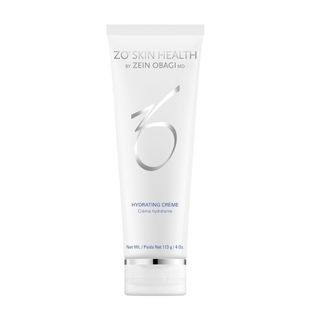
ZO Skin Health Hydrating Creme
Works for
1 of 1 advertised claim delivered
Moisturizing12 ingredients credited for this claimStrong support
“Hydrating Creme”
This product can help improve hydration of the skin with the two types of ingredients.
The first type is called “humectants”:
these ingredients help attract water.
When humectants are on the surface of the skin, they “pull in” the moisture from the outside environment, or from
within deeper layers of the skin. The following ingredients in this product do the job:
glycerin, butylene glycol.
This product also contains ingredients called “occlusives”. They help reduce the speed with which our skin loses moisture to the outside environment. These ingredients also help soften the upper layer of the skin, so it feels less tight and nicer to the touch. The following ingredients in this product do the job: butyrospermum parkii butter, cetyl alcohol.
The following ingredients in this product are especially good for supporting the skin barrier and helping with the hydration level: colloidal oatmeal, petrolatum, tetrapeptide-21
Anti-agingNot advertised by the brand · 5 ingredients credited for this claimModerate support
This product contains retinyl palmitate, tetrapeptide-21. These ingredients might be able to help reduce and prevent fine lines and wrinkles, improve skin elasticity and firmness, but there is not enough evidence that it actually works.
Evens skin toneNot advertised by the brand · 3 ingredients credited for this claimModerate support
The following ingredient (ingredients) in this product might be helpful, but there is no evidence to confirm that it actually works: retinyl palmitate.
Can it cause trouble?
Irritancy1 strong irritant: Retinyl palmitateMedium risk
Comedogenic2 ingredients rated 2 or more on the 0–5 pore-clogging scale2 flagged

User reviews
Be the first — your take helps the next person decide.
Ingredients
Filter by role to see what each ingredient is doing.
Water~40–60%
Glycerin~3.9–5.8%
- Irritation risk
- Low
One of the best moisturizing ingredients. Naturally present in skin. It attracts water to the upper layer of the skin working as a humectant
More about GlycerinPetrolatum~3.7–5.6%
- Irritation risk
- Low
One of the most effective and the most studied occlusive ingredients that creates a protective layer on top of the skin preventing moisture loss
More about PetrolatumDistearyldimonium chloride~2.7–4%
- Irritation risk
- Low
Isopropyl palmitate~2–2.9%
- Irritation risk
- Medium
- Comedogenicity
- 3/5
Helps soften the upper layer of the skin and create a thicker product consistency
More about Isopropyl palmitateCyclopentasiloxane~1.7–2.5%
- Irritation risk
- Low
A silicone that helps improve the product texture and spreadability. Can absorb oil creating a short-term mattifying effect on the skin
More about CyclopentasiloxaneCetyl alcohol~1.4–2.1%
- Irritation risk
- Low
A non-drying alcohol that works to soften the skin and stabilize product formulations helping oil and water mix together
More about Cetyl alcoholButyrospermum parkii butter~1.3–2%
- Irritation risk
- Low
- Comedogenicity
- 3/5
A great moisturising ingredient that softens the skin and reduces water loss from its upper layer. It also can be helpful in protecting skin from free radicals
More about Butyrospermum parkii butterColloidal oatmeal~1.2–1.7%
- Irritation risk
- Low
Helps to restore skin barrier function, soften the upper layer of the skin and calm down inflammation
More about Colloidal oatmealOphiopogon japonicus root extract~0.6–1.4%
- Irritation risk
- Medium
Plant extract that might help neutralize free radicals and support skin barrier function, but research on its effectiveness in skin is lacking
More about Ophiopogon japonicus root extractTocopheryl acetate~0.5–1.2%
- Irritation risk
- Medium
A more stable but less bio-available form of vitamin E compared to Tocopherol. Might help moisturize and protect the skin from free radicals, but mostly used in low concentrations to stabilize other ingredients.
More about Tocopheryl acetateRetinyl palmitate~0.4–0.95%
- Irritation risk
- High
Three steps removed from the active form of vitamin A - retinoic acid. To have an effect in the skin, it first needs to be converted twice to become the retinoic acid. This means it is less potent than retinol, but could also be less irritating. Once converted to the retinoic acid in the skin, it helps against all signs of aging, improves skin cell turnover and helps fight blemishes and clogged pores. However, in many cosmetic formulations, it is used in a concentration that is too low to have the full effect
More about Retinyl palmitateAscorbic acid~0.4–0.9%
- Irritation risk
- High
The most well-researched antioxidant that works in skin. Helps neutralize free radicals supporting collagen production, helping to even out the skin tone and preventing early signs of aging
More about Ascorbic acidBeta-glucan~0.3–0.75%
- Irritation risk
- Low
Helps attract water to the upper layer of the skin, calm down inflammation and irritation, restore the barrier function and support wound healing. It can be helpful in reducing fine lines and wrinkles
More about Beta-glucanTetrapeptide-21~0.2–0.75%
- Irritation risk
- Low
A type of peptide. Peptides are excellent moisturizers and might be able support collagen production reducing fine lines and wrinkles
More about Tetrapeptide-21Myristoyl pentapeptide-11~0.15–0.6%
- Irritation risk
- Low
Polymethyl methacrylate~0.15–0.6%
- Irritation risk
- Low
Is used to enhance product texture and can help to optically mask skin imperfections
More about Polymethyl methacrylateDipotassium glycyrrhizate~0.1–0.45%
- Irritation risk
- Low
A salt derived from licorice. Works as an emollient to soften the upper layer of the skin and can help calm down inflammation. Might be helpful for skin lightening
More about Dipotassium glycyrrhizateMaltodextrin~0.1–0.35%
- Irritation risk
- Low
Used to stabilize the product formulation and can help absorb oil
More about MaltodextrinBenzalkonium chloride~0.05–0.1%
- Irritation risk
- High
Helps water and oil mix together and works as a cleansing agent (detergent). Also used as a preservative. Can be irritating
More about Benzalkonium chlorideButylene glycol~0.05–0.25%
- Irritation risk
- Low
Used to create a nice product texture and help delivery of other ingredients. Might be somewhat helpful in attracting water to the upper layer of the skin
More about Butylene glycolSodium chloride~0.05–0.2%
- Irritation risk
- Low
Used to stabilize mixtures of oil and water, and create thicker, gel-like product textures
More about Sodium chlorideBenzyl alcohol~0.05–0.15%
- Irritation risk
- High
A preservative. Can be used to mask unpleasant smell. Can be irritating
More about Benzyl alcoholIngredient list view
Water, Glycerin, Petrolatum, Distearyldimonium chloride, Isopropyl palmitate, Cyclopentasiloxane, Cetyl alcohol, Butyrospermum parkii butter, Colloidal oatmeal, Ophiopogon japonicus root extract, Tocopheryl acetate, Retinyl palmitate, Ascorbic acid, Beta-glucan, Tetrapeptide-21, Myristoyl pentapeptide-11, Polymethyl methacrylate, Dipotassium glycyrrhizate, Maltodextrin, Benzalkonium chloride, Butylene glycol, Sodium chloride, Benzyl alcohol
Compare prices
Retailers ranked by price — lowest first.

Worth comparing, line by line.
Match % combines shared ingredients, the first five ingredients, shared actives and hero ingredients, irritancy (lower counts in the alternative's favour), texture and body area. Only products in the same routine step are compared.
| ZO Skin HealthHydrating CremeYOUR PRODUCT | AveenoBaby Soothing Relief Emollient Cream | |
|---|---|---|
| Match | — | 52% |
| Price | $118.97 | $5.62−$113.35 |
| Shared key ingredients | — | 3 of 8 |
| Key difference | — | Oatmeal Extract |
| Irritancy | Medium | Low |
| Drying alcohol | — | — |
| View product | Shop |

Product summary
"ZO Skin Health - Hydrating Creme" is effective for: Anti-inflammatory and Moisturizing
This product could be helpful for: Anti-aging, but its actives are not the most effective or are not well-studied.
Ingredient callouts
- This product also contains Vitamin C (Ascorbic Acid). It can be an effective active for anti-aging and evening out the skin tone, but in this product it is used for stabilizing other ingredients in the formulation. In this concentration (0.40% - 0.90%) it cannot have a noticeable benefit for the skin.
- This product includes a form of Retinoids (vitamin A) - retinyl palmitate 0.40% - 0.95%, but this type of vitamin A is not very effective. It could in theory help with fine lines and wrinkles, but the effect is most likely minimal.
- Peptides (tetrapeptide-21 0.20% - 0.75%). There are many different kind of Peptides and they are naturally present in our skin. They all are a combination of aminoacids. Some of them work as natural antibiotics, promote wound-healing and production of collagen. The science is still not settled on how effective Peptides are in skincare, but it is very likely that they have a benefit. They might help restore the skin barrier and fight the signs of aging. At the very least, Peptides work as humectants: they attract water to the upper layer of the skin and improve its hydration.
- Humectants (glycerin 3.90% - 5.80%). These ingredients help attract water to the upper layer of the skin and improve the skin hydration.
Price
The product retails for 89.99£ in the United Kingdom and for 125.00$ in the United States.
For a detailed price comparison: click here.
Sources cited in this review
Every concentration estimate and effectiveness label is anchored to one of these 16 studies and safety reviews.
- 1
- 2Final Report on the Safety Assessment of Isopropyl Isostearatejournals.sagepub.com
- 3
- 4
- 5Cosmetic use of an ophiopogon japonicus active principlepatents.google.com
- 6β-Glucans: Multi-Functional Modulator of Wound Healingncbi.nlm.nih.gov

Affiliate links · As an Amazon Associate, WIMJ earns from qualifying purchases.