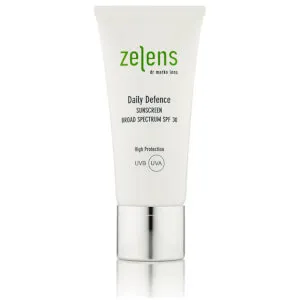
Works for
MoisturizingGlycerin, Cetearyl alcohol + 14 moreWorks
“Daily Defence Moisturiser”
This product can help improve hydration of the skin with the two types of ingredients.
The first type is called “humectants”:
these ingredients help attract water.
When humectants are on the surface of the skin, they “pull in” the moisture from the outside environment, or from
within deeper layers of the skin. The following ingredients in this product do the job:
glycerin, sodium hyaluronate.
This product also contains ingredients called “occlusives”. They help reduce the speed with which our skin loses moisture to the outside environment. These ingredients also help soften the upper layer of the skin, so it feels less tight and nicer to the touch. The following ingredients in this product do the job: dimethicone, cetearyl alcohol.
Evens skin toneAscorbyl tetraisopalmitate ~0.35–0.65%Under-dosed
“Innovative Imudilin® reinforces the immune system, whilst a dose of Vitamin C brightens dull skin and lightens pigmentation spots.”
Effective ingredients missing or their concentration is too low
Anti-oxidationSide benefit · Centella asiatica extract, Camellia sinensis leaf extract + 5 moreMay help
This product contains antioxidants (camellia sinensis leaf extract, centella asiatica extract, ginkgo biloba leaf extract) that might be able to help neutralize free radicals in skin to lessen the damage it gets from the UV light (sun). There is not enough evidence to confirm their effectiveness in skin though.
Anti-agingSide benefit the brand mentions · Centella asiatica extract, Glutamylamidoethyl imidazole + 2 moreMay help
“Fortified with micro-encapsulation technology, the sunscreen delivers organic UV filters embedded in silica-based capsules that create an invisible layer over skin, shielding from the sun and free radicals that can lead to the formation of fine lines and wrinkles.”
This product contains centella asiatica extract. This ingredient might be able to help reduce and prevent fine lines and wrinkles, improve skin elasticity and firmness, but there is not enough evidence that it actually works.
Can it cause trouble?
Irritancy3 strong irritants: Perilla frutescens leaf extract, Parfum + 1 more — patch-test recommendedHigh risk
Comedogenic2 ingredients rated 2 or more on the 0–5 pore-clogging scale2 flagged
User reviews
Be the first — your take helps the next person decide.
Ingredients
Filter by role to see what each ingredient is doing.
Water~45–55%
Ethylhexyl methoxycinnamate~5.4–6.6%
- Irritation risk
- High
Octinoxate. When used in higher concentrations, works as a sunscreen protecting the skin from UVB rays. When used in lower concentration, helps to preserve the product formulation. Is shown to be harmful to coral reefs - consider avoiding bathing in coral reef areas when wearing a product with this ingredient. It can be irritating
More about Ethylhexyl methoxycinnamateEthylhexyl salicylate~4.7–5.8%
- Irritation risk
- Low
Octisalate. A UV filter. It offers some protection against the sun rays that cause sunburn (UVB), but does not protect against the most aging sun rays (UVA). It loses its effectiveness quickly when exposed to sunlight. It is an organic, or so called "chemical" sunscreen
More about Ethylhexyl salicylateCyclohexasiloxane~3.2–4%
- Irritation risk
- Low
A silicone that serves as an emollient. Helps create a nice non-greasy feels
More about CyclohexasiloxaneGlycerin~2.5–3%
- Irritation risk
- Low
One of the best moisturizing ingredients. Naturally present in skin. It attracts water to the upper layer of the skin working as a humectant
More about GlycerinButylene glycol~2–2.4%
- Irritation risk
- Low
Used to create a nice product texture and help delivery of other ingredients. Might be somewhat helpful in attracting water to the upper layer of the skin
More about Butylene glycolButyloctyl salicylate~1.7–2.1%
- Irritation risk
- Medium
A synthetic ester of salicylic acid that is used to help disperse pigments and boost effectiveness of sunscreen ingredients. It is able to absorb UV light (working as an organic, or chemical filter), but is not approved as a sunscreen ingredient on its own
More about Butyloctyl salicylateButyl methoxydibenzoylmethane~2–2.4%
- Irritation risk
- Medium
Avobenzone. An organic, or so-called "chemical" UV filter. Protects against both UVA and UVB rays. Needs to be combined with other filters in a formulation to be stable.
More about Butyl methoxydibenzoylmethaneOctocrylene~1.7–2%
- Irritation risk
- Medium
A weak sunscreen that protects against the sun rays that cause sunburn (UVB) and is somewhat effective against the UVA rays. It is quite stable and can help stabilize other, more vulnerable, sunscreen ingredients like Avobenzone. It is an organic, or so called "chemical" sunscreen
More about OctocryleneIsononyl isononanoate~1–1.2%
- Irritation risk
- Low
Forms a protective film on the surface of the skin to prevent moisture loss. Gives a velvety feel to products while reducing tackiness
More about Isononyl isononanoateCetearyl alcohol~0.9–1.1%
- Irritation risk
- Low
- Comedogenicity
- 2/5
A non-drying alcohol. Works as an emollient. Helps water and oil mix together and creates a nice product texture
More about Cetearyl alcoholGlyceryl stearate~0.65–0.95%
- Irritation risk
- Low
An emollient that softens the skin and forms a protective layer on its surface. Helps water and oil mix together
More about Glyceryl stearatePeg-100 stearate~0.65–0.95%
- Irritation risk
- Low
Helps oil and water mix togehter and creates a nice product texture
More about Peg-100 stearateDimethicone~0.55–0.85%
- Irritation risk
- Low
A silicone that helps to reduce water loss from the surface of the skin. Can temporarily "fill in" lines and wrinkles, absorb oil, and create a nice product finish
More about DimethiconeMicrococcus lysate~0.45–0.65%
- Irritation risk
- Low
Consists of remains of dead bacteria cells. Is likely helpful in attracting water to the upper layer of the skin. Might be helpful in reducing inflammation and neutralizing free radicals in skin. It is claimed to be a "DNA repair enzyme"
More about Micrococcus lysatePerilla frutescens leaf extract~0.45–0.7%
- Irritation risk
- High
Used as a fragrance for its mint-like smell
More about Perilla frutescens leaf extractSodium hyaluronate~0.45–0.65%
- Irritation risk
- Low
One of the best moisturizing ingredients. Attracts water into the upper layer of the skin
More about Sodium hyaluronateGlutamylamidoethyl imidazole~0.4–0.6%
- Irritation risk
- Low
A peptide that is claimed to be helpful in supporting vitamin D production in skin but evidence is lacking
More about Glutamylamidoethyl imidazoleAscorbyl tetraisopalmitate~0.35–0.65%
- Irritation risk
- Medium
A vitamin C derivative. Studies show that is might be effective in reducing hyperpigmentation, but there are no studies confirming that it is effectively converted into the bioavailable form of Vitamin C in skin. It is not clear how this derivative compares in effectiveness to the topical application of bioavailable form of vitamin C (L-ascorbic acid)
More about Ascorbyl tetraisopalmitateTocopheryl acetate~0.3–0.6%
- Irritation risk
- Medium
A more stable but less bio-available form of vitamin E compared to Tocopherol. Might help moisturize and protect the skin from free radicals, but mostly used in low concentrations to stabilize other ingredients.
More about Tocopheryl acetateCamellia sinensis leaf extract~0.3–0.55%
- Irritation risk
- Low
Can contain potent anti-oxidant compounds (abbreviated ECG, GCG, EGC, and EGCG) that might help protect the skin from free radicals. Can help calm down inflammation and has some anti-bacterial properties. Unfortunately, these antioxidants are unstable and lose their effectiveness very quickly in products. The concentration of the antioxidant compounds in the extract also tends to be low to be effective in topical formulation
More about Camellia sinensis leaf extractCentella asiatica extract~0.3–0.6%
- Irritation risk
- Medium
A plant extract that has been shown to be able to reduce inflammation in skin, support restoration of skin barrier function, as well as support collagen production. Contains active compounds called centelloids: asiaticoside, madecasosside, asiatic acid and madecassic acid. Might be helpful in preventing stretch marks. It can be itself be irritating though.
More about Centella asiatica extractEchinacea angustifolia leaf extract~0.25–0.45%
- Irritation risk
- Low
Ginkgo biloba leaf extract~0.25–0.5%
- Irritation risk
- High
A plant extract that might help neutralize free radicals and reduce inflammation in skin. It can be irritating
More about Ginkgo biloba leaf extractPinus strobus bark extract~0.25–0.5%
- Irritation risk
- Low
Lecithin~0.3–0.55%
- Irritation risk
- Low
Used mostly for creating emulsions - helping oil and water mix together. Helps soften the upper layer of the skin
More about LecithinSilica~0.4–0.65%
Hydrogenated palm glycerides~0.3–0.6%
- Irritation risk
- Low
An emollient that softens the skin
More about Hydrogenated palm glyceridesCyclopentasiloxane~0.3–0.55%
- Irritation risk
- Low
A silicone that helps improve the product texture and spreadability. Can absorb oil creating a short-term mattifying effect on the skin
More about CyclopentasiloxanePvp~0.25–0.5%
- Irritation risk
- Medium
Helps evenly disperse other ingredients in a formulation and create an even layer on the surface of the skin
More about PvpPotassium cetyl phosphate~0.25–0.5%
- Irritation risk
- Medium
Helps oil and water mix together
More about Potassium cetyl phosphateSorbitol~0.25–0.45%
- Irritation risk
- Low
Helps attract water to the upper layer of the skin and improves the product texture
More about SorbitolCeteareth-20~0.3–0.6%
- Irritation risk
- Medium
- Comedogenicity
- 2/5
Helps oil and water mix together. Has some emollient properties
More about Ceteareth-20Acrylates/c10-30 alkyl acrylate crosspolymer~0.25–0.45%
- Irritation risk
- Medium
Maintains the texture of skincare products. Allows the product to spread evenly. Helps oil and water mix together
More about Acrylates/c10-30 alkyl acrylate crosspolymerSodium polyacrylate~0.3–0.5%
- Irritation risk
- Low
Used to create a gel-like product texture, as well as to stabilize emulsions
More about Sodium polyacrylateParfum~0.2–0.35%
- Irritation risk
- High
An aromatic blend of unspecified and possibly irritating ingredients
More about ParfumLinalool~0.2–0.35%
Sorbic acid~0.15–0.3%
Chlorphenesin~0.15–0.25%
Phenoxyethanol~0.2–0.35%
- Irritation risk
- Low
A preservative. It helps prevent bacterial growth in cosmetic products
More about PhenoxyethanolBht~0.15–0.25%
Sodium hydroxide~0.1–0.2%
Disodium edta~0.1–0.15%
Ingredient list view
Water, Ethylhexyl methoxycinnamate, Ethylhexyl salicylate, Cyclohexasiloxane, Glycerin, Butylene glycol, Butyloctyl salicylate, Butyl methoxydibenzoylmethane, Octocrylene, Isononyl isononanoate, Cetearyl alcohol, Glyceryl stearate, Peg-100 stearate, Dimethicone, Micrococcus lysate, Perilla frutescens leaf extract, Sodium hyaluronate, Glutamylamidoethyl imidazole, Ascorbyl tetraisopalmitate, Tocopheryl acetate, Camellia sinensis leaf extract, Centella asiatica extract, Echinacea angustifolia leaf extract, Ginkgo biloba leaf extract, Pinus strobus bark extract, Lecithin, Silica, Hydrogenated palm glycerides, Cyclopentasiloxane, Pvp, Potassium cetyl phosphate, Sorbitol, Ceteareth-20, Acrylates/c10-30 alkyl acrylate crosspolymer, Sodium polyacrylate, Parfum, Linalool, Sorbic acid, Chlorphenesin, Phenoxyethanol, Bht, Sodium hydroxide, Disodium edta
Compare prices
Retailers ranked by price — lowest first.

Worth comparing, line by line.
Match % combines shared ingredients, the first five ingredients, shared actives and hero ingredients, irritancy (lower counts in the alternative's favour), texture and body area. Only products in the same routine step are compared.
| ZelensDaily Defence MoisturiserYOUR PRODUCT | RevueleHYDRALIFT HYALURON Day Cream-Fluid | La Roche-PosayIntense 24 Hour Rehydrating Light Face Moisturizer | Beauty of JoseonDay Dew Sunscreen | |
|---|---|---|---|---|
| Match | — | 36% | 36% | 34% |
| Price | — | $6.37 | — | $16.20 |
| Shared key ingredients | — | 5 of 13 | 4 of 13 | 6 of 13 |
| Key difference | — | Mineral Oil | Butyrospermum Parkii Butter | Niacinamide |
| Irritancy | High | Medium | Medium | Low |
| Drying alcohol | — | — | — | — |
| View product | Shop | Shop | Shop |


More alternatives: Clinique Superdefense Night Recovery Moisturizer Combination Oily SkinInstant Effects AM Energiser
Sources cited in this review
Every concentration estimate and effectiveness label is anchored to one of these 20 studies and safety reviews.
- 1
- 2
- 3
- 4Final Report on the Safety Assessment of Dimethicone Copolyoljournals.sagepub.com
- 5Hyaluronic acid: A key molecule in skin agingncbi.nlm.nih.gov
- 6

Affiliate links · As an Amazon Associate, WIMJ earns from qualifying purchases.