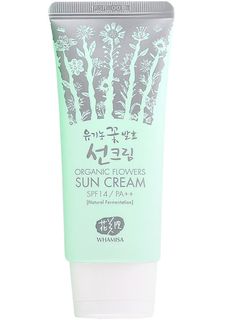
Whamisa Organic Flowers Sun Cream SPF 14
Works for
1 of 3 advertised claims delivered
Sun protectionSPF 14 · 2 UV filters · Broad spectrumNo real protectionSPF too low
This product does not offer sun protection, or it is very low.
This product can be considered "reef safe" because it does not contain the UV filters (oxybenzone and octinoxate) that can be harmful to coral reefs when present in the water in high concentrations.
MoisturizingArgania spinosa kernel oil, Beeswax + 9 moreGood evidence
“What it is Whamisa Organic Flowers Sun Cream SPF 14 is enriched with aloe maculata extract, organic shea butter and argan oil to condition and moisturise the skin.”
This product can help improve hydration of the skin with the two types of ingredients.
The first type is called “humectants”:
these ingredients help attract water.
When humectants are on the surface of the skin, they “pull in” the moisture from the outside environment, or from
within deeper layers of the skin. The following ingredients in this product do the job:
lactobacillus/rice ferment filtrate, scutellaria baicalensis root extract.
This product also contains ingredients called “occlusives”. They help reduce the speed with which our skin loses moisture to the outside environment. These ingredients also help soften the upper layer of the skin, so it feels less tight and nicer to the touch. The following ingredients in this product do the job: beeswax, butyrospermum parkii butter.
Anti-agingCamellia sinensis leaf extract, Butyrospermum parkii butterLimited evidence
“Rice ferment filtrates help to prevent premature ageing .”
This product does not contain ingredients that are able to reduce fine lines and wrinkles or help with skin elasticity, but it can improve the look of the skin temporarily through moisturization. Well-moisturized skin might also be able to repair the sun damage better.These ingredients - butyrospermum parkii butter, camellia sinensis leaf extract - could be helpful for preventing or repairing signs of aging in theory, but there is no evidence that it actually works.
This ingredient camellia sinensis leaf extract might be able to help neutralize free radicals in skin and help it fight off some of the sun damage.
Anti-oxidationNot advertised by the brand · Camellia sinensis leaf extract, Butyrospermum parkii butter + 7 moreModerate evidence
This product contains antioxidants (camellia sinensis leaf extract) that might be able to help neutralize free radicals in skin to lessen the damage it gets from the UV light (sun). There is not enough evidence to confirm their effectiveness in skin though.
Can it cause trouble?
Irritancy8 strong irritants: Rosa damascena flower, Aniba rosaeodora wood oil + 6 more — patch-test recommendedHigh risk
Comedogenic3 ingredients rated 2 or more on the 0–5 pore-clogging scale3 flagged
User reviews
Be the first — your take helps the next person decide.
Ingredients
Filter by role to see what each ingredient is doing.
Aloe maculata leaf extract~26–31%
- Irritation risk
- Low
Zinc oxide~11–14%
- Irritation risk
- Low
A broad spectrum sunblock (protects from both UVA and UVB rays). Is suitable for most sensitive skins. In small concentrations, can be used as a colorant
More about Zinc oxideTitanium dioxide~6.1–7.4%
- Irritation risk
- Low
Works as a UV filter when used in high concentrations. It is photostable and is effective mostly against the UVB light, with some protection in the UVA range. In small concentrations, used for its ability to improve the color of cosmetic products. Is usually well tolerated by the skin
More about Titanium dioxideOlea europaea fruit oil~4.6–5.6%
- Irritation risk
- Medium
An emollient that helps soften the skin but is not effective for restoring its barrier function. Might be helpful to calm down inflammation
More about Olea europaea fruit oilCetearyl alcohol~3.8–4.7%
- Irritation risk
- Low
- Comedogenicity
- 2/5
A non-drying alcohol. Works as an emollient. Helps water and oil mix together and creates a nice product texture
More about Cetearyl alcoholCetyl alcohol~3.2–3.9%
- Irritation risk
- Low
A non-drying alcohol that works to soften the skin and stabilize product formulations helping oil and water mix together
More about Cetyl alcoholButyrospermum parkii butter~2.8–3.4%
- Irritation risk
- Low
- Comedogenicity
- 3/5
A great moisturising ingredient that softens the skin and reduces water loss from its upper layer. It also can be helpful in protecting skin from free radicals
More about Butyrospermum parkii butterArgania spinosa kernel oil~2.2–2.7%
- Irritation risk
- Medium
An emollient that helps soften the upper layer of the skin. Might have some weak anti-oxidant properties
More about Argania spinosa kernel oilRhodiola rosea root extract~1.8–2.2%
- Irritation risk
- Low
Lactobacillus/rice ferment filtrate~1.5–1.8%
- Irritation risk
- Low
A fermentation product created by bacteria Lactobacillus out of rice. The fermented product helps attract water to the upper layer of the skin. It has anti-bacterial properties and might be helpful in calming down inflammation, but studies are lacking
More about Lactobacillus/rice ferment filtrateCamellia sinensis leaf extract~1.3–1.6%
- Irritation risk
- Low
Can contain potent anti-oxidant compounds (abbreviated ECG, GCG, EGC, and EGCG) that might help protect the skin from free radicals. Can help calm down inflammation and has some anti-bacterial properties. Unfortunately, these antioxidants are unstable and lose their effectiveness very quickly in products. The concentration of the antioxidant compounds in the extract also tends to be low to be effective in topical formulation
More about Camellia sinensis leaf extractCamellia japonica seed oil~1.2–1.4%
- Irritation risk
- Low
A plant oil that helps to soften the upper layer of the skin and can help restore skin's barrier function. Might have an anti-oxidant effect
More about Camellia japonica seed oilBeeswax~1.2–1.4%
- Irritation risk
- Low
Forms a protective barrier that holds water and keeps dry skin hydrated. Keeps an emulsion from separating into its oil and liquid components, and increases the thickness of a product. Can be an allergen
More about BeeswaxLactobacillus~1–1.2%
- Irritation risk
- Low
A non-living ingredient made by fermentation with the bacteria Lactobacillus. It can help attract water to the upper layer of the skin and might help reduce inflammation
More about LactobacillusChrysanthemum sinense flower extract~1–1.3%
Lactobacillus~0.95–1.15%
- Irritation risk
- Low
A non-living ingredient made by fermentation with the bacteria Lactobacillus. It can help attract water to the upper layer of the skin and might help reduce inflammation
More about LactobacillusRosa damascena flower~0.95–1.15%
- Irritation risk
- High
Lactobacillus~0.75–1.15%
- Irritation risk
- Low
A non-living ingredient made by fermentation with the bacteria Lactobacillus. It can help attract water to the upper layer of the skin and might help reduce inflammation
More about LactobacillusTaraxacum officinale root~0.7–1.05%
- Irritation risk
- Low
Cetearyl olivate~0.65–1%
Sorbitan olivate~0.65–0.95%
Scutellaria baicalensis root extract~0.6–0.85%
- Irritation risk
- High
A plant extract that might contain a compound baicalin that could be helpful in neutralizing free radicals and reducing inflammation in skin. The baicalin concentration in skincare products is often too low for an effective action. Can be used for its fragrant properties
More about Scutellaria baicalensis root extractPaeonia suffruticosa root extract~0.55–0.8%
Glycyrrhiza glabra root extract~0.5–0.8%
- Irritation risk
- Medium
A plant extract that can help lighten the skin and calm down inflammation. Might be helpful in neutralizing free radicals
More about Glycyrrhiza glabra root extractSpirulina platensis extract~0.5–0.7%
- Irritation risk
- Low
- Comedogenicity
- 3/5
An algae extract. Might help to attract water to the upper layer of the skin and have an anti-oxidant effect
More about Spirulina platensis extractXanthan gum~0.5–0.7%
- Irritation risk
- Low
Used to create a thicker product consistency
More about Xanthan gumAniba rosaeodora wood oil~0.3–0.6%
- Irritation risk
- High
Citrus aurantium bergamia fruit oil~0.25–0.5%
- Irritation risk
- High
A plant oil with a high content of volatile compounds that can irritate the skin and lead to allergic reactions. Can lead to photosensitivity
More about Citrus aurantium bergamia fruit oilRosmarinus officinalis leaf oil~0.3–0.55%
- Irritation risk
- High
A plant oil with high content of volatile compounds that can irritate the skin. Can be used as a fragrance. Has anti-bacterial properties and might help neutralize free radicals on the surface of the skin
More about Rosmarinus officinalis leaf oilLavandula angustifolia oil~0.2–0.4%
- Irritation risk
- High
An essential oil. Potential allergen and can be irritating. It has some anti-bacterial properties
More about Lavandula angustifolia oilCymbopogon schoenanthus oil~0.2–0.35%
- Irritation risk
- High
Limonene~0.15–0.3%
- Irritation risk
- High
A common frangrance that can easily irritate skin, especially if exposed to air, light or heat
More about LimoneneLinalool~0.15–0.3%
Ingredient list view
Aloe maculata leaf extract, Zinc oxide, Titanium dioxide, Olea europaea fruit oil, Cetearyl alcohol, Cetyl alcohol, Butyrospermum parkii butter, Argania spinosa kernel oil, Rhodiola rosea root extract, Lactobacillus/rice ferment filtrate, Camellia sinensis leaf extract, Camellia japonica seed oil, Beeswax, Lactobacillus, Chrysanthemum sinense flower extract, Unknown, Lactobacillus, Rosa damascena flower, Unknown, Lactobacillus, Taraxacum officinale root, Unknown, Cetearyl olivate, Sorbitan olivate, Scutellaria baicalensis root extract, Paeonia suffruticosa root extract, Glycyrrhiza glabra root extract, Spirulina platensis extract, Xanthan gum, Aniba rosaeodora wood oil, Citrus aurantium bergamia fruit oil, Rosmarinus officinalis leaf oil, Lavandula angustifolia oil, Cymbopogon schoenanthus oil, Limonene, Linalool
Compare prices
Retailers ranked by price — lowest first.
Product summary
"Whamisa - Organic Flowers Sun Cream SPF 14" offers broad spectrum protection. It means that it protects from both UVA and UVB rays (you can remember UVB as "burning" sunlight - they cause sunburn. You can remember UVA rays as "aging" - they do not lead to sunburn, but they cause photodamage and contribute to early signs of skin aging and hyperpigmentation). On the negative side, the SPF of this moisturizer is not high enough. We recommend to use a sunscreen with at least SPF 30 daily.
Its formula is also hydrating, so you might not need an additional moistruizer during the day.
Sunscreen filters
This moisturizer is a mineral sunscreen. It uses titanium dioxide and zinc oxide for sun protection. Both titanium dioxide and zinc oxide almost never irritate even the most sensitive skin and eyes, but can leave a white cast.
Irritation risk
There are quite a few common irritants in this product, including ingredients without particular skin benefits. We would not recommend it for sensitive skin. We assess the overall irritancy of this moisturizer to be high. For a detailed overview of all potential irritants: click here
You can see the detailed formula review with the breakdown of all actives in the product and the full ingredient list with estimated concentrations in the tables below.
Sources cited in this review
Every concentration estimate and effectiveness label is anchored to one of these 21 studies and safety reviews.
- 1A review of inorganic UV filters zinc oxide and titanium dioxideonlinelibrary.wiley.com
- 2
- 3
- 4
- 5
- 6Use of “natural” oils for moisturization: Review of olive, coconut, and sunflower seed oilonlinelibrary.wiley.com

Affiliate links · As an Amazon Associate, WIMJ earns from qualifying purchases.