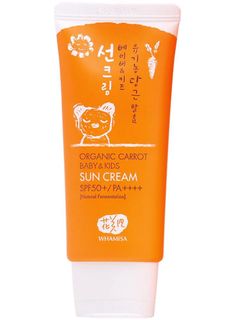
Whamisa Organic Carrot Baby and Kids Sun Cream SPF 50
Works for
1 of 2 advertised claims delivered
Sun protectionSPF 50 · 1 UV filter · Broad spectrumWeak protectionLow filter dose
This product uses a single UV filter (zinc oxide) in a relatively low concentration and might not be able to provide a reliable sun protection.
This product can be considered "reef safe" because it does not contain the UV filters (oxybenzone and octinoxate) that can be harmful to coral reefs when present in the water in high concentrations.
Moisturizing10 ingredients credited for this claimStrong support
“Zinc oxide, carrot extracts and murumuru butter protect and nourish delicate skin.”
This product can help improve hydration of the skin with the two types of ingredients.
The first type is called “humectants”:
these ingredients help attract water.
When humectants are on the surface of the skin, they “pull in” the moisture from the outside environment, or from
within deeper layers of the skin. The following ingredients in this product do the job:
lactobacillus ferment, scutellaria baicalensis root extract.
This product also contains ingredients called “occlusives”. They help reduce the speed with which our skin loses moisture to the outside environment. These ingredients also help soften the upper layer of the skin, so it feels less tight and nicer to the touch. The following ingredients in this product do the job: beeswax, astrocaryum murumuru seed butter.
The following ingredients in this product are especially good for supporting the skin barrier and helping with the hydration level: avena sativa kernel extract
Can it cause trouble?
Irritancy8 strong irritants: Calendula officinalis flower oil, Salvia officinalis oil + 6 more — patch-test recommendedHigh risk
ComedogenicClean of flagged comedogenic ingredientsNone flagged


User reviews
Be the first — your take helps the next person decide.
Ingredients
Filter by role to see what each ingredient is doing.
Daucus carota sativa root extract~22–33%
- Irritation risk
- Low
Carrot extract. Might have anti-oxidant properties and be used to add orange color
More about Daucus carota sativa root extractAvena sativa kernel extract~4.4–6.5%
- Irritation risk
- Low
An effective moisturizing and skin barrier repair ingredient. Helps calm down inflammation and has some anti-oxidant properties
More about Avena sativa kernel extractZinc oxide~4.6–7%
- Irritation risk
- Low
A broad spectrum sunblock (protects from both UVA and UVB rays). Is suitable for most sensitive skins. In small concentrations, can be used as a colorant
More about Zinc oxideCoco-caprylate/caprate~3.3–4.9%
- Irritation risk
- Low
Helps to soften the upper layer of the skin without creating a greasy texture
More about Coco-caprylate/caprateDaucus carota sativa seed oil~2.4–3.6%
- Irritation risk
- Low
A plant oil that might help neutralize free radicals and have an anti-bacterial effect
More about Daucus carota sativa seed oilOlea europaea fruit oil~1.7–2.6%
- Irritation risk
- Medium
An emollient that helps soften the skin but is not effective for restoring its barrier function. Might be helpful to calm down inflammation
More about Olea europaea fruit oilAstrocaryum murumuru seed butter~1.8–2.6%
- Irritation risk
- Medium
Helps soften the upper layer of the skin. Could be comedogenic due to the myrisic acid content
More about Astrocaryum murumuru seed butterSorbitan olivate~1.4–2.1%
Calendula officinalis flower oil~1.1–1.7%
- Irritation risk
- High
A plant oil that might have an antibacterial and some antioxidant effect. Is a common allergen and irritant
More about Calendula officinalis flower oilCamellia japonica seed oil~1.1–1.6%
- Irritation risk
- Low
A plant oil that helps to soften the upper layer of the skin and can help restore skin's barrier function. Might have an anti-oxidant effect
More about Camellia japonica seed oilLactobacillus~0.6–1.4%
- Irritation risk
- Low
A non-living ingredient made by fermentation with the bacteria Lactobacillus. It can help attract water to the upper layer of the skin and might help reduce inflammation
More about LactobacillusDaucus carota sativa root~0.55–1.25%
- Irritation risk
- Low
Lactobacillus~0.5–1.2%
- Irritation risk
- Low
A non-living ingredient made by fermentation with the bacteria Lactobacillus. It can help attract water to the upper layer of the skin and might help reduce inflammation
More about LactobacillusAloe barbadensis leaf~0.45–1.05%
- Irritation risk
- Low
Molasses~0.45–1.05%
- Irritation risk
- Low
Lactobacillus ferment~0.4–0.95%
- Irritation risk
- Low
A fermentation product created by bacteria Lactobacillus. The fermented product has anti-bacterial properties and might be helpful in calming down inflammation, but studies are lacking. Helps attract water to the upper layer of the skin. Can be used as a preservative
More about Lactobacillus fermentBeta-glucan~0.35–0.8%
- Irritation risk
- Low
Helps attract water to the upper layer of the skin, calm down inflammation and irritation, restore the barrier function and support wound healing. It can be helpful in reducing fine lines and wrinkles
More about Beta-glucanPolyglyceryl-2 dipolyhydroxystearate~0.3–0.75%
- Irritation risk
- Low
Helps to soften the upper layer of the skin
More about Polyglyceryl-2 dipolyhydroxystearateIsostearic acid~0.35–0.85%
- Irritation risk
- Low
Used to create a nice product texture
More about Isostearic acidBeeswax~0.35–0.8%
- Irritation risk
- Low
Forms a protective barrier that holds water and keeps dry skin hydrated. Keeps an emulsion from separating into its oil and liquid components, and increases the thickness of a product. Can be an allergen
More about BeeswaxPolyhydroxystearic acid~0.2–0.75%
- Irritation risk
- Medium
Used to create a thicker product consistency and stabilize the formulation
More about Polyhydroxystearic acidScutellaria baicalensis root extract~0.15–0.6%
- Irritation risk
- High
A plant extract that might contain a compound baicalin that could be helpful in neutralizing free radicals and reducing inflammation in skin. The baicalin concentration in skincare products is often too low for an effective action. Can be used for its fragrant properties
More about Scutellaria baicalensis root extractPaeonia suffruticosa root extract~0.15–0.55%
Glycyrrhiza glabra root extract~0.15–0.65%
- Irritation risk
- Medium
A plant extract that can help lighten the skin and calm down inflammation. Might be helpful in neutralizing free radicals
More about Glycyrrhiza glabra root extractJasminum officinale oil~0.1–0.45%
- Irritation risk
- Low
Salvia officinalis oil~0.1–0.45%
- Irritation risk
- High
Citrus aurantium bergamia fruit oil~0.1–0.3%
- Irritation risk
- High
A plant oil with a high content of volatile compounds that can irritate the skin and lead to allergic reactions. Can lead to photosensitivity
More about Citrus aurantium bergamia fruit oilAniba rosodora wood oil~0.1–0.35%
Parfum~0.05–0.25%
- Irritation risk
- High
An aromatic blend of unspecified and possibly irritating ingredients
More about ParfumBenzyl benzoate~0.05–0.2%
- Irritation risk
- High
Fragrance with sweet balsamic smell. Help to preserve products and dissolve other ingredients. Could trigger allergic reactions and be irritating
More about Benzyl benzoateLinalool~0.05–0.15%
Limonene~0.05–0.15%
- Irritation risk
- High
A common frangrance that can easily irritate skin, especially if exposed to air, light or heat
More about LimoneneIngredient list view
Daucus carota sativa root extract, Avena sativa kernel extract, Zinc oxide, Coco-caprylate/caprate, Daucus carota sativa seed oil, Olea europaea fruit oil, Astrocaryum murumuru seed butter, Sorbitan olivate, Calendula officinalis flower oil, Camellia japonica seed oil, Lactobacillus, Daucus carota sativa root, Unknown, Lactobacillus, Unknown, Aloe barbadensis leaf, Molasses, Unknown, Lactobacillus ferment, Beta-glucan, Polyglyceryl-2 dipolyhydroxystearate, Isostearic acid, Beeswax, Polyhydroxystearic acid, Scutellaria baicalensis root extract, Paeonia suffruticosa root extract, Glycyrrhiza glabra root extract, Jasminum officinale oil, Salvia officinalis oil, Citrus aurantium bergamia fruit oil, Aniba rosodora wood oil, Parfum, Benzyl benzoate, Linalool, Limonene
Compare prices
Retailers ranked by price — lowest first.
Worth comparing, line by line.
Match % combines shared ingredients, the first five ingredients, shared actives and hero ingredients, irritancy (lower counts in the alternative's favour), texture and body area. Only products in the same routine step are compared.
| WhamisaOrganic Carrot Baby and Kids Sun Cream SPF 50YOUR PRODUCT | BadgerSPF 30 Clear Zinc Sunscreen Cream | Beauty by EarthMineral Sunscreen Stick - SPF 30 Zinc Oxide Sunscreen Lotion Stick Made with Organic Ingredients, Best Sun Protection Travel Sunscreen Face and Body, Reef Safe Sunscreen, Water Resistant | |
|---|---|---|---|
| Match | — | 51% | 51% |
| Price | $20.62 | $19.83−$0.79 | $17.99−$2.63 |
| Shared key ingredients | — | 3 of 8 | 3 of 8 |
| Key difference | — | Cera Alba | Butyrospermum Parkii Butter |
| Irritancy | High | Low | Low |
| SPF | SPF 50 | SPF 30 | SPF 30 |
| Drying alcohol | — | — | — |
| View product | Shop | Shop |


Product summary
We are worried that "Whamisa - Organic Carrot Baby and Kids Sun Cream SPF 50" might not be able to provide reliable sun protection because it uses a single UV filter (zinc oxide) in a relatively weak concentration.
Its formula is also hydrating, so you might not need an additional moistruizer during the day.
Sunscreen filters
This moisturizer is a mineral sunscreen. It uses zinc oxide for sun protection. Zinc oxide almost never irritates the skin or stings eyes, but it can leave a white cast.
Irritation risk
This moisturizer contains a bunch of common irritants, including ingredients that do not provide any known benefit for the skin. It might not be the best choice if your skin is sensitive. We assess the overall irritancy of this moisturizer to be high. For a detailed overview of all potential irritants: click here
You can see the detailed formula review with the breakdown of all actives in the product and the full ingredient list with estimated concentrations in the tables below.
Sources cited in this review
Every concentration estimate and effectiveness label is anchored to one of these 27 studies and safety reviews.
- 1A review of inorganic UV filters zinc oxide and titanium dioxideonlinelibrary.wiley.com
- 2
- 3
- 4
- 5
- 6Safety Assessment of Alkyl Esters as Used in Cosmeticscir-safety.org

Affiliate links · As an Amazon Associate, WIMJ earns from qualifying purchases.