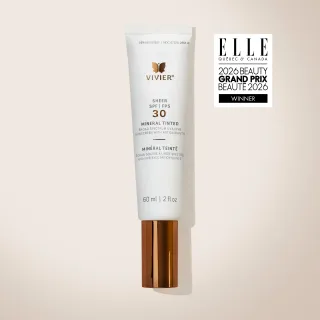
Vivier SHEER SPF 30 Mineral Tinted
Works for
Sun protectionSPF 30 · 2 UV filtersBroad spectrum
This product offers a good level of protection against both UVB and UVA rays.
It is a mineral sunscreen. In other words, it contains non-organic UV filters. It will probably not sting your eyes but might leave a white cast.
This product can be considered "reef safe" because it does not contain the UV filters (oxybenzone and octinoxate) that can be harmful to coral reefs when present in the water in high concentrations.
Anti-agingCamellia sinensis leaf extract, Sodium ascorbyl phosphateWorks well
“Enriched with Vitamins C and E to brighten the skin and reduce the appearance of fine lines and wrinkles.”
This product can help prevent early signs of skin aging because it offers a good level of broad spectrum sun protection. Sun damage is the main cause of premature skin aging, and protecting your skin from the sun is the best anti-aging strategy.
Evens skin toneCamellia sinensis leaf extractWorks well
“Enriched with Vitamins C and E to brighten the skin and reduce the appearance of fine lines and wrinkles.”
This product offers broad spectrum sun protection. It means that it can prevent hyperpigmentation and help keep the skin tone even (sun damage is the main factor causing age spots, darkening of post-acne marks and other discolorations).
Anti-oxidationSide benefit · Camellia sinensis leaf extract, Tocopheryl acetate + 2 moreMay help
This product contains antioxidants (camellia sinensis leaf extract) that can help neutralize free radicals in skin to lessen the damage it gets from the UV light (sun). There is some human evidence for this effect in skin, though it is smaller or less consistent than the evidence for the best antioxidants.
MoisturizingSide benefit · C12-15 alkyl benzoate, Caprylic/capric triglyceride + 11 moreWorks
This product can help improve hydration of the skin with the two types of ingredients.
The first type is called “humectants”:
these ingredients help attract water.
When humectants are on the surface of the skin, they “pull in” the moisture from the outside environment, or from
within deeper layers of the skin. The following ingredients in this product do the job:
glycerin, propylene glycol.
This product also contains ingredients called “occlusives”. They help reduce the speed with which our skin loses moisture to the outside environment. These ingredients also help soften the upper layer of the skin, so it feels less tight and nicer to the touch. The following ingredients in this product do the job: caprylic/capric triglyceride, dimethicone.
Can it cause trouble?
Irritancy2 strong irritants: Citrus aurantium dulcis peel extract, Citrus limon peel extractMedium risk
Comedogenic2 ingredients rated 2 or more on the 0–5 pore-clogging scale2 flagged
User reviews
Be the first — your take helps the next person decide.
Ingredients
Filter by role to see what each ingredient is doing.
Titanium dioxide10%
- Irritation risk
- Low
Works as a UV filter when used in high concentrations. It is photostable and is effective mostly against the UVB light, with some protection in the UVA range. In small concentrations, used for its ability to improve the color of cosmetic products. Is usually well tolerated by the skin
More about Titanium dioxideZinc oxide8%
- Irritation risk
- Low
A broad spectrum sunblock (protects from both UVA and UVB rays). Is suitable for most sensitive skins. In small concentrations, can be used as a colorant
More about Zinc oxideAlumina~23–35%
- Irritation risk
- Low
The same compound that is used safely in dental implants and bone cements. In cosmetics, it is used to improve the consistency of products
More about AluminaAmmonium acryloyldimethyltaurate/vp copolymer~7.4–11%
- Irritation risk
- Low
Increases thickness of a product. Texture enhancer for oil-in-water emulsions
More about Ammonium acryloyldimethyltaurate/vp copolymerBis-peg/ppg-16/16 peg/ppg-16/16 dimethicone~4.7–7.1%
Butylparaben~0.2–0.4%
C12-15 alkyl benzoate~3–4.5%
- Irritation risk
- Low
Enhances the product texture and makes it more spreadable. Helps reduce water loss from the outer layer of skin. Extands the shelf life by preventing bacteria growth
More about C12-15 alkyl benzoateCaprylic/capric triglyceride~2.7–4.1%
- Irritation risk
- Medium
A good mix of fatty acids that forms a protective layer on the skin. Improves the shelf life of products. Derived from coconut and glycerin
More about Caprylic/capric triglycerideCeteareth-20~2.3–3.5%
- Irritation risk
- Medium
- Comedogenicity
- 2/5
Helps oil and water mix together. Has some emollient properties
More about Ceteareth-20Cetearyl alcohol~2–2.9%
- Irritation risk
- Low
- Comedogenicity
- 2/5
A non-drying alcohol. Works as an emollient. Helps water and oil mix together and creates a nice product texture
More about Cetearyl alcoholCetyl dimethicone~1.4–2.2%
- Irritation risk
- Low
A type of silicone. Helps soften the upper layer of the skin and creates a nice, light product texture
More about Cetyl dimethiconeCitrus aurantium dulcis peel extract~1–1.5%
Citrus limon peel extract~0.8–1.25%
Cyclohexasiloxane~0.8–1.2%
- Irritation risk
- Low
A silicone that serves as an emollient. Helps create a nice non-greasy feels
More about CyclohexasiloxaneCyclopentasiloxane~0.55–1.3%
- Irritation risk
- Low
A silicone that helps improve the product texture and spreadability. Can absorb oil creating a short-term mattifying effect on the skin
More about CyclopentasiloxaneDimethicone~0.55–1.25%
- Irritation risk
- Low
A silicone that helps to reduce water loss from the surface of the skin. Can temporarily "fill in" lines and wrinkles, absorb oil, and create a nice product finish
More about DimethiconeDipropylene glycol dibenzoate~0.5–1.15%
- Irritation risk
- Low
Tocopheryl acetate~0.45–1.05%
- Irritation risk
- Medium
A more stable but less bio-available form of vitamin E compared to Tocopherol. Might help moisturize and protect the skin from free radicals, but mostly used in low concentrations to stabilize other ingredients.
More about Tocopheryl acetateEthylparaben~0.2–0.4%
Glycerin~0.45–1%
- Irritation risk
- Low
One of the best moisturizing ingredients. Naturally present in skin. It attracts water to the upper layer of the skin working as a humectant
More about GlycerinGlyceryl stearate~0.45–1.05%
- Irritation risk
- Low
An emollient that softens the skin and forms a protective layer on its surface. Helps water and oil mix together
More about Glyceryl stearateCamellia sinensis leaf extract~0.4–0.9%
- Irritation risk
- Low
Can contain potent anti-oxidant compounds (abbreviated ECG, GCG, EGC, and EGCG) that might help protect the skin from free radicals. Can help calm down inflammation and has some anti-bacterial properties. Unfortunately, these antioxidants are unstable and lose their effectiveness very quickly in products. The concentration of the antioxidant compounds in the extract also tends to be low to be effective in topical formulation
More about Camellia sinensis leaf extractCi 77491~0.35–0.8%
- Irritation risk
- Low
A red colorant made of iron oxide. Typically is not irritating
More about Ci 77491Ci 77492~0.35–0.8%
Ci 77499~0.3–0.75%
Isopropyl titanium triisostearate~0.4–0.9%
- Irritation risk
- Medium
Helps water and oil mix together
More about Isopropyl titanium triisostearateMethylparaben~0.15–0.3%
Phenoxyethanol~0.3–0.75%
- Irritation risk
- Low
A preservative. It helps prevent bacterial growth in cosmetic products
More about PhenoxyethanolPhytic acid~0.35–0.75%
- Irritation risk
- Medium
An alpha-hydroxy acid (AHA), but is mostly used to stabilize product formulations in cosmetics
More about Phytic acidPolyhydroxystearic acid~0.35–0.8%
- Irritation risk
- Medium
Used to create a thicker product consistency and stabilize the formulation
More about Polyhydroxystearic acidPolysorbate 20~0.35–0.8%
Ppg-15 stearyl ether benzoate~0.4–0.9%
- Irritation risk
- Low
Propylene glycol~0.3–0.7%
- Irritation risk
- High
Helps oil and water mix together and can enhance the penetration of other ingredients into the skin. It can be irritating
More about Propylene glycolPropylparaben~0.2–0.4%
Pyrus malus fruit extract~0.3–0.7%
- Irritation risk
- Medium
Can have some moisturizing properties due to its sugar content
More about Pyrus malus fruit extractSaccharum officinarum extract~0.15–0.65%
- Irritation risk
- Low
Sugar extract that helps attract water to the upper layer of the skin
More about Saccharum officinarum extractSodium ascorbyl phosphate~0.15–0.6%
- Irritation risk
- Medium
A stable derivative of vitamin C. It is oil-soluble which means it is more likely to penetrate the skin compared to the pure form of vitamin C (which is water-soluble), but it is less bio-available and is way less effective in stimulating collagen and reducing wrinkles compared to the pure form of vitamin C (L-ascorbic acid) and its other derivatives (for example, magnesium ascorbyl phosphate). At the same time, this vitamin C derivative has been shown in studies to be effective in reducing acne, blemishes and clogged pores. It is less irritating then the pure form of vitamin C
More about Sodium ascorbyl phosphateSodium hydroxide~0.15–0.55%
T-butyl alcohol~0.1–0.4%
- Irritation risk
- Medium
Used to dissolve other ingredients and to improve smell of products. It could be irritating
More about T-butyl alcoholTriethoxycaprylylsilane~0.1–0.4%
- Irritation risk
- Low
A type of silicone that helps oil and water mix well together. Helps to disperse other ingredients, e.g. pigments, evenly in a formulation
More about TriethoxycaprylylsilaneVp/eicosene copolymer~0.1–0.35%
- Irritation risk
- Medium
Used to improve the product adherence to the skin, for example, to pro-long the protective effect of sunscreens. Can be irritating to very sensitive skin
More about Vp/eicosene copolymerWater~0.05–0.25%
Xanthan gum~0.05–0.3%
- Irritation risk
- Low
Used to create a thicker product consistency
More about Xanthan gumIngredient list view
Titanium dioxide, Zinc oxide, Alumina, Ammonium acryloyldimethyltaurate/vp copolymer, Bis-peg/ppg-16/16 peg/ppg-16/16 dimethicone, Butylparaben, C12-15 alkyl benzoate, Caprylic/capric triglyceride, Ceteareth-20, Cetearyl alcohol, Cetyl dimethicone, Citrus aurantium dulcis peel extract, Citrus limon peel extract, Cyclohexasiloxane, Cyclopentasiloxane, Dimethicone, Dipropylene glycol dibenzoate, Tocopheryl acetate, Ethylparaben, Glycerin, Glyceryl stearate, Camellia sinensis leaf extract, Ci 77491, Ci 77492, Ci 77499, Isopropyl titanium triisostearate, Methylparaben, Phenoxyethanol, Phytic acid, Polyhydroxystearic acid, Polysorbate 20, Ppg-15 stearyl ether benzoate, Propylene glycol, Propylparaben, Pyrus malus fruit extract, Saccharum officinarum extract, Sodium ascorbyl phosphate, Sodium hydroxide, T-butyl alcohol, Triethoxycaprylylsilane, Vp/eicosene copolymer, Water, Xanthan gum
Compare prices
Retailers ranked by price — lowest first.

Worth comparing, line by line.
Match % combines shared ingredients, the first five ingredients, shared actives and hero ingredients, irritancy (lower counts in the alternative's favour), texture and body area. Only products in the same routine step are compared.
| VivierSHEER SPF 30 Mineral TintedYOUR PRODUCT | EltaMDUV Elements Broad-Spectrum SPF44 | ALASTIN SkincareHydraTint Pro Mineral Broad Spectrum Sunscreen SPF 36 | NourishMaxTINTED MINERAL DEFENSE SUNSCREEN SPF 30 | |
|---|---|---|---|---|
| Match | — | 42% | 42% | 41% |
| Price | $72.00 | $37.60−$34.40 | $84.00+$12.00 | — |
| Shared key ingredients | — | 6 of 9 | 7 of 9 | 5 of 9 |
| Key difference | — | Octyldodecyl Neopentanoate | Ectoin | Knotgrass Extract |
| Irritancy | Medium | Low | Low | Low |
| SPF | SPF 30 | SPF 44 | SPF 36 | SPF 30 |
| Drying alcohol | — | — | — | — |
| View product | Shop | Shop | Shop |


More alternatives: Obagi SUZANOBAGIMD Physical Defense Tinted Broad Spectrum SPF50Eau Thermale Avene Mineral Light Hydrating Sunscreen Lotion SPF 50+
Sources cited in this review
Every concentration estimate and effectiveness label is anchored to one of these 23 studies and safety reviews.
- 1A review of inorganic UV filters zinc oxide and titanium dioxideonlinelibrary.wiley.com
- 2
- 3
- 4
- 5
- 6

Affiliate links · As an Amazon Associate, WIMJ earns from qualifying purchases.