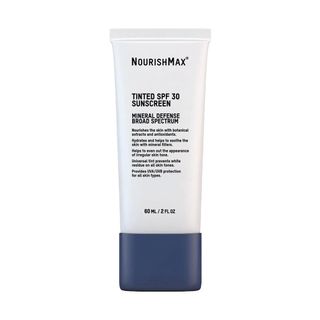
NourishMax TINTED MINERAL DEFENSE SUNSCREEN SPF 30
Works for
3 of 3 advertised claims delivered
Sun protectionSPF 30 · 3 UV filtersBroad spectrum
This product offers a good level of protection against both UVB and UVA rays.
This sunscreen uses organic (so-called "chemical") sunscreen filters. Organic, or "chemical" filters usually provide reliable sun protection and rarely leave a white cast. Sunscreens with organic filters can sting eyes.
This product can be considered "reef safe" because it does not contain the UV filters (oxybenzone and octinoxate) that can be harmful to coral reefs when present in the water in high concentrations.
Evens skin toneTetrahexyldecyl ascorbateStrong evidence
“The sheer, natural-looking tint helps to even out skin tone and imparts a radiant glow.”
This product offers broad spectrum sun protection. It means that it can prevent hyperpigmentation and help keep the skin tone even (sun damage is the main factor causing age spots, darkening of post-acne marks and other discolorations).
Anti-agingAloe barbadensis leaf juice, Tetrahexyldecyl ascorbateStrong evidence
“Vitis Vinifera Fruit Cell Extract (Grape Extract) These plant-derived stem cells help to protect skin against environmental damage that contributes to signs of aging like fine lines, wrinkles, and discoloration.”
This product can help prevent early signs of skin aging because it offers a good level of broad spectrum sun protection. Sun damage is the main cause of premature skin aging, and protecting your skin from the sun is the best anti-aging strategy.
Anti-oxidationNot advertised by the brand · Polygonum aviculare extract, Tocopheryl acetate + 1 moreStrong evidence
This product contains antioxidants (polygonum aviculare extract) that can help neutralize free radicals in skin. By doing so, they can lessen the damage the skin gets from the UV light (sun).
MoisturizingNot advertised by the brand · Glycerin, Caprylic/capric triglyceride + 14 moreGood evidence
This product can help improve hydration of the skin with the two types of ingredients.
The first type is called “humectants”:
these ingredients help attract water.
When humectants are on the surface of the skin, they “pull in” the moisture from the outside environment, or from
within deeper layers of the skin. The following ingredients in this product do the job:
glycerin, aloe barbadensis extract.
This product also contains ingredients called “occlusives”. They help reduce the speed with which our skin loses moisture to the outside environment. These ingredients also help soften the upper layer of the skin, so it feels less tight and nicer to the touch. The following ingredients in this product do the job: caprylic/capric triglyceride, dimethicone.
Can it cause trouble?
Irritancy14 flagged ingredientsLow risk
Comedogenic2 ingredients rated 2 or more on the 0–5 pore-clogging scale2 flagged
User reviews
Be the first — your take helps the next person decide.
Ingredients
Filter by role to see what each ingredient is doing.
Aloe barbadensis leaf juice~26–32%
- Irritation risk
- Medium
Traditionally used to treat sunburns, dermatitis and inflammation, but evidence for its effectiveness is lacking. The extract can contain humectants that help attract water into the skin
More about Aloe barbadensis leaf juiceAloe barbadensis extract~6–7.3%
- Irritation risk
- Medium
Traditionally used to treat sunburns, dermatitis and inflammation, but evidence for its effectiveness is lacking. The extract can contain humectants that help attract water into the skin
More about Aloe barbadensis extractTitanium dioxide7.75%
- Irritation risk
- Low
Works as a UV filter when used in high concentrations. It is photostable and is effective mostly against the UVB light, with some protection in the UVA range. In small concentrations, used for its ability to improve the color of cosmetic products. Is usually well tolerated by the skin
More about Titanium dioxideZinc oxide10%
- Irritation risk
- Low
A broad spectrum sunblock (protects from both UVA and UVB rays). Is suitable for most sensitive skins. In small concentrations, can be used as a colorant
More about Zinc oxideWater~6.1–7.5%
Caprylic/capric triglyceride~5.1–6.3%
- Irritation risk
- Medium
A good mix of fatty acids that forms a protective layer on the skin. Improves the shelf life of products. Derived from coconut and glycerin
More about Caprylic/capric triglycerideButyloctyl salicylate~3.7–4.6%
- Irritation risk
- Medium
A synthetic ester of salicylic acid that is used to help disperse pigments and boost effectiveness of sunscreen ingredients. It is able to absorb UV light (working as an organic, or chemical filter), but is not approved as a sunscreen ingredient on its own
More about Butyloctyl salicylateGlycerin~2.9–3.5%
- Irritation risk
- Low
One of the best moisturizing ingredients. Naturally present in skin. It attracts water to the upper layer of the skin working as a humectant
More about GlycerinDimethicone~2.4–2.9%
- Irritation risk
- Low
A silicone that helps to reduce water loss from the surface of the skin. Can temporarily "fill in" lines and wrinkles, absorb oil, and create a nice product finish
More about DimethiconeStyrene/acrylates copolymer~1.9–2.3%
- Irritation risk
- Low
Used to create an even product consistency. Can help boost efficiency of sunscreen filters
More about Styrene/acrylates copolymerCoco-caprylate/caprate~1.8–2.2%
- Irritation risk
- Low
Helps to soften the upper layer of the skin without creating a greasy texture
More about Coco-caprylate/caprateAluminum stearate~1.3–1.6%
- Irritation risk
- Medium
Used to help evenly disperse other ingredients (for example, pigment) in a formulation
More about Aluminum stearateCarthamus tinctorius oleosomes~1.2–1.5%
- Irritation risk
- Low
Helps soften the upper layer of the skin
More about Carthamus tinctorius oleosomesPolyhydroxystearic acid~1.1–1.3%
- Irritation risk
- Medium
Used to create a thicker product consistency and stabilize the formulation
More about Polyhydroxystearic acidAloe barbadensis leaf juice~1–1.2%
- Irritation risk
- Medium
Traditionally used to treat sunburns, dermatitis and inflammation, but evidence for its effectiveness is lacking. The extract can contain humectants that help attract water into the skin
More about Aloe barbadensis leaf juicePolygonum aviculare extract~1–1.3%
- Irritation risk
- Medium
A plant extract that contains a flavanol Juglanin. It can help neutralize free radicals in skin and reduce inflammation
More about Polygonum aviculare extractTocopheryl acetate~0.9–1.15%
- Irritation risk
- Medium
A more stable but less bio-available form of vitamin E compared to Tocopherol. Might help moisturize and protect the skin from free radicals, but mostly used in low concentrations to stabilize other ingredients.
More about Tocopheryl acetatePerilla frutescens extract~0.9–1.1%
- Irritation risk
- Low
Vitis vinifera fruit cell extract~0.75–1.15%
- Irritation risk
- Low
Lepidium sativum sprout extract~0.75–1.1%
- Irritation risk
- Low
Squalane~0.75–1.15%
- Irritation risk
- Low
An oil naturally present in skin. Works as an emollient to soften the skin and form a protective layer on its surface without a greasy feeling.
More about SqualaneCetearyl alcohol~0.75–1.15%
- Irritation risk
- Low
- Comedogenicity
- 2/5
A non-drying alcohol. Works as an emollient. Helps water and oil mix together and creates a nice product texture
More about Cetearyl alcoholIsononyl isononanoate~0.7–1.05%
- Irritation risk
- Low
Forms a protective film on the surface of the skin to prevent moisture loss. Gives a velvety feel to products while reducing tackiness
More about Isononyl isononanoateCoco-glucoside~0.65–0.95%
- Irritation risk
- High
Used as a cleansing agent (surfactant) in cleansers. Helps water and oil mix together in lotions. Can be irritating
More about Coco-glucosidePentylene glycol~0.7–1.05%
- Irritation risk
- Medium
Used to preserve products, dissolve other ingredients and create a nice product texture
More about Pentylene glycolBehenyl alcohol~0.7–1.05%
- Irritation risk
- Low
Non-drying alcohol that helps water and oil mix together. Also serves as an emollient
More about Behenyl alcoholXanthan gum~0.65–0.95%
- Irritation risk
- Low
Used to create a thicker product consistency
More about Xanthan gumTriethoxycaprylylsilane~0.6–0.9%
- Irritation risk
- Low
A type of silicone that helps oil and water mix well together. Helps to disperse other ingredients, e.g. pigments, evenly in a formulation
More about TriethoxycaprylylsilaneArachidyl glucoside~0.6–0.9%
Simmondsia chinensis seed oil~0.6–0.85%
- Irritation risk
- Medium
Softens the upper layer of skin and helps restore the healthy skin barrier. Has shown to help calm down inflammation in skin. It is a stable oil, meaning that it retains its properties even when exposed to air.
More about Simmondsia chinensis seed oilStearic acid~0.65–0.95%
- Irritation risk
- Low
Helps oil and water mix together and works as an emollient
More about Stearic acidSucrose stearate~0.65–0.95%
Phenethyl alcohol~0.55–0.8%
Tetrahexyldecyl ascorbate~0.55–0.8%
- Irritation risk
- Medium
Being a lipid soluble form of vitamin C, it is more stable than ascorbic acid, but still degrades quickly and needs to be stabilized in a formulation with another ingredient. It is claimed to penetrate skin better than pure vitamin C and have the the similar benefits, but solid studies of its effectiveness are lacking. Is likely to require a higher concentration in a product than pure vitamin C to be effective. It might be able to help reduce pore clogging.
More about Tetrahexyldecyl ascorbateGlyceryl caprylate~0.6–0.9%
- Irritation risk
- Low
An emollient that can also help water and oil mix together, as well as prevent bacteria growth in products
More about Glyceryl caprylateEthylene/propylene/styrene copolymer~0.5–0.75%
- Irritation risk
- Low
Used to create a thicker product consistency
More about Ethylene/propylene/styrene copolymerSorbitan oleate~0.5–0.75%
- Irritation risk
- Medium
- Comedogenicity
- 2/5
Helps oil and water mix together
More about Sorbitan oleatePolyglyceryl-2 caprate~0.5–0.8%
Propanediol~0.5–0.75%
- Irritation risk
- Low
Acts as a solvent for other ingredients. Speeds up the absorption of other ingredients into the skin
More about PropanediolAlumina~0.55–0.85%
- Irritation risk
- Low
The same compound that is used safely in dental implants and bone cements. In cosmetics, it is used to improve the consistency of products
More about AluminaArachidyl alcohol~0.5–0.75%
- Irritation risk
- Low
Used to soften the upper layer of the skin and create a thicker product consistency
More about Arachidyl alcoholIron oxides~0.3–0.6%
- Irritation risk
- Low
An umbrella term for the following three colorants: CI 77491, CI 77492, CI 77499. They might be able to offer some protection against visible light, but the degree of the protection is not clear
More about Iron oxidesCi 77492~0.3–0.6%
Ci 77491~0.2–0.35%
- Irritation risk
- Low
A red colorant made of iron oxide. Typically is not irritating
More about Ci 77491Ci 77499~0.2–0.35%
Ingredient list view
Aloe barbadensis leaf juice, Aloe barbadensis extract, Titanium dioxide, Zinc oxide, Water, Caprylic/capric triglyceride, Butyloctyl salicylate, Glycerin, Dimethicone, Styrene/acrylates copolymer, Coco-caprylate/caprate, Aluminum stearate, Carthamus tinctorius oleosomes, Polyhydroxystearic acid, Aloe barbadensis leaf juice, Polygonum aviculare extract, Tocopheryl acetate, Perilla frutescens extract, Vitis vinifera fruit cell extract, Lepidium sativum sprout extract, Squalane, Cetearyl alcohol, Isononyl isononanoate, Coco-glucoside, Pentylene glycol, Behenyl alcohol, Xanthan gum, Triethoxycaprylylsilane, Arachidyl glucoside, Simmondsia chinensis seed oil, Stearic acid, Sucrose stearate, Phenethyl alcohol, Tetrahexyldecyl ascorbate, Glyceryl caprylate, Ethylene/propylene/styrene copolymer, Sorbitan oleate, Polyglyceryl-2 caprate, Propanediol, Alumina, Arachidyl alcohol, Iron oxides, Ci 77492, Ci 77491, Ci 77499
Compare prices
Retailers ranked by price — lowest first.
Product summary
We assess that "NourishMax - TINTED MINERAL DEFENSE SUNSCREEN SPF 30" can provide reliable sun protection based on the ingredient list. We love that it can protect from both UVA and UVB rays (not all sunscreens with SPF ratings give UVA protection. UVA rays do not cause sunburn, but still damage our skin and lead to early aging).
This product should also be hydrating enough to use without an additional moisturizer during the day. Like all broad-spectrum sunscreens, this product has an anti-aging benefit.
Sunscreen filters
This is a "mixed" sunscreen in the sense that it uses both mineral and organic (so-called "chemical") sun filters. Here are the organic filters this product uses: butyloctyl salicylate. As for the mineral filters, this sunscreen uses both titanium dioxide and zinc oxide.
Irritation risk
There are some common irritants in this product, including ingredients that do not have benefits for the skin. We assess the overall irritancy of this product to be medium. For a detailed overview of all potential irritants: click here
You can see the detailed formula review with the breakdown of all actives in the product and the full ingredient list with estimated concentrations in the tables below.
Price
The product retails for 39.00$ in the United States.
For a detailed price comparison: click here.
Sources cited in this review
Every concentration estimate and effectiveness label is anchored to one of these 19 studies and safety reviews.
- 1A review of inorganic UV filters zinc oxide and titanium dioxideonlinelibrary.wiley.com
- 2
- 3
- 4
- 5
- 6

Affiliate links · As an Amazon Associate, WIMJ earns from qualifying purchases.