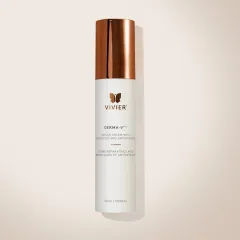
Works for:
based on ingredients and %- Moisturizing
Can it cause trouble?
- Irritation risk: high
- Comedogenic risk ingredients: 0
Key actives
Works for
Moisturizing
What does the product description say?
Formulated with 5 innovative ingredients; prebiotics, antioxidants, hydration/repairing boosters, and peptides to hydrate, strengthen and improve the skin’s barrier function.
Source: Vivier
This product can help improve hydration of the skin with the two types of ingredients.
The first type is called “humectants”:
these ingredients help attract water.
When humectants are on the surface of the skin, they “pull in” the moisture from the outside environment, or from
within deeper layers of the skin. The following ingredients in this product do the job:
glycerin, hydrolyzed glycosaminoglycans.
This product also contains ingredients called “occlusives”. They help reduce the speed with which our skin loses moisture to the outside environment. These ingredients also help soften the upper layer of the skin, so it feels less tight and nicer to the touch. The following ingredients in this product do the job: caprylic/capric triglyceride, dimethicone.
Consists of remains of dead bacteria cells. Is likely helpful in attracting water to the upper layer of the skin. Might be helpful in reducing inflammation and neutralizing free radicals in skin. It is claimed to be a "DNA repair enzyme"
Might be helpful in neutralising free radicals in skin and have some hydration properties
A good mix of fatty acids that forms a protective layer on the skin. Improves the shelf life of products. Derived from coconut and glycerin
One of the best moisturizing ingredients. Attracts water into the upper layer of the skin
A silicone that helps to reduce water loss from the surface of the skin. Can temporarily "fill in" lines and wrinkles, absorb oil, and create a nice product finish
One of the best moisturizing ingredients. Naturally present in skin. It attracts water to the upper layer of the skin working as a humectant
Long sugars that help attract water to the upper layer of the skin
Helps soften the upper layer of the skin
An emollient that helps soften the skin but is not effective for restoring its barrier function. Might be helpful to calm down inflammation
Helps soften the upper layer of the skin
Helps soften the upper layer of the skin, dissolve other ingredients and create a thicker product consistency
Helps preserve products and creates a nice product texture
A silicone that forms a light film on the skin surface helping to bind water and temporarily absorb oils creating a matt and powdery feel
Helps oil and water mix together and can enhance the penetration of other ingredients into the skin. It can be irritating
Used to create a nice product texture and help delivery of other ingredients. Might be somewhat helpful in attracting water to the upper layer of the skin
A plant extract that is claimed to be helpful in moisturizing and lightening the skin, but evidence is missing
Used mostly for creating emulsions - helping oil and water mix together. Helps soften the upper layer of the skin
How honest is this product?
| Promise | Can it deliver? |
|---|---|
| Moisturizing |
Total Promises Fulfilled score: 75/100.
We receive a small commission for purchases made through these links at no cost for you. Thank you for your support! Learn more
Affiliate link · supports WIMJ at no cost to you
Potential irritants
Comedogenic ingredients
No comedogenic ingredients detected
User reviews (0)
Averages from community submissions.
No reviews yet for this product.
Be the first to share your experience!
Tried this product?
Help capture what the ingredient list can't—texture, finish, pilling, scent, and more. Answer what you can, skip the rest.
Takes ~30 seconds.
Reviews are shown in aggregate. No personal details.
| Product | Similarity | Price | Irritancy |
|---|---|---|---|
 Vivier DERMA-V™ | Current | $184.00 | |
 SENTÉ Dermal Repair Body Cream | 38% | $110.00 | |
 COSRX Skin Barrier Moisturizing Cream | 38% | ≈ $16.76 | |
 Real Barrier Extreme Cream Original | 38% | $38.00 | |
 Elizabeth Grant Caviar Cellular Recharge Super Body Cream | 38% | ≈ $40.22 | |
 Mesoestetic Fast Skin Repair | 38% | $58.99 |
Key Actives
Might be helpful in neutralising free radicals in skin and have some hydration properties
Consists of remains of dead bacteria cells. Is likely helpful in attracting water to the upper layer of the skin. Might be helpful in reducing inflammation and neutralizing free radicals in skin. It is claimed to be a "DNA repair enzyme"
A silicone that helps to reduce water loss from the surface of the skin. Can temporarily "fill in" lines and wrinkles, absorb oil, and create a nice product finish
A silicone that forms a light film on the skin surface helping to bind water and temporarily absorb oils creating a matt and powdery feel
One of the best moisturizing ingredients. Naturally present in skin. It attracts water to the upper layer of the skin working as a humectant
A good mix of fatty acids that forms a protective layer on the skin. Improves the shelf life of products. Derived from coconut and glycerin
Helps soften the upper layer of the skin
Long sugars that help attract water to the upper layer of the skin
One of the best moisturizing ingredients. Attracts water into the upper layer of the skin
Potential irritants
Helps oil and water mix together and can enhance the penetration of other ingredients into the skin. It can be irritating
An essentil oil from orange peel. Potential allergen and can be irritating
Might be helpful in neutralising free radicals in skin and have some hydration properties
A good mix of fatty acids that forms a protective layer on the skin. Improves the shelf life of products. Derived from coconut and glycerin
An emollient that helps soften the skin but is not effective for restoring its barrier function. Might be helpful to calm down inflammation
Helps water and oil mix together and stabilize the product formulation
A preservative that comes from radishes fermented by a bacteria. New research suggests that the preservation properties in the ingredient come from an ammonium salt that is not present naturally in radish root but used in its cultivation. Is problematic because the exact amount of the preservative agents is difficult to determine
Helps preserve products and creates a nice product texture
Comedogenic ingredients
We couldn't find any comedogenic ingredients in this product
All ingredients
One of the best moisturizing ingredients. Naturally present in skin. It attracts water to the upper layer of the skin working as a humectant
Might be helpful in neutralising free radicals in skin and have some hydration properties
A preservative. It helps prevent bacterial growth in cosmetic products
Helps soften the upper layer of the skin, dissolve other ingredients and create a thicker product consistency
A good mix of fatty acids that forms a protective layer on the skin. Improves the shelf life of products. Derived from coconut and glycerin
An emollient that helps soften the skin but is not effective for restoring its barrier function. Might be helpful to calm down inflammation
A silicone that helps to reduce water loss from the surface of the skin. Can temporarily "fill in" lines and wrinkles, absorb oil, and create a nice product finish
A silicone that forms a light film on the skin surface helping to bind water and temporarily absorb oils creating a matt and powdery feel
Used to create a nice product texture and help delivery of other ingredients. Might be somewhat helpful in attracting water to the upper layer of the skin
A plant extract that is claimed to be helpful in moisturizing and lightening the skin, but evidence is missing
Helps water and oil mix together and stabilize the product formulation
Helps oil and water mix together and can enhance the penetration of other ingredients into the skin. It can be irritating
Used mostly for creating emulsions - helping oil and water mix together. Helps soften the upper layer of the skin
Consists of remains of dead bacteria cells. Is likely helpful in attracting water to the upper layer of the skin. Might be helpful in reducing inflammation and neutralizing free radicals in skin. It is claimed to be a "DNA repair enzyme"
A preservative that comes from radishes fermented by a bacteria. New research suggests that the preservation properties in the ingredient come from an ammonium salt that is not present naturally in radish root but used in its cultivation. Is problematic because the exact amount of the preservative agents is difficult to determine
Helps preserve products and creates a nice product texture
Long sugars that help attract water to the upper layer of the skin
Used to thicken product formulations and create gel-like textures
One of the best moisturizing ingredients. Attracts water into the upper layer of the skin
Acts as a solvent for other ingredients. Speeds up the absorption of other ingredients into the skin
An essentil oil from orange peel. Potential allergen and can be irritating
Ingredient list view
Water, Glycerin, Thermus thermophillus ferment, Phenoxyethanol, Potassium sorbate, Hea/sodium acryloyldimethyltaurate/steareth-20 methacrylate copolymer, C13-14 isoparaffin, Polysorbate 80, Decyl glucoside, Caprylic/capric triglyceride, Teprenone, Hydrolyzed myrtus communis leaf extract, Ethylhexylglycerin, Hydrolyzed vegetable protein, Sodium benzoate, Olea europaea fruit oil, Dimethicone, Hydrolyzed jojoba esters, C9-12 alkane, Polysilicone-11, Proline, Butylene glycol, Hydrolyzed rice extract, Hydroxyresveratrol, Polyglyceryl-10 oleate, Polyglyceryl-6 laurate, Sorbitan palmitate, Dicetyl phosphate, Propylene glycol, Citrus medica acida peel extract, Citrus aurantium dulcis peel extract, Lecithin, Micrococcus lysate, Leuconostoc/radish root ferment filtrate, 1,2-hexanediol, Caprylyl glycol, Tropolone, Hydrolyzed glycosaminoglycans, Hydroxyethylcellulose, Hexylene glycol, Polydextrose, Sodium hyaluronate, Propanediol, Orobanche rapum extract, Citrus aurantium dulcis peel oil
- Glycerol and the skin: holistic approach to its origin and functions
- Safety Assessment of Isoparaffins as Used in Cosmetics
- Ecofriendly surfactant is allergen of the year
- Antioxidant Activity of Myrtus communis L. and Myrtus nivellei Batt. & Trab. Extracts: A Brief Review
- Antimicrobial and antioxidative activity of extracts and essential oils of Myrtus communis L.
- Use of “natural” oils for moisturization: Review of olive, coconut, and sunflower seed oil
- Dimethicone as a protective ingredient in topical medications
- Final Report on the Safety Assessment of Dimethicone Copolyol
- Surfactants and experimental irritant contact dermatitis
- Propylene Glycol
- Skin-sensitizing and irritant properties of propylene glycol
- The influence of alkane chain length on the skin irritation potential of 1,2-alkanediols
- Hyaluronic acid: A key molecule in skin aging
- Hyaluronan (Hyaluronic Acid): a natural moisturizer for skin care