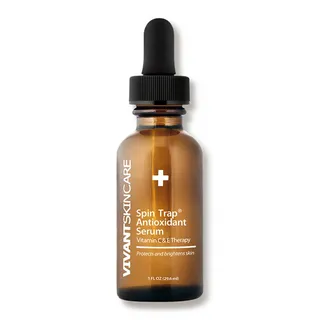
Vivant Skin Care Pure C + E

Vivant Skin Care Pure C + E

Efficacy83/100IrritancyMedium

Works for

Anti-aging
Ascorbic acid, Niacinamide + 1 more
Works well
What the product description says
“Vivant Spin Trap Antioxidant Serum protects against environmental damage, reduces the appearance of fine lines and wrinkles and helps flush out impacted, enlarged pores using for a rejuvenated complexion.”
Source: Dermstore

This product can help reduce and prevent fine lines and wrinkles, improve skin elasticity and firmness because it contains ascorbic acid.

Keep in mind that it typically takes at least 6 weeks to notice any results because the changes that are needed to improve fine lines and elasticity happen in the deeper layers of the skin. No topical anti-aging product can “erase” wrinkles or fully reverse signs of aging.

Ascorbic acidHeroEffect: HighThe most well-researched antioxidant that works in skin. Helps neutralize free radicals supporting collagen production, helping to even out the skin tone and preventing early signs of aging~3.6–5.5%
NiacinamideUnder-dosedIs proven to be effective in reducing blemishes, evening out skin tone and helping to improve lines and wrinkles. It helps the skin to repair sun damage, calm down inflammation and keep maintain good levels of moisture. The concentration of about 2% is effective for supporting the skin barrier and evening out the skin tone. Concentration of 4-6% is better for helping with acne and balancing the sebum production~0.15–0.55%
Lactic acidUnder-dosedAn exfoliating and moisturizing alpha-hydroxy acid (AHA). Typically causes less irritation than other AHAs, for example, glycolic acid. At high concentrations (about 15%), lactic acid can help reduce lines and wrinkles. Recent studies show that lactic acid can support the "good" bacteria living on skin's surface (healthy skin microbiome)~0.05–0.1%
Evens skin tone
Ascorbic acid, Niacinamide + 1 more
Works well
What the product description says
“Vitamin C neutralizes free radicals and supports collagen while lactic acid exfoliates and brightens away hyperpigmentation.”
Source: Dermstore

This product can help reduce hypepigmentation and even out the skin tone because it contains the following effective ingredients: ascorbic acid.

Keep in mind that you would need to apply any topical skincare targetted at hypigmentation consistently for a couple of months to get a result. No topical skincare product can help get rid of hyperpigmentation (including post-acne marks and age spots) instantly.

Ascorbic acidHeroEffect: HighThe most well-researched antioxidant that works in skin. Helps neutralize free radicals supporting collagen production, helping to even out the skin tone and preventing early signs of aging~3.6–5.5%
NiacinamideUnder-dosedIs proven to be effective in reducing blemishes, evening out skin tone and helping to improve lines and wrinkles. It helps the skin to repair sun damage, calm down inflammation and keep maintain good levels of moisture. The concentration of about 2% is effective for supporting the skin barrier and evening out the skin tone. Concentration of 4-6% is better for helping with acne and balancing the sebum production~0.15–0.55%
Lactic acidUnder-dosedAn exfoliating and moisturizing alpha-hydroxy acid (AHA). Typically causes less irritation than other AHAs, for example, glycolic acid. At high concentrations (about 15%), lactic acid can help reduce lines and wrinkles. Recent studies show that lactic acid can support the "good" bacteria living on skin's surface (healthy skin microbiome)~0.05–0.1%
Exfoliation
Urea, Lactic acid
Not delivered
What the product description says
“Vitamin C neutralizes free radicals and supports collagen while lactic acid exfoliates and brightens away hyperpigmentation.”
Source: Dermstore

This product might help exfoliate the skin with urea, but this ingredient is not the most effective.

UreaEffect: MediumNaturally present in skin (urea makes up about 7% of natural moisturizing factors in skin). Attracts water to the upper layer of the skin. Also has a positive effect on the skin barrier beyond the humectant action. Can enhance penetration of other ingredients. Is an exfoliating ingredient when used in high concentrations~0.2–0.75%
Lactic acidUnder-dosedAn exfoliating and moisturizing alpha-hydroxy acid (AHA). Typically causes less irritation than other AHAs, for example, glycolic acid. At high concentrations (about 15%), lactic acid can help reduce lines and wrinkles. Recent studies show that lactic acid can support the "good" bacteria living on skin's surface (healthy skin microbiome)~0.05–0.1%
Moisturizing
Side benefit · Urea, Sodium lactate + 7 more
Works well

This product contains good ingredients to attract water to the upper layer of the skin. These ingredients are called "humectants": fructose, glycine.

When humectants are on the surface of the skin, they “pull in” the moisture from the outside environment, or from within deeper layers of the skin. If the air is dry, humectants can speed up the moisture loss from the skin. This is why it is a good idea to use another product on top of this one to help "seal in" the moisture (look for ingredients like dimethicone, squalane, oils and butters).

The following ingredients in this product are especially good for supporting the skin barrier and helping with the hydration level: urea

UreaHero· HumectantEffect: HighNaturally present in skin (urea makes up about 7% of natural moisturizing factors in skin). Attracts water to the upper layer of the skin. Also has a positive effect on the skin barrier beyond the humectant action. Can enhance penetration of other ingredients. Is an exfoliating ingredient when used in high concentrations~0.2–0.75%
Sodium lactateKey active· HumectantEffect: HighHelps attract water to the upper layer of the skin. Is often used to adjust the pH level of the product~0.9–1.35%
Sodium pcaKey active· HumectantEffect: HighNaturally present in skin and helps to attract water to its upper layer~0.6–1.4%
GlycineKey active· HumectantEffect: HighHelps to attract water to the upper layer of the skin and can help restore the skin barrier function~0.45–1.05%
FructoseKey active· HumectantEffect: HighHelps attract water to the upper layer of the skin~0.35–0.85%
InositolKey active· HumectantEffect: High~0.1–0.4%
Propylene glycol· HumectantEffect: LowHelps oil and water mix together and can enhance the penetration of other ingredients into the skin. It can be irritating~4.8–7.2%
NiacinamideUnder-dosedIs proven to be effective in reducing blemishes, evening out skin tone and helping to improve lines and wrinkles. It helps the skin to repair sun damage, calm down inflammation and keep maintain good levels of moisture. The concentration of about 2% is effective for supporting the skin barrier and evening out the skin tone. Concentration of 4-6% is better for helping with acne and balancing the sebum production~0.15–0.55%
Lactic acidUnder-dosedAn exfoliating and moisturizing alpha-hydroxy acid (AHA). Typically causes less irritation than other AHAs, for example, glycolic acid. At high concentrations (about 15%), lactic acid can help reduce lines and wrinkles. Recent studies show that lactic acid can support the "good" bacteria living on skin's surface (healthy skin microbiome)~0.05–0.1%
Anti-oxidation
Side benefit · Ascorbic acid, Tocopheryl acetate
Works well

This product contains antioxidants (ascorbic acid) that can help neutralize free radicals in skin. By doing so, they can lessen the damage the skin gets from the UV light (sun).

Ascorbic acidHeroEffect: HighThe most well-researched antioxidant that works in skin. Helps neutralize free radicals supporting collagen production, helping to even out the skin tone and preventing early signs of aging~3.6–5.5%
Tocopheryl acetateEffect: LowA more stable but less bio-available form of vitamin E compared to Tocopherol. Might help moisturize and protect the skin from free radicals, but mostly used in low concentrations to stabilize other ingredients.~1.9–2.9%

Can it cause trouble?

Irritancy
2 strong irritants: Alcohol denat., Diazolidinyl urea
Medium risk
We flagged 8 ingredients with irritancy potential. Severity depends on your sensitivity threshold; the table lists the worst offenders first.
IngredientFunctionIrritationEst. amount
Propylene glycolHelps oil and water mix together and can enhance the penetration of other ingredients into the skin. It can be irritatingHigh~4.8–7.2%est.
Ascorbic acidThe most well-researched antioxidant that works in skin. Helps neutralize free radicals supporting collagen production, helping to even out the skin tone and preventing early signs of agingHigh~3.6–5.5%est.
Alcohol denat.Produces temporary toning effect. Can help dissolve other ingredients or preserve productsHigh~2.6–3.9%est.
Diazolidinyl ureaA preservative. Works by releasing formaldehyde. Can be irritatingHigh~0.05–0.1%est.
Tocopheryl acetateA more stable but less bio-available form of vitamin E compared to Tocopherol. Might help moisturize and protect the skin from free radicals, but mostly used in low concentrations to stabilize other ingredients.Medium~1.9–2.9%est.
Citric acidCan work as an exfoliant but is typically used to adjust the product pHMedium~1.1–1.6%est.
Sodium lactateHelps attract water to the upper layer of the skin. Is often used to adjust the pH level of the productMedium~0.9–1.35%est.
Lactic acidAn exfoliating and moisturizing alpha-hydroxy acid (AHA). Typically causes less irritation than other AHAs, for example, glycolic acid. At high concentrations (about 15%), lactic acid can help reduce lines and wrinkles. Recent studies show that lactic acid can support the "good" bacteria living on skin's surface (healthy skin microbiome)Medium~0.05–0.1%est.
Comedogenic
Clean of flagged comedogenic ingredients
None flagged
Did this help you decide?

User reviews

Would you recommend?
No community reviews yet.

Be the first — your take helps the next person decide.

Ingredients

Filter by role to see what each ingredient is doing.

Water~40–60%
Formula
Irritation risk
Low

Plain old water

More about Water
Propylene glycol~4.8–7.2%
Irritant · high
Irritation risk
High
Works for
Moisturizing

Helps oil and water mix together and can enhance the penetration of other ingredients into the skin. It can be irritating

More about Propylene glycol
Ascorbic acid~3.6–5.5%
Hero · Anti-aging, Anti-oxidation, Evens skin toneIrritant · high
Irritation risk
High
Works for
Anti-oxidationAnti-agingEvens skin tone

The most well-researched antioxidant that works in skin. Helps neutralize free radicals supporting collagen production, helping to even out the skin tone and preventing early signs of aging

More about Ascorbic acid
Alcohol denat.~2.6–3.9%
Irritant · high
Irritation risk
High

Produces temporary toning effect. Can help dissolve other ingredients or preserve products

More about Alcohol denat.
Tocopheryl acetate~1.9–2.9%
Irritant · medium
Irritation risk
Medium
Works for
Anti-oxidation

A more stable but less bio-available form of vitamin E compared to Tocopherol. Might help moisturize and protect the skin from free radicals, but mostly used in low concentrations to stabilize other ingredients.

More about Tocopheryl acetate
Polysorbate 80~1.6–2.4%
Formula
Irritation risk
Low
Works for
Cleansing

Helps water and oil mix together

More about Polysorbate 80
Xanthan gum~1.3–1.9%
Formula
Irritation risk
Low
Works for
Cleansing

Used to create a thicker product consistency

More about Xanthan gum
Citric acid~1.1–1.6%
Irritant · medium
Irritation risk
Medium

Can work as an exfoliant but is typically used to adjust the product pH

More about Citric acid
Sodium lactate~0.9–1.35%
Key activeIrritant · medium
Irritation risk
Medium
Works for
Moisturizing

Helps attract water to the upper layer of the skin. Is often used to adjust the pH level of the product

More about Sodium lactate
Sodium pca~0.6–1.4%
Key active
Irritation risk
Low
Works for
Moisturizing

Naturally present in skin and helps to attract water to its upper layer

More about Sodium pca
Glycine~0.45–1.05%
Key active
Irritation risk
Low
Works for
Moisturizing

Helps to attract water to the upper layer of the skin and can help restore the skin barrier function

More about Glycine
Fructose~0.35–0.85%
Key active
Irritation risk
Low
Works for
Moisturizing

Helps attract water to the upper layer of the skin

More about Fructose
Urea~0.2–0.75%
Hero · Moisturizing
Irritation risk
Low
Works for
MoisturizingExfoliation

Naturally present in skin (urea makes up about 7% of natural moisturizing factors in skin). Attracts water to the upper layer of the skin. Also has a positive effect on the skin barrier beyond the humectant action. Can enhance penetration of other ingredients. Is an exfoliating ingredient when used in high concentrations

More about Urea
Niacinamide~0.15–0.55%
Under-dosed
Irritation risk
Low
Works for
Anti-agingEvens skin toneAnti-blemishMoisturizingReduces irritationReduces rednessAnti-inflammatoryAntibacterial

Is proven to be effective in reducing blemishes, evening out skin tone and helping to improve lines and wrinkles. It helps the skin to repair sun damage, calm down inflammation and keep maintain good levels of moisture. The concentration of about 2% is effective for supporting the skin barrier and evening out the skin tone. Concentration of 4-6% is better for helping with acne and balancing the sebum production

More about Niacinamide
Inositol~0.1–0.4%
Key active
Irritation risk
Low
Works for
Moisturizing
More about Inositol
Sodium benzoate~0.05–0.2%
Formula
Irritation risk
Low

A preservative

More about Sodium benzoate
Lactic acid~0.05–0.1%
Under-dosedIrritant · medium
Irritation risk
Medium
Works for
Evens skin toneMoisturizingExfoliationAnti-aging

An exfoliating and moisturizing alpha-hydroxy acid (AHA). Typically causes less irritation than other AHAs, for example, glycolic acid. At high concentrations (about 15%), lactic acid can help reduce lines and wrinkles. Recent studies show that lactic acid can support the "good" bacteria living on skin's surface (healthy skin microbiome)

More about Lactic acid
Diazolidinyl urea~0.05–0.1%
Irritant · high
Irritation risk
High

A preservative. Works by releasing formaldehyde. Can be irritating

More about Diazolidinyl urea
Methylparaben~0.05–0.2%
Formula
Irritation risk
Low

A preservative

More about Methylparaben
Propylparaben~0.05–0.15%
Formula
Irritation risk
Low

A preservative

More about Propylparaben
Ingredient list view

Water, Propylene glycol, Ascorbic acid, Alcohol denat., Tocopheryl acetate, Polysorbate 80, Xanthan gum, Citric acid, Sodium lactate, Sodium pca, Glycine, Fructose, Urea, Niacinamide, Inositol, Sodium benzoate, Lactic acid, Diazolidinyl urea, Methylparaben, Propylparaben

Compare prices

Retailers ranked by price — lowest first.

🇨🇦 Amazon CA (CA)
Price unavailable Out of stock
Check
🇦🇺 Amazon Australia (AU)
Price unavailable Out of stock
Check

Affiliate links · As an Amazon Associate, WIMJ earns from qualifying purchases.

Worth comparing, line by line.

Match % combines shared ingredients, the first five ingredients, shared actives and hero ingredients, irritancy (lower counts in the alternative's favour), texture and body area. Only products in the same routine step are compared.

Side-by-side comparison of this product against its closest alternatives
Vivant Skin CarePure C + EYOUR PRODUCTBiobareVitamin C, B, E & Ferulic SerumNorevaIklen+ [Pure-C-Reverse] Regenerating & Perfecting Booster SerumBy WishtrendPure Vitamin C 15% with Ferulic Acid
Match—77%76%76%
Price—$58.00$49.00$28.27
Shared key ingredients—2 of 82 of 82 of 8
Key difference—Ferulic AcidSunflower Seed OilFerulic Acid
Irritancy Medium Medium Medium Low
Drying alcohol Contains drying alcohol — Contains drying alcohol —
View product Shop Shop Shop

More alternatives: Purito SEOUL Pure Vitamin C New FormulaUrban Skin Rx Even Tone Super Glow Serum

Cheaper alternatives? Browse formulas in the same category.
We compare ingredient profiles across our catalog — pick the closest match for your budget.
Open dupe finder
Vivant Skin Care Pure C + E
Vivant Skin CarePure C + E

Affiliate links · As an Amazon Associate, WIMJ earns from qualifying purchases.

As an Amazon Associate, WIMJ earns from qualifying purchases.