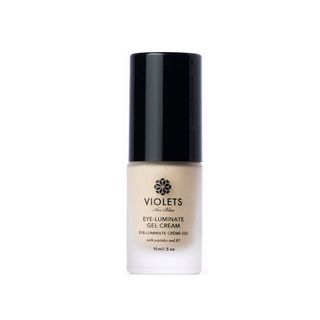
Violets are Blue Eye-Luminate Gel Cream
Works for
2 of 2 advertised claims delivered
Moisturizing17 ingredients credited for this claimStrong support
“Violets are Blue Eye-Luminate Gel Cream goes on smooth, gives a little tightening tingle and helps keep your eyes looking hydrated, smooth and bright!”
This product can help soften the skin and reduce its moisture loss with emollients and occlusives: simmondsia chinensis seed oil, cocos nucifera fruit extract.
Keep in mind that this product does not contain effective ingredients to attract water to the upper layer of the skin. This is why an additional product with humectants like glycerin or hyaluronic acid can be helpful (apply it before this product for the best results).
The following ingredients in this product are especially good for supporting the skin barrier and helping with the hydration level: palmitoyl dipeptide-5 diaminobutyroyl hydroxythreonine
Anti-aging4 ingredients credited for this claimModerate support
“a lightweight anti aging eye gel/cream that instantly smooths, tightens and depuffs Good For.”
This product contains palmitoyl dipeptide-5 diaminobutyroyl hydroxythreonine. This ingredient might be able to help reduce and prevent fine lines and wrinkles, improve skin elasticity and firmness, but there is not enough evidence that it actually works.
Anti-oxidationNot advertised by the brand · 9 ingredients credited for this claimStrong support
This product contains antioxidants (superoxide dismutase) that can help neutralize free radicals in skin. By doing so, they can lessen the damage the skin gets from the UV light (sun).
Can it cause trouble?
Irritancy3 strong irritants: Salvia sclarea extract, Rosa damascena extract + 1 more — patch-test recommendedHigh risk
Comedogenic2 ingredients rated 2 or more on the 0–5 pore-clogging scale2 flagged
User reviews
Be the first — your take helps the next person decide.
Ingredients
Filter by role to see what each ingredient is doing.
Water~40–60%
Salvia sclarea extract~6.5–9.8%
- Irritation risk
- High
Used as a fragrance. Can be irritating
More about Salvia sclarea extractClay~3.6–5.3%
- Irritation risk
- Low
Can absorb oil. There is no research confirming other benefits for the skin
More about ClayWater~2.4–3.6%
Prunus domestica seed oil~1.8–2.6%
- Irritation risk
- Medium
Helps soften the upper layer of the skin
More about Prunus domestica seed oilOenothera biennis oil~1.5–2.2%
- Irritation risk
- Medium
Helps soften the upper layer of the skin and can support skin barrier function
More about Oenothera biennis oilOlea europaea fruit oil~1.1–1.7%
- Irritation risk
- Medium
An emollient that helps soften the skin but is not effective for restoring its barrier function. Might be helpful to calm down inflammation
More about Olea europaea fruit oilSimmondsia chinensis seed oil~1.1–1.6%
- Irritation risk
- Medium
Softens the upper layer of skin and helps restore the healthy skin barrier. Has shown to help calm down inflammation in skin. It is a stable oil, meaning that it retains its properties even when exposed to air.
More about Simmondsia chinensis seed oilHelianthus annuus seed wax~0.6–1.4%
- Irritation risk
- Low
Helps soften the upper layer of the skin and support skin's barrier function while creating a thicker product consistency
More about Helianthus annuus seed waxAlgin~0.4–0.95%
- Irritation risk
- Low
- Comedogenicity
- 3/5
Used to thicken product formulation. Can help attract water to the upper layer of the skin
More about AlginCaprylic/capric triglyceride~0.45–1.05%
- Irritation risk
- Medium
A good mix of fatty acids that forms a protective layer on the skin. Improves the shelf life of products. Derived from coconut and glycerin
More about Caprylic/capric triglycerideSelaginella lepidophylla extract~0.35–0.8%
- Irritation risk
- Medium
A plant extract that might be able to attract water to the upper layer of the skin, soften it and have some antioxidant effect, but evidence of effectiveness in skin is lacking
More about Selaginella lepidophylla extractRosa damascena extract~0.2–0.75%
- Irritation risk
- High
Oil of a very fragrant pink rose used as fragrance in cosmetics. Extensive research has shown it has mixed benefits. In the pro column, inhaling this flower’s scent seems to have relaxing properties and the plant’s petals contain skin-soothing and antioxidant compounds that can benefit skin. On the flipside, the numerous chemicals that create this rose’s distinctive fragrance pose a risk of causing skin aggravation.
More about Rosa damascena extractCalendula officinalis extract~0.15–0.65%
- Irritation risk
- High
A plant extract that might help neutralize free radicals in skin
More about Calendula officinalis extractArnica montana flower extract~0.15–0.55%
- Irritation risk
- High
A plant extract that can be irritating. It can have some anti-bacterial properties, but there are no evidence of a beneficial effect for skin
More about Arnica montana flower extractSodium benzoate~0.25–0.5%
Gluconolactone~0.15–0.55%
- Irritation risk
- Medium
A polyhydroxy acid (PHA) that helps shed the dead cells from the skin surface revealing smoother skin. Is believed to be genter than AHAs. It helps attract water to the upper layer of the skin and can stimulate production of skin's own hyaluronic acid resulting in improved hydration levels. It has been shown to be helpful against acne and clogged pores if used consistently (e.g over a period of 12 weeks) in high enough concentration. It can help reduce fine lines and wrinkles and improve skin tone with long-term application. Can help neutralize free radicals
More about GluconolactoneRosa damascena extract~0.15–0.55%
- Irritation risk
- High
Oil of a very fragrant pink rose used as fragrance in cosmetics. Extensive research has shown it has mixed benefits. In the pro column, inhaling this flower’s scent seems to have relaxing properties and the plant’s petals contain skin-soothing and antioxidant compounds that can benefit skin. On the flipside, the numerous chemicals that create this rose’s distinctive fragrance pose a risk of causing skin aggravation.
More about Rosa damascena extractGlycyrrhiza glabra root extract~0.1–0.45%
- Irritation risk
- Medium
A plant extract that can help lighten the skin and calm down inflammation. Might be helpful in neutralizing free radicals
More about Glycyrrhiza glabra root extractRosa damascena extract~0.1–0.45%
- Irritation risk
- High
Oil of a very fragrant pink rose used as fragrance in cosmetics. Extensive research has shown it has mixed benefits. In the pro column, inhaling this flower’s scent seems to have relaxing properties and the plant’s petals contain skin-soothing and antioxidant compounds that can benefit skin. On the flipside, the numerous chemicals that create this rose’s distinctive fragrance pose a risk of causing skin aggravation.
More about Rosa damascena extractCoffea arabica seed extract~0.1–0.4%
- Irritation risk
- Low
Might be helpful in neutralizing free radicals in skin
More about Coffea arabica seed extractOryza sativa extract~0.1–0.45%
- Irritation risk
- Low
A grain extract that helps to create a thicker product consistency. It might have some anti-oxidant properties and help attract water to the upper layer of the skin
More about Oryza sativa extractLeuconostoc ferment filtrate~0.1–0.35%
Superoxide dismutase~0.1–0.35%
- Irritation risk
- Low
An antioxidant enzyme that is naturally present in skin. It can help support skin barrier function and reduce inflammation in skin. It is used in topical medications for inflammatory skin conditions including atopic dermatitis (eczema) and psoriasis. There are three types of natural Superoxide Dismutase in human skin. The compound used in topical treatments and cosmetics are mimics of typically one of these natural variants
More about Superoxide dismutaseSoybean peroxidase~0.1–0.35%
- Irritation risk
- Low
Lactobacillus~0.1–0.3%
- Irritation risk
- Low
A non-living ingredient made by fermentation with the bacteria Lactobacillus. It can help attract water to the upper layer of the skin and might help reduce inflammation
More about LactobacillusCocos nucifera fruit extract~0.1–0.35%
- Irritation risk
- Low
- Comedogenicity
- 3/5
An emollient. Found to be as effective as a moisturizer for dry skin as mineral oil. Could be comedogenic
More about Cocos nucifera fruit extractCetyl palmitate~0.1–0.45%
- Irritation risk
- Low
An emollient that helps soften the skin and is used to improve product texture and stability
More about Cetyl palmitateSorbitan palmitate~0.1–0.4%
- Irritation risk
- Medium
Helps water and oil mix together and stabilize the product formulation
More about Sorbitan palmitateSorbitan olivate~0.1–0.35%
Euphrasia officinalis extract~0.1–0.3%
- Irritation risk
- Low
Hyaluronic acid~0.05–0.25%
- Irritation risk
- Low
One of the best moisturizing ingredients. Attracts water into the upper layer of the skin. Naturally present in skin. Typically has large molecule size unless advertised otherwise on the product label. Helps support skin's barrier function and may help to reduce inflammation
More about Hyaluronic acidNiacinamide~0.05–0.2%
- Irritation risk
- Low
Is proven to be effective in reducing blemishes, evening out skin tone and helping to improve lines and wrinkles. It helps the skin to repair sun damage, calm down inflammation and keep maintain good levels of moisture. The concentration of about 2% is effective for supporting the skin barrier and evening out the skin tone. Concentration of 4-6% is better for helping with acne and balancing the sebum production
More about NiacinamidePalmitoyl dipeptide-5 diaminobutyroyl hydroxythreonine~0.05–0.1%
- Irritation risk
- Low
Palmitoyl dipeptide-5 diaminohydroxybutyrate~0.01–0.05%
- Irritation risk
- Low
Tripeptide-7~0.01–0.05%
- Irritation risk
- Low
Xanthan gum~0.01–0.05%
- Irritation risk
- Low
Used to create a thicker product consistency
More about Xanthan gumIngredient list view
Water, Salvia sclarea extract, Clay, Water, Prunus domestica seed oil, Oenothera biennis oil, Olea europaea fruit oil, Simmondsia chinensis seed oil, Helianthus annuus seed wax, Algin, Caprylic/capric triglyceride, Selaginella lepidophylla extract, Rosa damascena extract, Calendula officinalis extract, Arnica montana flower extract, Sodium benzoate, Gluconolactone, Rosa damascena extract, Glycyrrhiza glabra root extract, Rosa damascena extract, Coffea arabica seed extract, Oryza sativa extract, Leuconostoc ferment filtrate, Superoxide dismutase, Soybean peroxidase, Lactobacillus, Cocos nucifera fruit extract, Cetyl palmitate, Sorbitan palmitate, Sorbitan olivate, Euphrasia officinalis extract, Hyaluronic acid, Niacinamide, Palmitoyl dipeptide-5 diaminobutyroyl hydroxythreonine, Palmitoyl dipeptide-5 diaminohydroxybutyrate, Tripeptide-7, Xanthan gum
Compare prices
Retailers ranked by price — lowest first.

Product summary
"Violets are Blue - Eye-Luminate Gel Cream" has a good moisturizing formula. As we expect from a proper moisturizer, the formula includes a combo of effective humectants and emollients. These are the two different types of ingredients that are essential for improving the skin hydration and supporting a healthy skin barrier. Selaginella lepidophylla extract in this product (humectants) attract water molecules to the upper layer of the skin (the water comes from the outside air or from the deeper layers of the skin if the air is dry). Emollients in this formulation (cocos nucifera fruit extract, helianthus annuus seed wax, oenothera biennis oil, simmondsia chinensis seed oil and cetyl palmitate) help to reduce the moisture loss from the skin. They also soften the skin surface and relieve the feeling of dryness and tightness.
Ingredient callouts
- We like that this moisturizer contains peptides (palmitoyl dipeptide-5 diaminobutyroyl hydroxythreonine 0.05% - 0.10%). There are many different kind of peptides and they are naturally present in our skin. They all are a combination of amino-acids. Some of them work as natural anti-biotics, promote wound-healing and production of collagen. The science is still not settled on how effective peptides in skincare are, but it is very likely that they have a benefit. Peptides might help restore the skin barrier and fight the signs of aging. At the very least, peptides work as humectants: they attract water to the upper layer of the skin and improve its hydration.
Irritation risk
This moisturizer contains a bunch of common irritants, including ingredients that do not provide any known benefit for the skin. It might not be the best choice if your skin is sensitive. We assess the overall irritancy of this moisturizer to be high. For a detailed overview of all potential irritants: click here
You can see the detailed formula review with the breakdown of all actives in the product and the full ingredient list with estimated concentrations in the tables below.
Price
The product retails for 68.00$ in the United States.
For a detailed price comparison: click here.
Sources cited in this review
Every concentration estimate and effectiveness label is anchored to one of these 33 studies and safety reviews.
- 1Use of “natural” oils for moisturization: Review of olive, coconut, and sunflower seed oilonlinelibrary.wiley.com
- 2
- 3
- 4
- 5Effects of Topical Arnica Gel on Post-Laser Treatment Bruisesonlinelibrary.wiley.com
- 6

Affiliate links · As an Amazon Associate, WIMJ earns from qualifying purchases.