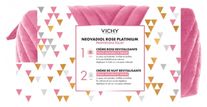
Vichy Neovadiol Rose Platinium Fortifying and Revitalizing Rose Cream + Night Cream Free
Works for
1 of 1 advertised claim delivered
MoisturizingParaffinum liquidum, Butyrospermum parkii butter + 26 moreStrong evidence
“Neovadiol Rose Platinium Fortifying and Revitalizing Rose Cream + Night Cream Free”
This product can help improve hydration of the skin with the two types of ingredients.
The first type is called “humectants”:
these ingredients help attract water.
When humectants are on the surface of the skin, they “pull in” the moisture from the outside environment, or from
within deeper layers of the skin. The following ingredients in this product do the job:
calcium pca, glycerin.
This product also contains ingredients called “occlusives”. They help reduce the speed with which our skin loses moisture to the outside environment. These ingredients also help soften the upper layer of the skin, so it feels less tight and nicer to the touch. The following ingredients in this product do the job: beeswax, butyrospermum parkii butter.
The following ingredients in this product are especially good for supporting the skin barrier and helping with the hydration level: paraffinum liquidum
Anti-agingNot advertised by the brand · Adenosine, Butyrospermum parkii butter + 1 moreStrong evidence
This product can help reduce and prevent fine lines and wrinkles, improve skin elasticity and firmness because it contains adenosine.
Keep in mind that it typically takes at least 6 weeks to notice any results because the changes that are needed to improve fine lines and elasticity happen in the deeper layers of the skin. No topical anti-aging product can “erase” wrinkles or fully reverse signs of aging.
ExfoliationNot advertised by the brand · Capryloyl salicylic acid, Hydroxyethylpiperazine ethane sulfonic acidStrong evidence
This product can help exfoliate the skin. In other words, it helps break down the bonds between dead cells on the surface of the skin and speed up the skin turnover. Skin often appears softer and brighter after exfoliation, but overdoing it can result in disrupted skin barrier. The following ingredient is doing the exfoliating job in this product: capryloyl salicylic acid.
Evens skin toneNot advertised by the brand · Capryloyl salicylic acidModerate evidence
The following ingredient (ingredients) in this product might be helpful, but there is no evidence to confirm that it actually works: capryloyl salicylic acid.
Can it cause trouble?
Irritancy3 strong irritants: Alcohol denat., Parfum + 1 more — patch-test recommendedHigh risk
Comedogenic2 ingredients rated 2 or more on the 0–5 pore-clogging scale2 flagged

User reviews
Be the first — your take helps the next person decide.
Ingredients
Filter by role to see what each ingredient is doing.
Water~40–60%
Glycerin~4–6%
- Irritation risk
- Low
One of the best moisturizing ingredients. Naturally present in skin. It attracts water to the upper layer of the skin working as a humectant
More about GlycerinAlcohol denat.~4.1–6.2%
- Irritation risk
- High
Produces temporary toning effect. Can help dissolve other ingredients or preserve products
More about Alcohol denat.Dimethicone~3.1–4.7%
- Irritation risk
- Low
A silicone that helps to reduce water loss from the surface of the skin. Can temporarily "fill in" lines and wrinkles, absorb oil, and create a nice product finish
More about DimethiconeParaffinum liquidum~2.5–3.7%
- Irritation risk
- Low
Mineral oil. One of the most effective and well studied occlusive and emollient moisturizing ingredients. Helps reduce moisture loss in skin and repair skin barrier function
More about Paraffinum liquidumButyrospermum parkii butter~2.1–3.2%
- Irritation risk
- Low
- Comedogenicity
- 3/5
A great moisturising ingredient that softens the skin and reduces water loss from its upper layer. It also can be helpful in protecting skin from free radicals
More about Butyrospermum parkii butterBis-behenyl/isostearyl/phytosteryl dimer dilinoleyl dimer dilinoleate~1.8–2.7%
- Irritation risk
- High
C30-45 alkyl dimethicone~1.6–2.4%
- Irritation risk
- Low
Peg-20 stearate~1.4–2.1%
Silica~1.4–2.1%
Oryza sativa bran oil~1.1–1.6%
- Irritation risk
- Low
Helps soften the upper layer of the skin and might have some anti-oxidant properties
More about Oryza sativa bran oilTin oxide~1.1–1.6%
- Irritation risk
- Low
A colorant that can add a pearl-like appearance to the formulation
More about Tin oxidePeg-100 stearate~0.95–1.4%
- Irritation risk
- Low
Helps oil and water mix togehter and creates a nice product texture
More about Peg-100 stearatePeg-30 dipolyhydroxystearate~0.55–1.3%
- Irritation risk
- Medium
Helps oil and water mix together
More about Peg-30 dipolyhydroxystearateCi 77491~0.5–1.2%
- Irritation risk
- Low
A red colorant made of iron oxide. Typically is not irritating
More about Ci 77491Iron oxides~0.55–1.25%
- Irritation risk
- Low
An umbrella term for the following three colorants: CI 77491, CI 77492, CI 77499. They might be able to offer some protection against visible light, but the degree of the protection is not clear
More about Iron oxidesCi 77891~0.5–1.2%
- Irritation risk
- Low
Titanium dioxide~0.55–1.25%
- Irritation risk
- Low
Works as a UV filter when used in high concentrations. It is photostable and is effective mostly against the UVB light, with some protection in the UVA range. In small concentrations, used for its ability to improve the color of cosmetic products. Is usually well tolerated by the skin
More about Titanium dioxideCera microcristallina~0.5–1.15%
- Irritation risk
- Low
Helps to soften the upper layer of the skin, reduce water loss from its surface and create a thicker product consistency
More about Cera microcristallinaMicrocrystalline wax~0.45–1%
Stearyl alcohol~0.45–1.05%
- Irritation risk
- Low
An emollient that helps soften the skin
More about Stearyl alcoholParaffin~0.35–0.85%
- Irritation risk
- Low
Prevents water loss from the skin surface and thickens the product consistency
More about ParaffinCera alba~0.5–1.1%
- Irritation risk
- Medium
Forms a protective barrier that holds water and keeps dry skin hydrated. Keeps an emulsion from separating into its oil and liquid components, and increases the thickness of a product. Can be an allergen
More about Cera albaBeeswax~0.45–1.05%
- Irritation risk
- Low
Forms a protective barrier that holds water and keeps dry skin hydrated. Keeps an emulsion from separating into its oil and liquid components, and increases the thickness of a product. Can be an allergen
More about BeeswaxPotassium hydroxide~0.4–0.95%
Carbomer~0.4–0.9%
- Irritation risk
- Low
Helps create a thicker or gel-like product texture. It is not a surfactant but can be used in gentle cleansing formulations
More about CarbomerGlyceryl stearate~0.45–1%
- Irritation risk
- Low
An emollient that softens the skin and forms a protective layer on its surface. Helps water and oil mix together
More about Glyceryl stearateCalcium pca~0.4–0.9%
- Irritation risk
- Low
Helps attract water to the upper layer of the skin
More about Calcium pcaTrideceth-6~0.4–0.95%
Sodium phytate~0.4–0.9%
Sodium hyaluronate~0.4–0.9%
- Irritation risk
- Low
One of the best moisturizing ingredients. Attracts water into the upper layer of the skin
More about Sodium hyaluronate2-oleamido-1,3-octadecanediol~0.4–0.9%
- Irritation risk
- Low
Helps soften the upper layer of the skin and slow down the water loss over time
More about 2-oleamido-1,3-octadecanediolPhenoxyethanol~0.4–0.95%
- Irritation risk
- Low
A preservative. It helps prevent bacterial growth in cosmetic products
More about PhenoxyethanolAmmonium polyacryloyldimethyl taurate~0.4–1%
- Irritation risk
- Low
Used to create a thicker product consistency
More about Ammonium polyacryloyldimethyl taurateTocopherol~0.35–0.85%
- Irritation risk
- Low
Pure form of vitamin E. Can help moisturise and protect the skin from free radicals. Often used to help stabilise other ingredients or the formula itself
More about TocopherolHydrogenated polyisobutene~0.45–1.05%
- Irritation risk
- Low
Used to improve the product consistency and soften the upper layer of the skin
More about Hydrogenated polyisobuteneCapryloyl salicylic acid~0.4–0.95%
- Irritation risk
- High
Citric acid~0.4–0.95%
- Irritation risk
- Medium
Can work as an exfoliant but is typically used to adjust the product pH
More about Citric acidSynthetic fluorphlogopite~0.4–0.95%
- Irritation risk
- Low
A mineral that is used as an optical filter (makes the skin looks nicer through light reflection) and to improve the texture of cosmetic products
More about Synthetic fluorphlogopitePentaerythrityl tetra-di-t-butyl hydroxyhydrocinnamate~0.35–0.85%
- Irritation risk
- Low
Used to increase stability of product formulations
More about Pentaerythrityl tetra-di-t-butyl hydroxyhydrocinnamateFaex extract~0.4–0.95%
- Irritation risk
- Low
Yeast extract. Helps attract water to the upper layer of the skin
More about Faex extractOctyldodecanol~0.45–1%
- Irritation risk
- Low
An emollient that helps to soften the skin and create a pleasant product texture and stabilize the formulation
More about OctyldodecanolCetyl palmitate~0.45–1.05%
- Irritation risk
- Low
An emollient that helps soften the skin and is used to improve product texture and stability
More about Cetyl palmitateAcrylates/c10-30 alkyl acrylate crosspolymer~0.45–1%
- Irritation risk
- Medium
Maintains the texture of skincare products. Allows the product to spread evenly. Helps oil and water mix together
More about Acrylates/c10-30 alkyl acrylate crosspolymerEthylhexylglycerin~0.4–1%
Parfum~0.4–0.95%
- Irritation risk
- High
An aromatic blend of unspecified and possibly irritating ingredients
More about ParfumWater~0.4–1%
Glycerin~0.45–1.05%
- Irritation risk
- Low
One of the best moisturizing ingredients. Naturally present in skin. It attracts water to the upper layer of the skin working as a humectant
More about GlycerinPrunus armeniaca kernel oil~0.45–1.05%
- Irritation risk
- Medium
An emollient that helps soften the skin
More about Prunus armeniaca kernel oilCaprylic/capric triglyceride~0.45–1.1%
- Irritation risk
- Medium
A good mix of fatty acids that forms a protective layer on the skin. Improves the shelf life of products. Derived from coconut and glycerin
More about Caprylic/capric triglyceridePentaerythrityl tetraethylhexanoate~0.45–1.05%
- Irritation risk
- Low
Used to create a nice product consistency while softening the upper layer of the skin
More about Pentaerythrityl tetraethylhexanoateCetyl alcohol~0.45–1.05%
- Irritation risk
- Low
A non-drying alcohol that works to soften the skin and stabilize product formulations helping oil and water mix together
More about Cetyl alcoholGlyceryl stearate~0.45–1.1%
- Irritation risk
- Low
An emollient that softens the skin and forms a protective layer on its surface. Helps water and oil mix together
More about Glyceryl stearateAlcohol denat.~0.4–1%
- Irritation risk
- High
Produces temporary toning effect. Can help dissolve other ingredients or preserve products
More about Alcohol denat.Propanediol~0.45–1%
- Irritation risk
- Low
Acts as a solvent for other ingredients. Speeds up the absorption of other ingredients into the skin
More about PropanediolButyrospermum parkii butter~0.45–1.05%
- Irritation risk
- Low
- Comedogenicity
- 3/5
A great moisturising ingredient that softens the skin and reduces water loss from its upper layer. It also can be helpful in protecting skin from free radicals
More about Butyrospermum parkii butterDimethicone~0.45–1.1%
- Irritation risk
- Low
A silicone that helps to reduce water loss from the surface of the skin. Can temporarily "fill in" lines and wrinkles, absorb oil, and create a nice product finish
More about DimethiconePeg-40 stearate~0.45–1.05%
Cera alba~0.5–1.2%
- Irritation risk
- Medium
Forms a protective barrier that holds water and keeps dry skin hydrated. Keeps an emulsion from separating into its oil and liquid components, and increases the thickness of a product. Can be an allergen
More about Cera albaHydroxyethylpiperazine ethane sulfonic acid~0.4–1%
- Irritation risk
- Medium
Used to regulate product's pH, but can be also used as an exfoliator when included in higher concentrations. There is a controversy about whether it can generate free radicals and induce skin cell damage when used in topical products
More about Hydroxyethylpiperazine ethane sulfonic acidTin oxide~0.5–1.15%
- Irritation risk
- Low
A colorant that can add a pearl-like appearance to the formulation
More about Tin oxideCi 77491~0.4–1%
- Irritation risk
- Low
A red colorant made of iron oxide. Typically is not irritating
More about Ci 77491Ci 77891~0.4–0.95%
- Irritation risk
- Low
Rosa gallica flower extract~0.4–0.95%
- Irritation risk
- High
Sorbitan tristearate~0.45–1%
- Irritation risk
- Medium
Helps oil and water mix together
More about Sorbitan tristearateSorbitol~0.4–0.95%
- Irritation risk
- Low
Helps attract water to the upper layer of the skin and improves the product texture
More about SorbitolCalcium pca~0.4–0.95%
- Irritation risk
- Low
Helps attract water to the upper layer of the skin
More about Calcium pcaDimethiconol~0.45–1.05%
- Irritation risk
- Low
A silicone that makes products more spreadable and keeps skin smooth. Helps to add gloss to skin and may visually fill in fine lines/wrinkles for short time
More about DimethiconolSilica~0.5–1.15%
Medicago sativa extract~0.4–1%
- Irritation risk
- Medium
A plant extract that might help neutralize free radicals in skin
More about Medicago sativa extractSodium benzoate~0.25–0.5%
Phenoxyethanol~0.45–1%
- Irritation risk
- Low
A preservative. It helps prevent bacterial growth in cosmetic products
More about PhenoxyethanolAdenosine~0.4–0.95%
- Irritation risk
- Low
Might help improve cell turnover and reduce inflammation in skin. One study shows that the ingredients might be able to help reduce dynamic wrinkles (for example, in the corners of the eyes or on the forehead)
More about AdenosinePropylene glycol~0.4–0.95%
- Irritation risk
- High
Helps oil and water mix together and can enhance the penetration of other ingredients into the skin. It can be irritating
More about Propylene glycolCaprylyl glycol~0.45–1%
- Irritation risk
- Medium
Helps preserve products and creates a nice product texture
More about Caprylyl glycolCitric acid~0.4–0.9%
- Irritation risk
- Medium
Can work as an exfoliant but is typically used to adjust the product pH
More about Citric acidTrisodium ethylenediamine disuccinate~0.4–0.9%
- Irritation risk
- Medium
Used to improve stability of the formulation
More about Trisodium ethylenediamine disuccinateXanthan gum~0.35–0.85%
- Irritation risk
- Low
Used to create a thicker product consistency
More about Xanthan gumPentaerythrityl tetra-di-t-butyl hydroxyhydrocinnamate~0.3–0.7%
- Irritation risk
- Low
Used to increase stability of product formulations
More about Pentaerythrityl tetra-di-t-butyl hydroxyhydrocinnamateSynthetic fluorphlogopite~0.35–0.8%
- Irritation risk
- Low
A mineral that is used as an optical filter (makes the skin looks nicer through light reflection) and to improve the texture of cosmetic products
More about Synthetic fluorphlogopiteFaex extract~0.35–0.8%
- Irritation risk
- Low
Yeast extract. Helps attract water to the upper layer of the skin
More about Faex extractEthylhexylglycerin~0.2–0.8%
Parfum~0.15–0.6%
- Irritation risk
- High
An aromatic blend of unspecified and possibly irritating ingredients
More about ParfumIngredient list view
Water, Glycerin, Alcohol denat., Dimethicone, Paraffinum liquidum, Butyrospermum parkii butter, Bis-behenyl/isostearyl/phytosteryl dimer dilinoleyl dimer dilinoleate, C30-45 alkyl dimethicone, Peg-20 stearate, Silica, Oryza sativa bran oil, Tin oxide, Peg-100 stearate, Peg-30 dipolyhydroxystearate, Ci 77491, Iron oxides, Ci 77891, Titanium dioxide, Cera microcristallina, Microcrystalline wax, Stearyl alcohol, Paraffin, Cera alba, Beeswax, Potassium hydroxide, Carbomer, Glyceryl stearate, Calcium pca, Trideceth-6, Sodium phytate, Sodium hyaluronate, 2-oleamido-1,3-octadecanediol, Phenoxyethanol, Ammonium polyacryloyldimethyl taurate, Tocopherol, Hydrogenated polyisobutene, Capryloyl salicylic acid, Citric acid, Synthetic fluorphlogopite, Pentaerythrityl tetra-di-t-butyl hydroxyhydrocinnamate, Faex extract, Octyldodecanol, Cetyl palmitate, Acrylates/c10-30 alkyl acrylate crosspolymer, Ethylhexylglycerin, Parfum, Water, Glycerin, Prunus armeniaca kernel oil, Caprylic/capric triglyceride, Pentaerythrityl tetraethylhexanoate, Cetyl alcohol, Glyceryl stearate, Alcohol denat., Propanediol, Butyrospermum parkii butter, Dimethicone, Peg-40 stearate, Cera alba, Hydroxyethylpiperazine ethane sulfonic acid, Tin oxide, Ci 77491, Ci 77891, Rosa gallica flower extract, Sorbitan tristearate, Sorbitol, Calcium pca, Dimethiconol, Silica, Medicago sativa extract, Sodium benzoate, Phenoxyethanol, Adenosine, Propylene glycol, Caprylyl glycol, Citric acid, Trisodium ethylenediamine disuccinate, Xanthan gum, Pentaerythrityl tetra-di-t-butyl hydroxyhydrocinnamate, Synthetic fluorphlogopite, Faex extract, Ethylhexylglycerin, Parfum
Compare prices
Retailers ranked by price — lowest first.

Affiliate links · prices updated regularly
Worth comparing, line by line.
Match % combines shared ingredients, the first five ingredients, shared actives and hero ingredients, irritancy (lower counts in the alternative's favour), texture and body area. Only products in the same routine step are compared.
| VichyNeovadiol Rose Platinium Fortifying and Revitalizing Rose Cream + Night Cream FreeYOUR PRODUCT | BIOTHERMBLUE THERAPY ANTI-AGING NIGHT CREAM | |
|---|---|---|
| Match | — | 52% |
| Price | $36.75 | $56.27+$19.52 |
| Shared key ingredients | — | 10 of 20 |
| Key difference | — | Glyceryl Acrylate/Acrylic Acid Copolymer |
| Irritancy | High | Medium |
| Drying alcohol | Contains drying alcohol | — |
| View product | Shop |
Product summary
Judging from the ingredient list, "Vichy - Neovadiol Rose Platinium Fortifying and Revitalizing Rose Cream + Night Cream Free" works well for improving skin hydration This moisturizer uses a good combo of humectants and emollients. These both types of ingredients are essentials for improving the skin hydration and keeping the skin barrier healthy. Humectants in this product (calcium pca, glycerin, sodium hyaluronate, caprylyl glycol and propylene glycol) help to increase the water content in the upper layer of the skin. (These ingredients do so by "capturing" water molecules from the outside air or from within the deeper layers of the skin). Emollients in this formulation (paraffinum liquidum, oryza sativa bran oil, beeswax, butyrospermum parkii butter and cera alba) help to reduce the moisture loss from the skin. They also soften the skin surface and relieve the feeling of dryness and tightness.
Ingredient callouts
- Adenosine 0.40% - 0.95%. It is a compound that in involved in many biological processes inside the skin cells. According one high-quality clinical trial, topical Adenosine in low concentrations can somewhat help improve "deep wrinkles" - the wrinkles that appear with age in places where our faces are most dynamic (for example, on the forehead or in the corners of the eyes).
Irritation risk
There are quite a few common irritants in this product, including ingredients without particular skin benefits. We would not recommend it for sensitive skin. We assess the overall irritancy of this moisturizer to be high. For a detailed overview of all potential irritants: click here
You can see the detailed formula review with the breakdown of all actives in the product and the full ingredient list with estimated concentrations in the tables below.
Price
The product retails from 27.80£ up to 37.61£ in the United Kingdom.
For a detailed price comparison: click here.
Sources cited in this review
Every concentration estimate and effectiveness label is anchored to one of these 23 studies and safety reviews.
- 1
- 2
- 3Final Report on the Safety Assessment of Dimethicone Copolyoljournals.sagepub.com
- 4A review on the extensive skin benefits of mineral oilncbi.nlm.nih.gov
- 5
- 6Safety Assessment of Tin(IV) Oxide as Used in Cosmeticscir-safety.org

Affiliate links · As an Amazon Associate, WIMJ earns from qualifying purchases.