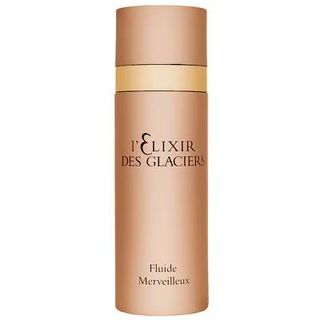
Valmont Elixir des Glaciers Fluide Merveilleux
Works for
1 of 1 advertised claim delivered
MoisturizingZinc pca, Glycerin + 14 moreGood evidence
“Fluide Merveilleux is a resplendent moisturiser with a uniquely jellified-water texture.”
This product can help improve hydration of the skin with the two types of ingredients.
The first type is called “humectants”:
these ingredients help attract water.
When humectants are on the surface of the skin, they “pull in” the moisture from the outside environment, or from
within deeper layers of the skin. The following ingredients in this product do the job:
glycerin, magnesium pca.
This product also contains ingredients called “occlusives”. They help reduce the speed with which our skin loses moisture to the outside environment. These ingredients also help soften the upper layer of the skin, so it feels less tight and nicer to the touch. The following ingredients in this product do the job: helianthus annuus seed oil, glycine soja oil.
Can it cause trouble?
Irritancy9 strong irritants: Parfum, Alpha-isomethyl ionone + 7 more — patch-test recommendedHigh risk
Comedogenic3 ingredients rated 2 or more on the 0–5 pore-clogging scale3 flagged
User reviews
Be the first — your take helps the next person decide.
Ingredients
Filter by role to see what each ingredient is doing.
Water~45–55%
Glycerin~4.7–5.8%
- Irritation risk
- Low
One of the best moisturizing ingredients. Naturally present in skin. It attracts water to the upper layer of the skin working as a humectant
More about GlycerinMaris aqua~4.2–5.1%
Triolein~3.3–4.1%
Coco-caprylate/caprate~2.6–3.2%
- Irritation risk
- Low
Helps to soften the upper layer of the skin without creating a greasy texture
More about Coco-caprylate/caprateGlycine soja oil~2.1–2.6%
- Irritation risk
- Medium
- Comedogenicity
- 2/5
A good emollient that helps soften the skin and helps repair its barrier function. It can clog pores if used in high concentrations.
More about Glycine soja oilHelianthus annuus seed oil~1.8–2.3%
- Irritation risk
- Low
A great emollient due to its high linoleic acid content. One of the most effective plant oils in helping skin hydration and repairing skin barrier function
More about Helianthus annuus seed oilHydrolyzed corallina officinalis extract~1.5–1.9%
- Irritation risk
- Low
- Comedogenicity
- 3/5
Inulin lauryl carbamate~1.3–1.6%
Lecithin~1.1–1.3%
- Irritation risk
- Low
Used mostly for creating emulsions - helping oil and water mix together. Helps soften the upper layer of the skin
More about LecithinMagnesium pca~0.7–1%
- Irritation risk
- Low
Helps attract water to the upper layer of the skin
More about Magnesium pcaManganese acetylmethionate~0.55–0.85%
- Irritation risk
- Low
Manganese pca~0.5–0.75%
- Irritation risk
- Low
Helps attract water to the upper layer of the skin. Often used as a part of an ingredient complex Physiogenyl together with Sodium PCA, Magnesium PCA and Zinc PCA. The manufacturer claims that it does more than attracting water, but there is no evidence or studies supporting this claim
More about Manganese pcaSodium dna~0.45–0.7%
- Irritation risk
- Low
Sodium pca~0.45–0.65%
- Irritation risk
- Low
Naturally present in skin and helps to attract water to its upper layer
More about Sodium pcaTocopherol~0.45–0.7%
- Irritation risk
- Low
Pure form of vitamin E. Can help moisturise and protect the skin from free radicals. Often used to help stabilise other ingredients or the formula itself
More about TocopherolZinc pca~0.45–0.7%
- Irritation risk
- Low
A compound that combines zinc with a hydrating ingredient PCA. Might to be helpful against acne and clogged pores. Can help calm down inflammation in skin. Could be helpful in reducing the formation of free radicals in skin. Might help to reduce fine lines in wrinkles, but solid evidence is missing
More about Zinc pca1,2-hexanediol~0.45–0.65%
Caprylyl glycol~0.4–0.6%
- Irritation risk
- Medium
Helps preserve products and creates a nice product texture
More about Caprylyl glycolDisodium edta~0.3–0.6%
Glyceryl dioleate~0.35–0.65%
- Irritation risk
- Low
Glyceryl linoleate~0.4–0.6%
- Irritation risk
- Medium
Helps oil and water mix together
More about Glyceryl linoleateGlyceryl linolenate~0.3–0.6%
- Irritation risk
- Low
Helps soften the upper layer of the skin
More about Glyceryl linolenateGlyceryl oleate~0.3–0.6%
- Irritation risk
- High
Helps oil and water mix together. Can be irritating
More about Glyceryl oleateGlyceryl palmitate~0.3–0.6%
- Irritation risk
- Low
Glyceryl stearate~0.35–0.6%
- Irritation risk
- Low
An emollient that softens the skin and forms a protective layer on its surface. Helps water and oil mix together
More about Glyceryl stearateHydrogenated lecithin~0.3–0.55%
- Irritation risk
- Low
Helps to retain moisture by creating a protective barrier on the skin. Rich in fatty acids. Improves product texture and helps with the penetration of other ingredients.
More about Hydrogenated lecithinPentylene glycol~0.35–0.6%
- Irritation risk
- Medium
Used to preserve products, dissolve other ingredients and create a nice product texture
More about Pentylene glycolPullulan~0.3–0.55%
- Irritation risk
- High
Creates a thin drying film on the skin resulting in a short-term tightening effect
More about PullulanSclerotium gum~0.25–0.5%
- Irritation risk
- Low
Used to create gel-like formulas and stabilize emulsions
More about Sclerotium gumSilica~0.45–0.65%
Sodium hydroxide~0.3–0.55%
Stearyl caprylate~0.3–0.55%
- Irritation risk
- Low
Stearyl heptanoate~0.3–0.6%
Xanthan gum~0.3–0.55%
- Irritation risk
- Low
Used to create a thicker product consistency
More about Xanthan gumIron oxides~0.25–0.5%
- Irritation risk
- Low
An umbrella term for the following three colorants: CI 77491, CI 77492, CI 77499. They might be able to offer some protection against visible light, but the degree of the protection is not clear
More about Iron oxidesMica~0.3–0.55%
- Irritation risk
- Low
Creates an illusion of smoother and more radiant skin tone. Adds shimmer to the skin by reflecting light
More about MicaTitanium dioxide~0.45–0.65%
- Irritation risk
- Low
Works as a UV filter when used in high concentrations. It is photostable and is effective mostly against the UVB light, with some protection in the UVA range. In small concentrations, used for its ability to improve the color of cosmetic products. Is usually well tolerated by the skin
More about Titanium dioxideEthylhexylglycerin~0.25–0.5%
Phenoxyethanol~0.3–0.55%
- Irritation risk
- Low
A preservative. It helps prevent bacterial growth in cosmetic products
More about PhenoxyethanolPotassium sorbate~0.3–0.5%
Sodium benzoate~0.25–0.45%
Parfum~0.25–0.4%
- Irritation risk
- High
An aromatic blend of unspecified and possibly irritating ingredients
More about ParfumAlpha-isomethyl ionone~0.25–0.45%
- Irritation risk
- High
A fragrance. Potential allergen and can be irritating
More about Alpha-isomethyl iononeBenzyl benzoate~0.2–0.4%
- Irritation risk
- High
Fragrance with sweet balsamic smell. Help to preserve products and dissolve other ingredients. Could trigger allergic reactions and be irritating
More about Benzyl benzoateCitral~0.15–0.3%
Citronellol~0.15–0.25%
Coumarin~0.15–0.3%
Geraniol~0.15–0.25%
Hexyl cinnamal~0.1–0.15%
Linalool~0.1–0.15%
Ingredient list view
Water, Glycerin, Maris aqua, Triolein, Coco-caprylate/caprate, Glycine soja oil, Helianthus annuus seed oil, Hydrolyzed corallina officinalis extract, Inulin lauryl carbamate, Lecithin, Magnesium pca, Manganese acetylmethionate, Manganese pca, Sodium dna, Sodium pca, Tocopherol, Zinc pca, 1,2-hexanediol, Caprylyl glycol, Disodium edta, Glyceryl dioleate, Glyceryl linoleate, Glyceryl linolenate, Glyceryl oleate, Glyceryl palmitate, Glyceryl stearate, Hydrogenated lecithin, Pentylene glycol, Pullulan, Sclerotium gum, Silica, Sodium hydroxide, Stearyl caprylate, Stearyl heptanoate, Xanthan gum, Iron oxides, Mica, Titanium dioxide, Ethylhexylglycerin, Phenoxyethanol, Potassium sorbate, Sodium benzoate, Parfum, Alpha-isomethyl ionone, Benzyl benzoate, Citral, Citronellol, Coumarin, Geraniol, Hexyl cinnamal, Linalool
Compare prices
Retailers ranked by price — lowest first.
Sources cited in this review
Every concentration estimate and effectiveness label is anchored to one of these 13 studies and safety reviews.
- 1
- 2Safety Assessment of Alkyl Esters as Used in Cosmeticscir-safety.org
- 3
- 4
- 5Effect of topically applied lipids on surfactant-irritated skinonlinelibrary.wiley.com
- 6

Affiliate links · As an Amazon Associate, WIMJ earns from qualifying purchases.