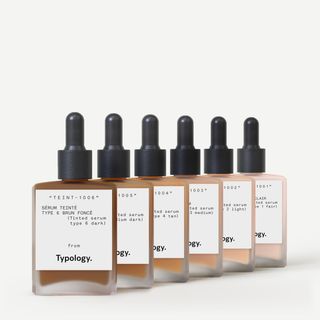
Typology Paris Tinted Serum — Vitamin C, Squalane & Aloe Vera
Works for
1 of 1 advertised claim delivered
Moisturizing5 ingredients credited for this claimGood support
“A silicon-free, non-clogging tinted serum for light coverage and a natural no-makeup finish.Formulated with vitamin C for radiance and squalane & aloe vera for deep, long-lasting hydration.99% naturally-derived formula. 30ml / 1 fl.oz.Find your shade here .”
This product can help improve hydration of the skin with the two types of ingredients.
The first type is called “humectants”:
these ingredients help attract water.
When humectants are on the surface of the skin, they “pull in” the moisture from the outside environment, or from
within deeper layers of the skin. The following ingredients in this product do the job:
glycerin.
This product also contains ingredients called “occlusives”. They help reduce the speed with which our skin loses moisture to the outside environment. These ingredients also help soften the upper layer of the skin, so it feels less tight and nicer to the touch. The following ingredients in this product do the job: squalane, coco-caprylate/caprate.
Can it cause trouble?
Irritancy7 flagged ingredientsLow risk
Comedogenic1 ingredient rated 2 or more on the 0–5 pore-clogging scale1 flagged
User reviews
Be the first — your take helps the next person decide.
Ingredients
Filter by role to see what each ingredient is doing.
Water~40–60%
Isoamyl laurate~4.5–6.7%
- Irritation risk
- Medium
Helps stabilize emulsions and create a nice product texture
More about Isoamyl laurateC9-12 alkane~3.7–5.6%
Squalane~2.8–4.1%
- Irritation risk
- Low
An oil naturally present in skin. Works as an emollient to soften the skin and form a protective layer on its surface without a greasy feeling.
More about SqualanePolyglyceryl-3 diisostearate~2–3%
- Irritation risk
- Medium
- Comedogenicity
- 3/5
Helps oil and water mix together
More about Polyglyceryl-3 diisostearatePropanediol~1.7–2.5%
- Irritation risk
- Low
Acts as a solvent for other ingredients. Speeds up the absorption of other ingredients into the skin
More about PropanediolSilica~1.6–2.4%
Polyglyceryl-6 polyricinoleate~1.2–1.8%
- Irritation risk
- Medium
Helps oil and water mix together
More about Polyglyceryl-6 polyricinoleateGlycerin~1–1.5%
- Irritation risk
- Low
One of the best moisturizing ingredients. Naturally present in skin. It attracts water to the upper layer of the skin working as a humectant
More about GlycerinMagnesium sulfate~0.8–1.25%
Ascorbyl tetraisopalmitate~0.45–1.1%
- Irritation risk
- Medium
A vitamin C derivative. Studies show that is might be effective in reducing hyperpigmentation, but there are no studies confirming that it is effectively converted into the bioavailable form of Vitamin C in skin. It is not clear how this derivative compares in effectiveness to the topical application of bioavailable form of vitamin C (L-ascorbic acid)
More about Ascorbyl tetraisopalmitatePolyglyceryl-2 isostearate~0.4–0.9%
Coco-caprylate/caprate~0.35–0.85%
- Irritation risk
- Low
Helps to soften the upper layer of the skin without creating a greasy texture
More about Coco-caprylate/caprateDisteardimonium hectorite~0.3–0.7%
- Irritation risk
- Low
A type of clay that is used to thicken the product consistency
More about Disteardimonium hectoriteHydroxyethylcellulose~0.2–0.75%
- Irritation risk
- Low
Used to thicken product formulations and create gel-like textures
More about HydroxyethylcelluloseSodium benzoate~0.25–0.5%
Disodium stearoyl glutamate~0.3–0.75%
- Irritation risk
- Medium
Helps oil and water mix together and workd as a cleanser
More about Disodium stearoyl glutamatePotassium sorbate~0.3–0.6%
Aloe barbadensis leaf juice~0.15–0.55%
- Irritation risk
- Medium
Traditionally used to treat sunburns, dermatitis and inflammation, but evidence for its effectiveness is lacking. The extract can contain humectants that help attract water into the skin
More about Aloe barbadensis leaf juiceAluminum hydroxide~0.15–0.55%
- Irritation risk
- Low
Is used to add opaque (non-transparent) appearance to formulations. Can be used to coat other ingredients for even dispersion. This is a different ingredient compared to the ones used in antipersperants (aluminium chloride and aluminium chlorohydrate)
More about Aluminum hydroxideSodium nitrate~0.1–0.4%
- Irritation risk
- Low
Ci 77891~0.1–0.35%
- Irritation risk
- Low
Titanium dioxide~0.15–0.65%
- Irritation risk
- Low
Works as a UV filter when used in high concentrations. It is photostable and is effective mostly against the UVB light, with some protection in the UVA range. In small concentrations, used for its ability to improve the color of cosmetic products. Is usually well tolerated by the skin
More about Titanium dioxideCi 77492~0.05–0.3%
Iron oxides~0.05–0.2%
- Irritation risk
- Low
An umbrella term for the following three colorants: CI 77491, CI 77492, CI 77499. They might be able to offer some protection against visible light, but the degree of the protection is not clear
More about Iron oxidesCi 77491~0.05–0.2%
- Irritation risk
- Low
A red colorant made of iron oxide. Typically is not irritating
More about Ci 77491Iron oxides~0.01–0.1%
- Irritation risk
- Low
An umbrella term for the following three colorants: CI 77491, CI 77492, CI 77499. They might be able to offer some protection against visible light, but the degree of the protection is not clear
More about Iron oxidesCi 77499~0.01–0.05%
Iron oxides~0.01–0.05%
- Irritation risk
- Low
An umbrella term for the following three colorants: CI 77491, CI 77492, CI 77499. They might be able to offer some protection against visible light, but the degree of the protection is not clear
More about Iron oxidesIngredient list view
Water, Isoamyl laurate, C9-12 alkane, Squalane, Polyglyceryl-3 diisostearate, Propanediol, Silica, Polyglyceryl-6 polyricinoleate, Glycerin, Magnesium sulfate, Ascorbyl tetraisopalmitate, Polyglyceryl-2 isostearate, Coco-caprylate/caprate, Disteardimonium hectorite, Hydroxyethylcellulose, Sodium benzoate, Disodium stearoyl glutamate, Potassium sorbate, Aloe barbadensis leaf juice, Aluminum hydroxide, Sodium nitrate, Ci 77891, Titanium dioxide, Ci 77492, Iron oxides, Ci 77491, Iron oxides, Ci 77499, Iron oxides
Compare prices
Retailers ranked by price — lowest first.
Affiliate links · prices updated regularly
Product summary
"Typology Paris - Tinted Serum — Vitamin C, Squalane & Aloe Vera" could be helpful for: Moisturizing, but its actives are not the most effective or are not well-studied.
Ingredient callouts
- Humectants (glycerin 1.00% - 1.50%). These ingredients help attract water to the upper layer of the skin and improve the skin hydration.
Price
The product retails for 40.70$ in the United States.
For a detailed price comparison: click here.
Sources cited in this review
Every concentration estimate and effectiveness label is anchored to one of these 8 studies and safety reviews.
- 1
- 2Safety Assessment of Magnesium Sulfate as Used in Cosmeticsncbi.nlm.nih.gov
- 3
- 4
- 5
- 6

Affiliate links · As an Amazon Associate, WIMJ earns from qualifying purchases.