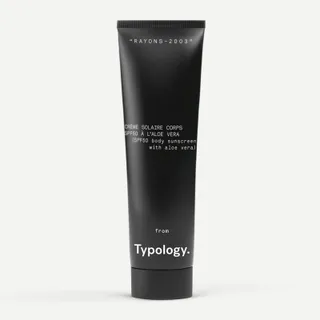
Typology Crème solaire corps SPF50 — à l'aloe vera
Works for
Sun protectionSPF 50 · 4 UV filtersBroad spectrum
This product offers a good level of protection against both UVB and UVA rays.
This sunscreen uses organic (so-called "chemical") sunscreen filters. Organic, or "chemical" filters usually provide reliable sun protection and rarely leave a white cast. Sunscreens with organic filters can sting eyes.
This product can be considered "reef safe" because it does not contain the UV filters (oxybenzone and octinoxate) that can be harmful to coral reefs when present in the water in high concentrations.
Evens skin toneSide benefit · No ingredient credited for this claimWorks well
This product offers broad spectrum sun protection. It means that it can prevent hyperpigmentation and help keep the skin tone even (sun damage is the main factor causing age spots, darkening of post-acne marks and other discolorations).
Anti-agingSide benefit · No ingredient credited for this claimWorks well
This product can help prevent early signs of skin aging because it offers a good level of broad spectrum sun protection. Sun damage is the main cause of premature skin aging, and protecting your skin from the sun is the best anti-aging strategy.
MoisturizingSide benefit · Myristyl myristate, Polyglyceryl-6 stearate + 5 moreWorks
This product can help soften the skin and reduce its moisture loss with emollients and occlusives: myristyl myristate, cetearyl alcohol.
Keep in mind that this product does not contain effective ingredients to attract water to the upper layer of the skin. This is why an additional product with humectants like glycerin or hyaluronic acid can be helpful (apply it before this product for the best results).
Can it cause trouble?
Irritancy16 flagged ingredientsLow risk
Comedogenic2 ingredients rated 2 or more on the 0–5 pore-clogging scale2 flagged
User reviews
Be the first — your take helps the next person decide.
Ingredients
Filter by role to see what each ingredient is doing.
Water~45–55%
Propanediol dicaprylate~5.9–7.2%
- Irritation risk
- Low
Cocoglycerides~3.5–4.2%
- Irritation risk
- High
Help soften the upper layer of the skin and make it easier for oil and water mix together. Recently, a rising number of allergic reactions to cocoglycerides and other coconut-derived surfactants has been reported. As there is a significant overlap between frequent irritants and allergens, we flag this ingredient for attention of those with very sensitive, reactive skin
More about CocoglyceridesDiethylamino hydroxybenzoyl hexyl benzoate~3.4–4.1%
- Irritation risk
- Medium
Uvinul A Plus. A new generation broad spectrum sunscreen that offers an effective protection especially in the UVA range. It is stable in formulations. Unfortunately, is not approved by the FDA (US) yet
More about Diethylamino hydroxybenzoyl hexyl benzoateBis-ethylhexyloxyphenol methoxyphenyl triazine~3–3.7%
- Irritation risk
- Medium
Tinosorb S. One of the most effective broad spectrum sunscreen ingredients. Protects from both UVA and UVB rays. It is photostable. Approved by the US FDA in 2026 (listed as bemotrizinol on US labels).
More about Bis-ethylhexyloxyphenol methoxyphenyl triazineMyristyl myristate~2–2.4%
- Irritation risk
- Medium
- Comedogenicity
- 3/5
An emollient. Is not recommended for acne-prone skin as it can be comedogenic
More about Myristyl myristateEthylhexyl triazone~2.1–2.6%
- Irritation risk
- Medium
Uvinul T. A UV filter. Effective against UVB rays. It is photostable. Can increase water resistance properties of the sunscreen. Unfortunately, not approved by the FDA (US) yet
More about Ethylhexyl triazoneOryza sativa starch~1.5–1.8%
- Irritation risk
- Low
Polyglyceryl-6 stearate~1.2–1.5%
- Irritation risk
- Low
Helps soften the upper layer of the skin
More about Polyglyceryl-6 stearatePolyglyceryl-6 behenate~0.95–1.15%
Capryloyl glycerin/sebacic acid copolymer~0.7–1.1%
- Irritation risk
- Low
Helps soften the upper layer of the skin
More about Capryloyl glycerin/sebacic acid copolymer1,2-heptanediol~0.6–0.9%
- Irritation risk
- Low
Propanediol~0.55–0.8%
- Irritation risk
- Low
Acts as a solvent for other ingredients. Speeds up the absorption of other ingredients into the skin
More about PropanediolSodium stearoyl glutamate~0.5–0.8%
- Irritation risk
- Medium
Helps oil and water mix together
More about Sodium stearoyl glutamateAloe barbadensis leaf juice powder~0.4–0.65%
- Irritation risk
- Medium
Traditionally used to treat sunburns, dermatitis and inflammation, but evidence for its effectiveness is lacking. The extract can contain humectants that help attract water into the skin
More about Aloe barbadensis leaf juice powderLauryl glucoside~0.5–0.75%
Polyglyceryl-6 laurate~0.45–0.65%
- Irritation risk
- Medium
Helps oil and water mix together
More about Polyglyceryl-6 laurateSodium hydroxide~0.3–0.6%
Phenylbenzimidazole sulfonic acid~0.5–0.75%
- Irritation risk
- Medium
Ensulizole. A UV filter that is effective against UVB rays. Does not protect against UVA light. It is photostable and can be used to help stabilize other sunscreen ingredients. It is water-soluble meaning that it can help create lighter sunscreen formulations
More about Phenylbenzimidazole sulfonic acidMyristyl glucoside~0.3–0.55%
- Irritation risk
- Low
Sodium gluconate~0.2–0.4%
Acacia senegal gum~0.2–0.4%
- Irritation risk
- Medium
Helps mask the small of other ingredients and improve the product texture
More about Acacia senegal gumXanthan gum~0.2–0.35%
- Irritation risk
- Low
Used to create a thicker product consistency
More about Xanthan gumO-cymen-5-ol~0.05–0.1%
Citric acid~0.15–0.25%
- Irritation risk
- Medium
Can work as an exfoliant but is typically used to adjust the product pH
More about Citric acidGlyceryl stearate~0.15–0.3%
- Irritation risk
- Low
An emollient that softens the skin and forms a protective layer on its surface. Helps water and oil mix together
More about Glyceryl stearateCandelilla/jojoba/rice bran polyglyceryl-3 esters~0.1–0.2%
- Irritation risk
- Medium
Help oil and water mix together
More about Candelilla/jojoba/rice bran polyglyceryl-3 estersCetearyl alcohol~0.15–0.25%
- Irritation risk
- Low
- Comedogenicity
- 2/5
A non-drying alcohol. Works as an emollient. Helps water and oil mix together and creates a nice product texture
More about Cetearyl alcoholSodium stearoyl lactylate~0.05–0.1%
- Irritation risk
- Medium
Helps oil and water mix together
More about Sodium stearoyl lactylateIngredient list view
Water, Propanediol dicaprylate, Cocoglycerides, Diethylamino hydroxybenzoyl hexyl benzoate, Bis-ethylhexyloxyphenol methoxyphenyl triazine, Myristyl myristate, Ethylhexyl triazone, Oryza sativa starch, Polyglyceryl-6 stearate, Polyglyceryl-6 behenate, Capryloyl glycerin/sebacic acid copolymer, 1,2-heptanediol, Propanediol, Sodium stearoyl glutamate, Aloe barbadensis leaf juice powder, Lauryl glucoside, Polyglyceryl-6 laurate, Sodium hydroxide, Phenylbenzimidazole sulfonic acid, Myristyl glucoside, Sodium gluconate, Acacia senegal gum, Xanthan gum, O-cymen-5-ol, Citric acid, Glyceryl stearate, Candelilla/jojoba/rice bran polyglyceryl-3 esters, Cetearyl alcohol, Sodium stearoyl lactylate
Compare prices
Retailers ranked by price — lowest first.

Worth comparing, line by line.
Match % combines shared ingredients, the first five ingredients, shared actives and hero ingredients, irritancy (lower counts in the alternative's favour), texture and body area. Only products in the same routine step are compared.
| TypologyCrème solaire corps SPF50 — à l'aloe veraYOUR PRODUCT | Topology ParisSPF 30 Body Sunscreen with Aloe Vera L91 | Drs. LeenartsSUNCARE SPF50 | NorevaCICADIANE SOOTHING REPAIRING CARE SPF 50+ | |
|---|---|---|---|---|
| Match | — | 38% | 37% | 36% |
| Price | $23.50 | $40.34+$16.84 | $24.30+$0.80 | $15.59−$7.91 |
| Shared key ingredients | — | 4 of 5 | 4 of 5 | 3 of 5 |
| Key difference | — | Butyrospermum Parkii Butter | Glycerin | Glycerin |
| Irritancy | Low | Low | Low | Low |
| SPF | SPF 50 | SPF 30 | SPF 50 | SPF 50 |
| Drying alcohol | — | — | — | — |
| View product | Shop | Shop | Shop |

More alternatives: SVR Sensifine AR Anti-Redness + Rosacea Cream SPF50+Alpha-H Daily Essential Moisturiser SPF50+ With Hydrosella
Sources cited in this review
Every concentration estimate and effectiveness label is anchored to one of these 2 studies and safety reviews.
- 1
- 2Allergic contact dermatitis caused by isopropyl methylphenol, a new haptenonlinelibrary.wiley.com

Affiliate links · As an Amazon Associate, WIMJ earns from qualifying purchases.