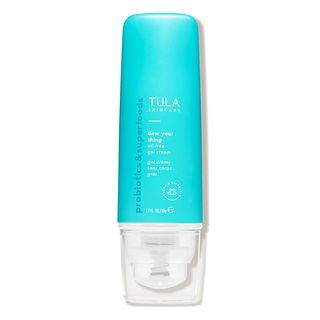
Tula Dew Your Thing Moisturizing Gel Cream
Works for
1 of 2 advertised claims delivered
Moisturizing22 ingredients credited for this claimStrong support
“Dew Your Thing Moisturizing Gel Cream”
This product can help improve hydration of the skin with the two types of ingredients.
The first type is called “humectants”:
these ingredients help attract water.
When humectants are on the surface of the skin, they “pull in” the moisture from the outside environment, or from
within deeper layers of the skin. The following ingredients in this product do the job:
glycerin, pantolactone.
This product also contains ingredients called “occlusives”. They help reduce the speed with which our skin loses moisture to the outside environment. These ingredients also help soften the upper layer of the skin, so it feels less tight and nicer to the touch. The following ingredients in this product do the job: chondrus crispus extract, dimethicone.
The following ingredients in this product are especially good for supporting the skin barrier and helping with the hydration level: panthenol
Anti-aging4 ingredients credited for this claimLimited support
“locks in skin’s hydration, strengthens skin’s barrier, boosts collagen production and improves skin elasticity.”
This product does not contain ingredients that are able to reduce fine lines and wrinkles or help with skin elasticity, but it can improve the look of the skin temporarily through moisturization. Well-moisturized skin might also be able to repair the sun damage better.This ingredient - lactococcus ferment lysate - could be helpful for preventing or repairing signs of aging in theory, but there is no evidence that it actually works.
Can it cause trouble?
Irritancy3 strong irritants: Rosa damascena extract, Ocimum sanctum leaf extract + 1 more — patch-test recommendedHigh risk
Comedogenic2 ingredients rated 2 or more on the 0–5 pore-clogging scale2 flagged
User reviews
Be the first — your take helps the next person decide.
Ingredients
Filter by role to see what each ingredient is doing.
Water~45–55%
Propanediol~4.5–5.5%
- Irritation risk
- Low
Acts as a solvent for other ingredients. Speeds up the absorption of other ingredients into the skin
More about PropanediolCyclopentasiloxane~4.1–5%
- Irritation risk
- Low
A silicone that helps improve the product texture and spreadability. Can absorb oil creating a short-term mattifying effect on the skin
More about CyclopentasiloxaneCyclohexasiloxane~3.1–3.8%
- Irritation risk
- Low
A silicone that serves as an emollient. Helps create a nice non-greasy feels
More about CyclohexasiloxaneCaprylyl methicone~2.3–2.8%
- Irritation risk
- Low
A type of silicone that helps to soften the upper layer of the skin and create a nice product finish on the skin
More about Caprylyl methiconeDimethicone~2–2.5%
- Irritation risk
- Low
A silicone that helps to reduce water loss from the surface of the skin. Can temporarily "fill in" lines and wrinkles, absorb oil, and create a nice product finish
More about DimethiconeAspergillus/rice ferment~1.7–2%
- Irritation risk
- Low
Lactococcus ferment lysate~1.4–1.8%
- Irritation risk
- Low
Consists of remains of dead bacteria cells. Is likely helpful in attracting water to the upper layer of the skin. Might be helpful in reducing inflammation and neutralizing free radicals in skin
More about Lactococcus ferment lysateSaccharomyces/rice ferment filtrate~1.2–1.4%
- Irritation risk
- Low
A product of yeast fermentation. Can contain humectants that help attract water to the upper layer of the skin and might help neutralize free oxidants
More about Saccharomyces/rice ferment filtrateLactic acid~0.95–1.15%
- Irritation risk
- Medium
An exfoliating and moisturizing alpha-hydroxy acid (AHA). Typically causes less irritation than other AHAs, for example, glycolic acid. At high concentrations (about 15%), lactic acid can help reduce lines and wrinkles. Recent studies show that lactic acid can support the "good" bacteria living on skin's surface (healthy skin microbiome)
More about Lactic acidAloe barbadensis flower extract~0.75–1.1%
- Irritation risk
- High
A plant extract that might have some anti-oxidant effect
More about Aloe barbadensis flower extractSodium hyaluronate~0.6–0.9%
- Irritation risk
- Low
One of the best moisturizing ingredients. Attracts water into the upper layer of the skin
More about Sodium hyaluronateCitrullus lanatus fruit extract~0.55–0.8%
- Irritation risk
- Medium
A plant extract that can contain an antioxidant compound
More about Citrullus lanatus fruit extractCoccinia indica fruit extract~0.5–0.75%
- Irritation risk
- Medium
A plant extract that might have some anti-oxidant effect helping neutralize free radicals in skin
More about Coccinia indica fruit extractCorallina officinalis extract~0.45–0.7%
- Irritation risk
- Low
- Comedogenicity
- 3/5
Red algae extract that helps attract water to the upper layer of the skin and might contain antioxidants
More about Corallina officinalis extractCurcuma longa root extract~0.45–0.7%
- Irritation risk
- High
A plant extract that can contain an active compound curcumin, that may have some anti-inflammatory properties when applied to the skin, but solid research is lacking and the typical concentration used in skincare products is too low. Can be an irritant
More about Curcuma longa root extractRosa damascena extract~0.45–0.7%
- Irritation risk
- High
Oil of a very fragrant pink rose used as fragrance in cosmetics. Extensive research has shown it has mixed benefits. In the pro column, inhaling this flower’s scent seems to have relaxing properties and the plant’s petals contain skin-soothing and antioxidant compounds that can benefit skin. On the flipside, the numerous chemicals that create this rose’s distinctive fragrance pose a risk of causing skin aggravation.
More about Rosa damascena extractMelia azadirachta flower extract~0.4–0.65%
- Irritation risk
- Medium
A plant extract that might be helpful to neutralize free radicals in skin
More about Melia azadirachta flower extractMelia azadirachta leaf extract~0.35–0.65%
- Irritation risk
- High
A plant extract that has anti-bacterial properties. Can be used to preserve the product. Can be irritating
More about Melia azadirachta leaf extractOcimum sanctum leaf extract~0.3–0.6%
- Irritation risk
- High
A plant extract that is rich in a fragrance compound eugenol that is a frequent allergen and can be irritating. It might also contain anti-oxidants to help neutralize free radicals
More about Ocimum sanctum leaf extractOpuntia ficus-indica extract~0.3–0.55%
- Irritation risk
- Low
Opuntia ficus-indica stem extract~0.3–0.55%
- Irritation risk
- Low
Malus domestica fruit extract~0.3–0.55%
- Irritation risk
- Medium
Helps attract water to the upper layer of the skin
More about Malus domestica fruit extractChondrus crispus extract~0.3–0.55%
- Irritation risk
- Low
- Comedogenicity
- 3/5
Red algae extract that helps attract water to the upper layer of the skin and create a nicer product consistency
More about Chondrus crispus extractCucumis melo fruit extract~0.25–0.5%
- Irritation risk
- Medium
A fruit extract that might have some anti-oxidant properties
More about Cucumis melo fruit extractSolanum melongena fruit extract~0.25–0.5%
- Irritation risk
- Medium
Eggplant fruit extract. Might have some anti-oxidant effect
More about Solanum melongena fruit extractGlycerin~0.3–0.6%
- Irritation risk
- Low
One of the best moisturizing ingredients. Naturally present in skin. It attracts water to the upper layer of the skin working as a humectant
More about GlycerinGluconolactone~0.25–0.5%
- Irritation risk
- Medium
A polyhydroxy acid (PHA) that helps shed the dead cells from the skin surface revealing smoother skin. Is believed to be genter than AHAs. It helps attract water to the upper layer of the skin and can stimulate production of skin's own hyaluronic acid resulting in improved hydration levels. It has been shown to be helpful against acne and clogged pores if used consistently (e.g over a period of 12 weeks) in high enough concentration. It can help reduce fine lines and wrinkles and improve skin tone with long-term application. Can help neutralize free radicals
More about GluconolactonePanthenol~0.3–0.5%
- Irritation risk
- Low
Helps attract water to the upper layer of the skin and can help improve skin barrier function
More about PanthenolPantolactone~0.25–0.5%
- Irritation risk
- Low
Helps attract water to the upper layer of the skin
More about PantolactoneSodium lactate~0.25–0.5%
- Irritation risk
- Medium
Helps attract water to the upper layer of the skin. Is often used to adjust the pH level of the product
More about Sodium lactateSodium pca~0.25–0.5%
- Irritation risk
- Low
Naturally present in skin and helps to attract water to its upper layer
More about Sodium pcaTocopherol~0.3–0.5%
- Irritation risk
- Low
Pure form of vitamin E. Can help moisturise and protect the skin from free radicals. Often used to help stabilise other ingredients or the formula itself
More about TocopherolSaccharide isomerate~0.25–0.5%
- Irritation risk
- Low
Helps attract water to the upper layer of the skin
More about Saccharide isomerateSodium benzoate~0.25–0.5%
Sodium chloride~0.3–0.55%
- Irritation risk
- Low
Used to stabilize mixtures of oil and water, and create thicker, gel-like product textures
More about Sodium chlorideSodium citrate~0.25–0.45%
- Irritation risk
- Medium
Helps to control the skin's pH level. Maintains the skin's natural film of amino-lactic acids and oils. Helps to preserve products
More about Sodium citrateCitric acid~0.25–0.45%
- Irritation risk
- Medium
Can work as an exfoliant but is typically used to adjust the product pH
More about Citric acidCaprylhydroxamic acid~0.25–0.45%
Caprylyl glycol~0.25–0.5%
- Irritation risk
- Medium
Helps preserve products and creates a nice product texture
More about Caprylyl glycolCetyl peg/ppg-10/1 dimethicone~0.25–0.4%
- Irritation risk
- Low
A type of silicone that helps water and oil mix together. Can help to soften upper layer of the skin
More about Cetyl peg/ppg-10/1 dimethiconeDimethicone/peg-10/15 crosspolymer~0.2–0.35%
Dipropylene glycol~0.15–0.3%
- Irritation risk
- Low
Helps to dissolve other ingredients in a formulation. Slows down the rate of product drying
More about Dipropylene glycolHexanediol~0.15–0.3%
Butylene glycol~0.15–0.3%
- Irritation risk
- Low
Used to create a nice product texture and help delivery of other ingredients. Might be somewhat helpful in attracting water to the upper layer of the skin
More about Butylene glycolPotassium sorbate~0.15–0.3%
Ethylhexylglycerin~0.15–0.25%
Parfum~0.05–0.15%
- Irritation risk
- High
An aromatic blend of unspecified and possibly irritating ingredients
More about ParfumPhenoxyethanol~0.15–0.25%
- Irritation risk
- Low
A preservative. It helps prevent bacterial growth in cosmetic products
More about PhenoxyethanolIngredient list view
Water, Propanediol, Cyclopentasiloxane, Cyclohexasiloxane, Caprylyl methicone, Dimethicone, Aspergillus/rice ferment, Lactococcus ferment lysate, Saccharomyces/rice ferment filtrate, Lactic acid, Aloe barbadensis flower extract, Sodium hyaluronate, Citrullus lanatus fruit extract, Coccinia indica fruit extract, Corallina officinalis extract, Curcuma longa root extract, Rosa damascena extract, Melia azadirachta flower extract, Melia azadirachta leaf extract, Ocimum sanctum leaf extract, Opuntia ficus-indica extract, Opuntia ficus-indica stem extract, Unknown, Malus domestica fruit extract, Chondrus crispus extract, Cucumis melo fruit extract, Solanum melongena fruit extract, Glycerin, Gluconolactone, Panthenol, Pantolactone, Sodium lactate, Sodium pca, Tocopherol, Saccharide isomerate, Sodium benzoate, Sodium chloride, Sodium citrate, Citric acid, Caprylhydroxamic acid, Caprylyl glycol, Cetyl peg/ppg-10/1 dimethicone, Dimethicone/peg-10/15 crosspolymer, Dipropylene glycol, Hexanediol, Butylene glycol, Potassium sorbate, Ethylhexylglycerin, Parfum, Phenoxyethanol
Compare prices
Retailers ranked by price — lowest first.

Product summary
"Tula - Dew Your Thing Moisturizing Gel Cream" is a well-rounded moisturizing product. As we expect from a proper moisturizer, the formula includes a combo of effective humectants and emollients. These are the two different types of ingredients that are essential for improving the skin hydration and supporting a healthy skin barrier. Humectants in this product (panthenol, glycerin, pantolactone, saccharide isomerate and sodium hyaluronate) help to increase the water content in the upper layer of the skin. (These ingredients do so by "capturing" water molecules from the outside air or from within the deeper layers of the skin). Emollients in this formulation (chondrus crispus extract, dimethicone, cyclopentasiloxane, caprylyl glycol and cyclohexasiloxane) help to reduce the moisture loss from the skin. They also soften the skin surface and relieve the feeling of dryness and tightness.
Ingredient callouts
- This product contains acids (gluconolactone and lactic acid). Their concentration is low, and they will not have a strong exfoliating effect. Instead, they work to support the skin natural acid mantle and to attract water (as humectants). PHAs (gluconolactone) especially are great for improving skin hydration. They might be even able to stimulate the production of skin's natural humectants and support the healthy skin microbiome.
Irritation risk
This moisturizer contains some common irritants, including those without a benefit for the skin. We assess the overall irritancy of this moisturizer to be high. For a detailed overview of all potential irritants: click here
You can see the detailed formula review with the breakdown of all actives in the product and the full ingredient list with estimated concentrations in the tables below.
About the brand
According to Cruelty-Free Kitty "Tula" is cruelty free and so is its parent company.
Price
The product retails for 48.00$ in the United States.
For a detailed price comparison: click here.
Sources cited in this review
Every concentration estimate and effectiveness label is anchored to one of these 30 studies and safety reviews.
- 1
- 2Final Report on the Safety Assessment of Dimethicone Copolyoljournals.sagepub.com
- 3Epidermal and dermal effects of topical lactic acidncbi.nlm.nih.gov
- 4Dual Effects of Alpha-Hydroxy Acids on the Skinpdfs.semanticscholar.org
- 5Hyaluronic acid: A key molecule in skin agingncbi.nlm.nih.gov
- 6

Affiliate links · As an Amazon Associate, WIMJ earns from qualifying purchases.