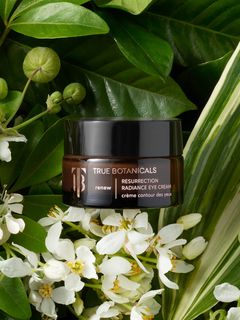
True Botanicals Resurrection Radiance Eye Cream
Works for
1 of 2 advertised claims delivered
MoisturizingCocos nucifera fruit extract, Glycerin + 15 moreGood evidence
“An innovative, brightening eye cream featuring a bioactive moisture retention complex from the Resurrection Plant to help intensely moisturize and dramatically reduce the appearance of dark circles, fine lines and wrinkles.”
This product can help improve hydration of the skin with the two types of ingredients.
The first type is called “humectants”:
these ingredients help attract water.
When humectants are on the surface of the skin, they “pull in” the moisture from the outside environment, or from
within deeper layers of the skin. The following ingredients in this product do the job:
glycerin, lactobacillus ferment.
This product also contains ingredients called “occlusives”. They help reduce the speed with which our skin loses moisture to the outside environment. These ingredients also help soften the upper layer of the skin, so it feels less tight and nicer to the touch. The following ingredients in this product do the job: cocos nucifera fruit extract, hippophae rhamnoides oil.
Anti-agingCamellia sinensis leaf extract, TocopherolLimited evidence
“Infused with a unique Tree Bark Extract that directly addresses the root cause of dark circles, while antioxidant-rich Turmeric, Coffee and Licorice Extracts help to depuff and brighten the 360° eye area to deliver youthful-looking, radiant eyes.”
This product does not contain ingredients that are able to reduce fine lines and wrinkles or help with skin elasticity, but it can improve the look of the skin temporarily through moisturization. Well-moisturized skin might also be able to repair the sun damage better.This ingredient - camellia sinensis leaf extract - could be helpful for preventing or repairing signs of aging in theory, but there is no evidence that it actually works.
This ingredient camellia sinensis leaf extract might be able to help neutralize free radicals in skin and help it fight off some of the sun damage.
Anti-oxidationNot advertised by the brand · Camellia sinensis leaf extract, Glycyrrhiza glabra root extract + 7 moreModerate evidence
This product contains antioxidants (camellia sinensis leaf extract) that might be able to help neutralize free radicals in skin to lessen the damage it gets from the UV light (sun). There is not enough evidence to confirm their effectiveness in skin though.
Can it cause trouble?
Irritancy1 strong irritant: Rosa rubiginosa seed oilMedium risk
Comedogenic2 ingredients rated 2 or more on the 0–5 pore-clogging scale2 flagged
User reviews
Be the first — your take helps the next person decide.
Ingredients
Filter by role to see what each ingredient is doing.
Camellia sinensis leaf extract~22–34%
- Irritation risk
- Low
Can contain potent anti-oxidant compounds (abbreviated ECG, GCG, EGC, and EGCG) that might help protect the skin from free radicals. Can help calm down inflammation and has some anti-bacterial properties. Unfortunately, these antioxidants are unstable and lose their effectiveness very quickly in products. The concentration of the antioxidant compounds in the extract also tends to be low to be effective in topical formulation
More about Camellia sinensis leaf extractMangifera indica seed butter~4.7–7%
- Irritation risk
- Low
Helps to soften the upper layer of the skin and might have some anti-oxidant effect
More about Mangifera indica seed butterGlycerin~4.1–6.2%
- Irritation risk
- Low
One of the best moisturizing ingredients. Naturally present in skin. It attracts water to the upper layer of the skin working as a humectant
More about GlycerinHydrogenated vegetable oil~3.7–5.5%
- Irritation risk
- Low
- Comedogenicity
- 2/5
An oil from a mixture of different vegetables. Helps soften the upper layer of the skin
More about Hydrogenated vegetable oilSilybum marianum ethyl ester~2.6–3.8%
- Irritation risk
- Medium
Helps to create a nice product texture. Used to substitute silicones
More about Silybum marianum ethyl esterLactobacillus ferment~1.9–2.9%
- Irritation risk
- Low
A fermentation product created by bacteria Lactobacillus. The fermented product has anti-bacterial properties and might be helpful in calming down inflammation, but studies are lacking. Helps attract water to the upper layer of the skin. Can be used as a preservative
More about Lactobacillus fermentCetearyl olivate~1.5–2.2%
Coffea arabica seed oil~1.2–1.9%
- Irritation risk
- Medium
Might be helpful in neutralizing free radicals in skin
More about Coffea arabica seed oilSorbitan olivate~1–1.5%
Selaginella lepidophylla extract~0.9–1.35%
- Irritation risk
- Medium
A plant extract that might be able to attract water to the upper layer of the skin, soften it and have some antioxidant effect, but evidence of effectiveness in skin is lacking
More about Selaginella lepidophylla extractTerminalia arjuna extract~0.5–1.2%
- Irritation risk
- Low
Sodium hyaluronate~0.4–1%
- Irritation risk
- Low
One of the best moisturizing ingredients. Attracts water into the upper layer of the skin
More about Sodium hyaluronateCoffea arabica seed extract~0.4–0.9%
- Irritation risk
- Low
Might be helpful in neutralizing free radicals in skin
More about Coffea arabica seed extractGlycyrrhiza glabra root extract~0.4–0.9%
- Irritation risk
- Medium
A plant extract that can help lighten the skin and calm down inflammation. Might be helpful in neutralizing free radicals
More about Glycyrrhiza glabra root extractHippophae rhamnoides oil~0.4–0.95%
- Irritation risk
- High
A good emollient. Contains various ingredients including vitamins and fatty acids that could work in the skin to neutralize free radicals and minimize moisture loss - if enough of these compounds is able to penetrate the skin in an active form.
More about Hippophae rhamnoides oilRosa rubiginosa seed oil~0.4–0.9%
- Irritation risk
- High
Plant oil that due to the high content of linoleic acid can support skin's barrier function and reduce moisture loss
More about Rosa rubiginosa seed oilSimmondsia chinensis seed oil~0.4–0.9%
- Irritation risk
- Medium
Softens the upper layer of skin and helps restore the healthy skin barrier. Has shown to help calm down inflammation in skin. It is a stable oil, meaning that it retains its properties even when exposed to air.
More about Simmondsia chinensis seed oilPersea gratissima oil~0.35–0.85%
- Irritation risk
- Medium
An emollient that helps soften the skin and could be helpful in repairing its barrier function
More about Persea gratissima oilCocos nucifera fruit extract~0.3–0.7%
- Irritation risk
- Low
- Comedogenicity
- 3/5
An emollient. Found to be as effective as a moisturizer for dry skin as mineral oil. Could be comedogenic
More about Cocos nucifera fruit extractCaprylic/capric triglyceride~0.3–0.7%
- Irritation risk
- Medium
A good mix of fatty acids that forms a protective layer on the skin. Improves the shelf life of products. Derived from coconut and glycerin
More about Caprylic/capric triglycerideLactobacillus~0.15–0.6%
- Irritation risk
- Low
A non-living ingredient made by fermentation with the bacteria Lactobacillus. It can help attract water to the upper layer of the skin and might help reduce inflammation
More about LactobacillusOleic acid~0.2–0.75%
- Irritation risk
- Medium
Helps soften the upper layer of the skin. At the same time, it can weaken the skin's barrier enhancing penetration of other ingredients and increasing the risk of skin dryness
More about Oleic acidPopulus tremuloides bark extract~0.15–0.55%
- Irritation risk
- Low
Citric acid~0.15–0.65%
- Irritation risk
- Medium
Can work as an exfoliant but is typically used to adjust the product pH
More about Citric acidSodium phytate~0.15–0.65%
Tocopherol~0.15–0.65%
- Irritation risk
- Low
Pure form of vitamin E. Can help moisturise and protect the skin from free radicals. Often used to help stabilise other ingredients or the formula itself
More about TocopherolSclerotium gum~0.15–0.6%
- Irritation risk
- Low
Used to create gel-like formulas and stabilize emulsions
More about Sclerotium gumLecithin~0.2–0.8%
- Irritation risk
- Low
Used mostly for creating emulsions - helping oil and water mix together. Helps soften the upper layer of the skin
More about LecithinPhenethyl alcohol~0.15–0.5%
Ethylhexylglycerin~0.1–0.4%
Camellia sinensis leaf extract~0.1–0.4%
- Irritation risk
- Low
Can contain potent anti-oxidant compounds (abbreviated ECG, GCG, EGC, and EGCG) that might help protect the skin from free radicals. Can help calm down inflammation and has some anti-bacterial properties. Unfortunately, these antioxidants are unstable and lose their effectiveness very quickly in products. The concentration of the antioxidant compounds in the extract also tends to be low to be effective in topical formulation
More about Camellia sinensis leaf extractHippophae rhamnoides oil~0.15–0.55%
- Irritation risk
- High
A good emollient. Contains various ingredients including vitamins and fatty acids that could work in the skin to neutralize free radicals and minimize moisture loss - if enough of these compounds is able to penetrate the skin in an active form.
More about Hippophae rhamnoides oilRosa rubiginosa seed oil~0.15–0.5%
- Irritation risk
- High
Plant oil that due to the high content of linoleic acid can support skin's barrier function and reduce moisture loss
More about Rosa rubiginosa seed oilSimmondsia chinensis seed oil~0.15–0.55%
- Irritation risk
- Medium
Softens the upper layer of skin and helps restore the healthy skin barrier. Has shown to help calm down inflammation in skin. It is a stable oil, meaning that it retains its properties even when exposed to air.
More about Simmondsia chinensis seed oilEthylhexylglycerin~0.05–0.25%
Ingredient list view
Camellia sinensis leaf extract, Mangifera indica seed butter, Glycerin, Hydrogenated vegetable oil, Silybum marianum ethyl ester, Lactobacillus ferment, Cetearyl olivate, Coffea arabica seed oil, Sorbitan olivate, Selaginella lepidophylla extract, Terminalia arjuna extract, Sodium hyaluronate, Coffea arabica seed extract, Glycyrrhiza glabra root extract, Hippophae rhamnoides oil, Rosa rubiginosa seed oil, Simmondsia chinensis seed oil, Persea gratissima oil, Cocos nucifera fruit extract, Caprylic/capric triglyceride, Lactobacillus, Oleic acid, Populus tremuloides bark extract, Citric acid, Sodium phytate, Tocopherol, Sclerotium gum, Lecithin, Phenethyl alcohol, Ethylhexylglycerin, Camellia sinensis leaf extract, Hippophae rhamnoides oil, Rosa rubiginosa seed oil, Simmondsia chinensis seed oil, Ethylhexylglycerin
Compare prices
Retailers ranked by price — lowest first.

Sources cited in this review
Every concentration estimate and effectiveness label is anchored to one of these 16 studies and safety reviews.
- 1Extraction and Characteristics of Seed Kernel Oil from Mangopdfs.semanticscholar.org
- 2
- 3
- 4
- 5
- 6

Affiliate links · As an Amazon Associate, WIMJ earns from qualifying purchases.