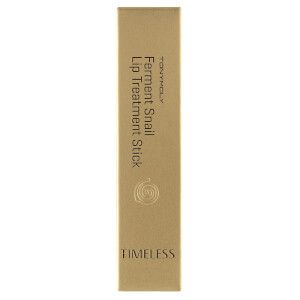
TONYMOLY Timeless Ferment Snail Lip Treatment Stick
Works for
1 of 3 advertised claims delivered
Sun protectionSPF 13 · 2 UV filters · Partial spectrumNo real protectionSPF too low
This product does not offer sun protection, or it is very low.
Moisturizing18 ingredients credited for this claimGood support
“hydrates your lips”
This product can help improve hydration of the skin with the two types of ingredients.
The first type is called “humectants”:
these ingredients help attract water.
When humectants are on the surface of the skin, they “pull in” the moisture from the outside environment, or from
within deeper layers of the skin. The following ingredients in this product do the job:
hydrolyzed collagen, snail secretion filtrate.
This product also contains ingredients called “occlusives”. They help reduce the speed with which our skin loses moisture to the outside environment. These ingredients also help soften the upper layer of the skin, so it feels less tight and nicer to the touch. The following ingredients in this product do the job: bis-diglyceryl polyacyladipate-2, caprylic/capric triglyceride.
Anti-aging4 ingredients credited for this claimLimited support
“more youthful”
This product does not contain ingredients that are able to reduce fine lines and wrinkles or help with skin elasticity, but it can improve the look of the skin temporarily through moisturization. Well-moisturized skin might also be able to repair the sun damage better.
This ingredient cereus grandiflorus flower extract might be able to help neutralize free radicals in skin and help it fight off some of the sun damage.
Anti-oxidationNot advertised by the brand · 7 ingredients credited for this claimModerate support
This product contains antioxidants (cereus grandiflorus flower extract) that might be able to help neutralize free radicals in skin to lessen the damage it gets from the UV light (sun). There is not enough evidence to confirm their effectiveness in skin though.
Can it cause trouble?
Irritancy1 strong irritant: ParfumMedium risk
Comedogenic1 ingredient rated 2 or more on the 0–5 pore-clogging scale1 flagged
User reviews
Be the first — your take helps the next person decide.
Ingredients
Filter by role to see what each ingredient is doing.
Diisostearyl malate~22–33%
- Irritation risk
- Medium
Helps to soften the upper layer of the skin
More about Diisostearyl malateCaprylic/capric triglyceride~5.1–7.7%
- Irritation risk
- Medium
A good mix of fatty acids that forms a protective layer on the skin. Improves the shelf life of products. Derived from coconut and glycerin
More about Caprylic/capric triglyceridePolybutene~4.5–6.8%
Ethylhexyl methoxycinnamate~4–6%
- Irritation risk
- High
Octinoxate. When used in higher concentrations, works as a sunscreen protecting the skin from UVB rays. When used in lower concentration, helps to preserve the product formulation. Is shown to be harmful to coral reefs - consider avoiding bathing in coral reef areas when wearing a product with this ingredient. It can be irritating
More about Ethylhexyl methoxycinnamateHydrogenated polydecene~2.7–4%
- Irritation risk
- Low
Helps to soften the upper layer of the skin and create a nice product texture
More about Hydrogenated polydeceneOzokerite~2–3%
Ethylhexyl salicylate~2–3%
- Irritation risk
- Low
Octisalate. A UV filter. It offers some protection against the sun rays that cause sunburn (UVB), but does not protect against the most aging sun rays (UVA). It loses its effectiveness quickly when exposed to sunlight. It is an organic, or so called "chemical" sunscreen
More about Ethylhexyl salicylateDicalcium phosphate~1.6–2.4%
- Irritation risk
- Low
Bis-diglyceryl polyacyladipate-2~1.3–2%
- Irritation risk
- Low
Helps soften the upper layer of the skin and reduce water loss from its surface
More about Bis-diglyceryl polyacyladipate-2Ceresin~0.95–1.45%
Polyethylene~0.95–1.45%
Euphorbia cerifera wax~0.6–1.4%
- Irritation risk
- Low
Silica dimethyl silylate~0.45–1.1%
Acetylated sucrose distearate~0.45–1%
- Irritation risk
- Low
Synthetic wax~0.4–0.95%
- Irritation risk
- Low
Used to stabilize product formulations and thicken product consistency
More about Synthetic waxEthylene/propylene copolymer~0.5–1.2%
- Irritation risk
- Low
Parfum~0.3–0.75%
- Irritation risk
- High
An aromatic blend of unspecified and possibly irritating ingredients
More about ParfumGlyceryl caprylate~0.4–0.9%
- Irritation risk
- Low
An emollient that can also help water and oil mix together, as well as prevent bacteria growth in products
More about Glyceryl caprylateSnail secretion filtrate~0.2–0.75%
- Irritation risk
- Medium
Typically contains hyaluronic acid that helps attract water to the upper layer of the skin. Might contain allantoin that is helpful in calming down inflammation. There is no evidence that it can have any further benefits for the skin, especially when used in skincare products
More about Snail secretion filtrateButylene glycol~0.2–0.7%
- Irritation risk
- Low
Used to create a nice product texture and help delivery of other ingredients. Might be somewhat helpful in attracting water to the upper layer of the skin
More about Butylene glycolHelianthus annuus seed oil~0.3–0.75%
- Irritation risk
- Low
A great emollient due to its high linoleic acid content. One of the most effective plant oils in helping skin hydration and repairing skin barrier function
More about Helianthus annuus seed oilWater~0.15–0.65%
Borago officinalis seed oil~0.2–0.8%
- Irritation risk
- Low
A plant oil that is effective in reducing irritation in skin, restore the barrier function and support its hydration
More about Borago officinalis seed oilBertholletia excelsa seed oil~0.2–0.8%
- Irritation risk
- Low
Prunus amygdalus dulcis oil~0.3–0.7%
- Irritation risk
- Low
An emollient that softens the skin
More about Prunus amygdalus dulcis oilOlea europaea fruit oil~0.2–0.75%
- Irritation risk
- Medium
An emollient that helps soften the skin but is not effective for restoring its barrier function. Might be helpful to calm down inflammation
More about Olea europaea fruit oilHydrolyzed collagen~0.35–0.85%
- Irritation risk
- Low
A typically plant-derived compound that is supposed mimic human collagen. Cannot penetrate the skin barrier so is not particularly useful in skincare products beyond attracting water to the upper layer of the skin
More about Hydrolyzed collagenSimmondsia chinensis seed oil~0.3–0.75%
- Irritation risk
- Medium
Softens the upper layer of skin and helps restore the healthy skin barrier. Has shown to help calm down inflammation in skin. It is a stable oil, meaning that it retains its properties even when exposed to air.
More about Simmondsia chinensis seed oilSalix alba bark extract~0.15–0.6%
- Irritation risk
- High
A plant extract that can help neutralize free radicals in skin. It contains a compound salicin that can theoretically be converted into salicylic acid that, in turn, helps reduce inflammation in skin, but the evidence of effectiveness in skin is lacking and the extract is usually not used in a concentration that would enable an exfoliating effect
More about Salix alba bark extractAloe barbadensis leaf juice~0.15–0.6%
- Irritation risk
- Medium
Traditionally used to treat sunburns, dermatitis and inflammation, but evidence for its effectiveness is lacking. The extract can contain humectants that help attract water into the skin
More about Aloe barbadensis leaf juiceGlycine soja oil~0.2–0.75%
- Irritation risk
- Medium
- Comedogenicity
- 2/5
A good emollient that helps soften the skin and helps repair its barrier function. It can clog pores if used in high concentrations.
More about Glycine soja oilSalix nigra bark extract~0.15–0.6%
- Irritation risk
- Medium
A plant extract that might contain salicylic acid
More about Salix nigra bark extractCentella asiatica extract~0.2–0.7%
- Irritation risk
- Medium
A plant extract that has been shown to be able to reduce inflammation in skin, support restoration of skin barrier function, as well as support collagen production. Contains active compounds called centelloids: asiaticoside, madecasosside, asiatic acid and madecassic acid. Might be helpful in preventing stretch marks. It can be itself be irritating though.
More about Centella asiatica extractGlycyrrhiza glabra root extract~0.15–0.6%
- Irritation risk
- Medium
A plant extract that can help lighten the skin and calm down inflammation. Might be helpful in neutralizing free radicals
More about Glycyrrhiza glabra root extractCamellia sinensis leaf extract~0.1–0.45%
- Irritation risk
- Low
Can contain potent anti-oxidant compounds (abbreviated ECG, GCG, EGC, and EGCG) that might help protect the skin from free radicals. Can help calm down inflammation and has some anti-bacterial properties. Unfortunately, these antioxidants are unstable and lose their effectiveness very quickly in products. The concentration of the antioxidant compounds in the extract also tends to be low to be effective in topical formulation
More about Camellia sinensis leaf extractCereus grandiflorus flower extract~0.1–0.45%
- Irritation risk
- Medium
A cactus extract that can help neutralize free radicals because it contains a chemical compound called betacyanins and flavonolglycosides. Can help make the surface of the skin dryer helping make pores look smaller for a very short period of time. The concentrations usually used in cosmetics are too small to have any effect
More about Cereus grandiflorus flower extractChamomilla recutita flower extract~0.1–0.4%
- Irritation risk
- High
Plant extract that can have healing and anti-inflammatory properties. It is a potential allergen and can be irritating
More about Chamomilla recutita flower extractPotassium sorbate~0.1–0.4%
Sodium benzoate~0.1–0.35%
Ingredient list view
Diisostearyl malate, Caprylic/capric triglyceride, Unknown, Polybutene, Ethylhexyl methoxycinnamate, Hydrogenated polydecene, Ozokerite, Ethylhexyl salicylate, Dicalcium phosphate, Bis-diglyceryl polyacyladipate-2, Ceresin, Polyethylene, Euphorbia cerifera wax, Silica dimethyl silylate, Acetylated sucrose distearate, Synthetic wax, Ethylene/propylene copolymer, Parfum, Glyceryl caprylate, Snail secretion filtrate, Butylene glycol, Helianthus annuus seed oil, Water, Borago officinalis seed oil, Bertholletia excelsa seed oil, Prunus amygdalus dulcis oil, Olea europaea fruit oil, Hydrolyzed collagen, Simmondsia chinensis seed oil, Salix alba bark extract, Aloe barbadensis leaf juice, Glycine soja oil, Salix nigra bark extract, Centella asiatica extract, Glycyrrhiza glabra root extract, Camellia sinensis leaf extract, Cereus grandiflorus flower extract, Chamomilla recutita flower extract, Potassium sorbate, Sodium benzoate
Compare prices
Retailers ranked by price — lowest first.

Product summary
We do not recommend "TONYMOLY - Timeless Ferment Snail Lip Treatment Stick" because it does not provide good UVA protection. UVA sun rays don't burn the skin, but they still lead to photoaging and hyperpigmentation.
Sunscreen filters
This sunscreen uses so-called "chemical", or organic UV filters (organic simply means that their molecules contain atoms of carbon). These filters typically give good sun protection and rarely leave a white cast, but they can be irritating for sensitive skin. The UV filters in this sunscreen are: octinoxate 3.40% - 5.10% and octisalate 1.80% - 2.70%.
Irritation risk
This formulation includes some common irritants, including ingredients that do not provide a benefit for the skin. We assess the overall irritancy of this lip product to be medium. For a detailed overview of all potential irritants: click here
You can see the detailed formula review with the breakdown of all actives in the product and the full ingredient list with estimated concentrations in the tables below.
Price
The product retails for 11.00$ in the United States and for 15.40CA$ in Canada.
For a detailed price comparison: click here.
Sources cited in this review
Every concentration estimate and effectiveness label is anchored to one of these 22 studies and safety reviews.
- 1
- 2Safety Assessment of Polyene Group as Used in Cosmeticscir-safety.org
- 3
- 4
- 5
- 6

Affiliate links · As an Amazon Associate, WIMJ earns from qualifying purchases.