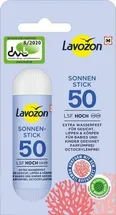
Lavozon Octocrylene-Free Sun Stick - SPF 50
Works for
Sun protectionSPF 50 · 3 UV filtersBroad spectrum
This product offers a good level of protection against both UVB and UVA rays.
This sunscreen uses organic (so-called "chemical") sunscreen filters. Organic, or "chemical" filters usually provide reliable sun protection and rarely leave a white cast. Sunscreens with organic filters can sting eyes.
This product can be considered "reef safe" because it does not contain the UV filters (oxybenzone and octinoxate) that can be harmful to coral reefs when present in the water in high concentrations.
Anti-agingSide benefit · Butyrospermum parkii butter, Tocopherol + 2 moreWorks well
This product can help prevent early signs of skin aging because it offers a good level of broad spectrum sun protection. Sun damage is the main cause of premature skin aging, and protecting your skin from the sun is the best anti-aging strategy.
MoisturizingSide benefit · Ricinus communis seed oil, Caprylic/capric triglyceride + 9 moreWorks
This product can help soften the skin and reduce its moisture loss with emollients and occlusives: butyrospermum parkii butter, caprylic/capric triglyceride.
Keep in mind that this product does not contain effective ingredients to attract water to the upper layer of the skin. This is why an additional product with humectants like glycerin or hyaluronic acid can be helpful (apply it before this product for the best results).
Can it cause trouble?
Irritancy14 flagged ingredientsLow risk
Comedogenic2 ingredients rated 2 or more on the 0–5 pore-clogging scale2 flagged
User reviews
1 of 1 community members would buy it again.
It's the first Lip sunscreen I tried that doesn't irritate or dry my lips. I'm very happy with it, and it's very cheap.
Ingredients
Filter by role to see what each ingredient is doing.
Ricinus communis seed oil~25–37%
- Irritation risk
- Medium
A plant oil that can help soften the skin. It might be helpful in calming down inflammation, but solid research is lacking. Is often used in lip products to create the needed product consistency
More about Ricinus communis seed oilCaprylic/capric triglyceride~6.8–10.2%
- Irritation risk
- Medium
A good mix of fatty acids that forms a protective layer on the skin. Improves the shelf life of products. Derived from coconut and glycerin
More about Caprylic/capric triglycerideDiethylamino hydroxybenzoyl hexyl benzoate~4.9–7.3%
- Irritation risk
- Medium
Uvinul A Plus. A new generation broad spectrum sunscreen that offers an effective protection especially in the UVA range. It is stable in formulations. Unfortunately, is not approved by the FDA (US) yet
More about Diethylamino hydroxybenzoyl hexyl benzoateCera alba~3.8–5.7%
- Irritation risk
- Medium
Forms a protective barrier that holds water and keeps dry skin hydrated. Keeps an emulsion from separating into its oil and liquid components, and increases the thickness of a product. Can be an allergen
More about Cera albaEuphorbia cerifera cera~3–4.5%
- Irritation risk
- Medium
Helps soften the upper layer of the skin and thickens the product's texture
More about Euphorbia cerifera ceraCopernicia cerifera cera~2.5–3.7%
- Irritation risk
- Low
Brazilian palm wax. Helps soften the upper layer of the skin
More about Copernicia cerifera ceraEthylhexyl triazone~2–3%
- Irritation risk
- Medium
Uvinul T. A UV filter. Effective against UVB rays. It is photostable. Can increase water resistance properties of the sunscreen. Unfortunately, not approved by the FDA (US) yet
More about Ethylhexyl triazoneBis-ethylhexyloxyphenol methoxyphenyl triazine~1.8–2.7%
- Irritation risk
- Medium
Tinosorb S. One of the most effective broad spectrum sunscreen ingredients. Protects from both UVA and UVB rays. It is photostable. Unfortunately, not approved by FDA (US) yet.
More about Bis-ethylhexyloxyphenol methoxyphenyl triazineHydrogenated castor oil~1.2–1.7%
- Irritation risk
- Medium
A plant oil that can help soften the skin. It might be helpful in calming down inflammation, but solid research is lacking. Is often used in lip products to create the needed product consistency
More about Hydrogenated castor oilDicaprylyl carbonate~0.95–1.45%
- Irritation risk
- Low
Helps products spread more easily and works as an emollient to soften skin
More about Dicaprylyl carbonateButyrospermum parkii butter~0.8–1.2%
- Irritation risk
- Low
- Comedogenicity
- 3/5
A great moisturising ingredient that softens the skin and reduces water loss from its upper layer. It also can be helpful in protecting skin from free radicals
More about Butyrospermum parkii butterSimmondsia chinensis seed oil~0.55–1.25%
- Irritation risk
- Medium
Softens the upper layer of skin and helps restore the healthy skin barrier. Has shown to help calm down inflammation in skin. It is a stable oil, meaning that it retains its properties even when exposed to air.
More about Simmondsia chinensis seed oilAlcohol~0.35–0.85%
- Irritation risk
- High
Can be drying and contribute to skin irritation. Used in formulars to dissolve other ingredients, create a thinner product consistency or for its antibacterial properties
More about AlcoholTocopherol~0.2–0.8%
- Irritation risk
- Low
Pure form of vitamin E. Can help moisturise and protect the skin from free radicals. Often used to help stabilise other ingredients or the formula itself
More about TocopherolPentaerythrityl tetra-di-t-butyl hydroxyhydrocinnamate~0.15–0.65%
- Irritation risk
- Low
Used to increase stability of product formulations
More about Pentaerythrityl tetra-di-t-butyl hydroxyhydrocinnamateAscorbyl palmitate~0.1–0.45%
- Irritation risk
- Medium
Being a lipid soluble form of vitamin C, it is more stable and can penetrate the skin better than L-Ascorbic acid. It is effective in protecting the skin from free radicals, as well as evening the skin tone, but is less effective in stimulating collagen production compared to L-Ascorbic acid.
More about Ascorbyl palmitateAscorbic acid~0.1–0.3%
- Irritation risk
- High
The most well-researched antioxidant that works in skin. Helps neutralize free radicals supporting collagen production, helping to even out the skin tone and preventing early signs of aging
More about Ascorbic acidCitric acid~0.05–0.2%
- Irritation risk
- Medium
Can work as an exfoliant but is typically used to adjust the product pH
More about Citric acidGlycine soja oil~0.1–0.45%
- Irritation risk
- Medium
- Comedogenicity
- 2/5
A good emollient that helps soften the skin and helps repair its barrier function. It can clog pores if used in high concentrations.
More about Glycine soja oilIngredient list view
Ricinus communis seed oil, Caprylic/capric triglyceride, Diethylamino hydroxybenzoyl hexyl benzoate, Cera alba, Euphorbia cerifera cera, Copernicia cerifera cera, Ethylhexyl triazone, Bis-ethylhexyloxyphenol methoxyphenyl triazine, Hydrogenated castor oil, Dicaprylyl carbonate, Butyrospermum parkii butter, Simmondsia chinensis seed oil, Alcohol, Tocopherol, Pentaerythrityl tetra-di-t-butyl hydroxyhydrocinnamate, Ascorbyl palmitate, Ascorbic acid, Citric acid, Glycine soja oil
Compare prices
Retailers ranked by price — lowest first.

Worth comparing, line by line.
Match % combines shared ingredients, the first five ingredients, shared actives and hero ingredients, irritancy (lower counts in the alternative's favour), texture and body area. Only products in the same routine step are compared.
| LavozonOctocrylene-Free Sun Stick - SPF 50YOUR PRODUCT | babyloveSun stick SPF50 | Matter CompanySubstance Baby Suncare Stick SPF 30 | FOTOPROTECTORInvisible Stick SPF 50 | |
|---|---|---|---|---|
| Match | — | 35% | 35% | 33% |
| Price | — | — | $6.40 | — |
| Shared key ingredients | — | 11 of 11 | 5 of 11 | 5 of 11 |
| Key difference | — | — | Sunflower Seed Oil | Panthenol |
| Irritancy | Low | Low | Low | Low |
| SPF | SPF 50 | SPF 50 | SPF 30 | SPF 50 |
| Drying alcohol | Contains drying alcohol | Contains drying alcohol | — | — |
| View product | Shop | Shop | Shop |



More alternatives: Mini Bloom Sunny Stick - SPF 30 Mineral SunscreenOh my cream skincare Stick Solaire SPF50+
Product summary
The ingredient list suggests that "Lavozon - Octocrylene-Free Sun Stick - SPF 50" can provide reliable sun protection. We love that it can protect from both UVA and UVB rays (not all sunscreens with SPF ratings give UVA protection. UVA rays do not cause sunburn, but still damage our skin and lead to early aging).
It also works as a moisturizer, so you do not have to use an additional hydrating product. Like all broad-spectrum sunscreens, this product has an anti-aging benefit.
Sunscreen filters
This sunscreen uses so-called "chemical", or organic UV filters (organic simply means that their molecules contain atoms of carbon). These filters typically give good sun protection and rarely leave a white cast, but they can be irritating for sensitive skin. The UV filters in this sunscreen are: tinosorb s 1.30% - 1.90%, uvinul a plus 4.60% - 6.90% and uvinul t 1.50% - 2.20%.
Irritation risk
There are some common irritants in this product, including ingredients that do not have benefits for the skin. We assess the overall irritancy of this sunscreen to be low. For a detailed overview of all potential irritants: click here
You can see the detailed formula review with the breakdown of all actives in the product and the full ingredient list with estimated concentrations in the tables below.
What our users say
Based on 1 review 100% recommend this product- As for the white cast, it did not leave a noticeable white residue for the reviewer.
- When it comes to using this sunscreen under makeup, the user found that it pills under a foundation.
- As for using this sunscreen in the eye area, the reviewer reported that it does not sting eyes.
Sources cited in this review
Every concentration estimate and effectiveness label is anchored to one of these 8 studies and safety reviews.
- 1
- 2
- 3
- 4
- 5
- 6Vitamin E in dermatologyncbi.nlm.nih.gov

Affiliate links · As an Amazon Associate, WIMJ earns from qualifying purchases.