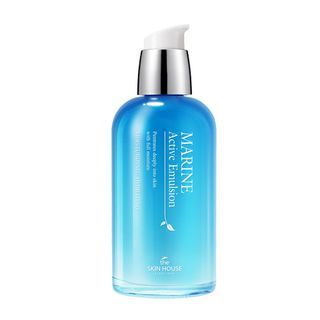
the SKIN HOUSE Marine Active Emulsion
Works for
1 of 1 advertised claim delivered
Moisturizing24 ingredients credited for this claimStrong support
“Leaves a protective film to help retain moisture in skin for a long time.”
This product can help improve hydration of the skin with the two types of ingredients.
The first type is called “humectants”:
these ingredients help attract water.
When humectants are on the surface of the skin, they “pull in” the moisture from the outside environment, or from
within deeper layers of the skin. The following ingredients in this product do the job:
betaine, glycerin.
This product also contains ingredients called “occlusives”. They help reduce the speed with which our skin loses moisture to the outside environment. These ingredients also help soften the upper layer of the skin, so it feels less tight and nicer to the touch. The following ingredients in this product do the job: dimethicone, hydrolyzed collagen.
The following ingredients in this product are especially good for supporting the skin barrier and helping with the hydration level: ceramide np
Anti-agingNot advertised by the brand · 5 ingredients credited for this claimStrong support
This product can help reduce and prevent fine lines and wrinkles, improve skin elasticity and firmness because it contains adenosine.
Keep in mind that it typically takes at least 6 weeks to notice any results because the changes that are needed to improve fine lines and elasticity happen in the deeper layers of the skin. No topical anti-aging product can “erase” wrinkles or fully reverse signs of aging.
Can it cause trouble?
Irritancy4 strong irritants: Rosa multiflora fruit extract, Gardenia florida fruit extract + 2 more — patch-test recommendedHigh risk
Comedogenic2 ingredients rated 2 or more on the 0–5 pore-clogging scale2 flagged


User reviews
Be the first — your take helps the next person decide.
Ingredients
Filter by role to see what each ingredient is doing.
Water~40–60%
Butylene glycol~5–7.5%
- Irritation risk
- Low
Used to create a nice product texture and help delivery of other ingredients. Might be somewhat helpful in attracting water to the upper layer of the skin
More about Butylene glycolGlycerin~3.1–4.7%
- Irritation risk
- Low
One of the best moisturizing ingredients. Naturally present in skin. It attracts water to the upper layer of the skin working as a humectant
More about Glycerin1,2-hexanediol~1.8–2.7%
Betaine~1.8–2.7%
- Irritation risk
- Low
Helps attract water to the upper layer of the skin and improves the product texture
More about BetaineAloe barbadensis leaf extract~1.5–2.3%
- Irritation risk
- Medium
Traditionally used to treat sunburns, dermatitis and inflammation, but evidence for its effectiveness is lacking. The extract can contain humectants that help attract water into the skin
More about Aloe barbadensis leaf extractPaeonia lactiflora bark/sap extract~1.2–1.8%
- Irritation risk
- Low
Lilium tigrinum extract~1–1.5%
- Irritation risk
- Low
Nelumbium speciosum flower extract~0.55–1.3%
- Irritation risk
- Low
Lonicera japonica flower extract~0.4–0.95%
- Irritation risk
- High
A plant extract that might help neutralize free radicals in skin. Can contain volalite oils and be irritating
More about Lonicera japonica flower extractChrysanthemum indicum flower extract~0.2–0.75%
- Irritation risk
- Low
Cucurbita pepo fruit extract~0.15–0.6%
- Irritation risk
- Low
Solanum lycopersicum fruit extract~0.15–0.5%
- Irritation risk
- Low
Sodium hyaluronate~0.1–0.45%
- Irritation risk
- Low
One of the best moisturizing ingredients. Attracts water into the upper layer of the skin
More about Sodium hyaluronateOrbignya oleifera seed oil~0.1–0.45%
- Irritation risk
- Low
A plant oil that can help soften the upper layer of the skin. Might be helpful in calming down inflammation in skin
More about Orbignya oleifera seed oilCaprylic/capric triglyceride~0.1–0.5%
- Irritation risk
- Medium
A good mix of fatty acids that forms a protective layer on the skin. Improves the shelf life of products. Derived from coconut and glycerin
More about Caprylic/capric triglycerideHydrogenated lecithin~0.1–0.4%
- Irritation risk
- Low
Helps to retain moisture by creating a protective barrier on the skin. Rich in fatty acids. Improves product texture and helps with the penetration of other ingredients.
More about Hydrogenated lecithinCeramide np~0.1–0.35%
- Irritation risk
- Low
A type of lipid similar to ceramides naturally present in skin. Helps to soften the upper layer of the skin and supports the skin barrier function to keep it hydrated. Can help to prevent inflammation in skin
More about Ceramide npSea water~0.05–0.2%
- Irritation risk
- Low
Dissolves other ingredients. It does not have additional skin benefits compared to plain water
More about Sea waterHoney~0.05–0.15%
- Irritation risk
- Low
Helps attract water to the skin and might have some anti-bacterial properties. Can be an allergen
More about HoneyPearl extract~0.05–0.15%
- Irritation risk
- Low
Arginine~0.01–0.05%
- Irritation risk
- Low
An amino acid that is naturally present in skin and helps keep it hydrated. When used together with AHAs, it can reduce their irritating effect on the skin
More about ArgininePanthenol~0.01–0.05%
- Irritation risk
- Low
Helps attract water to the upper layer of the skin and can help improve skin barrier function
More about PanthenolGlycereth-26~0.05–0.1%
Carbomer~0.05–0.1%
- Irritation risk
- Low
Helps create a thicker or gel-like product texture. It is not a surfactant but can be used in gentle cleansing formulations
More about CarbomerSimmondsia chinensis seed oil~0.05–0.25%
- Irritation risk
- Medium
Softens the upper layer of skin and helps restore the healthy skin barrier. Has shown to help calm down inflammation in skin. It is a stable oil, meaning that it retains its properties even when exposed to air.
More about Simmondsia chinensis seed oilLimnanthes alba seed oil~0.05–0.2%
- Irritation risk
- Low
This oil's cmposition is closest to rapeseed oil. It is a very stable oil and serves as an emoillient
More about Limnanthes alba seed oilSorbitan isostearate~0.05–0.2%
- Irritation risk
- Low
Helps oil and water mix together
More about Sorbitan isostearateButyrospermum parkii butter~0.05–0.3%
- Irritation risk
- Low
- Comedogenicity
- 3/5
A great moisturising ingredient that softens the skin and reduces water loss from its upper layer. It also can be helpful in protecting skin from free radicals
More about Butyrospermum parkii butterIsononyl isononanoate~0.05–0.25%
- Irritation risk
- Low
Forms a protective film on the surface of the skin to prevent moisture loss. Gives a velvety feel to products while reducing tackiness
More about Isononyl isononanoatePolysorbate 60~0.05–0.3%
Niacinamide~0.05–0.25%
- Irritation risk
- Low
Is proven to be effective in reducing blemishes, evening out skin tone and helping to improve lines and wrinkles. It helps the skin to repair sun damage, calm down inflammation and keep maintain good levels of moisture. The concentration of about 2% is effective for supporting the skin barrier and evening out the skin tone. Concentration of 4-6% is better for helping with acne and balancing the sebum production
More about NiacinamideRosa canina fruit oil~0.1–0.3%
- Irritation risk
- Medium
A great emollient. Contains vitamin E (tocopherol) which may give it some anti-oxidant properties. Can contain volatile compounds and can be irritating
More about Rosa canina fruit oilOlea europaea fruit oil~0.05–0.25%
- Irritation risk
- Medium
An emollient that helps soften the skin but is not effective for restoring its barrier function. Might be helpful to calm down inflammation
More about Olea europaea fruit oilMacadamia integrifolia seed oil~0.05–0.3%
- Irritation risk
- Low
A plant oil that helps soften the upper layer of the skin
More about Macadamia integrifolia seed oilDimethicone~0.1–0.35%
- Irritation risk
- Low
A silicone that helps to reduce water loss from the surface of the skin. Can temporarily "fill in" lines and wrinkles, absorb oil, and create a nice product finish
More about DimethiconeMyrciaria dubia fruit extract~0.05–0.2%
- Irritation risk
- Medium
A plant extract that might help neutralize free radicals in skin, but research on its effectiveness is lacking
More about Myrciaria dubia fruit extractEuterpe oleracea fruit extract~0.05–0.25%
- Irritation risk
- Medium
A plant extract that can have some anti-oxidant effect in skin
More about Euterpe oleracea fruit extractPanax ginseng root extract~0.05–0.3%
- Irritation risk
- High
A plant extract that might have some anti-inflammatory properties, but solid evidence is lacking. It can be irritating
More about Panax ginseng root extractCamellia sinensis leaf extract~0.05–0.25%
- Irritation risk
- Low
Can contain potent anti-oxidant compounds (abbreviated ECG, GCG, EGC, and EGCG) that might help protect the skin from free radicals. Can help calm down inflammation and has some anti-bacterial properties. Unfortunately, these antioxidants are unstable and lose their effectiveness very quickly in products. The concentration of the antioxidant compounds in the extract also tends to be low to be effective in topical formulation
More about Camellia sinensis leaf extractRosa multiflora fruit extract~0.05–0.2%
Gardenia florida fruit extract~0.05–0.2%
- Irritation risk
- High
Used as a fragrance. Can be irritating.
More about Gardenia florida fruit extractScutellaria baicalensis root extract~0.05–0.15%
- Irritation risk
- High
A plant extract that might contain a compound baicalin that could be helpful in neutralizing free radicals and reducing inflammation in skin. The baicalin concentration in skincare products is often too low for an effective action. Can be used for its fragrant properties
More about Scutellaria baicalensis root extractLigustrum japonicum fruit extract~0.05–0.25%
- Irritation risk
- Low
Ecklonia cava extract~0.05–0.2%
- Irritation risk
- Low
- Comedogenicity
- 3/5
Hizikia fusiforme extract~0.05–0.25%
- Irritation risk
- Low
Codium tomentosum extract~0.05–0.25%
- Irritation risk
- Low
Gelidium cartilagineum extract~0.05–0.25%
- Irritation risk
- Low
Adenosine~0.05–0.3%
- Irritation risk
- Low
Might help improve cell turnover and reduce inflammation in skin. One study shows that the ingredients might be able to help reduce dynamic wrinkles (for example, in the corners of the eyes or on the forehead)
More about AdenosineDisodium edta~0.05–0.25%
Leontopodium alpinum extract~0.05–0.25%
- Irritation risk
- Low
Malva sylvestris flower extract~0.05–0.25%
- Irritation risk
- High
Used as a fragrance
More about Malva sylvestris flower extractHydrolyzed collagen~0.1–0.35%
- Irritation risk
- Low
A typically plant-derived compound that is supposed mimic human collagen. Cannot penetrate the skin barrier so is not particularly useful in skincare products beyond attracting water to the upper layer of the skin
More about Hydrolyzed collagenCamellia sinensis callus culture extract~0.1–0.3%
- Irritation risk
- Low
Bambusa vulgaris callus culture extract~0.1–0.3%
- Irritation risk
- Low
Ethylhexylglycerin~0.05–0.2%
Parfum~0.05–0.15%
- Irritation risk
- High
An aromatic blend of unspecified and possibly irritating ingredients
More about ParfumIngredient list view
Water, Butylene glycol, Glycerin, 1,2-hexanediol, Betaine, Aloe barbadensis leaf extract, Paeonia lactiflora bark/sap extract, Lilium tigrinum extract, Nelumbium speciosum flower extract, Lonicera japonica flower extract, Chrysanthemum indicum flower extract, Cucurbita pepo fruit extract, Solanum lycopersicum fruit extract, Sodium hyaluronate, Orbignya oleifera seed oil, Caprylic/capric triglyceride, Hydrogenated lecithin, Ceramide np, Sea water, Honey, Pearl extract, Arginine, Panthenol, Glycereth-26, Carbomer, Simmondsia chinensis seed oil, Limnanthes alba seed oil, Sorbitan isostearate, Butyrospermum parkii butter, Isononyl isononanoate, Polysorbate 60, Niacinamide, Rosa canina fruit oil, Olea europaea fruit oil, Macadamia integrifolia seed oil, Dimethicone, Myrciaria dubia fruit extract, Euterpe oleracea fruit extract, Panax ginseng root extract, Camellia sinensis leaf extract, Rosa multiflora fruit extract, Gardenia florida fruit extract, Scutellaria baicalensis root extract, Ligustrum japonicum fruit extract, Ecklonia cava extract, Hizikia fusiforme extract, Codium tomentosum extract, Gelidium cartilagineum extract, Adenosine, Disodium edta, Leontopodium alpinum extract, Malva sylvestris flower extract, Hydrolyzed collagen, Camellia sinensis callus culture extract, Bambusa vulgaris callus culture extract, Ethylhexylglycerin, Parfum
Compare prices
Retailers ranked by price — lowest first.

Worth comparing, line by line.
Match % combines shared ingredients, the first five ingredients, shared actives and hero ingredients, irritancy (lower counts in the alternative's favour), texture and body area. Only products in the same routine step are compared.
| the SKIN HOUSEMarine Active EmulsionYOUR PRODUCT | MEDI-PEELDerma Maison Maricell Time Firming Cream | BY ECOMHoney Glow Cera Cream | NERISHSoy Ceramide Barrier Cream | |
|---|---|---|---|---|
| Match | — | 61% | 60% | 60% |
| Price | $25.80 | $43.99+$18.19 | $52.22+$26.42 | $16.11−$9.69 |
| Shared key ingredients | — | 7 of 8 | 6 of 8 | 6 of 8 |
| Key difference | — | Panthenol | Niacinamide | Niacinamide |
| Irritancy | High | Medium | Medium | Medium |
| Drying alcohol | — | — | — | — |
| View product | Shop | Shop | Shop |


Product summary
"the SKIN HOUSE - Marine Active Emulsion" has a good moisturizing formula. The formulation is based on a combination of good humectants and emollients. Both are needed to increase the skin hydration level. Betaine, glycerin, hydrolyzed collagen, sodium hyaluronate and honey in this product (humectants) attract water molecules to the upper layer of the skin (the water comes from the outside air or from the deeper layers of the skin if the air is dry). Emollients in this formulation (ceramide np, hydrolyzed collagen, dimethicone and aloe barbadensis leaf extract) help to reduce the moisture loss from the skin. They also soften the skin surface and relieve the feeling of dryness and tightness.
Ingredient callouts
- Another benefit is that this moisturizer contain ceramides (ceramide np 0.10% - 0.35%). Ceramides are an important part of our natural skin barrier. The Ceramides used in skincare are synthetic or come from plants. They help soften the skin and can help "fill the gaps" in the skin barrier, keeping the skin hydrated and resilient for longer.
- Adenosine 0.05% - 0.30%. It is a chemical present inside our skin cells. A clinical trial confirmed that topical application of Adenosine in a low concentration can reduce dynamic wrinkles (these are the wrinkles that appear with age in a places where our mimic is the most active, for example, in the corners of the eyes or on the forehead).
Irritation risk
We assess the overall irritancy of this moisturizer to be high. For a detailed overview of all potential irritants: click here
You can see the detailed formula review with the breakdown of all actives in the product and the full ingredient list with estimated concentrations in the tables below.
Price
The product retails from 22.00$ up to 25.80$ in the United States and for 24.05£ in the United Kingdom.
For a detailed price comparison: click here.
Sources cited in this review
Every concentration estimate and effectiveness label is anchored to one of these 30 studies and safety reviews.
- 1
- 2
- 3
- 4
- 5Hyaluronic acid: A key molecule in skin agingncbi.nlm.nih.gov
- 6

Affiliate links · As an Amazon Associate, WIMJ earns from qualifying purchases.