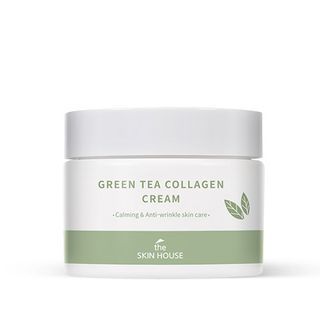
the SKIN HOUSE Green Tea Collagen Cream
Works for
2 of 2 advertised claims delivered
Moisturizing29 ingredients credited for this claimStrong support
“The Skin House Green Tea Collagen Cream helps to deeply hydrate and nourish skin.”
This product can help improve hydration of the skin with the two types of ingredients.
The first type is called “humectants”:
these ingredients help attract water.
When humectants are on the surface of the skin, they “pull in” the moisture from the outside environment, or from
within deeper layers of the skin. The following ingredients in this product do the job:
arginine, betaine.
This product also contains ingredients called “occlusives”. They help reduce the speed with which our skin loses moisture to the outside environment. These ingredients also help soften the upper layer of the skin, so it feels less tight and nicer to the touch. The following ingredients in this product do the job: arginine, beeswax.
The following ingredients in this product are especially good for supporting the skin barrier and helping with the hydration level: ceramide np, paraffinum liquidum
Anti-aging2 ingredients credited for this claimStrong support
“Green Tea Extract helps to soothe skin and minimize appearance of pores Collagen improves skin elasticity and firmness Macadamia Seed Oil keeps skin moisturized and provides nourishment to skin”
This product can help reduce and prevent fine lines and wrinkles, improve skin elasticity and firmness because it contains adenosine.
Keep in mind that it typically takes at least 6 weeks to notice any results because the changes that are needed to improve fine lines and elasticity happen in the deeper layers of the skin. No topical anti-aging product can “erase” wrinkles or fully reverse signs of aging.
Can it cause trouble?
Irritancy4 strong irritants: Thymus vulgaris extract, Parfum + 2 more — patch-test recommendedHigh risk
Comedogenic1 ingredient rated 2 or more on the 0–5 pore-clogging scale1 flagged
User reviews
Be the first — your take helps the next person decide.
Ingredients
Filter by role to see what each ingredient is doing.
Water~45–55%
Butylene glycol~5.9–7.2%
- Irritation risk
- Low
Used to create a nice product texture and help delivery of other ingredients. Might be somewhat helpful in attracting water to the upper layer of the skin
More about Butylene glycolGlycerin~4.1–5%
- Irritation risk
- Low
One of the best moisturizing ingredients. Naturally present in skin. It attracts water to the upper layer of the skin working as a humectant
More about GlycerinSqualane~3.1–3.8%
- Irritation risk
- Low
An oil naturally present in skin. Works as an emollient to soften the skin and form a protective layer on its surface without a greasy feeling.
More about SqualaneCyclomethicone~2.3–2.8%
- Irritation risk
- Low
A type of silicone that leaves a nice silky finish on the skin and can help soften its upper layer
More about CyclomethiconeParaffinum liquidum~1.8–2.3%
- Irritation risk
- Low
Mineral oil. One of the most effective and well studied occlusive and emollient moisturizing ingredients. Helps reduce moisture loss in skin and repair skin barrier function
More about Paraffinum liquidumSodium hyaluronate~1.5–1.8%
- Irritation risk
- Low
One of the best moisturizing ingredients. Attracts water into the upper layer of the skin
More about Sodium hyaluronateCetyl ethylhexanoate~1.3–1.6%
- Irritation risk
- Medium
An emollient that helps soften the skin and creates a thicker product texture
More about Cetyl ethylhexanoateMacadamia integrifolia seed oil~1–1.2%
- Irritation risk
- Low
A plant oil that helps soften the upper layer of the skin
More about Macadamia integrifolia seed oilDimethicone~0.75–1.1%
- Irritation risk
- Low
A silicone that helps to reduce water loss from the surface of the skin. Can temporarily "fill in" lines and wrinkles, absorb oil, and create a nice product finish
More about Dimethicone1,2-hexanediol~0.45–0.7%
Caprylic/capric triglyceride~0.5–0.75%
- Irritation risk
- Medium
A good mix of fatty acids that forms a protective layer on the skin. Improves the shelf life of products. Derived from coconut and glycerin
More about Caprylic/capric triglycerideCetearyl alcohol~0.5–0.7%
- Irritation risk
- Low
- Comedogenicity
- 2/5
A non-drying alcohol. Works as an emollient. Helps water and oil mix together and creates a nice product texture
More about Cetearyl alcoholStearic acid~0.45–0.7%
- Irritation risk
- Low
Helps oil and water mix together and works as an emollient
More about Stearic acidDimethicone/vinyl dimethicone crosspolymer~0.25–0.5%
- Irritation risk
- Low
Used to stabilize product formulations and create a nice product texture
More about Dimethicone/vinyl dimethicone crosspolymerGlyceryl stearate~0.3–0.6%
- Irritation risk
- Low
An emollient that softens the skin and forms a protective layer on its surface. Helps water and oil mix together
More about Glyceryl stearatePeg-100 stearate~0.4–0.6%
- Irritation risk
- Low
Helps oil and water mix togehter and creates a nice product texture
More about Peg-100 stearateHydrolyzed collagen~0.3–0.55%
- Irritation risk
- Low
A typically plant-derived compound that is supposed mimic human collagen. Cannot penetrate the skin barrier so is not particularly useful in skincare products beyond attracting water to the upper layer of the skin
More about Hydrolyzed collagenBetaine~0.2–0.35%
- Irritation risk
- Low
Helps attract water to the upper layer of the skin and improves the product texture
More about BetaineMethyl gluceth-20~0.2–0.35%
- Irritation risk
- Low
Helps attract water to the upper layer of the skin and soften it
More about Methyl gluceth-20Peg-10 dimethicone~0.25–0.45%
- Irritation risk
- Low
A silicone that works to soften the upper layer of the skin and reduce its water loss
More about Peg-10 dimethiconePolysorbate 60~0.2–0.4%
Sorbitan isostearate~0.2–0.35%
- Irritation risk
- Low
Helps oil and water mix together
More about Sorbitan isostearateBeeswax~0.25–0.4%
- Irritation risk
- Low
Forms a protective barrier that holds water and keeps dry skin hydrated. Keeps an emulsion from separating into its oil and liquid components, and increases the thickness of a product. Can be an allergen
More about BeeswaxCarbomer~0.15–0.3%
- Irritation risk
- Low
Helps create a thicker or gel-like product texture. It is not a surfactant but can be used in gentle cleansing formulations
More about CarbomerSorbitan stearate~0.2–0.35%
Sodium polyacrylate~0.25–0.45%
- Irritation risk
- Low
Used to create a gel-like product texture, as well as to stabilize emulsions
More about Sodium polyacrylateC13-14 isoparaffin~0.2–0.4%
- Irritation risk
- Low
Helps soften the upper layer of the skin, dissolve other ingredients and create a thicker product consistency
More about C13-14 isoparaffinLaureth-7~0.2–0.4%
Hydrogenated lecithin~0.2–0.4%
- Irritation risk
- Low
Helps to retain moisture by creating a protective barrier on the skin. Rich in fatty acids. Improves product texture and helps with the penetration of other ingredients.
More about Hydrogenated lecithinLinoleic acid~0.3–0.55%
- Irritation risk
- Low
An excellent emollient. Helps soften the skin, restore its barrier function, and can help to calm down inflammation. It can be helpful to prevent blemishes and clogged pores
More about Linoleic acidCeramide np~0.25–0.45%
- Irritation risk
- Low
A type of lipid similar to ceramides naturally present in skin. Helps to soften the upper layer of the skin and supports the skin barrier function to keep it hydrated. Can help to prevent inflammation in skin
More about Ceramide npCamellia japonica seed oil~0.25–0.45%
- Irritation risk
- Low
A plant oil that helps to soften the upper layer of the skin and can help restore skin's barrier function. Might have an anti-oxidant effect
More about Camellia japonica seed oilArginine~0.2–0.4%
- Irritation risk
- Low
An amino acid that is naturally present in skin and helps keep it hydrated. When used together with AHAs, it can reduce their irritating effect on the skin
More about ArginineMyrciaria dubia fruit extract~0.2–0.4%
- Irritation risk
- Medium
A plant extract that might help neutralize free radicals in skin, but research on its effectiveness is lacking
More about Myrciaria dubia fruit extractEuterpe oleracea fruit extract~0.2–0.4%
- Irritation risk
- Medium
A plant extract that can have some anti-oxidant effect in skin
More about Euterpe oleracea fruit extractAloe barbadensis leaf extract~0.25–0.5%
- Irritation risk
- Medium
Traditionally used to treat sunburns, dermatitis and inflammation, but evidence for its effectiveness is lacking. The extract can contain humectants that help attract water into the skin
More about Aloe barbadensis leaf extractCamellia sinensis leaf extract~0.25–0.45%
- Irritation risk
- Low
Can contain potent anti-oxidant compounds (abbreviated ECG, GCG, EGC, and EGCG) that might help protect the skin from free radicals. Can help calm down inflammation and has some anti-bacterial properties. Unfortunately, these antioxidants are unstable and lose their effectiveness very quickly in products. The concentration of the antioxidant compounds in the extract also tends to be low to be effective in topical formulation
More about Camellia sinensis leaf extractPanthenol~0.2–0.4%
- Irritation risk
- Low
Helps attract water to the upper layer of the skin and can help improve skin barrier function
More about PanthenolAllantoin~0.2–0.35%
- Irritation risk
- Low
Helps calm down inflammation in skin and can help reduce itching. Helps to repair the skin barrier and keep skin hydrated
More about AllantoinAdenosine~0.2–0.4%
- Irritation risk
- Low
Might help improve cell turnover and reduce inflammation in skin. One study shows that the ingredients might be able to help reduce dynamic wrinkles (for example, in the corners of the eyes or on the forehead)
More about AdenosineDisodium edta~0.2–0.4%
Panax ginseng cell culture extract~0.2–0.4%
- Irritation risk
- Low
Bambusa vulgaris callus culture extract~0.2–0.4%
- Irritation risk
- Low
Aloe barbadensis callus culture extract~0.2–0.4%
- Irritation risk
- Low
Leontopodium alpinum extract~0.2–0.4%
- Irritation risk
- Low
Thymus vulgaris extract~0.2–0.35%
- Irritation risk
- High
Buddleja davidii extract~0.2–0.4%
- Irritation risk
- Low
Snail secretion filtrate~0.2–0.4%
- Irritation risk
- Medium
Typically contains hyaluronic acid that helps attract water to the upper layer of the skin. Might contain allantoin that is helpful in calming down inflammation. There is no evidence that it can have any further benefits for the skin, especially when used in skincare products
More about Snail secretion filtrateAralia cordata extract~0.2–0.4%
- Irritation risk
- Low
Saururus chinensis extract~0.2–0.4%
- Irritation risk
- Medium
Plant extract that might have some anti-inflammatory properties
More about Saururus chinensis extractPortulaca oleracea extract~0.2–0.4%
- Irritation risk
- Medium
A plant extract that has some anti-oxidant activity, but solid research is lacking. Can help attract water to the upper layer of the skin
More about Portulaca oleracea extractElsholtzia splendens extract~0.2–0.35%
- Irritation risk
- Low
Phenoxyethanol~0.15–0.3%
- Irritation risk
- Low
A preservative. It helps prevent bacterial growth in cosmetic products
More about PhenoxyethanolEthylhexylglycerin~0.15–0.3%
Ci 19140~0.15–0.25%
Ci 15985~0.15–0.25%
Parfum~0.1–0.2%
- Irritation risk
- High
An aromatic blend of unspecified and possibly irritating ingredients
More about ParfumLinalool~0.05–0.1%
Limonene~0.05–0.1%
- Irritation risk
- High
A common frangrance that can easily irritate skin, especially if exposed to air, light or heat
More about LimoneneIngredient list view
Water, Butylene glycol, Glycerin, Squalane, Cyclomethicone, Paraffinum liquidum, Sodium hyaluronate, Cetyl ethylhexanoate, Macadamia integrifolia seed oil, Dimethicone, 1,2-hexanediol, Caprylic/capric triglyceride, Cetearyl alcohol, Stearic acid, Dimethicone/vinyl dimethicone crosspolymer, Glyceryl stearate, Peg-100 stearate, Hydrolyzed collagen, Betaine, Methyl gluceth-20, Peg-10 dimethicone, Polysorbate 60, Sorbitan isostearate, Beeswax, Carbomer, Sorbitan stearate, Sodium polyacrylate, C13-14 isoparaffin, Laureth-7, Hydrogenated lecithin, Linoleic acid, Ceramide np, Camellia japonica seed oil, Arginine, Myrciaria dubia fruit extract, Euterpe oleracea fruit extract, Aloe barbadensis leaf extract, Camellia sinensis leaf extract, Panthenol, Allantoin, Adenosine, Disodium edta, Panax ginseng cell culture extract, Bambusa vulgaris callus culture extract, Aloe barbadensis callus culture extract, Leontopodium alpinum extract, Thymus vulgaris extract, Buddleja davidii extract, Snail secretion filtrate, Aralia cordata extract, Saururus chinensis extract, Portulaca oleracea extract, Elsholtzia splendens extract, Phenoxyethanol, Ethylhexylglycerin, Ci 19140, Ci 15985, Parfum, Linalool, Limonene
Compare prices
Retailers ranked by price — lowest first.

Affiliate links · prices updated regularly
Worth comparing, line by line.
Match % combines shared ingredients, the first five ingredients, shared actives and hero ingredients, irritancy (lower counts in the alternative's favour), texture and body area. Only products in the same routine step are compared.
| the SKIN HOUSEGreen Tea Collagen CreamYOUR PRODUCT | epiiHPT6 Ultra Cream 10% | ACWELLLicorice pH Balancing Extreme Moisture Cream 55ml | CiracleRepairing V3 Snail Cream | |
|---|---|---|---|---|
| Match | — | 54% | 54% | 53% |
| Price | $11.44 | $38.49+$27.05 | $39.60+$28.16 | $26.50+$15.06 |
| Shared key ingredients | — | 9 of 20 | 11 of 20 | 13 of 20 |
| Key difference | — | Palmitoyl Tripeptide-38 | Niacinamide | Madecassic Acid |
| Irritancy | High | Medium | Medium | High |
| Drying alcohol | — | — | Contains drying alcohol | — |
| View product | Shop | Shop | Shop |



Product summary
"the SKIN HOUSE - Green Tea Collagen Cream" is a well-rounded moisturizing product. This moisturizer uses a good combo of humectants and emollients. These both types of ingredients are essentials for improving the skin hydration and keeping the skin barrier healthy. Humectants in this product (arginine, betaine, cyclomethicone, glycerin and hydrolyzed collagen) help to increase the water content in the upper layer of the skin. (These ingredients do so by "capturing" water molecules from the outside air or from within the deeper layers of the skin). Ceramide np, paraffinum liquidum, cyclomethicone, hydrolyzed collagen and arginine in this product help decrease the water evoporation from the skin, so that it stays hydrated for longer. These ingredients also soften the skin and take away the feeling of tightness and dryness.
Ingredient callouts
- Another benefit is that this moisturizer contain ceramides (ceramide np 0.25% - 0.45%). Ceramides are an important part of our natural skin barrier. The Ceramides used in skincare are synthetic or come from plants. They help soften the skin and can help "fill the gaps" in the skin barrier, keeping the skin hydrated and resilient for longer.
- Adenosine 0.20% - 0.40%. It is a compound that in involved in many biological processes inside the skin cells. According one high-quality clinical trial, topical Adenosine in low concentrations can somewhat help improve "deep wrinkles" - the wrinkles that appear with age in places where our faces are most dynamic (for example, on the forehead or in the corners of the eyes).
Irritation risk
This moisturizer contains a bunch of common irritants, including ingredients that do not provide any known benefit for the skin. It might not be the best choice if your skin is sensitive. We assess the overall irritancy of this moisturizer to be high. For a detailed overview of all potential irritants: click here
You can see the detailed formula review with the breakdown of all actives in the product and the full ingredient list with estimated concentrations in the tables below.
Price
The product retails for 25.00A$ in Australia, from 11.44$ up to 24.00$ in the United States and for 15.50£ in the United Kingdom.
For a detailed price comparison: click here.
Sources cited in this review
Every concentration estimate and effectiveness label is anchored to one of these 26 studies and safety reviews.
- 1
- 2A review on the extensive skin benefits of mineral oilncbi.nlm.nih.gov
- 3Hyaluronic acid: A key molecule in skin agingncbi.nlm.nih.gov
- 4
- 5
- 6

Affiliate links · As an Amazon Associate, WIMJ earns from qualifying purchases.