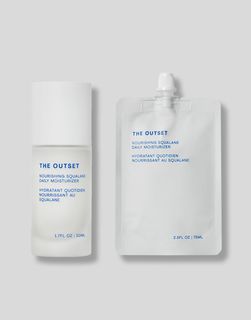
The outset Nourishing Squalane Daily Moisturizer
Works for
1 of 2 advertised claims delivered
Moisturizing24 ingredients credited for this claimGood support
“Nourishing Squalane Daily Moisturizer”
This product can help improve hydration of the skin with the two types of ingredients.
The first type is called “humectants”:
these ingredients help attract water.
When humectants are on the surface of the skin, they “pull in” the moisture from the outside environment, or from
within deeper layers of the skin. The following ingredients in this product do the job:
glycerin, polyglycerin-3.
This product also contains ingredients called “occlusives”. They help reduce the speed with which our skin loses moisture to the outside environment. These ingredients also help soften the upper layer of the skin, so it feels less tight and nicer to the touch. The following ingredients in this product do the job: caprylic/capric triglyceride, cocos nucifera oil.
Evens skin toneNo ingredient credited for this claimNo support
“It is packed with soothing botanical extracts to reduce the look redness and improve skin's texture and tone.”
Effective ingredients missing or their concentration is too low
Can it cause trouble?
Irritancy2 strong irritants: Humulus lupulus extract, Rosmarinus officinalis leaf extractMedium risk
Comedogenic6 ingredients rated 2 or more on the 0–5 pore-clogging scale6 flagged
User reviews
Be the first — your take helps the next person decide.
Ingredients
Filter by role to see what each ingredient is doing.
Water~45–55%
Caprylic/capric triglyceride~5.6–6.8%
- Irritation risk
- Medium
A good mix of fatty acids that forms a protective layer on the skin. Improves the shelf life of products. Derived from coconut and glycerin
More about Caprylic/capric triglyceridePentylene glycol~4.4–5.4%
- Irritation risk
- Medium
Used to preserve products, dissolve other ingredients and create a nice product texture
More about Pentylene glycolGlycerin~3.1–3.8%
- Irritation risk
- Low
One of the best moisturizing ingredients. Naturally present in skin. It attracts water to the upper layer of the skin working as a humectant
More about GlycerinEthylhexyl palmitate~2.4–2.9%
- Irritation risk
- Low
- Comedogenicity
- 3/5
An emollient that helps soften the skin and create a nice product texture
More about Ethylhexyl palmitateCetearyl alcohol~1.9–2.4%
- Irritation risk
- Low
- Comedogenicity
- 2/5
A non-drying alcohol. Works as an emollient. Helps water and oil mix together and creates a nice product texture
More about Cetearyl alcoholSqualane~1.7–2.1%
- Irritation risk
- Low
An oil naturally present in skin. Works as an emollient to soften the skin and form a protective layer on its surface without a greasy feeling.
More about SqualaneCassia angustifolia seed polysaccharide~1.4–1.7%
- Irritation risk
- Medium
Helps attract water to the upper layer of the skin. Is sometimes referred to as "natural" hyaluronic acid (even though hyaluronic acid is not unnatural and is present in human skin)
More about Cassia angustifolia seed polysaccharideHelianthus annuus seed oil~1.3–1.6%
- Irritation risk
- Low
A great emollient due to its high linoleic acid content. One of the most effective plant oils in helping skin hydration and repairing skin barrier function
More about Helianthus annuus seed oilCocos nucifera oil~0.95–1.15%
- Irritation risk
- Low
- Comedogenicity
- 3/5
An emollient. Found to be as effective as a moisturizer for dry skin as mineral oil. Could be comedogenic
More about Cocos nucifera oilCarthamus tinctorius seed oil~0.7–1.05%
- Irritation risk
- Low
An emollient that helps soften the skin and might help calm down inflammation
More about Carthamus tinctorius seed oilPersea gratissima oil~0.6–0.9%
- Irritation risk
- Medium
An emollient that helps soften the skin and could be helpful in repairing its barrier function
More about Persea gratissima oilHumulus lupulus extract~0.5–0.75%
- Irritation risk
- High
Hops extract. Can contain common irritants and allergens geraniol, limonene, linalool
More about Humulus lupulus extractHelianthus annuus extract~0.5–0.75%
- Irritation risk
- Low
Helps soften the upper layer of the skin
More about Helianthus annuus extractHelianthus annuus seed wax~0.45–0.7%
- Irritation risk
- Low
Helps soften the upper layer of the skin and support skin's barrier function while creating a thicker product consistency
More about Helianthus annuus seed waxRosmarinus officinalis leaf extract~0.35–0.65%
- Irritation risk
- High
Can be helpful in reducing inflammation in skin, including inflamed acne. It can be irritating
More about Rosmarinus officinalis leaf extractAloe barbadensis leaf juice~0.4–0.6%
- Irritation risk
- Medium
Traditionally used to treat sunburns, dermatitis and inflammation, but evidence for its effectiveness is lacking. The extract can contain humectants that help attract water into the skin
More about Aloe barbadensis leaf juicePrunus insititia seed oil~0.35–0.65%
- Irritation risk
- Low
Oryza sativa bran extract~0.3–0.55%
Fucus vesiculosus extract~0.3–0.5%
- Irritation risk
- Low
- Comedogenicity
- 3/5
Leuconostoc/radish root ferment filtrate~0.25–0.5%
- Irritation risk
- Medium
A preservative that comes from radishes fermented by a bacteria. New research suggests that the preservation properties in the ingredient come from an ammonium salt that is not present naturally in radish root but used in its cultivation. Is problematic because the exact amount of the preservative agents is difficult to determine
More about Leuconostoc/radish root ferment filtrateLeontopodium alpinum extract~0.25–0.45%
- Irritation risk
- Low
Glycine soja oil~0.25–0.45%
- Irritation risk
- Medium
- Comedogenicity
- 2/5
A good emollient that helps soften the skin and helps repair its barrier function. It can clog pores if used in high concentrations.
More about Glycine soja oilJojoba esters~0.3–0.5%
- Irritation risk
- Medium
An emollient made of jojoba oil. Helps soften the skin and support its barrier function
More about Jojoba estersDicaprylyl ether~0.25–0.5%
- Irritation risk
- Low
Helps soften the upper layer of the skin while creating a non-greasy feel on the skin. Helps to dissolve other ingredients
More about Dicaprylyl etherDiheptyl succinate~0.25–0.5%
- Irritation risk
- Low
Helps to soften the upper layer of the skin and creates a nice product finish on the skin
More about Diheptyl succinateGlyceryl stearate~0.3–0.55%
- Irritation risk
- Low
An emollient that softens the skin and forms a protective layer on its surface. Helps water and oil mix together
More about Glyceryl stearateCarbomer~0.25–0.45%
- Irritation risk
- Low
Helps create a thicker or gel-like product texture. It is not a surfactant but can be used in gentle cleansing formulations
More about CarbomerPhenoxyethanol~0.25–0.45%
- Irritation risk
- Low
A preservative. It helps prevent bacterial growth in cosmetic products
More about PhenoxyethanolCitric acid~0.25–0.45%
- Irritation risk
- Medium
Can work as an exfoliant but is typically used to adjust the product pH
More about Citric acidHydrogenated vegetable oil~0.25–0.5%
- Irritation risk
- Low
- Comedogenicity
- 2/5
An oil from a mixture of different vegetables. Helps soften the upper layer of the skin
More about Hydrogenated vegetable oilXanthan gum~0.25–0.45%
- Irritation risk
- Low
Used to create a thicker product consistency
More about Xanthan gumPolyglycerin-3~0.25–0.45%
- Irritation risk
- Low
Helps to attract water to the upper layer of the skin
More about Polyglycerin-3Caprylyl glycol~0.25–0.45%
- Irritation risk
- Medium
Helps preserve products and creates a nice product texture
More about Caprylyl glycolCapryloyl glycerin/sebacic acid copolymer~0.25–0.4%
- Irritation risk
- Low
Helps soften the upper layer of the skin
More about Capryloyl glycerin/sebacic acid copolymerTocopheryl acetate~0.2–0.4%
- Irritation risk
- Medium
A more stable but less bio-available form of vitamin E compared to Tocopherol. Might help moisturize and protect the skin from free radicals, but mostly used in low concentrations to stabilize other ingredients.
More about Tocopheryl acetateTocopherol~0.2–0.4%
- Irritation risk
- Low
Pure form of vitamin E. Can help moisturise and protect the skin from free radicals. Often used to help stabilise other ingredients or the formula itself
More about TocopherolTetrasodium glutamate diacetate~0.2–0.35%
- Irritation risk
- Low
Helps stabilize the product formulation
More about Tetrasodium glutamate diacetatePotassium hydroxide~0.2–0.35%
Potassium sorbate~0.15–0.25%
Sodium benzoate~0.1–0.2%
Sodium formate~0.15–0.25%
- Irritation risk
- Low
Sodium glycolate~0.15–0.25%
- Irritation risk
- Low
Sodium hydroxide~0.1–0.15%
Sodium stearoyl glutamate~0.15–0.3%
- Irritation risk
- Medium
Helps oil and water mix together
More about Sodium stearoyl glutamateIngredient list view
Water, Caprylic/capric triglyceride, Pentylene glycol, Glycerin, Ethylhexyl palmitate, Cetearyl alcohol, Squalane, Cassia angustifolia seed polysaccharide, Helianthus annuus seed oil, Cocos nucifera oil, Carthamus tinctorius seed oil, Persea gratissima oil, Humulus lupulus extract, Helianthus annuus extract, Helianthus annuus seed wax, Rosmarinus officinalis leaf extract, Aloe barbadensis leaf juice, Prunus insititia seed oil, Oryza sativa bran extract, Fucus vesiculosus extract, Leuconostoc/radish root ferment filtrate, Leontopodium alpinum extract, Glycine soja oil, Jojoba esters, Dicaprylyl ether, Diheptyl succinate, Glyceryl stearate, Carbomer, Phenoxyethanol, Citric acid, Hydrogenated vegetable oil, Xanthan gum, Polyglycerin-3, Caprylyl glycol, Capryloyl glycerin/sebacic acid copolymer, Tocopheryl acetate, Tocopherol, Tetrasodium glutamate diacetate, Potassium hydroxide, Potassium sorbate, Sodium benzoate, Sodium formate, Sodium glycolate, Sodium hydroxide, Sodium stearoyl glutamate
Compare prices
Retailers ranked by price — lowest first.


Affiliate links · prices updated regularly · As an Amazon Associate, WIMJ earns from qualifying purchases.
Sources cited in this review
Every concentration estimate and effectiveness label is anchored to one of these 13 studies and safety reviews.
- 1
- 2
- 3
- 4Contact Burn with Blister Formation in Children Treated with Sennosidesonlinelibrary.wiley.com
- 5
- 6

Affiliate links · As an Amazon Associate, WIMJ earns from qualifying purchases.