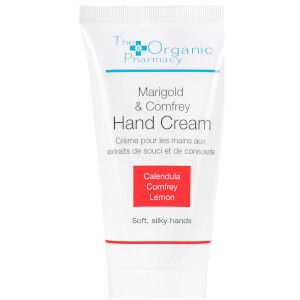
The Organic Pharmacy Marigold and Comfrey Hand Cream
Works for
1 of 1 advertised claim delivered
Moisturizing14 ingredients credited for this claimGood support
“Potent Marigold works to nourish and rejuvenate the look of dry skin, while Shea Butter and Coconut, Jojoba and Sesame Oils drench your hands in goodness.”
This product can help improve hydration of the skin with the two types of ingredients.
The first type is called “humectants”:
these ingredients help attract water.
When humectants are on the surface of the skin, they “pull in” the moisture from the outside environment, or from
within deeper layers of the skin. The following ingredients in this product do the job:
glycine, sodium lactate.
This product also contains ingredients called “occlusives”. They help reduce the speed with which our skin loses moisture to the outside environment. These ingredients also help soften the upper layer of the skin, so it feels less tight and nicer to the touch. The following ingredients in this product do the job: butyrospermum parkii butter, cocos nucifera oil.
Can it cause trouble?
Irritancy4 strong irritants: Alcohol, Citrus grandis + 2 more — patch-test recommendedHigh risk
Comedogenic2 ingredients rated 2 or more on the 0–5 pore-clogging scale2 flagged
User reviews
Be the first — your take helps the next person decide.
Ingredients
Filter by role to see what each ingredient is doing.
Water~40–60%
Aloe barbadensis extract~5.6–8.5%
- Irritation risk
- Medium
Traditionally used to treat sunburns, dermatitis and inflammation, but evidence for its effectiveness is lacking. The extract can contain humectants that help attract water into the skin
More about Aloe barbadensis extractAlcohol~4–6%
- Irritation risk
- High
Can be drying and contribute to skin irritation. Used in formulars to dissolve other ingredients, create a thinner product consistency or for its antibacterial properties
More about AlcoholCocos nucifera oil~2.9–4.3%
- Irritation risk
- Low
- Comedogenicity
- 3/5
An emollient. Found to be as effective as a moisturizer for dry skin as mineral oil. Could be comedogenic
More about Cocos nucifera oilSesamum indicum seed oil~2.1–3.2%
- Irritation risk
- Low
A good moisturizing plant oil. Due to the high linoleic acid content, it helps soften the upper layer of the skin, reduce water loss and support skin barrier function
More about Sesamum indicum seed oilSimmondsia chinensis seed oil~1.8–2.8%
- Irritation risk
- Medium
Softens the upper layer of skin and helps restore the healthy skin barrier. Has shown to help calm down inflammation in skin. It is a stable oil, meaning that it retains its properties even when exposed to air.
More about Simmondsia chinensis seed oilButyrospermum parkii butter~1.6–2.3%
- Irritation risk
- Low
- Comedogenicity
- 3/5
A great moisturising ingredient that softens the skin and reduces water loss from its upper layer. It also can be helpful in protecting skin from free radicals
More about Butyrospermum parkii butterBehenyl alcohol~1.4–2.1%
- Irritation risk
- Low
Non-drying alcohol that helps water and oil mix together. Also serves as an emollient
More about Behenyl alcoholGlyceryl stearate~1.1–1.6%
- Irritation risk
- Low
An emollient that softens the skin and forms a protective layer on its surface. Helps water and oil mix together
More about Glyceryl stearatePhospholipids~0.85–1.25%
- Irritation risk
- Low
Emollients that are naturaly present in skin. In addition, they help water and oil mix together in the product
More about PhospholipidsGlycine soja sterols~0.55–1.25%
- Irritation risk
- Low
An emollient that helps soften the skin
More about Glycine soja sterolsGlycine~0.4–0.95%
- Irritation risk
- Low
Helps to attract water to the upper layer of the skin and can help restore the skin barrier function
More about GlycineHoney~0.35–0.85%
- Irritation risk
- Low
Helps attract water to the skin and might have some anti-bacterial properties. Can be an allergen
More about HoneyMel~0.35–0.85%
- Irritation risk
- Low
Helps to soften the upper layer of the skin and attract water to it
More about MelPropolis cera~0.35–0.8%
- Irritation risk
- Low
Symphytum officinale extract~0.3–0.7%
- Irritation risk
- Low
Citrus grandis~0.15–0.6%
- Irritation risk
- High
Tocopherol~0.15–0.55%
- Irritation risk
- Low
Pure form of vitamin E. Can help moisturise and protect the skin from free radicals. Often used to help stabilise other ingredients or the formula itself
More about TocopherolSodium lactate~0.1–0.45%
- Irritation risk
- Medium
Helps attract water to the upper layer of the skin. Is often used to adjust the pH level of the product
More about Sodium lactateHoney~0.1–0.4%
- Irritation risk
- Low
Helps attract water to the skin and might have some anti-bacterial properties. Can be an allergen
More about HoneyAscorbyl palmitate~0.05–0.25%
- Irritation risk
- Medium
Being a lipid soluble form of vitamin C, it is more stable and can penetrate the skin better than L-Ascorbic acid. It is effective in protecting the skin from free radicals, as well as evening the skin tone, but is less effective in stimulating collagen production compared to L-Ascorbic acid.
More about Ascorbyl palmitateGeraniol~0.05–0.2%
Farnesol~0.05–0.15%
Ingredient list view
Water, Aloe barbadensis extract, Unknown, Alcohol, Cocos nucifera oil, Sesamum indicum seed oil, Simmondsia chinensis seed oil, Butyrospermum parkii butter, Behenyl alcohol, Glyceryl stearate, Phospholipids, Glycine soja sterols, Glycine, Honey, Mel, Propolis cera, Symphytum officinale extract, Citrus grandis, Tocopherol, Sodium lactate, Honey, Ascorbyl palmitate, Geraniol, Farnesol
Compare prices
Retailers ranked by price — lowest first.
Affiliate links · prices updated regularly · As an Amazon Associate, WIMJ earns from qualifying purchases.
Sources cited in this review
Every concentration estimate and effectiveness label is anchored to one of these 8 studies and safety reviews.
- 1
- 2Triglyceride composition of Sesamum indicum seed oilonlinelibrary.wiley.com
- 3
- 4
- 5Functional glycine receptor in cultured human keratinocytesonlinelibrary.wiley.com
- 6Vitamin E in dermatologyncbi.nlm.nih.gov

Affiliate links · As an Amazon Associate, WIMJ earns from qualifying purchases.