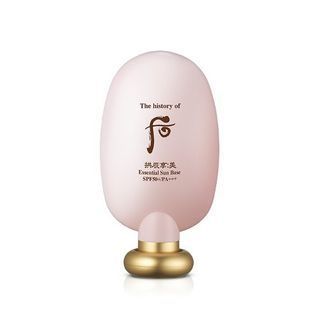
The History of Whoo Gongjinhyang Mi Essential Sun Base
Works for
1 of 1 advertised claim delivered
Sun protectionSPF 50 · 7 UV filtersBroad spectrum
This product offers a good level of protection against both UVB and UVA rays.
This sunscreen uses organic (so-called "chemical") sunscreen filters. Organic, or "chemical" filters usually provide reliable sun protection and rarely leave a white cast. Sunscreens with organic filters can sting eyes.
Evens skin toneNot advertised by the brand · 1 ingredient credited for this claimStrong support
This product offers broad spectrum sun protection. It means that it can prevent hyperpigmentation and help keep the skin tone even (sun damage is the main factor causing age spots, darkening of post-acne marks and other discolorations).
Anti-agingNot advertised by the brand · 3 ingredients credited for this claimStrong support
This product can help prevent early signs of skin aging because it offers a good level of broad spectrum sun protection. Sun damage is the main cause of premature skin aging, and protecting your skin from the sun is the best anti-aging strategy.
Anti-oxidationNot advertised by the brand · 8 ingredients credited for this claimModerate support
This product contains antioxidants (cornus officinalis fruit extract) that might be able to help neutralize free radicals in skin to lessen the damage it gets from the UV light (sun). There is not enough evidence to confirm their effectiveness in skin though.
MoisturizingNot advertised by the brand · 16 ingredients credited for this claimGood support
This product can help improve hydration of the skin with the two types of ingredients.
The first type is called “humectants”:
these ingredients help attract water.
When humectants are on the surface of the skin, they “pull in” the moisture from the outside environment, or from
within deeper layers of the skin. The following ingredients in this product do the job:
glycerin, butylene glycol.
This product also contains ingredients called “occlusives”. They help reduce the speed with which our skin loses moisture to the outside environment. These ingredients also help soften the upper layer of the skin, so it feels less tight and nicer to the touch. The following ingredients in this product do the job: dimethicone, peg-10 dimethicone.
Can it cause trouble?
Irritancy10 strong irritants: Thymus vulgaris extract, Parfum + 8 more — patch-test recommendedHigh risk
ComedogenicClean of flagged comedogenic ingredientsNone flagged


User reviews
Be the first — your take helps the next person decide.
Ingredients
Filter by role to see what each ingredient is doing.
Water~45–55%
Caprylyl methicone~5.3–6.5%
- Irritation risk
- Low
A type of silicone that helps to soften the upper layer of the skin and create a nice product finish on the skin
More about Caprylyl methiconeCyclopentasiloxane~4.4–5.4%
- Irritation risk
- Low
A silicone that helps improve the product texture and spreadability. Can absorb oil creating a short-term mattifying effect on the skin
More about CyclopentasiloxaneDimethicone~3.3–4%
- Irritation risk
- Low
A silicone that helps to reduce water loss from the surface of the skin. Can temporarily "fill in" lines and wrinkles, absorb oil, and create a nice product finish
More about DimethiconeEthylhexyl methoxycinnamate~3.2–3.9%
- Irritation risk
- High
Octinoxate. When used in higher concentrations, works as a sunscreen protecting the skin from UVB rays. When used in lower concentration, helps to preserve the product formulation. Is shown to be harmful to coral reefs - consider avoiding bathing in coral reef areas when wearing a product with this ingredient. It can be irritating
More about Ethylhexyl methoxycinnamateEthylhexyl salicylate~2.5–3.1%
- Irritation risk
- Low
Octisalate. A UV filter. It offers some protection against the sun rays that cause sunburn (UVB), but does not protect against the most aging sun rays (UVA). It loses its effectiveness quickly when exposed to sunlight. It is an organic, or so called "chemical" sunscreen
More about Ethylhexyl salicylateDipropylene glycol~1.6–1.9%
- Irritation risk
- Low
Helps to dissolve other ingredients in a formulation. Slows down the rate of product drying
More about Dipropylene glycolButylene glycol~1.4–1.7%
- Irritation risk
- Low
Used to create a nice product texture and help delivery of other ingredients. Might be somewhat helpful in attracting water to the upper layer of the skin
More about Butylene glycolGlycerin~1.2–1.5%
- Irritation risk
- Low
One of the best moisturizing ingredients. Naturally present in skin. It attracts water to the upper layer of the skin working as a humectant
More about GlycerinPeg-12 dimethicone/ppg-20 crosspolymer~0.9–1.1%
- Irritation risk
- Low
Helps water and oil mix together
More about Peg-12 dimethicone/ppg-20 crosspolymerZinc oxide~1.2–1.5%
- Irritation risk
- Low
A broad spectrum sunblock (protects from both UVA and UVB rays). Is suitable for most sensitive skins. In small concentrations, can be used as a colorant
More about Zinc oxidePhenylbenzimidazole sulfonic acid~0.75–1.15%
- Irritation risk
- Medium
Ensulizole. A UV filter that is effective against UVB rays. Does not protect against UVA light. It is photostable and can be used to help stabilize other sunscreen ingredients. It is water-soluble meaning that it can help create lighter sunscreen formulations
More about Phenylbenzimidazole sulfonic acidDimethicone/peg-10/15 crosspolymer~0.5–0.75%
Titanium dioxide~0.6–0.9%
- Irritation risk
- Low
Works as a UV filter when used in high concentrations. It is photostable and is effective mostly against the UVB light, with some protection in the UVA range. In small concentrations, used for its ability to improve the color of cosmetic products. Is usually well tolerated by the skin
More about Titanium dioxideTromethamine~0.35–0.6%
Peg-10 dimethicone~0.45–0.65%
- Irritation risk
- Low
A silicone that works to soften the upper layer of the skin and reduce its water loss
More about Peg-10 dimethiconeHydroxyethyl acrylate/sodium acryloyldimethyl taurate copolymer~0.3–0.6%
- Irritation risk
- Medium
A gelling agent that thickens the product consistency and leaves the skin with a velvety finish
More about Hydroxyethyl acrylate/sodium acryloyldimethyl taurate copolymerDimethicone crosspolymer~0.3–0.55%
- Irritation risk
- Low
Used to create a thicker product texture. Helps soften the upper layer of the skin and might be able to prevent moisture loss from its surface
More about Dimethicone crosspolymerDiphenyl dimethicone/vinyl diphenyl dimethicone/silsesquioxane crosspolymer~0.25–0.5%
Bis-ethylhexyloxyphenol methoxyphenyl triazine~0.45–0.65%
- Irritation risk
- Medium
Tinosorb S. One of the most effective broad spectrum sunscreen ingredients. Protects from both UVA and UVB rays. It is photostable. Unfortunately, not approved by FDA (US) yet.
More about Bis-ethylhexyloxyphenol methoxyphenyl triazineDiethylamino hydroxybenzoyl hexyl benzoate~0.45–0.65%
- Irritation risk
- Medium
Uvinul A Plus. A new generation broad spectrum sunscreen that offers an effective protection especially in the UVA range. It is stable in formulations. Unfortunately, is not approved by the FDA (US) yet
More about Diethylamino hydroxybenzoyl hexyl benzoatePanthenol~0.2–0.4%
- Irritation risk
- Low
Helps attract water to the upper layer of the skin and can help improve skin barrier function
More about PanthenolCornus officinalis fruit extract~0.2–0.35%
- Irritation risk
- High
A plant extract that contains anti-oxidants. It might help to neutralize free radicals in skin. Can be used to help preserve the product formulation
More about Cornus officinalis fruit extractAngelica acutiloba root extract~0.2–0.35%
- Irritation risk
- Low
Thymus vulgaris extract~0.2–0.35%
- Irritation risk
- High
Velvet extract~0.2–0.4%
- Irritation risk
- Low
Ophiopogon japonicus root extract~0.2–0.4%
- Irritation risk
- Medium
Plant extract that might help neutralize free radicals and support skin barrier function, but research on its effectiveness in skin is lacking
More about Ophiopogon japonicus root extractRehmannia chinensis root extract~0.2–0.4%
- Irritation risk
- Low
Glycyrrhiza glabra root extract~0.2–0.4%
- Irritation risk
- Medium
A plant extract that can help lighten the skin and calm down inflammation. Might be helpful in neutralizing free radicals
More about Glycyrrhiza glabra root extractPolygonatum odoratum root extract~0.25–0.45%
- Irritation risk
- Low
Lycium chinense fruit extract~0.25–0.45%
- Irritation risk
- Low
Morus alba fruit extract~0.25–0.5%
- Irritation risk
- Low
Schisandra chinensis fruit extract~0.25–0.45%
- Irritation risk
- Medium
A berry extract that might help neutralize free radicals on the surface of the skin
More about Schisandra chinensis fruit extractCnidium officinale root extract~0.25–0.45%
- Irritation risk
- Low
Prunus mume flower extract~0.25–0.45%
- Irritation risk
- Low
Carthamus tinctorius flower extract~0.25–0.45%
- Irritation risk
- Low
Atractylodes japonica rhizome extract~0.25–0.45%
- Irritation risk
- Low
Cimicifuga racemosa root extract~0.25–0.5%
- Irritation risk
- Low
Punica granatum fruit extract~0.25–0.45%
- Irritation risk
- High
A fruit extract that is used to add a fragrance to the product. It might have some antioxidant properties
More about Punica granatum fruit extractChrysanthemum indicum flower extract~0.25–0.45%
- Irritation risk
- Low
Lonicera japonica flower extract~0.25–0.45%
- Irritation risk
- High
A plant extract that might help neutralize free radicals in skin. Can contain volalite oils and be irritating
More about Lonicera japonica flower extractNelumbium speciosum flower extract~0.25–0.45%
- Irritation risk
- Low
Paeonia albiflora flower extract~0.25–0.45%
- Irritation risk
- Low
Amber powder~0.25–0.45%
Coral powder~0.3–0.6%
- Irritation risk
- Low
Gold~0.25–0.45%
Kaolin~0.4–0.6%
- Irritation risk
- Low
A type of clay that consists mainly of aluminum silicate. Helps absorb oil and creates a thicker product consistency. Can be used to add a white color
More about KaolinPearl powder~0.25–0.45%
- Irritation risk
- Low
Consists of 95% calcium carbonate that does not have any effect on the skin. The remaining 5% can include compounds that can help neutralize free radicals and support skin barrier function
More about Pearl powderVinyl dimethicone/methicone silsesquioxane crosspolymer~0.25–0.45%
- Irritation risk
- Low
A type of silicone that create a smooth product finish and can create an optical soft-focus effect on the skin. Helps to thicken the product consistency
More about Vinyl dimethicone/methicone silsesquioxane crosspolymerSqualane~0.3–0.55%
- Irritation risk
- Low
An oil naturally present in skin. Works as an emollient to soften the skin and form a protective layer on its surface without a greasy feeling.
More about Squalane2-hexanol~0.25–0.4%
- Irritation risk
- Low
Aluminum hydroxide oxide~0.25–0.45%
- Irritation risk
- Low
Polysorbate 60~0.25–0.5%
Stearic acid~0.4–0.6%
- Irritation risk
- Low
Helps oil and water mix together and works as an emollient
More about Stearic acidTriethoxycaprylylsilane~0.25–0.45%
- Irritation risk
- Low
A type of silicone that helps oil and water mix well together. Helps to disperse other ingredients, e.g. pigments, evenly in a formulation
More about TriethoxycaprylylsilanePalmitoyl proline~0.25–0.45%
- Irritation risk
- Low
An amino-acid that helps attract watet to the upper layer of the skin and might have some anti-aging properties
More about Palmitoyl prolineSodium citrate~0.25–0.45%
- Irritation risk
- Medium
Helps to control the skin's pH level. Maintains the skin's natural film of amino-lactic acids and oils. Helps to preserve products
More about Sodium citrateTalc~0.35–0.65%
Magnesium palmitoyl glutamate~0.25–0.45%
- Irritation risk
- Low
An amino acid that helps attract water to the upper layer of the skin. Might be helpful against lines and wrinkles, but evidence of effectiveness is lacking
More about Magnesium palmitoyl glutamateSodium palmitoyl sarcosinate~0.35–0.6%
- Irritation risk
- Medium
Helps water and oil mix together
More about Sodium palmitoyl sarcosinatePalmitic acid~0.3–0.55%
- Irritation risk
- Low
An emollient that is naturally present in skin and helps soften it
More about Palmitic acidTocopherol~0.25–0.5%
- Irritation risk
- Low
Pure form of vitamin E. Can help moisturise and protect the skin from free radicals. Often used to help stabilise other ingredients or the formula itself
More about TocopherolParfum~0.2–0.4%
- Irritation risk
- High
An aromatic blend of unspecified and possibly irritating ingredients
More about ParfumAlpha-isomethyl ionone~0.2–0.4%
- Irritation risk
- High
A fragrance. Potential allergen and can be irritating
More about Alpha-isomethyl iononeBenzyl benzoate~0.2–0.4%
- Irritation risk
- High
Fragrance with sweet balsamic smell. Help to preserve products and dissolve other ingredients. Could trigger allergic reactions and be irritating
More about Benzyl benzoateBenzyl salicylate~0.2–0.4%
Citronellol~0.2–0.35%
Geraniol~0.2–0.35%
Hydroxycitronellal~0.2–0.35%
- Irritation risk
- High
A fragrance. A likely allergen and can be irritating
More about HydroxycitronellalLimonene~0.15–0.3%
- Irritation risk
- High
A common frangrance that can easily irritate skin, especially if exposed to air, light or heat
More about LimoneneLinalool~0.15–0.25%
Titanium dioxide~0.25–0.45%
- Irritation risk
- Low
Works as a UV filter when used in high concentrations. It is photostable and is effective mostly against the UVB light, with some protection in the UVA range. In small concentrations, used for its ability to improve the color of cosmetic products. Is usually well tolerated by the skin
More about Titanium dioxideCi 77891~0.15–0.3%
- Irritation risk
- Low
Ci 77492~0.1–0.2%
Ci 77491~0.1–0.2%
- Irritation risk
- Low
A red colorant made of iron oxide. Typically is not irritating
More about Ci 77491Ingredient list view
Water, Caprylyl methicone, Cyclopentasiloxane, Dimethicone, Ethylhexyl methoxycinnamate, Ethylhexyl salicylate, Dipropylene glycol, Butylene glycol, Glycerin, Peg-12 dimethicone/ppg-20 crosspolymer, Zinc oxide, Phenylbenzimidazole sulfonic acid, Dimethicone/peg-10/15 crosspolymer, Titanium dioxide, Tromethamine, Peg-10 dimethicone, Hydroxyethyl acrylate/sodium acryloyldimethyl taurate copolymer, Dimethicone crosspolymer, Diphenyl dimethicone/vinyl diphenyl dimethicone/silsesquioxane crosspolymer, Bis-ethylhexyloxyphenol methoxyphenyl triazine, Diethylamino hydroxybenzoyl hexyl benzoate, Panthenol, Cornus officinalis fruit extract, Angelica acutiloba root extract, Thymus vulgaris extract, Velvet extract, Ophiopogon japonicus root extract, Rehmannia chinensis root extract, Glycyrrhiza glabra root extract, Polygonatum odoratum root extract, Lycium chinense fruit extract, Morus alba fruit extract, Schisandra chinensis fruit extract, Cnidium officinale root extract, Prunus mume flower extract, Carthamus tinctorius flower extract, Atractylodes japonica rhizome extract, Cimicifuga racemosa root extract, Punica granatum fruit extract, Chrysanthemum indicum flower extract, Lonicera japonica flower extract, Nelumbium speciosum flower extract, Paeonia albiflora flower extract, Amber powder, Coral powder, Gold, Kaolin, Pearl powder, Vinyl dimethicone/methicone silsesquioxane crosspolymer, Squalane, 2-hexanol, Aluminum hydroxide oxide, Polysorbate 60, Stearic acid, Triethoxycaprylylsilane, Palmitoyl proline, Sodium citrate, Talc, Magnesium palmitoyl glutamate, Sodium palmitoyl sarcosinate, Palmitic acid, Tocopherol, Parfum, Alpha-isomethyl ionone, Benzyl benzoate, Benzyl salicylate, Citronellol, Geraniol, Hydroxycitronellal, Limonene, Linalool, Titanium dioxide, Ci 77891, Ci 77492, Ci 77491
Compare prices
Retailers ranked by price — lowest first.

Affiliate links · prices updated regularly
Worth comparing, line by line.
Match % combines shared ingredients, the first five ingredients, shared actives and hero ingredients, irritancy (lower counts in the alternative's favour), texture and body area. Only products in the same routine step are compared.
| The History of WhooGongjinhyang Mi Essential Sun BaseYOUR PRODUCT | DCLSkincare Super Sheer SPF50 Broad Spectrum Protection Sunscreen | THE FACE SHOPNatural Sun Eco No Shine Hydrating Sun Cream SPF50 PA 1 | NellaHoney 1 Snail White Moist Sun Cream | |
|---|---|---|---|---|
| Match | — | 54% | 53% | 53% |
| Price | $36.60 | $60.81+$24.21 | $14.50−$22.10 | $14.40−$22.20 |
| Shared key ingredients | — | 8 of 17 | 8 of 17 | 9 of 17 |
| Key difference | — | Tetrahexyldecyl Ascorbate | Caprylic/Capric Triglyceride | Niacinamide |
| Irritancy | High | Low | Medium | Medium |
| SPF | SPF 50 | SPF 50 | SPF 50 | SPF 50 |
| Drying alcohol | — | — | Contains drying alcohol | — |
| View product | Shop | Shop | Shop |


Product summary
Based on the ingredient list, we assess that "The History of Whoo - Gongjinhyang Mi Essential Sun Base" can provide reliable sun protection. We love that it can protect from both UVA and UVB rays (not all sunscreens with SPF ratings give UVA protection. UVA rays do not cause sunburn, but still damage our skin and lead to early aging).
This moisturizer should also be hydrating enough to use without an additional moisturizer during the day. This product prevents early signs of aging by protecting against sun damage (all broad spectrum sunscreens do that).
Sunscreen filters
This sunscreen uses so-called "chemical", or organic UV filters (organic simply means that their molecules contain atoms of carbon). These filters typically give good sun protection and rarely leave a white cast, but they can be irritating for sensitive skin. The UV filters in this sunscreen are: tinosorb s 0.45% - 0.65%, octinoxate 3.20% - 3.90% and octisalate 2.50% - 3.10%.
Irritation risk
This moisturizer contains a bunch of common irritants, including ingredients that do not provide any known benefit for the skin. It might not be the best choice if your skin is sensitive. We assess the overall irritancy of this moisturizer to be high. For a detailed overview of all potential irritants: click here
You can see the detailed formula review with the breakdown of all actives in the product and the full ingredient list with estimated concentrations in the tables below.
Price
The product retails for 36.60$ in the United States.
For a detailed price comparison: click here.
Sources cited in this review
Every concentration estimate and effectiveness label is anchored to one of these 21 studies and safety reviews.
- 1
- 2Final Report on the Safety Assessment of Dimethicone Copolyoljournals.sagepub.com
- 3
- 4A review of inorganic UV filters zinc oxide and titanium dioxideonlinelibrary.wiley.com
- 5
- 6

Affiliate links · As an Amazon Associate, WIMJ earns from qualifying purchases.