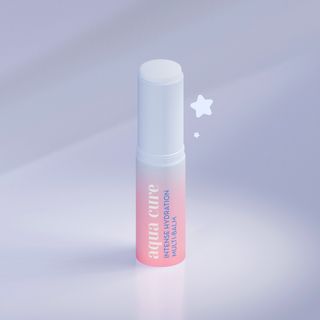
The Crème Shop AQUA CURE 24H Multi-Balm
Works for
1 of 1 advertised claim delivered
Moisturizing25 ingredients credited for this claimGood support
“Use as a moisturizer, primer, or lip balm for replenishing cooling effect.”
This product can help improve hydration of the skin with the two types of ingredients.
The first type is called “humectants”:
these ingredients help attract water.
When humectants are on the surface of the skin, they “pull in” the moisture from the outside environment, or from
within deeper layers of the skin. The following ingredients in this product do the job:
glycerin, hyaluronic acid.
This product also contains ingredients called “occlusives”. They help reduce the speed with which our skin loses moisture to the outside environment. These ingredients also help soften the upper layer of the skin, so it feels less tight and nicer to the touch. The following ingredients in this product do the job: caprylic/capric triglyceride, copernicia cerifera wax.
Can it cause trouble?
Irritancy2 strong irritants: Lavandula angustifolia flower/leaf/stem extract, ParfumMedium risk
Comedogenic1 ingredient rated 2 or more on the 0–5 pore-clogging scale1 flagged
User reviews
Be the first — your take helps the next person decide.
Ingredients
Filter by role to see what each ingredient is doing.
Water~45–55%
Octyldodecanol~4.5–5.5%
- Irritation risk
- Low
An emollient that helps to soften the skin and create a pleasant product texture and stabilize the formulation
More about OctyldodecanolCaprylic/capric triglyceride~4.4–5.4%
- Irritation risk
- Medium
A good mix of fatty acids that forms a protective layer on the skin. Improves the shelf life of products. Derived from coconut and glycerin
More about Caprylic/capric triglycerideSynthetic wax~3.3–4%
- Irritation risk
- Low
Used to stabilize product formulations and thicken product consistency
More about Synthetic waxHydrogenated polydecene~2.5–3%
- Irritation risk
- Low
Helps to soften the upper layer of the skin and create a nice product texture
More about Hydrogenated polydeceneHelianthus annuus seed oil~2.2–2.7%
- Irritation risk
- Low
A great emollient due to its high linoleic acid content. One of the most effective plant oils in helping skin hydration and repairing skin barrier function
More about Helianthus annuus seed oilIsononyl isononanoate~1.8–2.2%
- Irritation risk
- Low
Forms a protective film on the surface of the skin to prevent moisture loss. Gives a velvety feel to products while reducing tackiness
More about Isononyl isononanoateCopernicia cerifera wax~1.6–2%
- Irritation risk
- Low
Helps to soften the upper layer of the skin and create a nice product consistency
More about Copernicia cerifera waxButylene glycol~1.2–1.5%
- Irritation risk
- Low
Used to create a nice product texture and help delivery of other ingredients. Might be somewhat helpful in attracting water to the upper layer of the skin
More about Butylene glycolDiisostearyl malate~1–1.2%
- Irritation risk
- Medium
Helps to soften the upper layer of the skin
More about Diisostearyl malateSimmondsia chinensis seed oil~0.8–1.15%
- Irritation risk
- Medium
Softens the upper layer of skin and helps restore the healthy skin barrier. Has shown to help calm down inflammation in skin. It is a stable oil, meaning that it retains its properties even when exposed to air.
More about Simmondsia chinensis seed oilJojoba esters~0.65–1%
- Irritation risk
- Medium
An emollient made of jojoba oil. Helps soften the skin and support its barrier function
More about Jojoba estersPolyglyceryl-4 isostearate~0.6–0.9%
- Irritation risk
- Medium
Helps water and oil mix together
More about Polyglyceryl-4 isostearateCoco-caprylate/caprate~0.55–0.85%
- Irritation risk
- Low
Helps to soften the upper layer of the skin without creating a greasy texture
More about Coco-caprylate/caprateSodium chloride~0.55–0.8%
- Irritation risk
- Low
Used to stabilize mixtures of oil and water, and create thicker, gel-like product textures
More about Sodium chlorideSilica~0.7–1.05%
Sorbitan isostearate~0.5–0.75%
- Irritation risk
- Low
Helps oil and water mix together
More about Sorbitan isostearatePolyglyceryl-3 polyricinoleate~0.5–0.75%
- Irritation risk
- Medium
Helps oil and water mix together
More about Polyglyceryl-3 polyricinoleateGlyceryl caprylate~0.5–0.75%
- Irritation risk
- Low
An emollient that can also help water and oil mix together, as well as prevent bacteria growth in products
More about Glyceryl caprylateDisteardimonium hectorite~0.4–0.65%
- Irritation risk
- Low
A type of clay that is used to thicken the product consistency
More about Disteardimonium hectoriteCaprylyl glycol~0.45–0.65%
- Irritation risk
- Medium
Helps preserve products and creates a nice product texture
More about Caprylyl glycolTocopheryl acetate~0.4–0.6%
- Irritation risk
- Medium
A more stable but less bio-available form of vitamin E compared to Tocopherol. Might help moisturize and protect the skin from free radicals, but mostly used in low concentrations to stabilize other ingredients.
More about Tocopheryl acetateEthylhexylglycerin~0.35–0.65%
Candida bombicola/glucose/methyl rapeseedate ferment~0.45–0.7%
- Irritation risk
- Low
Helps water and oil mix together and preserve the product formulation
More about Candida bombicola/glucose/methyl rapeseedate fermentOryza sativa germ oil~0.4–0.65%
Glycerin~0.4–0.65%
- Irritation risk
- Low
One of the best moisturizing ingredients. Naturally present in skin. It attracts water to the upper layer of the skin working as a humectant
More about GlycerinPolyglyceryl-2 triisostearate~0.4–0.6%
- Irritation risk
- Low
Helps to soften the upper layer of the skin and create a nice product texture
More about Polyglyceryl-2 triisostearateAscorbic acid~0.35–0.6%
- Irritation risk
- High
The most well-researched antioxidant that works in skin. Helps neutralize free radicals supporting collagen production, helping to even out the skin tone and preventing early signs of aging
More about Ascorbic acidLavandula angustifolia flower/leaf/stem extract~0.3–0.6%
Camellia sinensis leaf extract~0.4–0.6%
- Irritation risk
- Low
Can contain potent anti-oxidant compounds (abbreviated ECG, GCG, EGC, and EGCG) that might help protect the skin from free radicals. Can help calm down inflammation and has some anti-bacterial properties. Unfortunately, these antioxidants are unstable and lose their effectiveness very quickly in products. The concentration of the antioxidant compounds in the extract also tends to be low to be effective in topical formulation
More about Camellia sinensis leaf extract1,2-hexanediol~0.35–0.6%
Aloe barbadensis leaf extract~0.45–0.65%
- Irritation risk
- Medium
Traditionally used to treat sunburns, dermatitis and inflammation, but evidence for its effectiveness is lacking. The extract can contain humectants that help attract water into the skin
More about Aloe barbadensis leaf extractAvena sativa meal extract~0.3–0.6%
- Irritation risk
- Low
A type of oatmeal extract. Helps restore skin barrier and has antioxidant properties
More about Avena sativa meal extractLepidium meyenii root extract~0.3–0.6%
- Irritation risk
- Low
Myrtus communis extract~0.35–0.6%
- Irritation risk
- Low
Salvia hispanica seed extract~0.4–0.6%
- Irritation risk
- Medium
A plant extract that typically contains linolenic and linoleic acids that help soften the upper layer of the skin and can support skin barrier function
More about Salvia hispanica seed extractAdansonia digitata seed extract~0.3–0.6%
- Irritation risk
- Low
Viola tricolor extract~0.35–0.65%
- Irritation risk
- Medium
A plant extract that might have an anti-inflammatory effect in skin
More about Viola tricolor extractPrunus domestica fruit extract~0.3–0.6%
- Irritation risk
- Medium
A plant extract. Might have some antioxidant properties
More about Prunus domestica fruit extractOphiopogon japonicus root extract~0.3–0.6%
- Irritation risk
- Medium
Plant extract that might help neutralize free radicals and support skin barrier function, but research on its effectiveness in skin is lacking
More about Ophiopogon japonicus root extractSaussurea involucrata extract~0.35–0.6%
- Irritation risk
- Low
Oryza sativa bran extract~0.3–0.6%
Nymphaea alba root extract~0.3–0.6%
- Irritation risk
- Medium
A plant root extract that might help neutralize free radicals in skin
More about Nymphaea alba root extractLens esculenta seed extract~0.35–0.6%
- Irritation risk
- Low
Nelumbo nucifera root extract~0.3–0.6%
- Irritation risk
- Low
Hibiscus esculentus fruit extract~0.3–0.6%
- Irritation risk
- High
A plant extract that might help to neutralize free radicals. It can be irritating
More about Hibiscus esculentus fruit extractLithospermum erythrorhizon root extract~0.3–0.6%
- Irritation risk
- High
A plant extract that might help neutralize free radicals in skin. Can be used for its fragrance
More about Lithospermum erythrorhizon root extractDioscorea japonica root extract~0.3–0.6%
- Irritation risk
- Low
Anthemis nobilis flower extract~0.3–0.55%
- Irritation risk
- High
A plant extract that one one hand, can contain compounds that can help calm down skin irritation, but, on the other hand, its other compounds (especially fragrant ones) can themselves be irritating
More about Anthemis nobilis flower extractCocos nucifera fruit extract~0.35–0.65%
- Irritation risk
- Low
- Comedogenicity
- 3/5
An emollient. Found to be as effective as a moisturizer for dry skin as mineral oil. Could be comedogenic
More about Cocos nucifera fruit extractSalicornia herbacea extract~0.3–0.55%
- Irritation risk
- Low
Astragalus membranaceus root extract~0.3–0.6%
- Irritation risk
- Low
Corchorus olitorius leaf extract~0.25–0.5%
- Irritation risk
- Low
Grifola frondosa fruiting body extract~0.3–0.55%
- Irritation risk
- Medium
Mushroom extract that helps attract water to the upper layer of the skin and might be able to stimulate sebum production in skin
More about Grifola frondosa fruiting body extractHyaluronic acid~0.2–0.4%
- Irritation risk
- Low
One of the best moisturizing ingredients. Attracts water into the upper layer of the skin. Naturally present in skin. Typically has large molecule size unless advertised otherwise on the product label. Helps support skin's barrier function and may help to reduce inflammation
More about Hyaluronic acidTremella fuciformis extract~0.2–0.35%
- Irritation risk
- Medium
A mushroom extract that might help attract water to the upper layer of the skin
More about Tremella fuciformis extractParfum~0.15–0.25%
- Irritation risk
- High
An aromatic blend of unspecified and possibly irritating ingredients
More about ParfumBlue 1 lake~0.15–0.3%
Ci 42090~0.15–0.3%
Ci 17200~0.1–0.2%
Ingredient list view
Water, Octyldodecanol, Caprylic/capric triglyceride, Synthetic wax, Hydrogenated polydecene, Helianthus annuus seed oil, Isononyl isononanoate, Copernicia cerifera wax, Butylene glycol, Diisostearyl malate, Simmondsia chinensis seed oil, Jojoba esters, Polyglyceryl-4 isostearate, Coco-caprylate/caprate, Sodium chloride, Silica, Sorbitan isostearate, Polyglyceryl-3 polyricinoleate, Glyceryl caprylate, Disteardimonium hectorite, Caprylyl glycol, Tocopheryl acetate, Ethylhexylglycerin, Candida bombicola/glucose/methyl rapeseedate ferment, Oryza sativa germ oil, Glycerin, Polyglyceryl-2 triisostearate, Ascorbic acid, Lavandula angustifolia flower/leaf/stem extract, Camellia sinensis leaf extract, 1,2-hexanediol, Aloe barbadensis leaf extract, Avena sativa meal extract, Lepidium meyenii root extract, Myrtus communis extract, Salvia hispanica seed extract, Adansonia digitata seed extract, Viola tricolor extract, Prunus domestica fruit extract, Ophiopogon japonicus root extract, Saussurea involucrata extract, Oryza sativa bran extract, Nymphaea alba root extract, Lens esculenta seed extract, Nelumbo nucifera root extract, Hibiscus esculentus fruit extract, Lithospermum erythrorhizon root extract, Dioscorea japonica root extract, Anthemis nobilis flower extract, Cocos nucifera fruit extract, Salicornia herbacea extract, Astragalus membranaceus root extract, Corchorus olitorius leaf extract, Grifola frondosa fruiting body extract, Hyaluronic acid, Tremella fuciformis extract, Parfum, Blue 1 lake, Ci 42090, Ci 17200
Compare prices
Retailers ranked by price — lowest first.
Sources cited in this review
Every concentration estimate and effectiveness label is anchored to one of these 16 studies and safety reviews.
- 1Safety Assessment of Polyene Group as Used in Cosmeticscir-safety.org
- 2
- 3
- 4Effect of topically applied lipids on surfactant-irritated skinonlinelibrary.wiley.com
- 5
- 6Safety Assessment of Alkyl Esters as Used in Cosmeticscir-safety.org

Affiliate links · As an Amazon Associate, WIMJ earns from qualifying purchases.