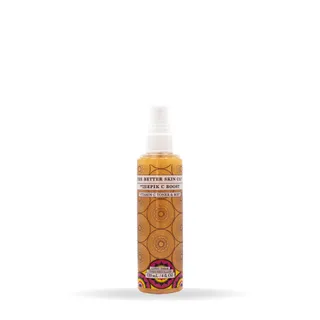
Works for
MoisturizingPanthenol, Glycerin + 6 moreWorks well
“• Cleansing, Brightening, Hydrating and Refreshing.”
This product contains good ingredients to attract water to the upper layer of the skin. These ingredients are called "humectants": biosaccharide gum-1, glycerin.
When humectants are on the surface of the skin, they “pull in” the moisture from the outside environment, or from within deeper layers of the skin. If the air is dry, humectants can speed up the moisture loss from the skin. This is why it is a good idea to use another product on top of this one to help "seal in" the moisture (look for ingredients like dimethicone, squalane, oils and butters).
The following ingredients in this product are especially good for supporting the skin barrier and helping with the hydration level: panthenol
Anti-oxidationSide benefit · Sodium ascorbyl phosphate, Leontopodium alpinum callus culture extract + 3 moreMay help
This product contains antioxidants (sodium ascorbyl phosphate) that might be able to help neutralize free radicals in skin to lessen the damage it gets from the UV light (sun). There is not enough evidence to confirm their effectiveness in skin though.
Can it cause trouble?
Irritancy3 strong irritants: Citrus limon seed oil, Gelidiella acerosa extract + 1 more — patch-test recommendedHigh risk
Comedogenic1 ingredient rated 2 or more on the 0–5 pore-clogging scale1 flagged

User reviews
Be the first — your take helps the next person decide.
Ingredients
Filter by role to see what each ingredient is doing.
Water~40–60%
Glycerin~4.1–6.1%
- Irritation risk
- Low
One of the best moisturizing ingredients. Naturally present in skin. It attracts water to the upper layer of the skin working as a humectant
More about GlycerinPolysorbate 20~3.2–4.8%
Sclerotium gum~2.5–3.8%
- Irritation risk
- Low
Used to create gel-like formulas and stabilize emulsions
More about Sclerotium gumSodium ascorbyl phosphate~1.8–2.7%
- Irritation risk
- Medium
A stable derivative of vitamin C. It is oil-soluble which means it is more likely to penetrate the skin compared to the pure form of vitamin C (which is water-soluble), but it is less bio-available and is way less effective in stimulating collagen and reducing wrinkles compared to the pure form of vitamin C (L-ascorbic acid) and its other derivatives (for example, magnesium ascorbyl phosphate). At the same time, this vitamin C derivative has been shown in studies to be effective in reducing acne, blemishes and clogged pores. It is less irritating then the pure form of vitamin C
More about Sodium ascorbyl phosphatePhenoxyethanol~0.5–1%
- Irritation risk
- Low
A preservative. It helps prevent bacterial growth in cosmetic products
More about PhenoxyethanolEthylhexylglycerin~1.2–1.8%
Citrus limon seed oil~1.1–1.7%
- Irritation risk
- High
Sodium citrate~0.95–1.4%
- Irritation risk
- Medium
Helps to control the skin's pH level. Maintains the skin's natural film of amino-lactic acids and oils. Helps to preserve products
More about Sodium citrateBiosaccharide gum-1~0.55–1.35%
- Irritation risk
- Low
Helps attract water to the upper layer of the skin and is claimed to provide a longer-lasting hydration because of its ability to create a water-binding film on the surface of the skin
More about Biosaccharide gum-1Panthenol~0.45–1.05%
- Irritation risk
- Low
Helps attract water to the upper layer of the skin and can help improve skin barrier function
More about PanthenolCamellia sinensis leaf extract~0.4–0.9%
- Irritation risk
- Low
Can contain potent anti-oxidant compounds (abbreviated ECG, GCG, EGC, and EGCG) that might help protect the skin from free radicals. Can help calm down inflammation and has some anti-bacterial properties. Unfortunately, these antioxidants are unstable and lose their effectiveness very quickly in products. The concentration of the antioxidant compounds in the extract also tends to be low to be effective in topical formulation
More about Camellia sinensis leaf extractAloe barbadensis leaf extract~0.4–0.9%
- Irritation risk
- Medium
Traditionally used to treat sunburns, dermatitis and inflammation, but evidence for its effectiveness is lacking. The extract can contain humectants that help attract water into the skin
More about Aloe barbadensis leaf extractMacrocystis pyrifera extract~0.2–0.8%
- Irritation risk
- Low
- Comedogenicity
- 3/5
Gelidiella acerosa extract~0.2–0.75%
- Irritation risk
- High
An algae extract that can help attract water to the upper layer of the skin and have some anti-oxidant properties
More about Gelidiella acerosa extractLeontopodium alpinum callus culture extract~0.2–0.7%
- Irritation risk
- Low
A plant stem cell extract that might help neutralize free radicals and reduce inflammation in skin
More about Leontopodium alpinum callus culture extractXanthan gum~0.2–0.7%
- Irritation risk
- Low
Used to create a thicker product consistency
More about Xanthan gumMarrubium vulgare extract~0.1–0.5%
- Irritation risk
- Low
Mica~0.15–0.55%
- Irritation risk
- Low
Creates an illusion of smoother and more radiant skin tone. Adds shimmer to the skin by reflecting light
More about MicaTitanium dioxide~0.15–0.65%
- Irritation risk
- Low
Works as a UV filter when used in high concentrations. It is photostable and is effective mostly against the UVB light, with some protection in the UVA range. In small concentrations, used for its ability to improve the color of cosmetic products. Is usually well tolerated by the skin
More about Titanium dioxideIron oxides~0.15–0.5%
- Irritation risk
- Low
An umbrella term for the following three colorants: CI 77491, CI 77492, CI 77499. They might be able to offer some protection against visible light, but the degree of the protection is not clear
More about Iron oxidesCalcium aluminum borosilicate~0.1–0.4%
Silica~0.15–0.55%
Tin oxide~0.15–0.5%
- Irritation risk
- Low
A colorant that can add a pearl-like appearance to the formulation
More about Tin oxideTocopheryl acetate~0.05–0.2%
- Irritation risk
- Medium
A more stable but less bio-available form of vitamin E compared to Tocopherol. Might help moisturize and protect the skin from free radicals, but mostly used in low concentrations to stabilize other ingredients.
More about Tocopheryl acetateCaprylic/capric triglyceride~0.05–0.25%
- Irritation risk
- Medium
A good mix of fatty acids that forms a protective layer on the skin. Improves the shelf life of products. Derived from coconut and glycerin
More about Caprylic/capric triglycerideHumulus lupulus extract~0.01–0.1%
- Irritation risk
- High
Hops extract. Can contain common irritants and allergens geraniol, limonene, linalool
More about Humulus lupulus extractIngredient list view
Water, Glycerin, Polysorbate 20, Sclerotium gum, Sodium ascorbyl phosphate, Phenoxyethanol, Ethylhexylglycerin, Citrus limon seed oil, Sodium citrate, Biosaccharide gum-1, Panthenol, Camellia sinensis leaf extract, Aloe barbadensis leaf extract, Macrocystis pyrifera extract, Gelidiella acerosa extract, Unknown, Leontopodium alpinum callus culture extract, Xanthan gum, Marrubium vulgare extract, Mica, Titanium dioxide, Iron oxides, Calcium aluminum borosilicate, Silica, Tin oxide, Tocopheryl acetate, Caprylic/capric triglyceride, Humulus lupulus extract
Compare prices
Retailers ranked by price — lowest first.
Worth comparing, line by line.
Match % combines shared ingredients, the first five ingredients, shared actives and hero ingredients, irritancy (lower counts in the alternative's favour), texture and body area. Only products in the same routine step are compared.
| The Better Skin Co.Epik C BoostYOUR PRODUCT | Etude HouseSake Bright White Mask | eb5Anti-Aging Vitamin C Serum Concentrate | PacificaCoconut Essence Hydro Mist | |
|---|---|---|---|---|
| Match | — | 58% | 56% | 56% |
| Price | — | — | — | $5.00 |
| Shared key ingredients | — | 3 of 7 | 3 of 7 | 3 of 7 |
| Key difference | — | Palmitoyl Tetrapeptide-7 | Betaine | Caffeine |
| Irritancy | High | Medium | Low | Medium |
| Drying alcohol | — | — | — | — |
| View product | Shop | Shop | Shop |


More alternatives: Olay Anti-Aging Face Moisturizer Fragrance-FreeDisco Hydrating Face Moisturizer
Sources cited in this review
Every concentration estimate and effectiveness label is anchored to one of these 15 studies and safety reviews.
- 1
- 2
- 3Sodium ascorbyl phosphate in topical microemulsionssciencedirect.com
- 4
- 5
- 6

Affiliate links · As an Amazon Associate, WIMJ earns from qualifying purchases.