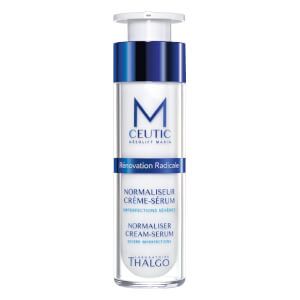
Thalgo Normalizer Cream-Serum

Thalgo Normalizer Cream-Serum

Efficacy75/100IrritancyMedium
Edit

Works for

2 of 2 advertised claims delivered

Moisturizing
12 ingredients credited for this claim
Good support

This product can help improve hydration of the skin with the two types of ingredients.

The first type is called “humectants”:
these ingredients help attract water. When humectants are on the surface of the skin, they “pull in” the moisture from the outside environment, or from within deeper layers of the skin. The following ingredients in this product do the job: algae extract, glycerin.

This product also contains ingredients called “occlusives”. They help reduce the speed with which our skin loses moisture to the outside environment. These ingredients also help soften the upper layer of the skin, so it feels less tight and nicer to the touch. The following ingredients in this product do the job: algae extract, ethyl linoleate.

Ethyl linoleateKey active· EmollientEffect: HighHelps reduce acne and blemishes. Helps to soften the upper layer of the skin and reduce inflammation. Might be helpful in reducing hyperpigmentation and evening out the skin tone, but evidence of effectiveness in skin are lacking~3–3.7%
Algae extractKey active· Humectant, EmollientEffect: HighPlant extract that helps the skin to attract water and make it more smooth for touch. Also shows promise of anti-aging properties, but research is not extensive yet~0.55–0.8%
Hydrolyzed yeast extractKey active· HumectantEffect: HighHelps attract water to the upper layer of the skin and might have some anti-oxidant and skin lightening properties~0.3–0.5%
Hydrolyzed hyaluronic acidKey active· HumectantEffect: HighOne of the best moisturizing ingredients. Attracts water into the upper layer of the skin. A version of it is naturally present in skin~0.4–0.65%
GlycerinKey active· HumectantEffect: HighOne of the best moisturizing ingredients. Naturally present in skin. It attracts water to the upper layer of the skin working as a humectant~2.4–2.9%
AdenosineKey activeEffect: MediumMight help improve cell turnover and reduce inflammation in skin. One study shows that the ingredients might be able to help reduce dynamic wrinkles (for example, in the corners of the eyes or on the forehead)~0.15–0.3%
Propylheptyl caprylateKey active· EmollientEffect: MediumHelps soften the upper layer of the skin~3.7–4.6%
Dicaprylyl carbonate· EmollientEffect: LowHelps products spread more easily and works as an emollient to soften skin~1.6–2%
Butylene glycol· HumectantEffect: LowUsed to create a nice product texture and help delivery of other ingredients. Might be somewhat helpful in attracting water to the upper layer of the skin~1.9–2.3%
Ethyl oleate· EmollientEffect: LowEthyl oleate is a long-chain fatty acid ethyl ester resulting from the formal condensation of the carboxy group of oleic acid with the hydroxy group of ethanol. It derives from an oleic acid. In skincare, it is used to soften the upper layer of the skin, improve the product texture and smell~0.55–0.85%
NiacinamideUnder-dosedEffect: HighIs proven to be effective in reducing blemishes, evening out skin tone and helping to improve lines and wrinkles. It helps the skin to repair sun damage, calm down inflammation and keep maintain good levels of moisture. The concentration of about 2% is effective for supporting the skin barrier and evening out the skin tone. Concentration of 4-6% is better for helping with acne and balancing the sebum production~0.45–0.7%
Aloe barbadensis leaf juiceEffect: Low, below effective doseTraditionally used to treat sunburns, dermatitis and inflammation, but evidence for its effectiveness is lacking. The extract can contain humectants that help attract water into the skin~0.3–0.55%
Anti-blemish
3 ingredients credited for this claim
Good support
What the product description says
“An anti-blemish complex provides antimicrobial properties and seeks to restore healthy lipid composition.”
Source: Lookfantastic CA

This product might be able to help reduce blemishes and clogged pores because it contains ethyl linoleate.

Ethyl linoleateKey activeEffect: HighHelps reduce acne and blemishes. Helps to soften the upper layer of the skin and reduce inflammation. Might be helpful in reducing hyperpigmentation and evening out the skin tone, but evidence of effectiveness in skin are lacking~3–3.7%
NiacinamideUnder-dosedEffect: HighIs proven to be effective in reducing blemishes, evening out skin tone and helping to improve lines and wrinkles. It helps the skin to repair sun damage, calm down inflammation and keep maintain good levels of moisture. The concentration of about 2% is effective for supporting the skin barrier and evening out the skin tone. Concentration of 4-6% is better for helping with acne and balancing the sebum production~0.45–0.7%
Aloe barbadensis leaf juiceEffect: Low, below effective doseTraditionally used to treat sunburns, dermatitis and inflammation, but evidence for its effectiveness is lacking. The extract can contain humectants that help attract water into the skin~0.3–0.55%
Anti-aging
Not advertised by the brand · 4 ingredients credited for this claim
Strong support

This product can help reduce and prevent fine lines and wrinkles, improve skin elasticity and firmness because it contains adenosine.

Keep in mind that it typically takes at least 6 weeks to notice any results because the changes that are needed to improve fine lines and elasticity happen in the deeper layers of the skin. No topical anti-aging product can “erase” wrinkles or fully reverse signs of aging.

AdenosineKey activeEffect: HighMight help improve cell turnover and reduce inflammation in skin. One study shows that the ingredients might be able to help reduce dynamic wrinkles (for example, in the corners of the eyes or on the forehead)~0.15–0.3%
Algae extractEffect: LowPlant extract that helps the skin to attract water and make it more smooth for touch. Also shows promise of anti-aging properties, but research is not extensive yet~0.55–0.8%
NiacinamideUnder-dosedEffect: HighIs proven to be effective in reducing blemishes, evening out skin tone and helping to improve lines and wrinkles. It helps the skin to repair sun damage, calm down inflammation and keep maintain good levels of moisture. The concentration of about 2% is effective for supporting the skin barrier and evening out the skin tone. Concentration of 4-6% is better for helping with acne and balancing the sebum production~0.45–0.7%
Aloe barbadensis leaf juiceEffect: Low, below effective doseTraditionally used to treat sunburns, dermatitis and inflammation, but evidence for its effectiveness is lacking. The extract can contain humectants that help attract water into the skin~0.3–0.55%

Can it cause trouble?

Irritancy
2 strong irritants: Parfum, Alcohol
Medium risk
We flagged 16 ingredients with irritancy potential. Severity depends on your sensitivity threshold; the table lists the worst offenders first.
IngredientFunctionIrritationEst. amount
ParfumAn aromatic blend of unspecified and possibly irritating ingredientsHigh~0.3–0.5%est.
AlcoholCan be drying and contribute to skin irritation. Used in formulars to dissolve other ingredients, create a thinner product consistency or for its antibacterial propertiesHigh~0.05–0.1%est.
Ethyl linoleateHelps reduce acne and blemishes. Helps to soften the upper layer of the skin and reduce inflammation. Might be helpful in reducing hyperpigmentation and evening out the skin tone, but evidence of effectiveness in skin are lackingMedium~3–3.7%est.
Steareth-2Helps oil and water mix togetherMedium~1.1–1.4%est.
Steareth-21Helps oil and water mix togetherMedium~1–1.2%est.
Ethyl oleateEthyl oleate is a long-chain fatty acid ethyl ester resulting from the formal condensation of the carboxy group of oleic acid with the hydroxy group of ethanol. It derives from an oleic acid. In skincare, it is used to soften the upper layer of the skin, improve the product texture and smellMedium~0.55–0.85%est.
Hydroxyethyl acrylate/sodium acryloyldimethyl taurate copolymerA gelling agent that thickens the product consistency and leaves the skin with a velvety finishMedium~0.5–0.75%est.
Aloe barbadensis leaf juiceTraditionally used to treat sunburns, dermatitis and inflammation, but evidence for its effectiveness is lacking. The extract can contain humectants that help attract water into the skinMedium~0.3–0.55%est.
Tocopheryl acetateA more stable but less bio-available form of vitamin E compared to Tocopherol. Might help moisturize and protect the skin from free radicals, but mostly used in low concentrations to stabilize other ingredients.Medium~0.3–0.55%est.
Glyceryl linoleateHelps oil and water mix togetherMedium~0.3–0.6%est.
ChlorphenesinA preservativeMedium~0.16–0.32%est.
EthylhexylglycerinA preservativeMedium~0.25–0.45%est.
Polysorbate 60Helps oil and water mix togetherMedium~0.25–0.45%est.
Citric acidCan work as an exfoliant but is typically used to adjust the product pHMedium~0.15–0.25%est.
T-butyl alcoholUsed to dissolve other ingredients and to improve smell of products. It could be irritatingMedium~0.1–0.2%est.
Propyl gallateHelps preserve product formulations and can mask the smell of other ingredients in a productMedium~0.1–0.15%est.
Comedogenic
2 ingredients rated 2 or more on the 0–5 pore-clogging scale
2 flagged
These ingredients have a comedogenic rating of 2 or more on a 0–5 scale; the table shows each one's rating. In leave-on products they can clog pores in acne-prone skin.
IngredientFunctionRatingEst. amount
Algae extractPlant extract that helps the skin to attract water and make it more smooth for touch. Also shows promise of anti-aging properties, but research is not extensive yet3/5~0.55–0.8%est.
Macrocystis pyrifera extract—3/5~0.3–0.55%est.
Edit

User reviews

Would you recommend?
No community reviews yet.

Be the first — your take helps the next person decide.

Write a review · ~30s

Ingredients

Filter by role to see what each ingredient is doing.

Water~45–55%
Formula
Irritation risk
Low

Plain old water

More about Water
Propylheptyl caprylate~3.7–4.6%
Key active
Irritation risk
Low
Works for
Moisturizing

Helps soften the upper layer of the skin

More about Propylheptyl caprylate
Propanediol~3.9–4.7%
Formula
Irritation risk
Low

Acts as a solvent for other ingredients. Speeds up the absorption of other ingredients into the skin

More about Propanediol
Ethyl linoleate~3–3.7%
Key activeIrritant · medium
Irritation risk
Medium
Works for
MoisturizingAnti-blemishEvens skin toneAnti-inflammatory

Helps reduce acne and blemishes. Helps to soften the upper layer of the skin and reduce inflammation. Might be helpful in reducing hyperpigmentation and evening out the skin tone, but evidence of effectiveness in skin are lacking

More about Ethyl linoleate
Glycerin~2.4–2.9%
Key active
Irritation risk
Low
Works for
Moisturizing

One of the best moisturizing ingredients. Naturally present in skin. It attracts water to the upper layer of the skin working as a humectant

More about Glycerin
Butylene glycol~1.9–2.3%
Formula
Irritation risk
Low
Works for
Moisturizing

Used to create a nice product texture and help delivery of other ingredients. Might be somewhat helpful in attracting water to the upper layer of the skin

More about Butylene glycol
Dicaprylyl carbonate~1.6–2%
Formula
Irritation risk
Low
Works for
Moisturizing

Helps products spread more easily and works as an emollient to soften skin

More about Dicaprylyl carbonate
Methyl methacrylate crosspolymer~1.5–1.8%
Formula
Irritation risk
Low
Works for
Mattifying

Helps thicken the product consistency

More about Methyl methacrylate crosspolymer
Steareth-2~1.1–1.4%
Irritant · medium
Irritation risk
Medium
Works for
Cleansing

Helps oil and water mix together

More about Steareth-2
Steareth-21~1–1.2%
Irritant · medium
Irritation risk
Medium
Works for
Cleansing

Helps oil and water mix together

More about Steareth-21
Sucrose palmitate~0.75–1.1%
Formula
Irritation risk
Low
Works for
Cleansing
More about Sucrose palmitate
Pentaerythrityl distearate~0.6–0.9%
Formula
Irritation risk
Low
Works for
Cleansing
More about Pentaerythrityl distearate
Ethyl oleate~0.55–0.85%
Irritant · medium
Irritation risk
Medium
Works for
Moisturizing

Ethyl oleate is a long-chain fatty acid ethyl ester resulting from the formal condensation of the carboxy group of oleic acid with the hydroxy group of ethanol. It derives from an oleic acid. In skincare, it is used to soften the upper layer of the skin, improve the product texture and smell

More about Ethyl oleate
Hydroxyethyl acrylate/sodium acryloyldimethyl taurate copolymer~0.5–0.75%
Irritant · medium
Irritation risk
Medium

A gelling agent that thickens the product consistency and leaves the skin with a velvety finish

More about Hydroxyethyl acrylate/sodium acryloyldimethyl taurate copolymer
Algae extract~0.55–0.8%
Key activeComedogenic 3/5
Irritation risk
Low
Comedogenicity
3/5
Works for
MoisturizingAnti-aging

Plant extract that helps the skin to attract water and make it more smooth for touch. Also shows promise of anti-aging properties, but research is not extensive yet

More about Algae extract
Phenoxyethanol~0.5–0.75%
Formula
Irritation risk
Low

A preservative. It helps prevent bacterial growth in cosmetic products

More about Phenoxyethanol
Niacinamide~0.45–0.7%
Under-dosed
Irritation risk
Low
Works for
Anti-agingEvens skin toneAnti-blemishMoisturizingReduces irritationAnti-inflammatoryAntibacterialReduces redness

Is proven to be effective in reducing blemishes, evening out skin tone and helping to improve lines and wrinkles. It helps the skin to repair sun damage, calm down inflammation and keep maintain good levels of moisture. The concentration of about 2% is effective for supporting the skin barrier and evening out the skin tone. Concentration of 4-6% is better for helping with acne and balancing the sebum production

More about Niacinamide
Hydrolyzed hyaluronic acid~0.4–0.65%
Key active
Irritation risk
Low
Works for
Moisturizing

One of the best moisturizing ingredients. Attracts water into the upper layer of the skin. A version of it is naturally present in skin

More about Hydrolyzed hyaluronic acid
Maris aqua~0.4–0.6%
Formula
Irritation risk
Low

Sea water. Helps dissolve other ingredients in a product

More about Maris aqua
Sea water~0.35–0.6%
Formula
Irritation risk
Low

Dissolves other ingredients. It does not have additional skin benefits compared to plain water

More about Sea water
Ethyl linolenate
Not recognized
Totarol~0.35–0.65%
Formula
Irritation risk
Low
More about Totarol
Macrocystis pyrifera extract~0.3–0.55%
Comedogenic 3/5
Irritation risk
Low
Comedogenicity
3/5
More about Macrocystis pyrifera extract
Barosma betulina leaf extract~0.25–0.5%
Formula
Aloe barbadensis leaf juice~0.3–0.55%
Irritant · medium
Irritation risk
Medium
Works for
MoisturizingAntibacterialAnti-inflammatoryReduces irritationReduces rednessAnti-agingAnti-blemish

Traditionally used to treat sunburns, dermatitis and inflammation, but evidence for its effectiveness is lacking. The extract can contain humectants that help attract water into the skin

More about Aloe barbadensis leaf juice
Hydrolyzed yeast extract~0.3–0.5%
Key active
Irritation risk
Low
Works for
MoisturizingAnti-oxidationEvens skin tone

Helps attract water to the upper layer of the skin and might have some anti-oxidant and skin lightening properties

More about Hydrolyzed yeast extract
Parfum~0.3–0.5%
Irritant · high
Irritation risk
High

An aromatic blend of unspecified and possibly irritating ingredients

More about Parfum
Polyacrylate crosspolymer-6~0.3–0.55%
Formula
Tocopheryl acetate~0.3–0.55%
Irritant · medium
Irritation risk
Medium
Works for
Anti-oxidation

A more stable but less bio-available form of vitamin E compared to Tocopherol. Might help moisturize and protect the skin from free radicals, but mostly used in low concentrations to stabilize other ingredients.

More about Tocopheryl acetate
Glyceryl linoleate~0.3–0.6%
Irritant · medium
Irritation risk
Medium
Works for
Cleansing

Helps oil and water mix together

More about Glyceryl linoleate
Chlorphenesin~0.16–0.32%
Irritant · medium
Irritation risk
Medium

A preservative

More about Chlorphenesin
Ethylhexylglycerin~0.25–0.45%
Irritant · medium
Irritation risk
Medium

A preservative

More about Ethylhexylglycerin
Polysorbate 60~0.25–0.45%
Irritant · medium
Irritation risk
Medium
Works for
Cleansing

Helps oil and water mix together

More about Polysorbate 60
Sorbitan isostearate~0.2–0.4%
Formula
Irritation risk
Low
Works for
Cleansing

Helps oil and water mix together

More about Sorbitan isostearate
Sodium phytate~0.2–0.35%
Formula
Irritation risk
Low

Used to stabilize product formulations

More about Sodium phytate
Adenosine~0.15–0.3%
Key active
Irritation risk
Low
Works for
Anti-agingMoisturizingAnti-oxidation

Might help improve cell turnover and reduce inflammation in skin. One study shows that the ingredients might be able to help reduce dynamic wrinkles (for example, in the corners of the eyes or on the forehead)

More about Adenosine
Citric acid~0.15–0.25%
Irritant · medium
Irritation risk
Medium

Can work as an exfoliant but is typically used to adjust the product pH

More about Citric acid
T-butyl alcohol~0.1–0.2%
Irritant · medium
Irritation risk
Medium

Used to dissolve other ingredients and to improve smell of products. It could be irritating

More about T-butyl alcohol
Sodium hydroxide~0.1–0.2%
Formula
Irritation risk
Low

Used to adjust the product's pH

More about Sodium hydroxide
Propyl gallate~0.1–0.15%
Irritant · medium
Irritation risk
Medium

Helps preserve product formulations and can mask the smell of other ingredients in a product

More about Propyl gallate
Alcohol~0.05–0.1%
Irritant · high
Irritation risk
High
Works for
Antibacterial

Can be drying and contribute to skin irritation. Used in formulars to dissolve other ingredients, create a thinner product consistency or for its antibacterial properties

More about Alcohol
Ingredient list view

Water, Propylheptyl caprylate, Propanediol, Ethyl linoleate, Glycerin, Butylene glycol, Dicaprylyl carbonate, Methyl methacrylate crosspolymer, Steareth-2, Steareth-21, Sucrose palmitate, Pentaerythrityl distearate, Ethyl oleate, Hydroxyethyl acrylate/sodium acryloyldimethyl taurate copolymer, Algae extract, Phenoxyethanol, Niacinamide, Hydrolyzed hyaluronic acid, Maris aqua, Sea water, Unknown, Totarol, Macrocystis pyrifera extract, Barosma betulina leaf extract, Aloe barbadensis leaf juice, Hydrolyzed yeast extract, Parfum, Polyacrylate crosspolymer-6, Tocopheryl acetate, Glyceryl linoleate, Chlorphenesin, Ethylhexylglycerin, Polysorbate 60, Sorbitan isostearate, Sodium phytate, Adenosine, Citric acid, T-butyl alcohol, Sodium hydroxide, Propyl gallate, Alcohol

Compare prices

Retailers ranked by price — lowest first.

Lookfantastic Australia
≈ $70.93
Buy
Lookfantastic CA
≈ $93.49
Buy

Affiliate links · prices updated regularly

Worth comparing, line by line.

Match % combines shared ingredients, the first five ingredients, shared actives and hero ingredients, irritancy (lower counts in the alternative's favour), texture and body area. Only products in the same routine step are compared.

Side-by-side comparison of this product against its closest alternatives
ThalgoNormalizer Cream-SerumYOUR PRODUCTNEOGEN X SUR.MEDICV.Biome Soothing CreamLumeneNordic Ageless [AJATON] Radiant Youth Night CreamDoctor Rogers RestoreRestore Face Cream
Match—87%87%87%
Price$100.00$28.00−$72.00$56.72−$43.28$72.00−$28.00
Shared key ingredients—4 of 84 of 83 of 8
Key difference—PanthenolCopper Heptapeptide-14 PantothenateButyrospermum Parkii Butter
Irritancy Medium High Medium Low
Drying alcohol Contains drying alcohol ———
View product Shop Shop Shop
Cheaper alternatives? See how this stacks up against similar formulas.
We compare ingredient profiles across our catalog — pick the closest match for your budget.
Open dupe finder

Sources cited in this review

Every concentration estimate and effectiveness label is anchored to one of these 12 studies and safety reviews.

  1. 1
  2. 2
  3. 3
  4. 4
  5. 5
  6. 6
Thalgo Normalizer Cream-Serum
ThalgoNormalizer Cream-Serum

Affiliate links · As an Amazon Associate, WIMJ earns from qualifying purchases.

As an Amazon Associate, WIMJ earns from qualifying purchases.