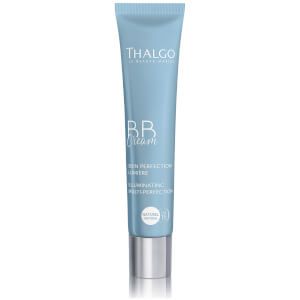
Thalgo Illuminating Multi-Perfection - Natural
Works for
1 of 1 advertised claim delivered
MoisturizingAlgae extract, Chondrus crispus + 15 moreGood evidence
“Working to hydrate the skin with a light, velvety formula, this Perfect Glow cream hides imperfections and conceals blemishes on the skin to give your complexion a picture perfect finish.”
This product can help improve hydration of the skin with the two types of ingredients.
The first type is called “humectants”:
these ingredients help attract water.
When humectants are on the surface of the skin, they “pull in” the moisture from the outside environment, or from
within deeper layers of the skin. The following ingredients in this product do the job:
algae extract, glycerin.
This product also contains ingredients called “occlusives”. They help reduce the speed with which our skin loses moisture to the outside environment. These ingredients also help soften the upper layer of the skin, so it feels less tight and nicer to the touch. The following ingredients in this product do the job: dimethicone, dimethiconol.
Can it cause trouble?
Irritancy8 strong irritants: Parfum, Alcohol + 6 more — patch-test recommendedHigh risk
Comedogenic2 ingredients rated 2 or more on the 0–5 pore-clogging scale2 flagged
User reviews
Be the first — your take helps the next person decide.
Ingredients
Filter by role to see what each ingredient is doing.
Water~45–55%
Cyclopentasiloxane~6.1–7.4%
- Irritation risk
- Low
A silicone that helps improve the product texture and spreadability. Can absorb oil creating a short-term mattifying effect on the skin
More about CyclopentasiloxaneTalc~4.6–5.6%
Glycerin~3.4–4.2%
- Irritation risk
- Low
One of the best moisturizing ingredients. Naturally present in skin. It attracts water to the upper layer of the skin working as a humectant
More about GlycerinButylene glycol~2.8–3.4%
- Irritation risk
- Low
Used to create a nice product texture and help delivery of other ingredients. Might be somewhat helpful in attracting water to the upper layer of the skin
More about Butylene glycolTitanium dioxide~2.8–3.4%
- Irritation risk
- Low
Works as a UV filter when used in high concentrations. It is photostable and is effective mostly against the UVB light, with some protection in the UVA range. In small concentrations, used for its ability to improve the color of cosmetic products. Is usually well tolerated by the skin
More about Titanium dioxideEthylhexyl methoxycinnamate~2.4–3%
- Irritation risk
- High
Octinoxate. When used in higher concentrations, works as a sunscreen protecting the skin from UVB rays. When used in lower concentration, helps to preserve the product formulation. Is shown to be harmful to coral reefs - consider avoiding bathing in coral reef areas when wearing a product with this ingredient. It can be irritating
More about Ethylhexyl methoxycinnamateCaprylyl methicone~1.6–2%
- Irritation risk
- Low
A type of silicone that helps to soften the upper layer of the skin and create a nice product finish on the skin
More about Caprylyl methiconeDimethicone~1.5–1.8%
- Irritation risk
- Low
A silicone that helps to reduce water loss from the surface of the skin. Can temporarily "fill in" lines and wrinkles, absorb oil, and create a nice product finish
More about DimethiconeCyclohexasiloxane~1.2–1.5%
- Irritation risk
- Low
A silicone that serves as an emollient. Helps create a nice non-greasy feels
More about CyclohexasiloxaneIsododecane~0.95–1.2%
- Irritation risk
- Low
An emollient that helps soften the skin and can decrease moisture loss. Helps create a nice product texture
More about IsododecaneLauryl peg-9 polydimethylsiloxyethyl dimethicone~0.75–1.1%
- Irritation risk
- Low
A type of silicone that helps to soften upper layer of the skin and create a nice product texture
More about Lauryl peg-9 polydimethylsiloxyethyl dimethiconeQuaternium-90 bentonite~0.7–1.05%
- Irritation risk
- Low
Verbena officinalis extract~0.7–1%
- Irritation risk
- Low
Algae extract~0.7–1.05%
- Irritation risk
- Low
- Comedogenicity
- 3/5
Plant extract that helps the skin to attract water and make it more smooth for touch. Also shows promise of anti-aging properties, but research is not extensive yet
More about Algae extractPolysiphonia lanosa extract~0.6–0.9%
- Irritation risk
- Low
Aloe barbadensis leaf juice~0.55–0.85%
- Irritation risk
- Medium
Traditionally used to treat sunburns, dermatitis and inflammation, but evidence for its effectiveness is lacking. The extract can contain humectants that help attract water into the skin
More about Aloe barbadensis leaf juiceChondrus crispus~0.55–0.8%
- Irritation risk
- Low
- Comedogenicity
- 3/5
Red algae extract that helps attract water to the upper layer of the skin and create a nicer product consistency
More about Chondrus crispusSodium chloride~0.55–0.8%
- Irritation risk
- Low
Used to stabilize mixtures of oil and water, and create thicker, gel-like product textures
More about Sodium chloridePeg-15/lauryl polydimethylsiloxyethyl dimethicone crosspolymer~0.5–0.7%
- Irritation risk
- Low
Phenoxyethanol~0.45–0.7%
- Irritation risk
- Low
A preservative. It helps prevent bacterial growth in cosmetic products
More about PhenoxyethanolParfum~0.4–0.6%
- Irritation risk
- High
An aromatic blend of unspecified and possibly irritating ingredients
More about ParfumDimethicone crosspolymer~0.4–0.6%
- Irritation risk
- Low
Used to create a thicker product texture. Helps soften the upper layer of the skin and might be able to prevent moisture loss from its surface
More about Dimethicone crosspolymerMagnesium stearate~0.35–0.65%
Alcohol~0.35–0.65%
- Irritation risk
- High
Can be drying and contribute to skin irritation. Used in formulars to dissolve other ingredients, create a thinner product consistency or for its antibacterial properties
More about AlcoholDimethiconol~0.45–0.65%
- Irritation risk
- Low
A silicone that makes products more spreadable and keeps skin smooth. Helps to add gloss to skin and may visually fill in fine lines/wrinkles for short time
More about DimethiconolChlorphenesin~0.16–0.32%
Sodium citrate~0.3–0.55%
- Irritation risk
- Medium
Helps to control the skin's pH level. Maintains the skin's natural film of amino-lactic acids and oils. Helps to preserve products
More about Sodium citrateHydrogenated lecithin~0.25–0.5%
- Irritation risk
- Low
Helps to retain moisture by creating a protective barrier on the skin. Rich in fatty acids. Improves product texture and helps with the penetration of other ingredients.
More about Hydrogenated lecithinAluminum hydroxide~0.3–0.5%
- Irritation risk
- Low
Is used to add opaque (non-transparent) appearance to formulations. Can be used to coat other ingredients for even dispersion. This is a different ingredient compared to the ones used in antipersperants (aluminium chloride and aluminium chlorohydrate)
More about Aluminum hydroxideGlyceryl acrylate/acrylic acid copolymer~0.25–0.5%
- Irritation risk
- Medium
Helps attract water to the upper layer of the skin and provide a longer-lasting hydration. Can create a thicker product consistency
More about Glyceryl acrylate/acrylic acid copolymerEthylhexylglycerin~0.25–0.45%
Xanthan gum~0.25–0.45%
- Irritation risk
- Low
Used to create a thicker product consistency
More about Xanthan gumCaprylyl glycol~0.25–0.45%
- Irritation risk
- Medium
Helps preserve products and creates a nice product texture
More about Caprylyl glycolDipropylene glycol~0.2–0.35%
- Irritation risk
- Low
Helps to dissolve other ingredients in a formulation. Slows down the rate of product drying
More about Dipropylene glycolBht~0.2–0.35%
Glucose~0.2–0.35%
- Irritation risk
- Low
Helps attract water to the upper layer of the skin. Could be helpful in restoring the skin barrier function
More about GlucoseTocopherol~0.2–0.35%
- Irritation risk
- Low
Pure form of vitamin E. Can help moisturise and protect the skin from free radicals. Often used to help stabilise other ingredients or the formula itself
More about TocopherolLimonene~0.15–0.3%
- Irritation risk
- High
A common frangrance that can easily irritate skin, especially if exposed to air, light or heat
More about LimoneneLinalool~0.15–0.25%
Hexyl cinnamal~0.15–0.3%
Citronellol~0.15–0.25%
Geraniol~0.1–0.15%
Citral~0.1–0.15%
Ingredient list view
Water, Cyclopentasiloxane, Talc, Glycerin, Butylene glycol, Titanium dioxide, Ethylhexyl methoxycinnamate, Caprylyl methicone, Dimethicone, Cyclohexasiloxane, Isododecane, Lauryl peg-9 polydimethylsiloxyethyl dimethicone, Quaternium-90 bentonite, Verbena officinalis extract, Algae extract, Polysiphonia lanosa extract, Aloe barbadensis leaf juice, Chondrus crispus, Sodium chloride, Peg-15/lauryl polydimethylsiloxyethyl dimethicone crosspolymer, Phenoxyethanol, Parfum, Dimethicone crosspolymer, Magnesium stearate, Alcohol, Dimethiconol, Chlorphenesin, Sodium citrate, Hydrogenated lecithin, Aluminum hydroxide, Glyceryl acrylate/acrylic acid copolymer, Ethylhexylglycerin, Xanthan gum, Caprylyl glycol, Dipropylene glycol, Bht, Glucose, Tocopherol, Limonene, Linalool, Hexyl cinnamal, Citronellol, Geraniol, Citral
Compare prices
Retailers ranked by price — lowest first.
.png)
Sources cited in this review
Every concentration estimate and effectiveness label is anchored to one of these 9 studies and safety reviews.
- 1
- 2
- 3Final Report on the Safety Assessment of Dimethicone Copolyoljournals.sagepub.com
- 4
- 5
- 6

Affiliate links · As an Amazon Associate, WIMJ earns from qualifying purchases.