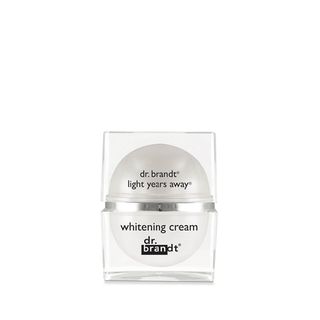
Dr. Brandt Light Years Away Whitening Cream
Works for
4 of 4 advertised claims delivered
Moisturizing21 ingredients credited for this claimStrong support
“Intense moisturizing whitening cream that targets and controls hyperpigmentation, promoting a more even, uniform complexion.”
This product can help improve hydration of the skin with the two types of ingredients.
The first type is called “humectants”:
these ingredients help attract water.
When humectants are on the surface of the skin, they “pull in” the moisture from the outside environment, or from
within deeper layers of the skin. The following ingredients in this product do the job:
glycerin, sodium hyaluronate.
This product also contains ingredients called “occlusives”. They help reduce the speed with which our skin loses moisture to the outside environment. These ingredients also help soften the upper layer of the skin, so it feels less tight and nicer to the touch. The following ingredients in this product do the job: butyrospermum parkii butter, dimethicone.
The following ingredients in this product are especially good for supporting the skin barrier and helping with the hydration level: ceramide 3, panthenol
Anti-aging5 ingredients credited for this claimStrong support
“Improves the appearance of lines and wrinkles, leaving skin silky smooth.”
This product can help reduce and prevent fine lines and wrinkles, improve skin elasticity and firmness because it contains adenosine.
These ingredients in the product can also be helpful, even though there is less evidence for their effectiveness: ascorbyl glucoside, astaxanthin.
Keep in mind that it typically takes at least 6 weeks to notice any results because the changes that are needed to improve fine lines and elasticity happen in the deeper layers of the skin. No topical anti-aging product can “erase” wrinkles or fully reverse signs of aging.
Anti-oxidation8 ingredients credited for this claimStrong support
This product contains antioxidants (astaxanthin) that can help neutralize free radicals in skin. By doing so, they can lessen the damage the skin gets from the UV light (sun).
The following ingredients - ascorbyl glucoside also can have an antioxidant effect, but there is less evidence to confirm their effectiveness in skin.
Evens skin tone4 ingredients credited for this claimModerate support
“Intense moisturizing whitening cream that targets and controls hyperpigmentation, promoting a more even, uniform complexion.”
The following ingredient (ingredients) in this product might be helpful, but there is no evidence to confirm that it actually works: ascorbyl glucoside, glycyrrhiza glabra root extract.
Can it cause trouble?
Irritancy2 strong irritants: Lavandula angustifolia oil, Citrus aurantium amara peel oilMedium risk
Comedogenic1 ingredient rated 2 or more on the 0–5 pore-clogging scale1 flagged


User reviews
Be the first — your take helps the next person decide.
Ingredients
Filter by role to see what each ingredient is doing.
Water~40–60%
Butylene glycol~4.5–6.8%
- Irritation risk
- Low
Used to create a nice product texture and help delivery of other ingredients. Might be somewhat helpful in attracting water to the upper layer of the skin
More about Butylene glycolGlycerin~2.9–4.4%
- Irritation risk
- Low
One of the best moisturizing ingredients. Naturally present in skin. It attracts water to the upper layer of the skin working as a humectant
More about GlycerinMethylsilanol hydroxyproline aspartate~2.3–3.4%
- Irritation risk
- Low
An amino-acid. There is not strong evidence of a particular beneficial effect for skin in topical applications, beyond attracting water to the upper layer of the skin
More about Methylsilanol hydroxyproline aspartateAscorbyl glucoside~1.7–2.6%
- Irritation risk
- Medium
A vitamin C derivative that is more stable but less potent than pure form of vitamin C. Has a potential to boost collagen production, nutralise free radicals and reduce hyperpigmentation, but the required concentration is likely to be much higher than for the pure form of vitamin C, limiting the ingredient's effectiveness in products
More about Ascorbyl glucosideDimethicone~1.4–2.1%
- Irritation risk
- Low
A silicone that helps to reduce water loss from the surface of the skin. Can temporarily "fill in" lines and wrinkles, absorb oil, and create a nice product finish
More about DimethiconePentylene glycol~1–1.5%
- Irritation risk
- Medium
Used to preserve products, dissolve other ingredients and create a nice product texture
More about Pentylene glycolPanthenol~1.1–1.6%
- Irritation risk
- Low
Helps attract water to the upper layer of the skin and can help improve skin barrier function
More about PanthenolJojoba wax peg-120 esters~0.85–1.3%
Butyrospermum parkii butter~0.55–1.3%
- Irritation risk
- Low
- Comedogenicity
- 3/5
A great moisturising ingredient that softens the skin and reduces water loss from its upper layer. It also can be helpful in protecting skin from free radicals
More about Butyrospermum parkii butterCyclopentasiloxane~0.45–1%
- Irritation risk
- Low
A silicone that helps improve the product texture and spreadability. Can absorb oil creating a short-term mattifying effect on the skin
More about CyclopentasiloxaneDimethiconol~0.35–0.8%
- Irritation risk
- Low
A silicone that makes products more spreadable and keeps skin smooth. Helps to add gloss to skin and may visually fill in fine lines/wrinkles for short time
More about DimethiconolPhytosterols~0.2–0.8%
- Irritation risk
- Medium
Lipids that work as an emollient and can be helpful in repairing skin barrier function
More about PhytosterolsEthylhexyl methoxycinnamate~0.4–0.9%
- Irritation risk
- High
Octinoxate. When used in higher concentrations, works as a sunscreen protecting the skin from UVB rays. When used in lower concentration, helps to preserve the product formulation. Is shown to be harmful to coral reefs - consider avoiding bathing in coral reef areas when wearing a product with this ingredient. It can be irritating
More about Ethylhexyl methoxycinnamateSqualane~0.15–0.65%
- Irritation risk
- Low
An oil naturally present in skin. Works as an emollient to soften the skin and form a protective layer on its surface without a greasy feeling.
More about SqualanePeg-11 methyl ether dimethicone~0.15–0.6%
- Irritation risk
- Medium
Helps oil and water mix together
More about Peg-11 methyl ether dimethiconeCaprylyl glycol~0.15–0.6%
- Irritation risk
- Medium
Helps preserve products and creates a nice product texture
More about Caprylyl glycolAdenosine~0.1–0.45%
- Irritation risk
- Low
Might help improve cell turnover and reduce inflammation in skin. One study shows that the ingredients might be able to help reduce dynamic wrinkles (for example, in the corners of the eyes or on the forehead)
More about AdenosineAstaxanthin~0.1–0.4%
- Irritation risk
- Medium
Helps neutralize free radicals in skin and might help to calm down inflammation
More about AstaxanthinPhenoxyethanol~0.1–0.4%
- Irritation risk
- Low
A preservative. It helps prevent bacterial growth in cosmetic products
More about PhenoxyethanolPotassium hydroxide~0.1–0.35%
Sodium polyacrylate~0.1–0.4%
- Irritation risk
- Low
Used to create a gel-like product texture, as well as to stabilize emulsions
More about Sodium polyacrylateAcrylates/c10-30 alkyl acrylate crosspolymer~0.05–0.3%
- Irritation risk
- Medium
Maintains the texture of skincare products. Allows the product to spread evenly. Helps oil and water mix together
More about Acrylates/c10-30 alkyl acrylate crosspolymerXanthan gum~0.05–0.25%
- Irritation risk
- Low
Used to create a thicker product consistency
More about Xanthan gumDisodium edta~0.05–0.2%
Sodium bisulfite~0.1–0.2%
Lavandula angustifolia oil~0.05–0.2%
- Irritation risk
- High
An essential oil. Potential allergen and can be irritating. It has some anti-bacterial properties
More about Lavandula angustifolia oilSodium hyaluronate~0.05–0.2%
- Irritation risk
- Low
One of the best moisturizing ingredients. Attracts water into the upper layer of the skin
More about Sodium hyaluronateHalidrys siliquosa extract~0.05–0.2%
- Irritation risk
- Low
Extract from large brown algae that can help attract water to the upper layer of the skin
More about Halidrys siliquosa extractCamellia sinensis leaf extract~0.05–0.25%
- Irritation risk
- Low
Can contain potent anti-oxidant compounds (abbreviated ECG, GCG, EGC, and EGCG) that might help protect the skin from free radicals. Can help calm down inflammation and has some anti-bacterial properties. Unfortunately, these antioxidants are unstable and lose their effectiveness very quickly in products. The concentration of the antioxidant compounds in the extract also tends to be low to be effective in topical formulation
More about Camellia sinensis leaf extractLonicera caprifolium flower extract~0.05–0.15%
- Irritation risk
- High
A plant extract that might help neutralize free radicals in skin. Can contain volalite oils and be irritating
More about Lonicera caprifolium flower extractAlteromonas ferment extract~0.05–0.2%
- Irritation risk
- Low
A marine extract that helps attract water to the upper layer of the skin. It is claimed to have anti-inflammatory properties but research is lacking
More about Alteromonas ferment extractHydroxyethylcellulose~0.05–0.25%
- Irritation risk
- Low
Used to thicken product formulations and create gel-like textures
More about HydroxyethylcelluloseLecithin~0.1–0.3%
- Irritation risk
- Low
Used mostly for creating emulsions - helping oil and water mix together. Helps soften the upper layer of the skin
More about LecithinSodium citrate~0.05–0.15%
- Irritation risk
- Medium
Helps to control the skin's pH level. Maintains the skin's natural film of amino-lactic acids and oils. Helps to preserve products
More about Sodium citrateCitric acid~0.05–0.15%
- Irritation risk
- Medium
Can work as an exfoliant but is typically used to adjust the product pH
More about Citric acidCitrus aurantium amara peel oil~0.05–0.2%
- Irritation risk
- High
Ceramide 3~0.05–0.3%
- Irritation risk
- Low
A type of lipid similar to ceramides naturally present in skin. Helps to soften the upper layer of the skin and supports the skin barrier function to keep it hydrated. Can help to prevent inflammation in skin
More about Ceramide 3Glycyrrhiza glabra root extract~0.05–0.2%
- Irritation risk
- Medium
A plant extract that can help lighten the skin and calm down inflammation. Might be helpful in neutralizing free radicals
More about Glycyrrhiza glabra root extractTocopheryl acetate~0.05–0.25%
- Irritation risk
- Medium
A more stable but less bio-available form of vitamin E compared to Tocopherol. Might help moisturize and protect the skin from free radicals, but mostly used in low concentrations to stabilize other ingredients.
More about Tocopheryl acetatePolymethyl methacrylate~0.05–0.25%
- Irritation risk
- Low
Is used to enhance product texture and can help to optically mask skin imperfections
More about Polymethyl methacrylateZizyphus jujuba fruit extract~0.05–0.1%
- Irritation risk
- Low
Hydrolyzed pea protein~0.05–0.25%
- Irritation risk
- Low
Olea europaea fruit oil~0.05–0.2%
- Irritation risk
- Medium
An emollient that helps soften the skin but is not effective for restoring its barrier function. Might be helpful to calm down inflammation
More about Olea europaea fruit oilPvm/ma copolymer~0.01–0.1%
- Irritation risk
- Low
Dipotassium glycyrrhizate~0.01–0.05%
- Irritation risk
- Low
A salt derived from licorice. Works as an emollient to soften the upper layer of the skin and can help calm down inflammation. Might be helpful for skin lightening
More about Dipotassium glycyrrhizateIngredient list view
Water, Butylene glycol, Glycerin, Methylsilanol hydroxyproline aspartate, Ascorbyl glucoside, Dimethicone, Pentylene glycol, Panthenol, Jojoba wax peg-120 esters, Butyrospermum parkii butter, Cyclopentasiloxane, Dimethiconol, Phytosterols, Ethylhexyl methoxycinnamate, Squalane, Peg-11 methyl ether dimethicone, Caprylyl glycol, Adenosine, Astaxanthin, Phenoxyethanol, Potassium hydroxide, Sodium polyacrylate, Acrylates/c10-30 alkyl acrylate crosspolymer, Xanthan gum, Disodium edta, Sodium bisulfite, Lavandula angustifolia oil, Sodium hyaluronate, Halidrys siliquosa extract, Camellia sinensis leaf extract, Lonicera caprifolium flower extract, Alteromonas ferment extract, Hydroxyethylcellulose, Lecithin, Sodium citrate, Citric acid, Citrus aurantium amara peel oil, Ceramide 3, Glycyrrhiza glabra root extract, Tocopheryl acetate, Polymethyl methacrylate, Unknown, Zizyphus jujuba fruit extract, Hydrolyzed pea protein, Olea europaea fruit oil, Pvm/ma copolymer, Dipotassium glycyrrhizate
Compare prices
Retailers ranked by price — lowest first.

Affiliate links · prices updated regularly
Worth comparing, line by line.
Match % combines shared ingredients, the first five ingredients, shared actives and hero ingredients, irritancy (lower counts in the alternative's favour), texture and body area. Only products in the same routine step are compared.
| Dr. BrandtLight Years Away Whitening CreamYOUR PRODUCT | Serendi BeautyLa-bloom Vital Repair Cream | MILKYDRESSWrinkle & Whitening Eye Cream | MEDI-PEELDeep VC Ultra Cream | |
|---|---|---|---|---|
| Match | — | 54% | 53% | 53% |
| Price | $79.99 | $74.42−$5.57 | $6.90−$73.09 | $24.85−$55.14 |
| Shared key ingredients | — | 7 of 17 | 9 of 17 | 9 of 17 |
| Key difference | — | Oligopeptide-1 | Niacinamide | Niacinamide |
| Irritancy | Medium | Medium | Medium | Medium |
| Drying alcohol | — | — | — | — |
| View product | Shop | Shop | Shop |

Product summary
"Dr. Brandt - Light Years Away Whitening Cream" is a well-rounded moisturizing product. The formulation is based on a combination of good humectants and emollients. Both are needed to increase the skin hydration level. Panthenol, glycerin, sodium hyaluronate, butylene glycol and caprylyl glycol in this product (humectants) attract water molecules to the upper layer of the skin (the water comes from the outside air or from the deeper layers of the skin if the air is dry). Phytosterols, dimethicone, dimethiconol, squalane and cyclopentasiloxane in this product help decrease the water evoporation from the skin, so that it stays hydrated for longer. These ingredients also soften the skin and take away the feeling of tightness and dryness.
Ingredient callouts
- Another benefit is that this moisturizer contain ceramides (ceramide 3 0.05% - 0.25%). Ceramides are an important part of our natural skin barrier. The Ceramides used in skincare are synthetic or come from plants. They help soften the skin and can help "fill the gaps" in the skin barrier, keeping the skin hydrated and resilient for longer.
- Adenosine 0.10% - 0.45%. It is a compound that in involved in many biological processes inside the skin cells. According one high-quality clinical trial, topical Adenosine in low concentrations can somewhat help improve "deep wrinkles" - the wrinkles that appear with age in places where our faces are most dynamic (for example, on the forehead or in the corners of the eyes).
- Panthenol (pro-vitamin B5) at about 1.10% - 1.60% concentration. In this concentration, Panthenol works effectively to improve the skin barrier and reduce inflammation.
Irritation risk
This moisturizer contains some common irritants, including those without a benefit for the skin. We assess the overall irritancy of this moisturizer to be medium. For a detailed overview of all potential irritants: click here
You can see the detailed formula review with the breakdown of all actives in the product and the full ingredient list with estimated concentrations in the tables below.
Price
The product retails from 39.00$ up to 110.00$ in the United States, for 132.94A$ in Australia, for 99.97£ in the United Kingdom and for 138.60CA$ in Canada.
For a detailed price comparison: click here.
Sources cited in this review
Every concentration estimate and effectiveness label is anchored to one of these 18 studies and safety reviews.
- 1
- 2The Roles of Vitamin C in Skin Healthncbi.nlm.nih.gov
- 3
- 4
- 5Final Report on the Safety Assessment of Dimethicone Copolyoljournals.sagepub.com
- 6Skin moisturizing effects of panthenol-based formulationspdfs.semanticscholar.org

Affiliate links · As an Amazon Associate, WIMJ earns from qualifying purchases.