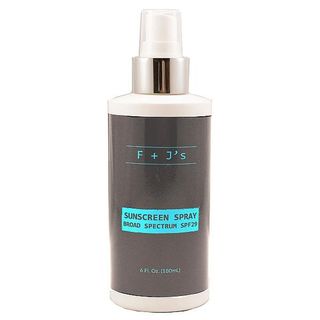
Thalgo F + J's SPF 29 Sunscreen Spray - a Dual Protection Product
Works for
0 of 1 advertised claim delivered
Sun protectionSPF 29 · 3 UV filters · Partial spectrumWeak protectionSPF under 30
This product does not offer good protection against UVA rays.
MoisturizingNot advertised by the brand · 4 ingredients credited for this claimGood support
This product can help soften the skin and reduce its moisture loss with emollients and occlusives: copernicia cerifera wax, dimethicone.
Keep in mind that this product does not contain effective ingredients to attract water to the upper layer of the skin. This is why an additional product with humectants like glycerin or hyaluronic acid can be helpful (apply it before this product for the best results).
Can it cause trouble?
Irritancy2 strong irritants: Benzophenone-3, MethylisothiazolinoneMedium risk
Comedogenic2 ingredients rated 2 or more on the 0–5 pore-clogging scale2 flagged
User reviews
Be the first — your take helps the next person decide.
Ingredients
Filter by role to see what each ingredient is doing.
Water~45–55%
Dimethicone~7.2–8.8%
- Irritation risk
- Low
A silicone that helps to reduce water loss from the surface of the skin. Can temporarily "fill in" lines and wrinkles, absorb oil, and create a nice product finish
More about DimethiconeEthylhexyl methoxycinnamate~5.5–6.7%
- Irritation risk
- High
Octinoxate. When used in higher concentrations, works as a sunscreen protecting the skin from UVB rays. When used in lower concentration, helps to preserve the product formulation. Is shown to be harmful to coral reefs - consider avoiding bathing in coral reef areas when wearing a product with this ingredient. It can be irritating
More about Ethylhexyl methoxycinnamateSynthetic beeswax~3.7–4.5%
- Irritation risk
- Low
Helps soften the upper layer of the skin
More about Synthetic beeswaxTitanium dioxide~3.7–4.5%
- Irritation risk
- Low
Works as a UV filter when used in high concentrations. It is photostable and is effective mostly against the UVB light, with some protection in the UVA range. In small concentrations, used for its ability to improve the color of cosmetic products. Is usually well tolerated by the skin
More about Titanium dioxideBenzophenone-3~2.9–3.6%
- Irritation risk
- High
Same as oxybenzone. Protects in the UVB and short UVA range. In small concentrations, used to stabilize product formulation. Can be irritating. Is shown to be harmful to coral reefs - consider avoiding bathing in coral reef areas when wearing a product with this ingredient. It can penetrate the skin and get absorbed into bloodstream faster than other popular filters available in the US. The study that produced this finding did not address any potential health effects of the absorption
More about Benzophenone-3Dimethiconol~2–2.5%
- Irritation risk
- Low
A silicone that makes products more spreadable and keeps skin smooth. Helps to add gloss to skin and may visually fill in fine lines/wrinkles for short time
More about DimethiconolCopernicia cerifera wax~1.8–2.2%
- Irritation risk
- Low
Helps to soften the upper layer of the skin and create a nice product consistency
More about Copernicia cerifera waxAlumina~1.6–2%
- Irritation risk
- Low
The same compound that is used safely in dental implants and bone cements. In cosmetics, it is used to improve the consistency of products
More about AluminaSorbitan tristearate~1.1–1.3%
- Irritation risk
- Medium
Helps oil and water mix together
More about Sorbitan tristearatePeg-100 stearate~0.95–1.15%
- Irritation risk
- Low
Helps oil and water mix togehter and creates a nice product texture
More about Peg-100 stearateSteareth-100~0.65–1%
Peg-20~0.6–0.9%
- Irritation risk
- Low
Bis-peg-12 dimethicone beeswax~0.55–0.8%
- Irritation risk
- Low
Laureth-23~0.6–0.9%
- Irritation risk
- Medium
- Comedogenicity
- 2/5
Helps oil and water mix together
More about Laureth-23Silica~0.65–1%
Laureth-4~0.45–0.7%
- Irritation risk
- Medium
- Comedogenicity
- 2/5
Helps water and oil mix together
More about Laureth-4Sodium silicate~0.35–0.65%
- Irritation risk
- Low
Vp/eicosene copolymer~0.35–0.6%
- Irritation risk
- Medium
Used to improve the product adherence to the skin, for example, to pro-long the protective effect of sunscreens. Can be irritating to very sensitive skin
More about Vp/eicosene copolymerSodium polyacrylate~0.4–0.6%
- Irritation risk
- Low
Used to create a gel-like product texture, as well as to stabilize emulsions
More about Sodium polyacrylateTriethanolamine~0.3–0.55%
- Irritation risk
- Medium
Used to adjust pH of the product and can help improve the product's smell
More about TriethanolamineDisodium edta~0.25–0.45%
Methylisothiazolinone~0.00075–0.0015%
Polyaminopropyl biguanide~0.15–0.3%
- Irritation risk
- High
A preservative. There seem to be an increasing number of cases of allergic reactions to it
More about Polyaminopropyl biguanidePhenoxyethanol~0.2–0.35%
- Irritation risk
- Low
A preservative. It helps prevent bacterial growth in cosmetic products
More about PhenoxyethanolEthylhexylglycerin~0.15–0.25%
Ingredient list view
Water, Dimethicone, Ethylhexyl methoxycinnamate, Synthetic beeswax, Titanium dioxide, Benzophenone-3, Dimethiconol, Copernicia cerifera wax, Alumina, Sorbitan tristearate, Peg-100 stearate, Steareth-100, Peg-20, Bis-peg-12 dimethicone beeswax, Laureth-23, Silica, Laureth-4, Sodium silicate, Vp/eicosene copolymer, Sodium polyacrylate, Triethanolamine, Disodium edta, Methylisothiazolinone, Polyaminopropyl biguanide, Phenoxyethanol, Ethylhexylglycerin
Compare prices
Retailers ranked by price — lowest first.
Product summary
We do not recommend "Thalgo - F + J's SPF 29 Sunscreen Spray - a Dual Protection Product" because it does not provide good UVA protection. UVA sun rays don't burn the skin, but they still lead to photoaging and hyperpigmentation.
Its formula is also hydrating, so you might not need an additional moistruizer during the day.
Sunscreen filters
This sunscreen uses a mixture of both mineral and organic (so-called "chemical") UV filters. The organic filters in the product are: oxybenzone and octinoxate. As for the mineral filters, this sunscreen uses titanium dioxide.
Irritation risk
This sunscreen contains some common irritants, including those without a benefit for the skin. We assess the overall irritancy of this product to be medium. For a detailed overview of all potential irritants: click here
You can see the detailed formula review with the breakdown of all actives in the product and the full ingredient list with estimated concentrations in the tables below.
Sources cited in this review
Every concentration estimate and effectiveness label is anchored to one of these 11 studies and safety reviews.
- 1
- 2Final Report on the Safety Assessment of Dimethicone Copolyoljournals.sagepub.com
- 3
- 4
- 5On Photostability of Oxybenzonecore.ac.uk
- 6

Affiliate links · As an Amazon Associate, WIMJ earns from qualifying purchases.