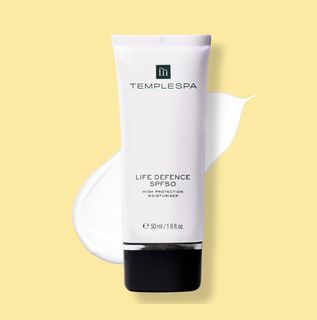
TEMPLESPA LIFE DEFENCE SPF50
Works for
2 of 2 advertised claims delivered
Sun protectionSPF 50 · 5 UV filtersBroad spectrum
This product offers a good level of protection against both UVB and UVA rays.
This sunscreen uses organic (so-called "chemical") sunscreen filters. Organic, or "chemical" filters usually provide reliable sun protection and rarely leave a white cast. Sunscreens with organic filters can sting eyes.
Moisturizing10 ingredients credited for this claimGood support
“A feather-light moisturiser provides an environmental skin filter for your face while remaining virtually undetectable with or without make-up, for a bright dewy complexion.”
This product can help improve hydration of the skin with the two types of ingredients.
The first type is called “humectants”:
these ingredients help attract water.
When humectants are on the surface of the skin, they “pull in” the moisture from the outside environment, or from
within deeper layers of the skin. The following ingredients in this product do the job:
fructose, glycerin.
This product also contains ingredients called “occlusives”. They help reduce the speed with which our skin loses moisture to the outside environment. These ingredients also help soften the upper layer of the skin, so it feels less tight and nicer to the touch. The following ingredients in this product do the job: dimethicone, cetearyl alcohol.
Anti-agingNot advertised by the brand · 1 ingredient credited for this claimStrong support
This product can help prevent early signs of skin aging because it offers a good level of broad spectrum sun protection. Sun damage is the main cause of premature skin aging, and protecting your skin from the sun is the best anti-aging strategy.
Evens skin toneNot advertised by the brand · No ingredient credited for this claimStrong support
This product offers broad spectrum sun protection. It means that it can prevent hyperpigmentation and help keep the skin tone even (sun damage is the main factor causing age spots, darkening of post-acne marks and other discolorations).
Can it cause trouble?
Irritancy8 strong irritants: Parfum, Withania somnifera root extract + 6 more — patch-test recommendedHigh risk
Comedogenic2 ingredients rated 2 or more on the 0–5 pore-clogging scale2 flagged
User reviews
Be the first — your take helps the next person decide.
Ingredients
Filter by role to see what each ingredient is doing.
Water~45–55%
Ethylhexyl salicylate~4.9–6%
- Irritation risk
- Low
Octisalate. A UV filter. It offers some protection against the sun rays that cause sunburn (UVB), but does not protect against the most aging sun rays (UVA). It loses its effectiveness quickly when exposed to sunlight. It is an organic, or so called "chemical" sunscreen
More about Ethylhexyl salicylateButyloctyl salicylate~4.4–5.3%
- Irritation risk
- Medium
A synthetic ester of salicylic acid that is used to help disperse pigments and boost effectiveness of sunscreen ingredients. It is able to absorb UV light (working as an organic, or chemical filter), but is not approved as a sunscreen ingredient on its own
More about Butyloctyl salicylateEthylhexyl methoxycinnamate~3.6–4.4%
- Irritation risk
- High
Octinoxate. When used in higher concentrations, works as a sunscreen protecting the skin from UVB rays. When used in lower concentration, helps to preserve the product formulation. Is shown to be harmful to coral reefs - consider avoiding bathing in coral reef areas when wearing a product with this ingredient. It can be irritating
More about Ethylhexyl methoxycinnamateOctocrylene~3.2–3.9%
- Irritation risk
- Medium
A weak sunscreen that protects against the sun rays that cause sunburn (UVB) and is somewhat effective against the UVA rays. It is quite stable and can help stabilize other, more vulnerable, sunscreen ingredients like Avobenzone. It is an organic, or so called "chemical" sunscreen
More about OctocryleneButyl methoxydibenzoylmethane~2.5–3%
- Irritation risk
- Medium
Avobenzone. An organic, or so-called "chemical" UV filter. Protects against both UVA and UVB rays. Needs to be combined with other filters in a formulation to be stable.
More about Butyl methoxydibenzoylmethanePolysilicone-11~1.7–2%
- Irritation risk
- Low
A silicone that forms a light film on the skin surface helping to bind water and temporarily absorb oils creating a matt and powdery feel
More about Polysilicone-11Tribehenin peg-20 esters~1.5–1.8%
- Irritation risk
- Medium
Helps oil and water mix together
More about Tribehenin peg-20 estersPolymethylsilsesquioxane~1.2–1.5%
- Irritation risk
- Low
A silicone that improves product texture and helps dissolve other ingredients. Can form a non-greasy film on the skin to prevent moisture loss
More about PolymethylsilsesquioxaneGlycerin~1–1.2%
- Irritation risk
- Low
One of the best moisturizing ingredients. Naturally present in skin. It attracts water to the upper layer of the skin working as a humectant
More about GlycerinHdi/trimethylol hexyllactone crosspolymer~0.7–1%
- Irritation risk
- Low
Used to create a silky product texture and add volume to products
More about Hdi/trimethylol hexyllactone crosspolymerBis-stearyl dimethicone~0.65–0.95%
- Irritation risk
- Low
Cetearyl alcohol~0.6–0.9%
- Irritation risk
- Low
- Comedogenicity
- 2/5
A non-drying alcohol. Works as an emollient. Helps water and oil mix together and creates a nice product texture
More about Cetearyl alcoholCetearyl glucoside~0.45–0.7%
- Irritation risk
- Medium
Helps water and oil in the product mix well together and improves product texture
More about Cetearyl glucosideGlyceryl behenate~0.45–0.7%
- Irritation risk
- Medium
Used to create a thicker product consistency and help soften the upper layer of the skin
More about Glyceryl behenateMagnesium aluminum silicate~0.45–0.65%
- Irritation risk
- Low
Might be helpful in restoring skin barrier function and, when combined with zinc carbonate and malonic acid, reducing fine lines and wrinkles by stimulating elastin production. Also helps stabilize the product formulation
More about Magnesium aluminum silicateDimethicone~0.45–0.7%
- Irritation risk
- Low
A silicone that helps to reduce water loss from the surface of the skin. Can temporarily "fill in" lines and wrinkles, absorb oil, and create a nice product finish
More about DimethiconeSodium lauryl glucose carboxylate~0.45–0.7%
- Irritation risk
- Medium
Helps water and oil mix together and works as a cleansing agent
More about Sodium lauryl glucose carboxylateHydroxyacetophenone~0.3–0.55%
Fructose~0.3–0.5%
- Irritation risk
- Low
Helps attract water to the upper layer of the skin
More about FructoseLauryl glucoside~0.35–0.65%
Cetearyl isononanoate~0.25–0.5%
- Irritation risk
- Low
An emollient that softens the skin and helps prevent moisture loss.
More about Cetearyl isononanoateTocopheryl acetate~0.25–0.45%
- Irritation risk
- Medium
A more stable but less bio-available form of vitamin E compared to Tocopherol. Might help moisturize and protect the skin from free radicals, but mostly used in low concentrations to stabilize other ingredients.
More about Tocopheryl acetateXanthan gum~0.25–0.45%
- Irritation risk
- Low
Used to create a thicker product consistency
More about Xanthan gumParfum~0.2–0.4%
- Irritation risk
- High
An aromatic blend of unspecified and possibly irritating ingredients
More about ParfumCaprylyl glycol~0.25–0.5%
- Irritation risk
- Medium
Helps preserve products and creates a nice product texture
More about Caprylyl glycol1,2-hexanediol~0.25–0.45%
Ceteareth-20~0.3–0.6%
- Irritation risk
- Medium
- Comedogenicity
- 2/5
Helps oil and water mix together. Has some emollient properties
More about Ceteareth-20Bht~0.25–0.45%
Disodium edta~0.25–0.45%
Sodium citrate~0.25–0.45%
- Irritation risk
- Medium
Helps to control the skin's pH level. Maintains the skin's natural film of amino-lactic acids and oils. Helps to preserve products
More about Sodium citrateWithania somnifera root extract~0.2–0.4%
- Irritation risk
- High
Glyceryl stearate~0.3–0.55%
- Irritation risk
- Low
An emollient that softens the skin and forms a protective layer on its surface. Helps water and oil mix together
More about Glyceryl stearateEthylhexylglycerin~0.25–0.45%
Laureth-12~0.25–0.45%
Sorbic acid~0.25–0.45%
Ceteareth-12~0.25–0.45%
Cetyl palmitate~0.25–0.5%
- Irritation risk
- Low
An emollient that helps soften the skin and is used to improve product texture and stability
More about Cetyl palmitateBenzoic acid~0.25–0.45%
Sodium hyaluronate~0.25–0.45%
- Irritation risk
- Low
One of the best moisturizing ingredients. Attracts water into the upper layer of the skin
More about Sodium hyaluronateHydrolyzed eruca sativa leaf~0.3–0.5%
- Irritation risk
- Low
Potassium sorbate~0.25–0.45%
Citric acid~0.25–0.45%
- Irritation risk
- Medium
Can work as an exfoliant but is typically used to adjust the product pH
More about Citric acidSodium benzoate~0.25–0.45%
Alpha-isomethyl ionone~0.2–0.35%
- Irritation risk
- High
A fragrance. Potential allergen and can be irritating
More about Alpha-isomethyl iononeBenzyl salicylate~0.2–0.35%
Citronellol~0.2–0.35%
Hexyl cinnamal~0.15–0.3%
Limonene~0.15–0.3%
- Irritation risk
- High
A common frangrance that can easily irritate skin, especially if exposed to air, light or heat
More about LimoneneLinalool~0.15–0.25%
Hexamethylindanopyran~0.15–0.25%
- Irritation risk
- Low
Tetramethyl acetyloctahydronaphthalenes~0.15–0.25%
- Irritation risk
- Low
Linalyl acetate~0.1–0.15%
- Irritation risk
- Low
Citrus aurantium peel oil~0.05–0.15%
- Irritation risk
- Low
Ingredient list view
Water, Ethylhexyl salicylate, Butyloctyl salicylate, Ethylhexyl methoxycinnamate, Octocrylene, Butyl methoxydibenzoylmethane, Polysilicone-11, Tribehenin peg-20 esters, Polymethylsilsesquioxane, Glycerin, Hdi/trimethylol hexyllactone crosspolymer, Bis-stearyl dimethicone, Cetearyl alcohol, Cetearyl glucoside, Glyceryl behenate, Magnesium aluminum silicate, Dimethicone, Sodium lauryl glucose carboxylate, Hydroxyacetophenone, Fructose, Lauryl glucoside, Cetearyl isononanoate, Tocopheryl acetate, Xanthan gum, Parfum, Caprylyl glycol, 1,2-hexanediol, Ceteareth-20, Bht, Disodium edta, Sodium citrate, Withania somnifera root extract, Glyceryl stearate, Ethylhexylglycerin, Laureth-12, Sorbic acid, Ceteareth-12, Cetyl palmitate, Benzoic acid, Sodium hyaluronate, Hydrolyzed eruca sativa leaf, Potassium sorbate, Citric acid, Sodium benzoate, Alpha-isomethyl ionone, Benzyl salicylate, Citronellol, Hexyl cinnamal, Limonene, Linalool, Hexamethylindanopyran, Tetramethyl acetyloctahydronaphthalenes, Linalyl acetate, Citrus aurantium peel oil
Compare prices
Retailers ranked by price — lowest first.

Affiliate links · prices updated regularly
Sources cited in this review
Every concentration estimate and effectiveness label is anchored to one of these 10 studies and safety reviews.
- 1
- 2
- 3
- 4
- 5
- 6

Affiliate links · As an Amazon Associate, WIMJ earns from qualifying purchases.