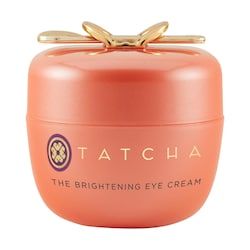
Tatcha The Brightening Eye Cream with Vitamin-C for Dark Circles
Works for
2 of 2 advertised claims delivered
Evens skin toneFerulic acid, Stearyl glycyrrhetinate + 4 moreModerate evidence
“The Brightening Eye Cream with Vitamin-C for Dark Circles”
The following ingredient (ingredients) in this product might be helpful, but there is no evidence to confirm that it actually works: ascorbyl glucoside, ferulic acid, prunus mume fruit extract, stearyl glycyrrhetinate.
MoisturizingBacillus ferment, Saccharomyces cerevisiae extract + 18 moreGood evidence
“- Encapsulated Niacinamide and Pro-Glutathione Antioxidant Booster: Target hyperpigmentation and improve the skin barrier.”
This product can help improve hydration of the skin with the two types of ingredients.
The first type is called “humectants”:
these ingredients help attract water.
When humectants are on the surface of the skin, they “pull in” the moisture from the outside environment, or from
within deeper layers of the skin. The following ingredients in this product do the job:
glycerin, saccharomyces cerevisiae extract.
This product also contains ingredients called “occlusives”. They help reduce the speed with which our skin loses moisture to the outside environment. These ingredients also help soften the upper layer of the skin, so it feels less tight and nicer to the touch. The following ingredients in this product do the job: squalane, behenyl alcohol.
Anti-oxidationNot advertised by the brand · Ferulic acid, Ascorbyl glucoside + 5 moreStrong evidence
This product contains antioxidants (ferulic acid) that can help neutralize free radicals in skin. By doing so, they can lessen the damage the skin gets from the UV light (sun).
The following ingredients - ascorbyl glucoside, camellia sinensis leaf extract also can have an antioxidant effect, but there is less evidence to confirm their effectiveness in skin.
Anti-agingNot advertised by the brand · Ascorbyl glucoside, Ferulic acid + 3 moreModerate evidence
This product contains ascorbyl glucoside, ferulic acid. These ingredients might be able to help reduce and prevent fine lines and wrinkles, improve skin elasticity and firmness, but there is not enough evidence that it actually works.
Can it cause trouble?
Irritancy12 flagged ingredientsMedium risk
Comedogenic1 ingredient rated 2 or more on the 0–5 pore-clogging scale1 flagged

User reviews
Be the first — your take helps the next person decide.
Ingredients
Filter by role to see what each ingredient is doing.
Water~45–55%
Squalane~4.5–5.5%
- Irritation risk
- Low
An oil naturally present in skin. Works as an emollient to soften the skin and form a protective layer on its surface without a greasy feeling.
More about SqualaneSaccharomyces/rice ferment filtrate~4.2–5.1%
- Irritation risk
- Low
A product of yeast fermentation. Can contain humectants that help attract water to the upper layer of the skin and might help neutralize free oxidants
More about Saccharomyces/rice ferment filtrateHydrogenated rice bran oil~3.3–4%
- Irritation risk
- Low
Glycerin~2.6–3.1%
- Irritation risk
- Low
One of the best moisturizing ingredients. Naturally present in skin. It attracts water to the upper layer of the skin working as a humectant
More about GlycerinC15-19 alkane~2.1–2.5%
- Irritation risk
- Low
Helps soften the upper layer of the skin and create a nice product texture
More about C15-19 alkanePropanediol~1.8–2.2%
- Irritation risk
- Low
Acts as a solvent for other ingredients. Speeds up the absorption of other ingredients into the skin
More about PropanediolBehenic acid~1.7–2.1%
Ascorbyl glucoside~1.4–1.7%
- Irritation risk
- Medium
A vitamin C derivative that is more stable but less potent than pure form of vitamin C. Has a potential to boost collagen production, nutralise free radicals and reduce hyperpigmentation, but the required concentration is likely to be much higher than for the pure form of vitamin C, limiting the ingredient's effectiveness in products
More about Ascorbyl glucosideButylene glycol~1.1–1.4%
- Irritation risk
- Low
Used to create a nice product texture and help delivery of other ingredients. Might be somewhat helpful in attracting water to the upper layer of the skin
More about Butylene glycolBehenyl alcohol~1–1.2%
- Irritation risk
- Low
Non-drying alcohol that helps water and oil mix together. Also serves as an emollient
More about Behenyl alcoholDipentaerythrityl hexahydroxystearate~0.75–1.1%
Glyceryl stearate se~0.7–1.05%
- Irritation risk
- Low
- Comedogenicity
- 2/5
Used to stabilize the product formulations and works as an emollient
More about Glyceryl stearate seGlyceryl stearate~0.7–1.05%
- Irritation risk
- Low
An emollient that softens the skin and forms a protective layer on its surface. Helps water and oil mix together
More about Glyceryl stearateBeheneth-20~0.65–0.95%
Dimer dilinoleyl dimer dilinoleate~0.65–0.95%
- Irritation risk
- Low
Helps create a nice product texture and soften the upper layer of the skin
More about Dimer dilinoleyl dimer dilinoleateCamellia sinensis leaf extract~0.6–0.95%
- Irritation risk
- Low
Can contain potent anti-oxidant compounds (abbreviated ECG, GCG, EGC, and EGCG) that might help protect the skin from free radicals. Can help calm down inflammation and has some anti-bacterial properties. Unfortunately, these antioxidants are unstable and lose their effectiveness very quickly in products. The concentration of the antioxidant compounds in the extract also tends to be low to be effective in topical formulation
More about Camellia sinensis leaf extractCladosiphon okamuranus extract~0.55–0.85%
- Irritation risk
- Low
Angelica acutiloba root extract~0.5–0.75%
- Irritation risk
- Low
Prunus mume fruit extract~0.5–0.75%
- Irritation risk
- Low
A plant extract that might have an anti-oxidant effect and help even out skin tone, but solid evidence of effectiveness is lacking
More about Prunus mume fruit extractNiacinamide~0.45–0.7%
- Irritation risk
- Low
Is proven to be effective in reducing blemishes, evening out skin tone and helping to improve lines and wrinkles. It helps the skin to repair sun damage, calm down inflammation and keep maintain good levels of moisture. The concentration of about 2% is effective for supporting the skin barrier and evening out the skin tone. Concentration of 4-6% is better for helping with acne and balancing the sebum production
More about NiacinamideSodium hyaluronate~0.45–0.7%
- Irritation risk
- Low
One of the best moisturizing ingredients. Attracts water into the upper layer of the skin
More about Sodium hyaluronateFerulic acid~0.45–0.65%
- Irritation risk
- Low
A potent anti-oxidant that has been shown to be effective in neutralizing free radicals in skin. There seem to have a synergetic effect of ferulic acid, vitamin E and C, meaning that when the ingredients are used together, they enhance each other's ability protect the skin against free radicals. Ferulic acid also helps to stabilize other ingredients - including vitamins C and E. It can help to even out the skin tone. Ferulic acid is approved for use as a sunscreen ingredient in Japan in concentrations up to 10%
More about Ferulic acidSaccharomyces cerevisiae extract~0.45–0.65%
- Irritation risk
- Medium
A moisturizing ingredient that works as a humectant to attract water to the upper layer of the skin.
More about Saccharomyces cerevisiae extractBacillus ferment~0.45–0.65%
- Irritation risk
- Low
A product of bacterial fermentation. Can help attract water to the upper layer of the skin
More about Bacillus fermentLecithin~0.5–0.75%
- Irritation risk
- Low
Used mostly for creating emulsions - helping oil and water mix together. Helps soften the upper layer of the skin
More about LecithinSynthetic fluorphlogopite~0.45–0.7%
- Irritation risk
- Low
A mineral that is used as an optical filter (makes the skin looks nicer through light reflection) and to improve the texture of cosmetic products
More about Synthetic fluorphlogopiteLysolecithin~0.45–0.7%
- Irritation risk
- Low
Lecithin derivative. It helps oil and water mix together and can enhance penetration of other ingredients. It helps soften the upper layer of the skin
More about LysolecithinSodium stearoyl glutamate~0.5–0.75%
- Irritation risk
- Medium
Helps oil and water mix together
More about Sodium stearoyl glutamateLysine carboxymethyl cysteinate~0.45–0.65%
- Irritation risk
- Low
Xanthan gum~0.45–0.7%
- Irritation risk
- Low
Used to create a thicker product consistency
More about Xanthan gumStearyl glycyrrhetinate~0.45–0.65%
- Irritation risk
- Medium
A fatty acid derived from licorice. Works as an emollient and can help calm down inflammation
More about Stearyl glycyrrhetinateCaprylyl glycol~0.45–0.7%
- Irritation risk
- Medium
Helps preserve products and creates a nice product texture
More about Caprylyl glycol1,2-hexanediol~0.45–0.65%
Caprylhydroxamic acid~0.4–0.6%
Tocopheryl acetate~0.4–0.65%
- Irritation risk
- Medium
A more stable but less bio-available form of vitamin E compared to Tocopherol. Might help moisturize and protect the skin from free radicals, but mostly used in low concentrations to stabilize other ingredients.
More about Tocopheryl acetateGlyceryl caprylate~0.45–0.7%
- Irritation risk
- Low
An emollient that can also help water and oil mix together, as well as prevent bacteria growth in products
More about Glyceryl caprylateTocopherol~0.35–0.6%
- Irritation risk
- Low
Pure form of vitamin E. Can help moisturise and protect the skin from free radicals. Often used to help stabilise other ingredients or the formula itself
More about TocopherolPotassium hydroxide~0.3–0.6%
Phytic acid~0.3–0.55%
- Irritation risk
- Medium
An alpha-hydroxy acid (AHA), but is mostly used to stabilize product formulations in cosmetics
More about Phytic acidSilica~0.45–0.65%
Ethylhexylglycerin~0.2–0.4%
Phenoxyethanol~0.15–0.3%
- Irritation risk
- Low
A preservative. It helps prevent bacterial growth in cosmetic products
More about PhenoxyethanolTin oxide~0.3–0.55%
- Irritation risk
- Low
A colorant that can add a pearl-like appearance to the formulation
More about Tin oxideTitanium dioxide~0.2–0.4%
- Irritation risk
- Low
Works as a UV filter when used in high concentrations. It is photostable and is effective mostly against the UVB light, with some protection in the UVA range. In small concentrations, used for its ability to improve the color of cosmetic products. Is usually well tolerated by the skin
More about Titanium dioxideCi 77491~0.15–0.25%
- Irritation risk
- Low
A red colorant made of iron oxide. Typically is not irritating
More about Ci 77491Ci 77492~0.15–0.25%
Ingredient list view
Water, Squalane, Saccharomyces/rice ferment filtrate, Hydrogenated rice bran oil, Glycerin, C15-19 alkane, Propanediol, Behenic acid, Ascorbyl glucoside, Butylene glycol, Behenyl alcohol, Dipentaerythrityl hexahydroxystearate, Glyceryl stearate se, Glyceryl stearate, Beheneth-20, Dimer dilinoleyl dimer dilinoleate, Camellia sinensis leaf extract, Cladosiphon okamuranus extract, Angelica acutiloba root extract, Prunus mume fruit extract, Niacinamide, Sodium hyaluronate, Ferulic acid, Saccharomyces cerevisiae extract, Bacillus ferment, Lecithin, Synthetic fluorphlogopite, Lysolecithin, Sodium stearoyl glutamate, Lysine carboxymethyl cysteinate, Xanthan gum, Stearyl glycyrrhetinate, Caprylyl glycol, 1,2-hexanediol, Caprylhydroxamic acid, Tocopheryl acetate, Glyceryl caprylate, Tocopherol, Potassium hydroxide, Phytic acid, Silica, Ethylhexylglycerin, Phenoxyethanol, Tin oxide, Titanium dioxide, Ci 77491, Ci 77492
Compare prices
Retailers ranked by price — lowest first.
Affiliate links · prices updated regularly · As an Amazon Associate, WIMJ earns from qualifying purchases.
Worth comparing, line by line.
Match % combines shared ingredients, the first five ingredients, shared actives and hero ingredients, irritancy (lower counts in the alternative's favour), texture and body area. Only products in the same routine step are compared.
| TatchaThe Brightening Eye Cream with Vitamin-C for Dark CirclesYOUR PRODUCT | La Roche-PosayPigmentclar Brightening Eye Cream | Community Sixty-SixHydrating Caffeine Eye Cream | PEACH & LILYPure Peach Retinoic Eye Cream | |
|---|---|---|---|---|
| Match | — | 86% | 82% | 80% |
| Price | $62.88 | $44.99−$17.89 | — | $43.00−$19.88 |
| Shared key ingredients | — | 4 of 12 | 4 of 12 | 5 of 12 |
| Key difference | — | Dimethicone | Retinol | Acetyl Octapeptide-3 |
| Irritancy | Medium | Low | Medium | Medium |
| Drying alcohol | — | — | — | — |
| View product | Shop | Shop | Shop |

Sources cited in this review
Every concentration estimate and effectiveness label is anchored to one of these 17 studies and safety reviews.
- 1
- 2The Roles of Vitamin C in Skin Healthncbi.nlm.nih.gov
- 3
- 4
- 5
- 6

Affiliate links · As an Amazon Associate, WIMJ earns from qualifying purchases.