Works for
1 of 2 advertised claims delivered
Moisturizing11 ingredients credited for this claimGood support
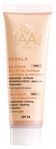
“Taaj Kerala BB Cream Safran Radiance 50ml , Colour Medium Tone 5-in-1 is a 5-in-1 SPF20 complexion enhancer, hydrating, unifying, radiance-boosting, soothing, protective that is suitable for all skin types.This BB cream targets uneven skin tone for flawless skin in a single step.”
This product can help improve hydration of the skin with the two types of ingredients.
The first type is called “humectants”:
these ingredients help attract water.
When humectants are on the surface of the skin, they “pull in” the moisture from the outside environment, or from
within deeper layers of the skin. The following ingredients in this product do the job:
glycerin, sodium hyaluronate.
This product also contains ingredients called “occlusives”. They help reduce the speed with which our skin loses moisture to the outside environment. These ingredients also help soften the upper layer of the skin, so it feels less tight and nicer to the touch. The following ingredients in this product do the job: caprylic/capric triglyceride, dimethicone.
Evens skin tone2 ingredients credited for this claimWeak support
“Taaj Kerala BB Cream Safran Radiance 50ml , Colour Medium Tone 5-in-1 is a 5-in-1 SPF20 complexion enhancer, hydrating, unifying, radiance-boosting, soothing, protective that is suitable for all skin types.This BB cream targets uneven skin tone for flawless skin in a single step.”
Effective ingredients missing or their concentration is too low
Can it cause trouble?
Irritancy9 strong irritants: Benzophenone-3, Imidazolidinyl urea + 7 more — patch-test recommendedHigh risk
Comedogenic3 ingredients rated 2 or more on the 0–5 pore-clogging scale3 flagged
User reviews
Be the first — your take helps the next person decide.
Ingredients
Filter by role to see what each ingredient is doing.
Water~45–55%
Cetearyl alcohol~4.9–6%
- Irritation risk
- Low
- Comedogenicity
- 2/5
A non-drying alcohol. Works as an emollient. Helps water and oil mix together and creates a nice product texture
More about Cetearyl alcoholCaprylic/capric triglyceride~4.5–5.5%
- Irritation risk
- Medium
A good mix of fatty acids that forms a protective layer on the skin. Improves the shelf life of products. Derived from coconut and glycerin
More about Caprylic/capric triglycerideEthylhexyl methoxycinnamate~3.6–4.4%
- Irritation risk
- High
Octinoxate. When used in higher concentrations, works as a sunscreen protecting the skin from UVB rays. When used in lower concentration, helps to preserve the product formulation. Is shown to be harmful to coral reefs - consider avoiding bathing in coral reef areas when wearing a product with this ingredient. It can be irritating
More about Ethylhexyl methoxycinnamateHelianthus annuus seed oil~2.4–3%
- Irritation risk
- Low
A great emollient due to its high linoleic acid content. One of the most effective plant oils in helping skin hydration and repairing skin barrier function
More about Helianthus annuus seed oilZinc oxide~2.8–3.5%
- Irritation risk
- Low
A broad spectrum sunblock (protects from both UVA and UVB rays). Is suitable for most sensitive skins. In small concentrations, can be used as a colorant
More about Zinc oxideTitanium dioxide~2.1–2.5%
- Irritation risk
- Low
Works as a UV filter when used in high concentrations. It is photostable and is effective mostly against the UVB light, with some protection in the UVA range. In small concentrations, used for its ability to improve the color of cosmetic products. Is usually well tolerated by the skin
More about Titanium dioxideGlycerin~1.5–1.8%
- Irritation risk
- Low
One of the best moisturizing ingredients. Naturally present in skin. It attracts water to the upper layer of the skin working as a humectant
More about GlycerinOctocrylene~1.6–1.9%
- Irritation risk
- Medium
A weak sunscreen that protects against the sun rays that cause sunburn (UVB) and is somewhat effective against the UVA rays. It is quite stable and can help stabilize other, more vulnerable, sunscreen ingredients like Avobenzone. It is an organic, or so called "chemical" sunscreen
More about OctocrylenePersea gratissima oil~1–1.2%
- Irritation risk
- Medium
An emollient that helps soften the skin and could be helpful in repairing its barrier function
More about Persea gratissima oilPropylene glycol~0.65–1%
- Irritation risk
- High
Helps oil and water mix together and can enhance the penetration of other ingredients into the skin. It can be irritating
More about Propylene glycolBenzophenone-3~0.8–1.2%
- Irritation risk
- High
Same as oxybenzone. Protects in the UVB and short UVA range. In small concentrations, used to stabilize product formulation. Can be irritating. Is shown to be harmful to coral reefs - consider avoiding bathing in coral reef areas when wearing a product with this ingredient. It can penetrate the skin and get absorbed into bloodstream faster than other popular filters available in the US. The study that produced this finding did not address any potential health effects of the absorption
More about Benzophenone-3Dimethicone~0.55–0.85%
- Irritation risk
- Low
A silicone that helps to reduce water loss from the surface of the skin. Can temporarily "fill in" lines and wrinkles, absorb oil, and create a nice product finish
More about DimethiconeEthylhexyl olivate~0.45–0.7%
- Irritation risk
- Low
Helps soften the upper layer of the skin
More about Ethylhexyl olivateOlive oil peg-7 esters~0.5–0.75%
- Irritation risk
- Medium
Helps oil and water mix together and works as a cleansing agent
More about Olive oil peg-7 estersPolysorbate 20~0.45–0.7%
Aloe barbadensis leaf juice~0.4–0.6%
- Irritation risk
- Medium
Traditionally used to treat sunburns, dermatitis and inflammation, but evidence for its effectiveness is lacking. The extract can contain humectants that help attract water into the skin
More about Aloe barbadensis leaf juiceBenzyl alcohol~0.3–0.55%
- Irritation risk
- High
A preservative. Can be used to mask unpleasant smell. Can be irritating
More about Benzyl alcoholButyl methoxydibenzoylmethane~0.5–0.8%
- Irritation risk
- Medium
Avobenzone. An organic, or so-called "chemical" UV filter. Protects against both UVA and UVB rays. Needs to be combined with other filters in a formulation to be stable.
More about Butyl methoxydibenzoylmethaneSodium hyaluronate~0.3–0.55%
- Irritation risk
- Low
One of the best moisturizing ingredients. Attracts water into the upper layer of the skin
More about Sodium hyaluronateXanthan gum~0.3–0.55%
- Irritation risk
- Low
Used to create a thicker product consistency
More about Xanthan gumZea mays starch~0.25–0.5%
- Irritation risk
- Medium
- Comedogenicity
- 3/5
Used to thicken the product's consistency
More about Zea mays starchCi 77491~0.25–0.45%
- Irritation risk
- Low
A red colorant made of iron oxide. Typically is not irritating
More about Ci 77491Iron oxides~0.25–0.4%
- Irritation risk
- Low
An umbrella term for the following three colorants: CI 77491, CI 77492, CI 77499. They might be able to offer some protection against visible light, but the degree of the protection is not clear
More about Iron oxidesCi 77492~0.25–0.45%
Iron oxides~0.25–0.4%
- Irritation risk
- Low
An umbrella term for the following three colorants: CI 77491, CI 77492, CI 77499. They might be able to offer some protection against visible light, but the degree of the protection is not clear
More about Iron oxidesCarbomer~0.25–0.45%
- Irritation risk
- Low
Helps create a thicker or gel-like product texture. It is not a surfactant but can be used in gentle cleansing formulations
More about CarbomerCeteareth-20~0.35–0.6%
- Irritation risk
- Medium
- Comedogenicity
- 2/5
Helps oil and water mix together. Has some emollient properties
More about Ceteareth-20Imidazolidinyl urea~0.25–0.45%
- Irritation risk
- High
A preservative. Is more irritating than many other preservatives available
More about Imidazolidinyl ureaTocopheryl acetate~0.25–0.5%
- Irritation risk
- Medium
A more stable but less bio-available form of vitamin E compared to Tocopherol. Might help moisturize and protect the skin from free radicals, but mostly used in low concentrations to stabilize other ingredients.
More about Tocopheryl acetateTriethanolamine~0.25–0.5%
- Irritation risk
- Medium
Used to adjust pH of the product and can help improve the product's smell
More about TriethanolamineParfum~0.25–0.4%
- Irritation risk
- High
An aromatic blend of unspecified and possibly irritating ingredients
More about ParfumLactic acid~0.25–0.45%
- Irritation risk
- Medium
An exfoliating and moisturizing alpha-hydroxy acid (AHA). Typically causes less irritation than other AHAs, for example, glycolic acid. At high concentrations (about 15%), lactic acid can help reduce lines and wrinkles. Recent studies show that lactic acid can support the "good" bacteria living on skin's surface (healthy skin microbiome)
More about Lactic acidSodium benzoate~0.25–0.45%
Ci 77499~0.25–0.45%
Iron oxides~0.2–0.4%
- Irritation risk
- Low
An umbrella term for the following three colorants: CI 77491, CI 77492, CI 77499. They might be able to offer some protection against visible light, but the degree of the protection is not clear
More about Iron oxidesPortulaca oleracea flower/leaf/stem extract~0.25–0.45%
- Irritation risk
- Low
Morus alba root extract~0.25–0.45%
- Irritation risk
- Low
Potassium sorbate~0.25–0.45%
Disodium edta~0.25–0.45%
Sodium metabisulfite~0.1–0.2%
Magnesium ascorbyl phosphate~0.25–0.45%
- Irritation risk
- Medium
A derivative of vitamin C that is more stable, but less bioavailable than the pure form of vitamin C. It does not penetrate the skin well, but has been shown to convert to pure vitamin C once in skin. It can be helpful in stimulating collagen production and lightening the skin tone, but the required concentration is likely to be very high
More about Magnesium ascorbyl phosphateChamomilla recutita extract~0.25–0.5%
- Irritation risk
- High
Plant extract that can have healing and anti-inflammatory properties. It is a potential allergen and can be irritating
More about Chamomilla recutita extractSodium chloride~0.25–0.5%
- Irritation risk
- Low
Used to stabilize mixtures of oil and water, and create thicker, gel-like product textures
More about Sodium chlorideSodium sulfate~0.25–0.5%
- Irritation risk
- Medium
Used to improve the product consistency and stabilize formulations
More about Sodium sulfateCurcuma longa root extract~0.2–0.4%
- Irritation risk
- High
A plant extract that can contain an active compound curcumin, that may have some anti-inflammatory properties when applied to the skin, but solid research is lacking and the typical concentration used in skincare products is too low. Can be an irritant
More about Curcuma longa root extractMica~0.25–0.5%
- Irritation risk
- Low
Creates an illusion of smoother and more radiant skin tone. Adds shimmer to the skin by reflecting light
More about MicaCi 77891~0.2–0.35%
- Irritation risk
- Low
Titanium dioxide~0.3–0.55%
- Irritation risk
- Low
Works as a UV filter when used in high concentrations. It is photostable and is effective mostly against the UVB light, with some protection in the UVA range. In small concentrations, used for its ability to improve the color of cosmetic products. Is usually well tolerated by the skin
More about Titanium dioxideCitral~0.15–0.3%
Hydroxycitronellal~0.15–0.25%
- Irritation risk
- High
A fragrance. A likely allergen and can be irritating
More about HydroxycitronellalGeraniol~0.15–0.3%
Linalool~0.15–0.25%
Citronellol~0.1–0.15%
Limonene~0.1–0.15%
- Irritation risk
- High
A common frangrance that can easily irritate skin, especially if exposed to air, light or heat
More about LimoneneIngredient list view
Water, Cetearyl alcohol, Caprylic/capric triglyceride, Ethylhexyl methoxycinnamate, Helianthus annuus seed oil, Zinc oxide, Titanium dioxide, Glycerin, Octocrylene, Persea gratissima oil, Propylene glycol, Benzophenone-3, Dimethicone, Ethylhexyl olivate, Olive oil peg-7 esters, Polysorbate 20, Aloe barbadensis leaf juice, Benzyl alcohol, Butyl methoxydibenzoylmethane, Sodium hyaluronate, Xanthan gum, Zea mays starch, Ci 77491, Iron oxides, Ci 77492, Iron oxides, Carbomer, Ceteareth-20, Imidazolidinyl urea, Tocopheryl acetate, Triethanolamine, Parfum, Lactic acid, Sodium benzoate, Ci 77499, Iron oxides, Portulaca oleracea flower/leaf/stem extract, Morus alba root extract, Potassium sorbate, Disodium edta, Sodium metabisulfite, Magnesium ascorbyl phosphate, Chamomilla recutita extract, Sodium chloride, Sodium sulfate, Curcuma longa root extract, Unknown, Mica, Ci 77891, Titanium dioxide, Citral, Hydroxycitronellal, Geraniol, Linalool, Citronellol, Limonene
Compare prices
Retailers ranked by price — lowest first.
Affiliate links · prices updated regularly · As an Amazon Associate, WIMJ earns from qualifying purchases.
Worth comparing, line by line.
Match % combines shared ingredients, the first five ingredients, shared actives and hero ingredients, irritancy (lower counts in the alternative's favour), texture and body area. Only products in the same routine step are compared.
| TaajKerala BB Cream Safran RadianceYOUR PRODUCT | January LabsRetexturizing Night Cream | Maria ÅkerbergFace Cream Sensitive | Medik8Advanced Night Restore Cream | |
|---|---|---|---|---|
| Match | — | 53% | 53% | 51% |
| Price | $19.57 | $86.00+$66.43 | — | — |
| Shared key ingredients | — | 3 of 14 | 2 of 14 | 3 of 14 |
| Key difference | — | Niacinamide | Beeswax | Ferric Hexapeptide-35 |
| Irritancy | High | Medium | Medium | High |
| Drying alcohol | — | — | — | — |
| View product | Shop | Shop | Shop |


Sources cited in this review
Every concentration estimate and effectiveness label is anchored to one of these 28 studies and safety reviews.
- 1
- 2
- 3Effect of topically applied lipids on surfactant-irritated skinonlinelibrary.wiley.com
- 4
- 5A review of inorganic UV filters zinc oxide and titanium dioxideonlinelibrary.wiley.com
- 6

Affiliate links · As an Amazon Associate, WIMJ earns from qualifying purchases.