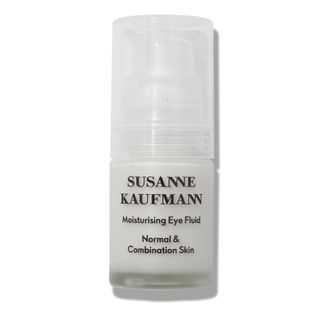
Susanne Kaufmann Moisturising Eye Fluid
Works for
2 of 2 advertised claims delivered
Moisturizing21 ingredients credited for this claimStrong support
“Moisturising Eye Fluid”
This product can help improve hydration of the skin with the two types of ingredients.
The first type is called “humectants”:
these ingredients help attract water.
When humectants are on the surface of the skin, they “pull in” the moisture from the outside environment, or from
within deeper layers of the skin. The following ingredients in this product do the job:
glycerin, saccharide isomerate.
This product also contains ingredients called “occlusives”. They help reduce the speed with which our skin loses moisture to the outside environment. These ingredients also help soften the upper layer of the skin, so it feels less tight and nicer to the touch. The following ingredients in this product do the job: helianthus annuus hybrid oil, sesamum indicum seed oil.
The following ingredients in this product are especially good for supporting the skin barrier and helping with the hydration level: panthenol, urea
Anti-aging3 ingredients credited for this claimModerate support
“This lightweight skincare is designed specifically to tackle the signs of ageing around the eyes.”
This product contains serine. This ingredient might be able to help reduce and prevent fine lines and wrinkles, improve skin elasticity and firmness, but there is not enough evidence that it actually works.
Can it cause trouble?
Irritancy3 strong irritants: Alcohol, Sodium anisate + 1 more — patch-test recommendedHigh risk
Comedogenic2 ingredients rated 2 or more on the 0–5 pore-clogging scale2 flagged
User reviews
Be the first — your take helps the next person decide.
Ingredients
Filter by role to see what each ingredient is doing.
Water~45–55%
Pentylene glycol~5.1–6.3%
- Irritation risk
- Medium
Used to preserve products, dissolve other ingredients and create a nice product texture
More about Pentylene glycolDicaprylyl ether~4.2–5.1%
- Irritation risk
- Low
Helps soften the upper layer of the skin while creating a non-greasy feel on the skin. Helps to dissolve other ingredients
More about Dicaprylyl etherGlycerin~3–3.7%
- Irritation risk
- Low
One of the best moisturizing ingredients. Naturally present in skin. It attracts water to the upper layer of the skin working as a humectant
More about GlycerinHelianthus annuus hybrid oil~2.4–2.9%
- Irritation risk
- Low
Helps soften the upper layer of the skin
More about Helianthus annuus hybrid oilMicrocrystalline cellulose~1.9–2.3%
Alcohol~1.6–2%
- Irritation risk
- High
Can be drying and contribute to skin irritation. Used in formulars to dissolve other ingredients, create a thinner product consistency or for its antibacterial properties
More about AlcoholLecithin~1.4–1.7%
- Irritation risk
- Low
Used mostly for creating emulsions - helping oil and water mix together. Helps soften the upper layer of the skin
More about LecithinSesamum indicum seed oil~1.2–1.5%
- Irritation risk
- Low
A good moisturizing plant oil. Due to the high linoleic acid content, it helps soften the upper layer of the skin, reduce water loss and support skin barrier function
More about Sesamum indicum seed oilZea mays germ oil~1–1.2%
- Irritation risk
- Low
- Comedogenicity
- 2/5
Ectoin~0.7–1.05%
- Irritation risk
- Low
Softens the upper layer of the skin and can support skin barrier function
More about EctoinSodium hyaluronate~0.6–0.9%
- Irritation risk
- Low
One of the best moisturizing ingredients. Attracts water into the upper layer of the skin
More about Sodium hyaluronateAdansonia digitata pulp extract~0.55–0.85%
- Irritation risk
- Low
Ascophyllum nodosum extract~0.5–0.75%
- Irritation risk
- Low
Brown seaweed extract. Can help attract water to the upper layer of the skin and might have some antioxidant effect
More about Ascophyllum nodosum extractBisabolol~0.45–0.65%
- Irritation risk
- Low
An active component of chamomile plant that historically has been used to calm down irritated skin. A recent study shows that bisabolol indeed can have some anti-inflammatory effect on skin, even though conclusive data is lacking. Bisabolol has a sweet floral scent and can be added to products for its aromatic properties
More about BisabololAlbatrellus confluens extract~0.45–0.7%
- Irritation risk
- Low
Sempervivum tectorum extract~0.45–0.65%
- Irritation risk
- Low
Macadamia integrifolia seed oil~0.45–0.65%
- Irritation risk
- Low
A plant oil that helps soften the upper layer of the skin
More about Macadamia integrifolia seed oilOlea europaea fruit oil~0.4–0.6%
- Irritation risk
- Medium
An emollient that helps soften the skin but is not effective for restoring its barrier function. Might be helpful to calm down inflammation
More about Olea europaea fruit oilCardiospermum halicacabum flower/leaf/vine extract~0.3–0.6%
- Irritation risk
- High
A plant extract that might have some anti-inflammatory and anti-oxidant properties but evidence is missing
More about Cardiospermum halicacabum flower/leaf/vine extractPropanediol~0.35–0.6%
- Irritation risk
- Low
Acts as a solvent for other ingredients. Speeds up the absorption of other ingredients into the skin
More about PropanediolPanthenol~0.3–0.55%
- Irritation risk
- Low
Helps attract water to the upper layer of the skin and can help improve skin barrier function
More about PanthenolSaccharide isomerate~0.3–0.5%
- Irritation risk
- Low
Helps attract water to the upper layer of the skin
More about Saccharide isomerateSodium stearoyl glutamate~0.35–0.6%
- Irritation risk
- Medium
Helps oil and water mix together
More about Sodium stearoyl glutamateDehydroxanthan gum~0.3–0.55%
- Irritation risk
- Low
Helps create thicker product formulations and stabilize emulsions
More about Dehydroxanthan gumAlgin~0.3–0.55%
- Irritation risk
- Low
- Comedogenicity
- 3/5
Used to thicken product formulation. Can help attract water to the upper layer of the skin
More about AlginCalcium alginate~0.3–0.55%
Sodium levulinate~0.25–0.5%
Escin~0.25–0.5%
- Irritation risk
- High
A compound obtained from horse chestnut. It is claimed that this chemical can improve circulation, but there is no evidence available that it works in skin
More about EscinSodium anisate~0.3–0.5%
Citric acid~0.3–0.5%
- Irritation risk
- Medium
Can work as an exfoliant but is typically used to adjust the product pH
More about Citric acidLactic acid~0.25–0.5%
- Irritation risk
- Medium
An exfoliating and moisturizing alpha-hydroxy acid (AHA). Typically causes less irritation than other AHAs, for example, glycolic acid. At high concentrations (about 15%), lactic acid can help reduce lines and wrinkles. Recent studies show that lactic acid can support the "good" bacteria living on skin's surface (healthy skin microbiome)
More about Lactic acidPotassium phosphate~0.3–0.55%
Serine~0.25–0.5%
- Irritation risk
- Low
An amino-acid that helps to attract water to the upper layer of the skin. In combination with other amino-acids, might help to reduce fine lines and wrinkles
More about SerineSodium lactate~0.25–0.5%
- Irritation risk
- Medium
Helps attract water to the upper layer of the skin. Is often used to adjust the pH level of the product
More about Sodium lactateSorbitol~0.25–0.45%
- Irritation risk
- Low
Helps attract water to the upper layer of the skin and improves the product texture
More about SorbitolUrea~0.25–0.45%
- Irritation risk
- Low
Naturally present in skin (urea makes up about 7% of natural moisturizing factors in skin). Attracts water to the upper layer of the skin. Also has a positive effect on the skin barrier beyond the humectant action. Can enhance penetration of other ingredients. Is an exfoliating ingredient when used in high concentrations
More about UreaCaffeine~0.2–0.4%
- Irritation risk
- Medium
Might be helpful in neutralizing free radicals. Can have a dehydration effect that might somewhat decrease the look of puffy eyes
More about CaffeineSodium chloride~0.25–0.45%
- Irritation risk
- Low
Used to stabilize mixtures of oil and water, and create thicker, gel-like product textures
More about Sodium chlorideSodium citrate~0.15–0.3%
- Irritation risk
- Medium
Helps to control the skin's pH level. Maintains the skin's natural film of amino-lactic acids and oils. Helps to preserve products
More about Sodium citrateSodium benzoate~0.1–0.2%
Xanthan gum~0.15–0.25%
- Irritation risk
- Low
Used to create a thicker product consistency
More about Xanthan gumPotassium sorbate~0.15–0.25%
Tocopherol~0.15–0.25%
- Irritation risk
- Low
Pure form of vitamin E. Can help moisturise and protect the skin from free radicals. Often used to help stabilise other ingredients or the formula itself
More about TocopherolAllantoin~0.05–0.15%
- Irritation risk
- Low
Helps calm down inflammation in skin and can help reduce itching. Helps to repair the skin barrier and keep skin hydrated
More about AllantoinParfum~0.05–0.1%
- Irritation risk
- High
An aromatic blend of unspecified and possibly irritating ingredients
More about ParfumIngredient list view
Water, Pentylene glycol, Dicaprylyl ether, Glycerin, Helianthus annuus hybrid oil, Microcrystalline cellulose, Alcohol, Lecithin, Sesamum indicum seed oil, Zea mays germ oil, Ectoin, Sodium hyaluronate, Adansonia digitata pulp extract, Ascophyllum nodosum extract, Bisabolol, Albatrellus confluens extract, Sempervivum tectorum extract, Macadamia integrifolia seed oil, Olea europaea fruit oil, Cardiospermum halicacabum flower/leaf/vine extract, Propanediol, Panthenol, Saccharide isomerate, Sodium stearoyl glutamate, Dehydroxanthan gum, Algin, Calcium alginate, Sodium levulinate, Escin, Sodium anisate, Citric acid, Lactic acid, Potassium phosphate, Serine, Sodium lactate, Sorbitol, Urea, Caffeine, Sodium chloride, Sodium citrate, Sodium benzoate, Xanthan gum, Potassium sorbate, Tocopherol, Allantoin, Parfum
Compare prices
Retailers ranked by price — lowest first.

Affiliate links · prices updated regularly
Worth comparing, line by line.
Match % combines shared ingredients, the first five ingredients, shared actives and hero ingredients, irritancy (lower counts in the alternative's favour), texture and body area. Only products in the same routine step are compared.
| Susanne KaufmannMoisturising Eye FluidYOUR PRODUCT | M-61Hydraboost Eye Cream | |
|---|---|---|
| Match | — | 50% |
| Price | $73.41 | $82.00+$8.59 |
| Shared key ingredients | — | 6 of 14 |
| Key difference | — | Linoleic Acid |
| Irritancy | High | Medium |
| Drying alcohol | Contains drying alcohol | — |
| View product | Shop |


Product summary
"Susanne Kaufmann - Moisturising Eye Fluid" has a good moisturizing formula. To work well, any moisturizer needs to include a combination of water-binding and emollient ingredients. Susanne Kaufmann - Moisturising Eye Fluid ticks this box. Panthenol, urea, glycerin, saccharide isomerate and sodium hyaluronate in this product (humectants) attract water molecules to the upper layer of the skin (the water comes from the outside air or from the deeper layers of the skin if the air is dry). Helianthus annuus hybrid oil, sesamum indicum seed oil, olea europaea fruit oil, dicaprylyl ether and lecithin in this product help decrease the water evoporation from the skin, so that it stays hydrated for longer. These ingredients also soften the skin and take away the feeling of tightness and dryness.
Irritation risk
We assess the overall irritancy of this moisturizer to be high. For a detailed overview of all potential irritants: click here
You can see the detailed formula review with the breakdown of all actives in the product and the full ingredient list with estimated concentrations in the tables below.
Price
The product retails from 55.00£ up to 81.50£ in the United Kingdom and for 75.00$ in the United States.
For a detailed price comparison: click here.
Sources cited in this review
Every concentration estimate and effectiveness label is anchored to one of these 19 studies and safety reviews.
- 1
- 2
- 3Triglyceride composition of Sesamum indicum seed oilonlinelibrary.wiley.com
- 4
- 5Hyaluronic acid: A key molecule in skin agingncbi.nlm.nih.gov
- 6

Affiliate links · As an Amazon Associate, WIMJ earns from qualifying purchases.