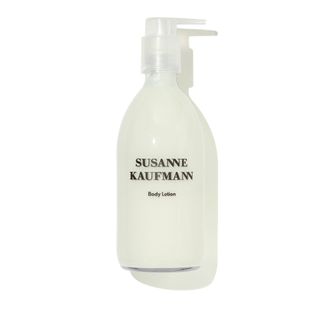
Susanne Kaufmann Hypersensitive Body Lotion Corps Hydratante
Works for
1 of 1 advertised claim delivered
Moisturizing13 ingredients credited for this claimGood support
“Hypersensitive Body Lotion Corps Hydratante”
This product can help improve hydration of the skin with the two types of ingredients.
The first type is called “humectants”:
these ingredients help attract water.
When humectants are on the surface of the skin, they “pull in” the moisture from the outside environment, or from
within deeper layers of the skin. The following ingredients in this product do the job:
glycerin, saccharide isomerate.
This product also contains ingredients called “occlusives”. They help reduce the speed with which our skin loses moisture to the outside environment. These ingredients also help soften the upper layer of the skin, so it feels less tight and nicer to the touch. The following ingredients in this product do the job: caprylic/capric triglyceride, helianthus annuus seed oil.
Can it cause trouble?
Irritancy1 strong irritant: Sodium anisateMedium risk
Comedogenic2 ingredients rated 2 or more on the 0–5 pore-clogging scale2 flagged
User reviews
Be the first — your take helps the next person decide.
Ingredients
Filter by role to see what each ingredient is doing.
Water~40–60%
Helianthus annuus seed oil~5–7.5%
- Irritation risk
- Low
A great emollient due to its high linoleic acid content. One of the most effective plant oils in helping skin hydration and repairing skin barrier function
More about Helianthus annuus seed oilCaprylic/capric triglyceride~3.8–5.7%
- Irritation risk
- Medium
A good mix of fatty acids that forms a protective layer on the skin. Improves the shelf life of products. Derived from coconut and glycerin
More about Caprylic/capric triglycerideGlycerin~2.7–4%
- Irritation risk
- Low
One of the best moisturizing ingredients. Naturally present in skin. It attracts water to the upper layer of the skin working as a humectant
More about GlycerinPentylene glycol~2.1–3.1%
- Irritation risk
- Medium
Used to preserve products, dissolve other ingredients and create a nice product texture
More about Pentylene glycolCetearyl alcohol~1.7–2.5%
- Irritation risk
- Low
- Comedogenicity
- 2/5
A non-drying alcohol. Works as an emollient. Helps water and oil mix together and creates a nice product texture
More about Cetearyl alcoholPalmitic acid~1.4–2.1%
- Irritation risk
- Low
An emollient that is naturally present in skin and helps soften it
More about Palmitic acidStearic acid~1.3–2%
- Irritation risk
- Low
Helps oil and water mix together and works as an emollient
More about Stearic acidBrassica oleracea italica seed oil~1–1.5%
- Irritation risk
- Medium
A plant seed oil that consists mainly of erucic acid and used to help soften the upper layer of the skin. This fatty acid can enhance penetration of other ingredients into the skin but it is not a good moisturizer on its own
More about Brassica oleracea italica seed oilButyrospermum parkii butter~0.85–1.3%
- Irritation risk
- Low
- Comedogenicity
- 3/5
A great moisturising ingredient that softens the skin and reduces water loss from its upper layer. It also can be helpful in protecting skin from free radicals
More about Butyrospermum parkii butterGlyceryl stearate citrate~0.55–1.25%
- Irritation risk
- Low
Helps oil and water mix together while softening the upper layer of the skin
More about Glyceryl stearate citrateSaccharide isomerate~0.4–0.95%
- Irritation risk
- Low
Helps attract water to the upper layer of the skin
More about Saccharide isomerateAlbatrellus confluens extract~0.35–0.85%
- Irritation risk
- Low
Propanediol~0.35–0.75%
- Irritation risk
- Low
Acts as a solvent for other ingredients. Speeds up the absorption of other ingredients into the skin
More about PropanediolTocopherol~0.2–0.7%
- Irritation risk
- Low
Pure form of vitamin E. Can help moisturise and protect the skin from free radicals. Often used to help stabilise other ingredients or the formula itself
More about TocopherolSodium levulinate~0.15–0.6%
Xanthan gum~0.15–0.55%
- Irritation risk
- Low
Used to create a thicker product consistency
More about Xanthan gumSodium anisate~0.1–0.4%
Citric acid~0.05–0.3%
- Irritation risk
- Medium
Can work as an exfoliant but is typically used to adjust the product pH
More about Citric acidBisabolol~0.05–0.2%
- Irritation risk
- Low
An active component of chamomile plant that historically has been used to calm down irritated skin. A recent study shows that bisabolol indeed can have some anti-inflammatory effect on skin, even though conclusive data is lacking. Bisabolol has a sweet floral scent and can be added to products for its aromatic properties
More about BisabololGlyceryl caprylate~0.1–0.3%
- Irritation risk
- Low
An emollient that can also help water and oil mix together, as well as prevent bacteria growth in products
More about Glyceryl caprylateSodium stearoyl glutamate~0.1–0.35%
- Irritation risk
- Medium
Helps oil and water mix together
More about Sodium stearoyl glutamateSodium citrate~0.01–0.1%
- Irritation risk
- Medium
Helps to control the skin's pH level. Maintains the skin's natural film of amino-lactic acids and oils. Helps to preserve products
More about Sodium citrateIngredient list view
Water, Helianthus annuus seed oil, Caprylic/capric triglyceride, Glycerin, Pentylene glycol, Cetearyl alcohol, Palmitic acid, Stearic acid, Brassica oleracea italica seed oil, Butyrospermum parkii butter, Glyceryl stearate citrate, Saccharide isomerate, Albatrellus confluens extract, Propanediol, Tocopherol, Sodium levulinate, Xanthan gum, Sodium anisate, Citric acid, Bisabolol, Glyceryl caprylate, Sodium stearoyl glutamate, Sodium citrate
Compare prices
Retailers ranked by price — lowest first.
Sources cited in this review
Every concentration estimate and effectiveness label is anchored to one of these 9 studies and safety reviews.
- 1
- 2
- 3Effect of topically applied lipids on surfactant-irritated skinonlinelibrary.wiley.com
- 4
- 5
- 6

Affiliate links · As an Amazon Associate, WIMJ earns from qualifying purchases.