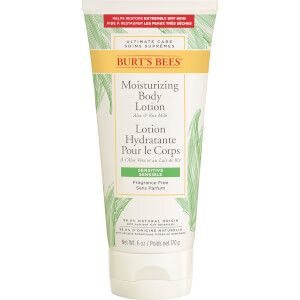
Burt's Bees Moisturising Body Lotion for Very Dry and Sensitive Skin

Burt's Bees Moisturising Body Lotion for Very Dry and Sensitive Skin

Efficacy75/100IrritancyMedium
Edit

Works for

1 of 1 advertised claim delivered

Moisturizing
Ricinus communis seed oil, Simmondsia chinensis seed oil + 23 more
Good evidence
What the product description says
“Moisturising Body Lotion for Very Dry and Sensitive Skin”
From product name

This product can help improve hydration of the skin with the two types of ingredients.

The first type is called “humectants”:
these ingredients help attract water. When humectants are on the surface of the skin, they “pull in” the moisture from the outside environment, or from within deeper layers of the skin. The following ingredients in this product do the job: arginine, biosaccharide gum-1.

This product also contains ingredients called “occlusives”. They help reduce the speed with which our skin loses moisture to the outside environment. These ingredients also help soften the upper layer of the skin, so it feels less tight and nicer to the touch. The following ingredients in this product do the job: arginine, butyrospermum parkii butter.

Ricinus communis seed oilKey active· Emollient, OcclusiveEffect: HighA plant oil that can help soften the skin. It might be helpful in calming down inflammation, but solid research is lacking. Is often used in lip products to create the needed product consistency~0.95–1.15%
Simmondsia chinensis seed oilKey active· Emollient, OcclusiveEffect: HighSoftens the upper layer of skin and helps restore the healthy skin barrier. Has shown to help calm down inflammation in skin. It is a stable oil, meaning that it retains its properties even when exposed to air.~3.2–3.9%
Biosaccharide gum-1Key active· HumectantEffect: HighHelps attract water to the upper layer of the skin and is claimed to provide a longer-lasting hydration because of its ability to create a water-binding film on the surface of the skin~0.2–0.4%
Butyrospermum parkii butterKey active· Emollient, OcclusiveEffect: HighA great moisturising ingredient that softens the skin and reduces water loss from its upper layer. It also can be helpful in protecting skin from free radicals~1.5–1.8%
Caprylic/capric triglycerideKey active· Emollient, OcclusiveEffect: HighA good mix of fatty acids that forms a protective layer on the skin. Improves the shelf life of products. Derived from coconut and glycerin~2.4–2.9%
Cera albaKey active· Emollient, OcclusiveEffect: HighForms a protective barrier that holds water and keeps dry skin hydrated. Keeps an emulsion from separating into its oil and liquid components, and increases the thickness of a product. Can be an allergen~0.55–0.85%
Helianthus annuus seed oilKey active· Emollient, OcclusiveEffect: HighA great emollient due to its high linoleic acid content. One of the most effective plant oils in helping skin hydration and repairing skin barrier function~4.1–5%
InositolKey active· HumectantEffect: High~0.2–0.4%
SucroseKey active· HumectantEffect: HighCan help attract water to the upper layer of the skin. In crystal form, it can work as a gentle exfoliant, gentler than the salt scrub. Helps stabilize the emulsion~0.2–0.35%
Saccharomyces fermentKey activeEffect: HighA product of yeast fermentation. Helps attract water to the upper layer of the skin~0.5–0.7%
Cocos nucifera oilKey active· Emollient, OcclusiveEffect: HighAn emollient. Found to be as effective as a moisturizer for dry skin as mineral oil. Could be comedogenic~1.9–2.3%
FructoseKey active· HumectantEffect: HighHelps attract water to the upper layer of the skin~0.2–0.4%
GlycerinKey active· HumectantEffect: HighOne of the best moisturizing ingredients. Naturally present in skin. It attracts water to the upper layer of the skin working as a humectant~4.7–5.8%
ArginineKey active· Humectant, OcclusiveEffect: HighAn amino acid that is naturally present in skin and helps keep it hydrated. When used together with AHAs, it can reduce their irritating effect on the skin~0.2–0.4%
TrehaloseKey active· HumectantEffect: HighA sugar that attracts water to the upper layer of the skin~0.2–0.4%
Glycine soja oilKey active· EmollientEffect: HighA good emollient that helps soften the skin and helps repair its barrier function. It can clog pores if used in high concentrations.~0.4–0.65%
Cetyl alcoholKey active· EmollientEffect: MediumA non-drying alcohol that works to soften the skin and stabilize product formulations helping oil and water mix together~1.6–2%
MelKey active· Humectant, EmollientEffect: MediumHelps to soften the upper layer of the skin and attract water to it~0.4–0.65%
Hydrogenated castor oilKey active· EmollientEffect: MediumA plant oil that can help soften the skin. It might be helpful in calming down inflammation, but solid research is lacking. Is often used in lip products to create the needed product consistency~0.4–0.6%
GlucoseKey active· HumectantEffect: MediumHelps attract water to the upper layer of the skin. Could be helpful in restoring the skin barrier function~0.25–0.4%
Glyceryl stearate citrate· EmollientEffect: LowHelps oil and water mix together while softening the upper layer of the skin~1.2–1.4%
Glyceryl caprylate· EmollientEffect: LowAn emollient that can also help water and oil mix together, as well as prevent bacteria growth in products~0.25–0.45%
Oryza sativa extractEffect: Low, below effective doseA grain extract that helps to create a thicker product consistency. It might have some anti-oxidant properties and help attract water to the upper layer of the skin~0.3–0.6%
TocopherolEffect: Low, below effective dosePure form of vitamin E. Can help moisturise and protect the skin from free radicals. Often used to help stabilise other ingredients or the formula itself~0.4–0.65%
Aloe barbadensis leaf juiceEffect: Low, below effective doseTraditionally used to treat sunburns, dermatitis and inflammation, but evidence for its effectiveness is lacking. The extract can contain humectants that help attract water into the skin~0.55–0.8%

Can it cause trouble?

Irritancy
2 strong irritants: Alcohol, Sodium anisate
Medium risk
We flagged 15 ingredients with irritancy potential. Severity depends on your sensitivity threshold; the table lists the worst offenders first.
IngredientFunctionIrritationEst. amount
AlcoholCan be drying and contribute to skin irritation. Used in formulars to dissolve other ingredients, create a thinner product consistency or for its antibacterial propertiesHigh~0.2–0.4%est.
Sodium anisateUsed as a fragranceHigh~0.2–0.35%est.
Simmondsia chinensis seed oilSoftens the upper layer of skin and helps restore the healthy skin barrier. Has shown to help calm down inflammation in skin. It is a stable oil, meaning that it retains its properties even when exposed to air.Medium~3.2–3.9%est.
Caprylic/capric triglycerideA good mix of fatty acids that forms a protective layer on the skin. Improves the shelf life of products. Derived from coconut and glycerinMedium~2.4–2.9%est.
Ricinus communis seed oilA plant oil that can help soften the skin. It might be helpful in calming down inflammation, but solid research is lacking. Is often used in lip products to create the needed product consistencyMedium~0.95–1.15%est.
Sodium stearoyl lactylateHelps oil and water mix togetherMedium~0.65–1%est.
Aloe barbadensis leaf juiceTraditionally used to treat sunburns, dermatitis and inflammation, but evidence for its effectiveness is lacking. The extract can contain humectants that help attract water into the skinMedium~0.55–0.8%est.
Cera albaForms a protective barrier that holds water and keeps dry skin hydrated. Keeps an emulsion from separating into its oil and liquid components, and increases the thickness of a product. Can be an allergenMedium~0.55–0.85%est.
Glycine soja oilA good emollient that helps soften the skin and helps repair its barrier function. It can clog pores if used in high concentrations.Medium~0.4–0.65%est.
Hydrogenated castor oilA plant oil that can help soften the skin. It might be helpful in calming down inflammation, but solid research is lacking. Is often used in lip products to create the needed product consistencyMedium~0.4–0.6%est.
Citric acidCan work as an exfoliant but is typically used to adjust the product pHMedium~0.25–0.45%est.
Potassium sorbateA preservativeMedium~0.25–0.45%est.
Sodium levulinateA preservativeMedium~0.15–0.3%est.
Sodium citrateHelps to control the skin's pH level. Maintains the skin's natural film of amino-lactic acids and oils. Helps to preserve productsMedium~0.15–0.25%est.
Benzoic acidA preservativeMedium~0.1–0.25%est.
Comedogenic
3 ingredients rated 2 or more on the 0–5 pore-clogging scale
3 flagged
These ingredients have a comedogenic rating of 2 or more on a 0–5 scale; the table shows each one's rating. In leave-on products they can clog pores in acne-prone skin.
IngredientFunctionRatingEst. amount
Cocos nucifera oilAn emollient. Found to be as effective as a moisturizer for dry skin as mineral oil. Could be comedogenic3/5~1.9–2.3%est.
Butyrospermum parkii butterA great moisturising ingredient that softens the skin and reduces water loss from its upper layer. It also can be helpful in protecting skin from free radicals3/5~1.5–1.8%est.
Glycine soja oilA good emollient that helps soften the skin and helps repair its barrier function. It can clog pores if used in high concentrations.2/5~0.4–0.65%est.
Edit

User reviews

Would you recommend?
No community reviews yet.

Be the first — your take helps the next person decide.

Write a review · ~30s

Ingredients

Filter by role to see what each ingredient is doing.

Water~45–55%
Formula
Irritation risk
Low

Plain old water

More about Water
Glycerin~4.7–5.8%
Key active
Irritation risk
Low
Works for
Moisturizing

One of the best moisturizing ingredients. Naturally present in skin. It attracts water to the upper layer of the skin working as a humectant

More about Glycerin
Helianthus annuus seed oil~4.1–5%
Key active
Irritation risk
Low
Works for
Moisturizing

A great emollient due to its high linoleic acid content. One of the most effective plant oils in helping skin hydration and repairing skin barrier function

More about Helianthus annuus seed oil
Simmondsia chinensis seed oil~3.2–3.9%
Key activeIrritant · medium
Irritation risk
Medium
Works for
Moisturizing

Softens the upper layer of skin and helps restore the healthy skin barrier. Has shown to help calm down inflammation in skin. It is a stable oil, meaning that it retains its properties even when exposed to air.

More about Simmondsia chinensis seed oil
Caprylic/capric triglyceride~2.4–2.9%
Key activeIrritant · medium
Irritation risk
Medium
Works for
Moisturizing

A good mix of fatty acids that forms a protective layer on the skin. Improves the shelf life of products. Derived from coconut and glycerin

More about Caprylic/capric triglyceride
Cocos nucifera oil~1.9–2.3%
Key activeComedogenic 3/5
Irritation risk
Low
Comedogenicity
3/5
Works for
Moisturizing

An emollient. Found to be as effective as a moisturizer for dry skin as mineral oil. Could be comedogenic

More about Cocos nucifera oil
Cetyl alcohol~1.6–2%
Key active
Irritation risk
Low
Works for
CleansingMoisturizing

A non-drying alcohol that works to soften the skin and stabilize product formulations helping oil and water mix together

More about Cetyl alcohol
Butyrospermum parkii butter~1.5–1.8%
Key activeComedogenic 3/5
Irritation risk
Low
Comedogenicity
3/5
Works for
MoisturizingAnti-oxidationAnti-aging

A great moisturising ingredient that softens the skin and reduces water loss from its upper layer. It also can be helpful in protecting skin from free radicals

More about Butyrospermum parkii butter
Glyceryl stearate citrate~1.2–1.4%
Formula
Irritation risk
Low
Works for
CleansingMoisturizing

Helps oil and water mix together while softening the upper layer of the skin

More about Glyceryl stearate citrate
Ricinus communis seed oil~0.95–1.15%
Key activeIrritant · medium
Irritation risk
Medium
Works for
MoisturizingAnti-inflammatory

A plant oil that can help soften the skin. It might be helpful in calming down inflammation, but solid research is lacking. Is often used in lip products to create the needed product consistency

More about Ricinus communis seed oil
Sodium stearoyl lactylate~0.65–1%
Irritant · medium
Irritation risk
Medium
Works for
Cleansing

Helps oil and water mix together

More about Sodium stearoyl lactylate
Aloe barbadensis leaf juice~0.55–0.8%
Irritant · medium
Irritation risk
Medium
Works for
MoisturizingReduces rednessAnti-inflammatoryAntibacterialReduces irritationAnti-agingAnti-blemish

Traditionally used to treat sunburns, dermatitis and inflammation, but evidence for its effectiveness is lacking. The extract can contain humectants that help attract water into the skin

More about Aloe barbadensis leaf juice
Saccharomyces ferment~0.5–0.7%
Key active
Irritation risk
Low
Works for
Moisturizing

A product of yeast fermentation. Helps attract water to the upper layer of the skin

More about Saccharomyces ferment
Cera alba~0.55–0.85%
Key activeIrritant · medium
Irritation risk
Medium
Works for
MoisturizingCleansing

Forms a protective barrier that holds water and keeps dry skin hydrated. Keeps an emulsion from separating into its oil and liquid components, and increases the thickness of a product. Can be an allergen

More about Cera alba
Tocopherol~0.4–0.65%
Formula
Irritation risk
Low
Works for
Anti-oxidationMoisturizingAnti-agingAnti-inflammatory

Pure form of vitamin E. Can help moisturise and protect the skin from free radicals. Often used to help stabilise other ingredients or the formula itself

More about Tocopherol
Glycine soja oil~0.4–0.65%
Key activeComedogenic 2/5Irritant · medium
Irritation risk
Medium
Comedogenicity
2/5
Works for
Moisturizing

A good emollient that helps soften the skin and helps repair its barrier function. It can clog pores if used in high concentrations.

More about Glycine soja oil
Mel~0.4–0.65%
Key active
Irritation risk
Low
Works for
Moisturizing

Helps to soften the upper layer of the skin and attract water to it

More about Mel
Hydrogenated castor oil~0.4–0.6%
Key activeIrritant · medium
Irritation risk
Medium
Works for
CleansingMoisturizingAnti-inflammatory

A plant oil that can help soften the skin. It might be helpful in calming down inflammation, but solid research is lacking. Is often used in lip products to create the needed product consistency

More about Hydrogenated castor oil
Oryza sativa extract~0.3–0.6%
Formula
Irritation risk
Low
Works for
MoisturizingAnti-oxidation

A grain extract that helps to create a thicker product consistency. It might have some anti-oxidant properties and help attract water to the upper layer of the skin

More about Oryza sativa extract
Polyglyceryl-3 stearate~0.3–0.55%
Formula
Irritation risk
Low
Works for
Cleansing

Helps oil and water mix together

More about Polyglyceryl-3 stearate
Xanthan gum~0.25–0.5%
Formula
Irritation risk
Low
Works for
Cleansing

Used to create a thicker product consistency

More about Xanthan gum
Citric acid~0.25–0.45%
Irritant · medium
Irritation risk
Medium

Can work as an exfoliant but is typically used to adjust the product pH

More about Citric acid
Arginine~0.2–0.4%
Key active
Irritation risk
Low
Works for
Moisturizing

An amino acid that is naturally present in skin and helps keep it hydrated. When used together with AHAs, it can reduce their irritating effect on the skin

More about Arginine
Potassium sorbate~0.25–0.45%
Irritant · medium
Irritation risk
Medium

A preservative

More about Potassium sorbate
Biosaccharide gum-1~0.2–0.4%
Key active
Irritation risk
Low
Works for
Moisturizing

Helps attract water to the upper layer of the skin and is claimed to provide a longer-lasting hydration because of its ability to create a water-binding film on the surface of the skin

More about Biosaccharide gum-1
Sucrose stearate~0.25–0.5%
Formula
Irritation risk
Low
Works for
Cleansing

Helps water and oil mix together

More about Sucrose stearate
Fructose~0.2–0.4%
Key active
Irritation risk
Low
Works for
Moisturizing

Helps attract water to the upper layer of the skin

More about Fructose
Glucose~0.25–0.4%
Key active
Irritation risk
Low
Works for
Moisturizing

Helps attract water to the upper layer of the skin. Could be helpful in restoring the skin barrier function

More about Glucose
Inositol~0.2–0.4%
Key active
Irritation risk
Low
Works for
Moisturizing
More about Inositol
Sucrose~0.2–0.35%
Key active
Irritation risk
Low
Works for
Moisturizing

Can help attract water to the upper layer of the skin. In crystal form, it can work as a gentle exfoliant, gentler than the salt scrub. Helps stabilize the emulsion

More about Sucrose
Trehalose~0.2–0.4%
Key active
Irritation risk
Low
Works for
Moisturizing

A sugar that attracts water to the upper layer of the skin

More about Trehalose
Alcohol~0.2–0.4%
Irritant · high
Irritation risk
High
Works for
Antibacterial

Can be drying and contribute to skin irritation. Used in formulars to dissolve other ingredients, create a thinner product consistency or for its antibacterial properties

More about Alcohol
Glyceryl caprylate~0.25–0.45%
Formula
Irritation risk
Low
Works for
CleansingMoisturizing

An emollient that can also help water and oil mix together, as well as prevent bacteria growth in products

More about Glyceryl caprylate
Magnesium aluminum silicate~0.2–0.4%
Formula
Irritation risk
Low
Works for
Anti-aging

Might be helpful in restoring skin barrier function and, when combined with zinc carbonate and malonic acid, reducing fine lines and wrinkles by stimulating elastin production. Also helps stabilize the product formulation

More about Magnesium aluminum silicate
Sodium anisate~0.2–0.35%
Irritant · high
Irritation risk
High

Used as a fragrance

More about Sodium anisate
Sodium levulinate~0.15–0.3%
Irritant · medium
Irritation risk
Medium

A preservative

More about Sodium levulinate
Sodium citrate~0.15–0.25%
Irritant · medium
Irritation risk
Medium

Helps to control the skin's pH level. Maintains the skin's natural film of amino-lactic acids and oils. Helps to preserve products

More about Sodium citrate
Sodium benzoate~0.1–0.2%
Formula
Irritation risk
Low

A preservative

More about Sodium benzoate
Sodium phytate~0.1–0.2%
Formula
Irritation risk
Low

Used to stabilize product formulations

More about Sodium phytate
Benzoic acid~0.1–0.25%
Irritant · medium
Irritation risk
Medium

A preservative

More about Benzoic acid
Phenoxyethanol~0.15–0.25%
Formula
Irritation risk
Low

A preservative. It helps prevent bacterial growth in cosmetic products

More about Phenoxyethanol
Ingredient list view

Water, Glycerin, Helianthus annuus seed oil, Simmondsia chinensis seed oil, Caprylic/capric triglyceride, Cocos nucifera oil, Cetyl alcohol, Butyrospermum parkii butter, Glyceryl stearate citrate, Ricinus communis seed oil, Sodium stearoyl lactylate, Aloe barbadensis leaf juice, Saccharomyces ferment, Cera alba, Tocopherol, Glycine soja oil, Mel, Hydrogenated castor oil, Oryza sativa extract, Polyglyceryl-3 stearate, Xanthan gum, Citric acid, Arginine, Potassium sorbate, Biosaccharide gum-1, Sucrose stearate, Fructose, Glucose, Inositol, Sucrose, Trehalose, Alcohol, Glyceryl caprylate, Magnesium aluminum silicate, Sodium anisate, Sodium levulinate, Sodium citrate, Sodium benzoate, Sodium phytate, Benzoic acid, Phenoxyethanol

Compare prices

Retailers ranked by price — lowest first.

Amazon UK
Price unavailable
Check

Affiliate links · prices updated regularly · As an Amazon Associate, WIMJ earns from qualifying purchases.

Cheaper alternatives? Browse formulas in the same category.
We compare ingredient profiles across our catalog — pick the closest match for your budget.
Open dupe finder

Sources cited in this review

Every concentration estimate and effectiveness label is anchored to one of these 16 studies and safety reviews.

  1. 1
  2. 2
  3. 3
  4. 4
  5. 5
  6. 6
Burt's Bees Moisturising Body Lotion for Very Dry and Sensitive Skin
Burt's BeesMoisturising Body Lotion for Very Dry and Sensitive Skin

Affiliate links · As an Amazon Associate, WIMJ earns from qualifying purchases.

As an Amazon Associate, WIMJ earns from qualifying purchases.