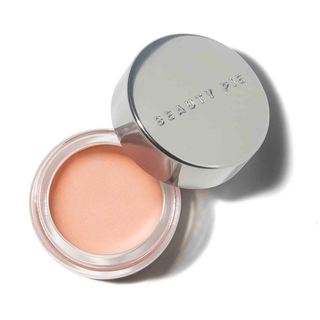
Works for
1 of 3 advertised claims delivered
Moisturizing11 ingredients credited for this claimGood support
“For brightening and moisturizing dark, problem undereye circles before applying a skin-tone matching concealer.”
This product can help soften the skin and reduce its moisture loss with emollients and occlusives: caprylic/capric triglyceride, helianthus annuus seed oil.
Keep in mind that this product does not contain effective ingredients to attract water to the upper layer of the skin. This is why an additional product with humectants like glycerin or hyaluronic acid can be helpful (apply it before this product for the best results).
Anti-aging2 ingredients credited for this claimLimited support
“Formulated with Essential Fatty Acids to moisturise and smooth fine lines, Linoleic Acid and vitamin E for delicate skin barrier repair, MDI Complex to reduce the appearance of dark circles and maintain the skin’s barrier, and high-tech Anti-Fatigue Brightening Micro-Pearls to instantly scatter light.”
This product does not contain ingredients that are able to reduce fine lines and wrinkles or help with skin elasticity, but it can improve the look of the skin temporarily through moisturization. Well-moisturized skin might also be able to repair the sun damage better.
This ingredient squalene might be able to help neutralize free radicals in skin and help it fight off some of the sun damage.
Evens skin toneNo ingredient credited for this claimNo support
“For brightening and moisturizing dark, problem undereye circles before applying a skin-tone matching concealer.”
Effective ingredients missing or their concentration is too low
Anti-oxidationNot advertised by the brand · 3 ingredients credited for this claimModerate support
This product contains antioxidants (squalene) that might be able to help neutralize free radicals in skin to lessen the damage it gets from the UV light (sun). There is not enough evidence to confirm their effectiveness in skin though.
Can it cause trouble?
Irritancy8 flagged ingredientsLow risk
Comedogenic1 ingredient rated 2 or more on the 0–5 pore-clogging scale1 flagged
User reviews
Be the first — your take helps the next person decide.
Ingredients
Filter by role to see what each ingredient is doing.
Ricinus communis seed oil~25–37%
- Irritation risk
- Medium
A plant oil that can help soften the skin. It might be helpful in calming down inflammation, but solid research is lacking. Is often used in lip products to create the needed product consistency
More about Ricinus communis seed oilCaprylic/capric triglyceride~6.3–9.4%
- Irritation risk
- Medium
A good mix of fatty acids that forms a protective layer on the skin. Improves the shelf life of products. Derived from coconut and glycerin
More about Caprylic/capric triglyceridePolyglyceryl-2 isostearate/dimer dilinoleate copolymer~4.7–7.1%
- Irritation risk
- Low
Mica~3.6–5.4%
- Irritation risk
- Low
Creates an illusion of smoother and more radiant skin tone. Adds shimmer to the skin by reflecting light
More about MicaOctyldodecanol~2.6–3.9%
- Irritation risk
- Low
An emollient that helps to soften the skin and create a pleasant product texture and stabilize the formulation
More about OctyldodecanolDiisostearyl malate~2.1–3.1%
- Irritation risk
- Medium
Helps to soften the upper layer of the skin
More about Diisostearyl malateTribehenin~1.6–2.4%
- Irritation risk
- Low
Used to create a thicker product consistency and soften the upper layer of the skin
More about TribeheninHelianthus annuus seed cera~1.4–2%
- Irritation risk
- Low
Helps soften the upper layer of the skin
More about Helianthus annuus seed ceraPolyhydroxystearic acid~1.1–1.6%
- Irritation risk
- Medium
Used to create a thicker product consistency and stabilize the formulation
More about Polyhydroxystearic acidDecylene glycol~0.85–1.3%
- Irritation risk
- Low
Used to creat a nice product texture and support penetration of other ingredients
More about Decylene glycolHelianthus annuus seed oil~0.55–1.35%
- Irritation risk
- Low
A great emollient due to its high linoleic acid content. One of the most effective plant oils in helping skin hydration and repairing skin barrier function
More about Helianthus annuus seed oilTocopherol~0.45–1.05%
- Irritation risk
- Low
Pure form of vitamin E. Can help moisturise and protect the skin from free radicals. Often used to help stabilise other ingredients or the formula itself
More about TocopherolWater~0.4–0.9%
Beta-sitosterol~0.4–1%
- Irritation risk
- Low
A phytosterol that can support skin's barrier function and help the skin stay hydrated
More about Beta-sitosterolSqualene~0.4–0.95%
- Irritation risk
- Low
- Comedogenicity
- 2/5
An oil that is naturally part of skin sebum that helps to soften its upper layer, reduce water loss and neutralize free radicals. It might be comedogenic. Avoid applying large concentrations (or pure oil) before sun exposure as oxidized squalene can clog pores and lead to skin irritation. Today squalene is mostly derived from vegetable oils or synthetized by yeast
More about SqualeneAscorbyl palmitate~0.35–0.75%
- Irritation risk
- Medium
Being a lipid soluble form of vitamin C, it is more stable and can penetrate the skin better than L-Ascorbic acid. It is effective in protecting the skin from free radicals, as well as evening the skin tone, but is less effective in stimulating collagen production compared to L-Ascorbic acid.
More about Ascorbyl palmitatePhenoxyethanol~0.35–0.8%
- Irritation risk
- Low
A preservative. It helps prevent bacterial growth in cosmetic products
More about PhenoxyethanolPotassium sorbate~0.3–0.6%
Glycosaminoglycans~0.4–1%
- Irritation risk
- Low
Long sugars that help attract water to the upper layer of the skin
More about GlycosaminoglycansTrisodium edta~0.15–0.6%
Titanium dioxide~0.3–0.7%
- Irritation risk
- Low
Works as a UV filter when used in high concentrations. It is photostable and is effective mostly against the UVB light, with some protection in the UVA range. In small concentrations, used for its ability to improve the color of cosmetic products. Is usually well tolerated by the skin
More about Titanium dioxideCi 77491~0.1–0.45%
- Irritation risk
- Low
A red colorant made of iron oxide. Typically is not irritating
More about Ci 77491Ci 77492~0.1–0.4%
Ci 42090~0.1–0.4%
Blue 1 lake~0.1–0.3%
Ci 77492~0.05–0.25%
Ci 77499~0.05–0.2%
Ingredient list view
Ricinus communis seed oil, Caprylic/capric triglyceride, Polyglyceryl-2 isostearate/dimer dilinoleate copolymer, Mica, Octyldodecanol, Diisostearyl malate, Tribehenin, Helianthus annuus seed cera, Polyhydroxystearic acid, Decylene glycol, Helianthus annuus seed oil, Tocopherol, Water, Beta-sitosterol, Squalene, Ascorbyl palmitate, Phenoxyethanol, Potassium sorbate, Glycosaminoglycans, Trisodium edta, Titanium dioxide, Ci 77491, Ci 77492, Ci 42090, Blue 1 lake, Ci 77492, Ci 77499
Compare prices
Retailers ranked by price — lowest first.
Sources cited in this review
Every concentration estimate and effectiveness label is anchored to one of these 15 studies and safety reviews.
- 1
- 2
- 3
- 4
- 5
- 6Effect of topically applied lipids on surfactant-irritated skinonlinelibrary.wiley.com

Affiliate links · As an Amazon Associate, WIMJ earns from qualifying purchases.